
 Let’s Keep It Real
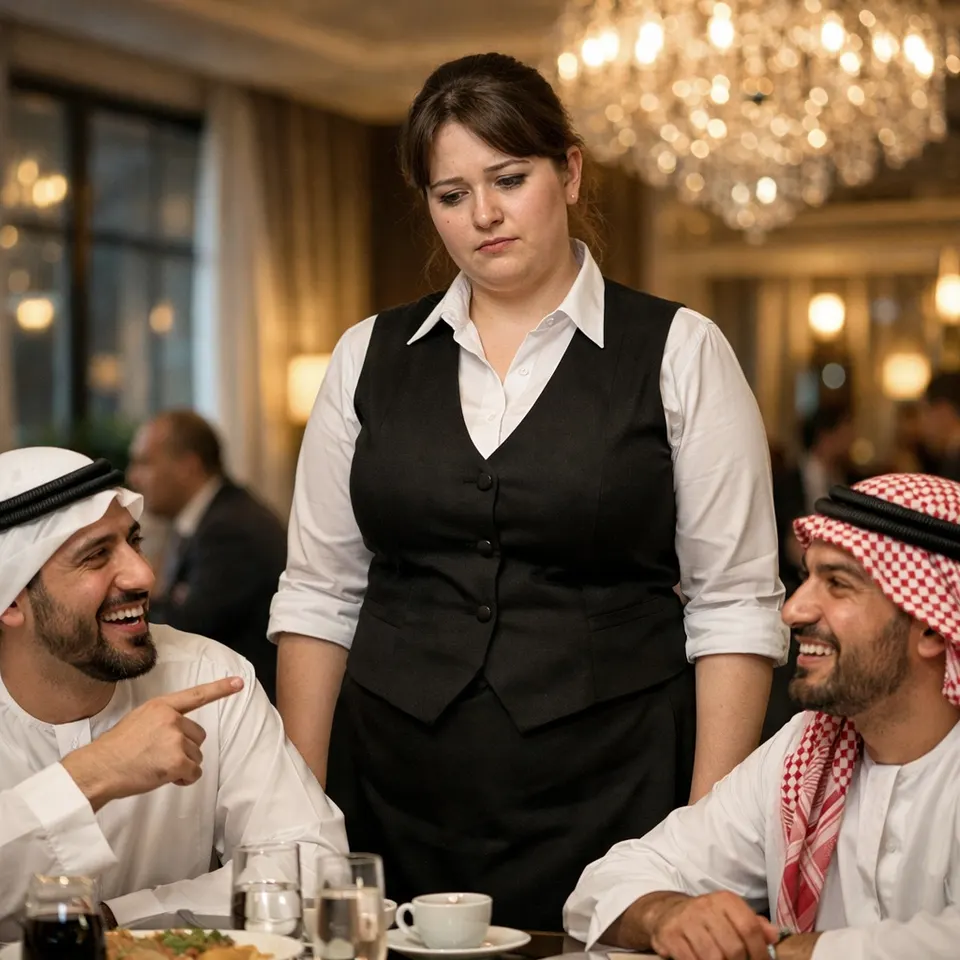
The soft glow of the chandeliers reflected off the polished marble floors of one of Dubai’s most exclusive restaurants. In a place where a single entrée costs more than a month’s rent for most people, and the air is thick with the scent of expensive cologne and influence, a small drama was about to unfold—one that would leave a lasting impression on everyone involved. That evening, Rashid Al-Maktoum, a man whose name carried significant weight in Middle Eastern business circles, decided to have a little fun at the expense of a young waitress.
He had no idea that his "lesson" would backfire, forcing him to reconsider his own perspective. Elena had been working at the restaurant for only three months. A twenty-four-year-old with steady blue eyes and a quiet, resilient demeanor, she had moved to Dubai from a small town near Kyiv. She was a woman who had seen her world change overnight and had the grit to start over in a foreign land.
Her hands, once used to drafting architectural plans and taking university notes, now carried heavy trays of gourmet food. She had traded the uncertainty of home for the long hours of the service industry, fueled by a hope for a more stable future. Every day, she was up at 4:00 AM in a small apartment she shared with three other women, commuting across the city to be on the floor by six.
Her uniform was always crisp, her blonde hair pulled back in a professional bun, and her service was impeccable. But behind that professional smile was a woman who sent nearly every dollar she earned back home. She was paying for her younger brother’s tuition and her mother’s heart medication. For Elena, every shift was a mission to keep her family afloat. That evening, the restaurant was particularly busy with high-profile guests.
Rashid Al-Maktoum arrived with his business partners, taking a large table in the center of the room. A man in his fifties, he exuded the kind of confidence that comes from owning half the shopping malls in the city. He was used to people deferring to him, used to his word being law. With him were Said, a long-time partner, and Khalid, a younger entrepreneur eager to impress the senior businessmen. Elena was assigned to their table.
When the manager told her she’d be handling the Al-Maktoum party, she took a deep breath and checked her reflection.
She knew that a table like this could mean a substantial tip—the kind of money that would cover her mother’s pharmacy bill for the next three months. Her mother had recently messaged her about the rising cost of living and the need for a new generator. Every dirham, every dollar, was a lifeline. Elena approached the table with a professional smile, her tablet ready.
She greeted them in perfect English, showing the quiet respect expected in a five-star establishment. Rashid barely looked at her. To him, she was just another face in a uniform, a temporary fixture there to serve his needs. He continued his conversation, discussing a multi-million dollar real estate deal and laughing at an inside joke. Elena waited patiently, her feet aching after an eight-hour shift, but her posture remained perfect.
Finally, Rashid signaled for her. The men began ordering, calling out expensive vintages and specialty dishes. Elena took the order with precision, clarifying details and ensuring everything was exactly to their liking. She demonstrated the kind of competence that usually goes unnoticed by men of Rashid’s stature.
As she finished taking the order and prepared to leave, Rashid stopped her. There was a glint in his eye—the look of a man looking for a bit of sport. He turned to his friends and said something in Arabic, sparking a round of laughter. Elena didn't react, but she recognized the tone. They were talking about her as if she were a piece of furniture.
Rashid leaned back, eyeing Elena with a patronizing smirk. He spoke loudly in Arabic, his voice full of unearned authority. He made a comment that was clearly intended to be a joke at her expense, and the table fell silent, waiting to see if the "pretty girl from the north" would show any sign of discomfort.
Thinking she couldn't understand a word, Rashid said in Arabic:
— "Tell me, boys, how many of these girls does it take to earn what I spend on a single bottle of wine? I wonder if she even understands the value of the money passing through her hands. Or is she just another pretty face who knows how to carry a plate while her own world falls apart?"
The air in the room seemed to still. Other staff members slowed down, sensing the tension. The floor manager watched from a distance, hesitant to intervene with such a powerful client. Elena stood perfectly still. Her expression didn't flicker.
Inside, she felt a surge of cold clarity. She understood every word. Elena wasn't just a waitress; she was a linguistics graduate who had specialized in Middle Eastern languages, dreaming of a career in diplomacy before the crisis hit. She spoke Arabic with near-native fluency, though she never mentioned it to her customers.
In that moment, she thought of everything she had endured—the cold nights in shelters, the long journey to Dubai, the men who thought her dignity was for sale. She remembered her father telling her to never let anyone make her feel small. She remembered her grandmother’s words: "Your character is the only thing no one can take from you."
Elena took a breath. Then, to the absolute shock of everyone at the table, she responded in fluent, formal Arabic. Her voice was calm, steady, and carried the weight of someone who knew exactly who she was.
She said:
— "Mr. Al-Maktoum, to answer your question: it would take a very long time to earn what you spend in an evening. But let me ask you this. How many millions does it take to buy a genuinely kind heart? How much of your wealth can purchase the resilience it takes to stand tall when everything you love is under threat?"
She continued, looking him directly in the eye:
— "I carry plates, yes. That is my job. But every dollar I earn ensures my brother can finish his education and my mother can get the medicine she needs. I understand the value of money far better than you might think, because I know that for some, a small amount of it is the difference between life and death."
A heavy silence fell over the table. Rashid froze, the color slowly draining from his face. He looked as though he had been struck. Said stopped smiling immediately, and Khalid looked down at his napkin, clearly embarrassed. The surrounding tables had gone quiet; the guests realized something significant had just happened.
Elena didn't raise her voice, but she didn't back down either. She was no longer just a waitress; she was a woman standing on her own ground.
— "You asked if I understand value? Value is leaving everything behind with one suitcase so your family doesn't go hungry. Value is working sixteen-hour days to send a wire transfer that keeps a home warm. I don't want your pity, Mr. Al-Maktoum. But I do expect your respect—the same respect any person in this room deserves, regardless of their bank account."
Rashid finally found his voice, though it was uncharacteristically quiet.
— "You... you speak our language?" he managed to say.
It was a redundant question, but his brain was still catching up. Elena gave a slight, professional nod.
— "Yes, sir. I studied your language and your culture because I respect them. I expected that respect to be mutual. You tried to belittle me because you thought I was powerless. But the only thing that makes a person weak is the habit of looking down on others."
The atmosphere in the restaurant shifted. A few guests at a nearby table began to clap—a quiet, respectful acknowledgment. Even the manager, who had been worried about a scene, looked at Elena with newfound pride.
Elena wasn't finished. She kept her gaze on Rashid, her expression one of calm dignity rather than anger.
— "The sad part, Mr. Al-Maktoum, isn't that you tried to insult me. It's that you’ve forgotten that every person serving you has a story. The waiter you ignore might have two degrees; the man cleaning the floors might have been a hero in his hometown. We are all people, and our stories deserve to be heard, not mocked."
Rashid looked genuinely shaken. Something in him—perhaps a memory of his own family’s humble beginnings before the oil boom—seemed to stir. He realized he had broken the very code of hospitality his culture held dear.
He realized that the woman standing before him possessed a type of strength he couldn't buy.
— "I... I apologize," Rashid said, his voice low but clear. "You are right. My behavior was beneath me. My words were arrogant and uncalled for."
Elena saw the sincerity in his eyes. The billionaire had been replaced, if only for a moment, by a man who realized he had made a mistake. Her own expression softened.
— "I appreciate the apology, Mr. Al-Maktoum. It is accepted. I only hope you remember this. The next time you see someone opening a door or serving your coffee, remember: they have a home they miss, a family they are protecting, and a dignity that isn't for sale."
Rashid nodded, unable to find further words. Said, his partner, looked at Elena with genuine admiration.
— "You are a remarkable woman," he said. "Your family should be very proud of you."
Elena offered a small, tired smile.
— "We do what we have to do, sir. Resilience is just part of the job."
Khalid, the younger man, asked quietly:
— "Why didn't you tell us you understood us from the start? It would have saved you the insult."
Elena looked at him with the wisdom of someone who had seen too much to be easily rattled.
















Share how the story made you feel
0Comments appear after a quick automatic check. Please no links, ads or personal data.
Next to your name we show your country, determined from your IP address; the address itself is never shown, and only a hashed fingerprint of it is kept to stop spam.