
 Let’s Keep It Real
Night fell over the city with a crushing weight, bringing a thunderstorm that seemed intent on washing away the world’s grit with icy rain and rolling thunder. But there was one place where even the heaviest downpour couldn’t scrub away the stain of poverty—the county landfill. It was a kingdom of the discarded, an endless expanse of refuse that smelled of rot and broken dreams.
The ground, a treacherous slurry of black mud, plastic, and shattered glass, had turned into a swamp that threatened to swallow anything that didn't move fast enough. In the middle of this desolate landscape, a small figure moved with surprising agility. Dana, a girl of only ten, was another shadow among shadows. Her clothes were a patchwork of oversized hand-me-downs and worn-out denim.
She wore a gray wool coat that hung to her knees, so soaked it felt like lead armor. Her rubber boots, salvaged weeks ago, were patched with duct tape to keep the slush out. The cold cut to the bone, making her teeth chatter in an involuntary rhythm, but Dana didn’t stop. She couldn’t afford to.
Her stomach gave a dull growl—a painful reminder that she hadn’t eaten in over twenty-four hours. Her hands, small and calloused from a life on the streets, tore through the heavy black bags a truck had dropped earlier that day. She was looking for the usual: aluminum cans, copper wire she could strip, or, if she got lucky, something valuable tossed out by mistake.
Everything she found could be traded at the scrap yard at dawn for a few dollars.
“One more can,” she whispered to herself, her voice raspy from the damp air. “One more thing, then I’ll find a place to sleep.”
The rain intensified, stinging her face and mixing with the grime on her cheeks. Dana was ready to give up and head back to her "apartment"—a makeshift shelter of cardboard boxes and heavy plastic sheeting in a nearby alley.
Suddenly, the atmosphere at the dump shifted. A sound reached her that didn't belong there: the soft, rhythmic hum of a high-end engine gliding over the gravel access road. Dana froze. Her instincts, sharpened by years of survival, screamed danger.
Nobody came to the landfill at this hour with good intentions, and the garbage trucks were loud and clunky. This vehicle moved like a predator. The girl quickly ducked behind a stack of old tires, curling into a ball to blend into the darkness. Through a gap in the rubber, she watched two powerful beams of light cut through the night.
The headlights illuminated the mounds of trash like a scene from a noir film. A black SUV, sleek and polished, pulled to a stop about twenty yards away. The contrast was jarring. This machine, worth more than Dana could earn in three lifetimes, looked like a spaceship on a dead planet.
The lights cut out, plunging the area back into a gloom broken only by distant flashes of lightning. The driver’s side door opened, and Dana held her breath. A woman stepped out. Dana squinted, trying to make out details through the downpour.
The stranger wore a long trench coat, but beneath the hem, Dana caught the glimpse of a dark uniform and sensible shoes. She didn't walk with the confidence of an owner; she moved with the nervous haste of someone terrified of being seen. Her dark hair, plastered to her head by the rain, made her face look gaunt and strained.
What caught Dana’s attention wasn't the woman, but what she was clutching to her chest—a bundle wrapped in a thick blanket. The woman stumbled through the mud, her shoes sinking into the filth. She looked around frantically, scanning the shadows. Dana pressed herself harder against the tires, praying the wind wouldn't give her away.
If this woman was here to hide something illegal, a witness would be a problem. The stranger stopped in a hollow between two hills of industrial waste and looked down at the bundle one last time. There was a brief pause, heavy with a tension that made the air feel electric.
The woman muttered something the wind carried away. With a sudden, jerky motion—as if the bundle were burning her hands—she set it down among the trash bags. With trembling hands, she piled a few smaller bags around it and dragged a soggy cardboard box over the top.
She was trying to camouflage the spot from a casual glance. Without looking back, she turned and ran to the SUV, slipping once before hauling herself inside. The engine roared to life, and the vehicle reversed sharply.
Tires spun, kicking up mud, before the car accelerated and vanished, leaving behind nothing but the sound of the rain. Dana stayed still, counting her heartbeats: one, two, three... ten seconds. The car was gone, but the unease remained. Curiosity began to win out over fear.
What could be so incriminating that someone would drive a luxury car into the middle of nowhere to dump it?
Drugs? A weapon? Stolen cash? If it was something valuable, it could be Dana’s ticket to a real meal. Maybe it was a "drop" meant for someone else to pick up later.
But if she got there first, no one would know. It could mean a month’s worth of food or a new pair of boots. Driven by necessity, she crawled out of her hiding spot. Her boots squelched in the mire as she hurried toward the spot where the woman had been. The rain lashed her face, washing away the dirt only to replace it with freezing water.
She reached the mound and shoved aside the wet cardboard and bags. Underneath lay a blanket that looked entirely out of place. Even in the dark, Dana could tell it was high-quality wool, soft to the touch, though now stained with mud. Dana reached out to touch it.
It was warm. And it moved. A gasp caught in her throat as the blanket shifted and a sound emerged—a sound she knew from the city parks. A cry. A sharp, desperate human cry.
Dana recoiled in shock, slipping and landing hard in the mud. She couldn't believe it. A baby. That woman had left a living infant in the trash. The initial shock was replaced by a surge of adrenaline. Dana scrambled to her knees and pulled back the edge of the blanket.
There, exposed to the elements, lay a newborn. His pale skin was turning a frantic red from the biting cold.
“Oh, no, no, no!” Dana cried, her voice cracking with horror. “Who would do this to you?”
The baby was dressed in a soft white onesie with delicate embroidery, now splattered with muddy rainwater.
His tiny hands were balled into fists, punching at the air in a search for warmth. Dana didn't hesitate. A protective instinct, forged in the harshness of her own abandonment, took over. She stripped off her heavy, wet coat so she wouldn't get the baby any wetter.
Left in just a thin t-shirt and a frayed sweater, she scooped the infant up, pressing him against her chest, trying to share the little warmth left in her own thin body.
“I’ve got you! I’ve got you!” she whispered, rocking him awkwardly. “Please don’t cry!”
Feeling the human contact, the baby’s screams subsided into ragged whimpers.
Dana looked around, making sure she was truly alone. As she adjusted the blanket to shield the baby’s head from the wind, her fingers brushed against something cold and hard. It was a chain, glinting even in the low light. Dana leaned in to see what it was.
It was a piece of jewelry—a thick silver chain with a rectangular nameplate, also solid silver. It felt heavy and expensive. The woman, in her rush, must have forgotten to take it off or didn't realize it was tangled in the baby's clothes. Dana held the plate, wiping a smudge of dirt away with her thumb.
There was an engraving in elegant, block letters. Dana squinted, reading the name as a flash of lightning lit up the sky: “STERLING.” The girl’s breath hitched. That name hit her like a physical blow.
In this city, that name wasn't just a word; it was an institution of power and wealth. Dana, who often slept on old newspapers, had seen it a thousand times in the headlines. Timothy and Elizabeth Sterling—the "Power Couple" of real estate and tech.
She remembered a magazine she’d found on a park bench a few weeks ago. The headline had read: “The Sterling Miracle: An Heir on the Way.” They had announced to the whole country that Elizabeth was pregnant. Dana had seen photos of the billionaire Timothy, though his wife was more private.
She looked down at the baby shivering in her arms, her mind racing.
“Are you... are you that baby?”
She whispered, feeling a chill that had nothing to do with the weather. “Are you the Sterling heir?”
The thoughts swirled in her head, refusing to settle.
If this was the child of the most famous millionaires in the state, what was he doing at a landfill in a storm? Was the woman in the car his mother, or someone who had kidnapped him? Why would she leave him to die among the trash? Dana tried to recall the woman's face, but it was a blur of panic and rain.
She’d heard stories on the street about the rich—sometimes, if a child wasn't "perfect" or if there was a scandal, they were discarded. She looked at the baby’s face, searching for a flaw. He was perfect. He was beautiful, even in the middle of the rot.
“It doesn’t matter who you are,” Dana said, her voice finding a sudden strength. “Rich or poor, nobody deserves to be out here.”
The baby whimpered again—a weak sound that suggested the cold was winning. Dana knew she had to move, or they would both freeze.
She tucked the silver chain into her pocket. It was the only proof of his identity they had. Dana stood up, carrying the precious weight with a strength she didn't know she possessed. Her hunger was still there, but it was secondary now to her mission.
“Let’s go,” she said, picking her way through the labyrinth of trash toward the distant city lights. “You aren't sleeping in a dump tonight. I promise.”
As she walked through the rain with the possible heir to a fortune pressed to her chest, Dana couldn't stop thinking about that dark-haired woman. Her profile was burned into her memory like a photograph.
If she saw her again, she would know her. Tomorrow, she would find the Sterling estate. But first, they had to survive the night. The rain had turned into a persistent, freezing mist that soaked through everything.
The wind kept up its assault, howling through the empty streets. The baby, whom Dana hadn't yet dared to name, started crying again. This time, it wasn't the sharp cry of cold. It was a rhythmic, demanding wail. Dana knew that sound better than anyone.
It was the voice of hunger.
“Just a little longer, please,” she whispered, walking as fast as her taped-up boots would allow.
Dana understood the gravity of the situation. Her body heat could keep him alive for a few hours, but without food, he would fade quickly.
A newborn couldn't eat what she ate. No scraps of a sandwich or stale bread. He needed milk—formula. Dana stopped under the awning of a closed storefront to get out of the wind.
Holding the baby with one arm, she dug into her coat pockets with the other. Her numb fingers pulled out a handful of change and a few crumpled, damp bills. It was everything she had—the result of three days of scavenging and carrying groceries for people at the market. She’d been saving it for new socks and maybe a hot burger.
Her stomach roared at the thought of food. She counted the money twice, hoping for a miracle. It wasn't much, barely enough to get her through a couple of days if she was careful. She looked at the baby.
His face was twisted in distress, his tiny mouth instinctively searching for something to nurse on.
“You win,” Dana said with a sad smile, clenching the money in her fist. “Today’s your day.”
She knew of a 24-hour CVS about five blocks away.
The walk felt like miles. Every shadow felt like a threat. When she reached the drugstore, she hesitated at the automatic doors. She knew the unwritten rules: people like her weren't welcome, especially at night.
She pushed through anyway. The sterile fluorescent lights stung her eyes, but the warmth of the store was a relief. The welcome ended there. A young clerk behind the counter looked up from his phone, his boredom instantly turning to disgust.
“Hey, kid, out!” he barked, waving her away. “We don’t allow loitering. Move it before I call the cops.”
Dana stood her ground, a puddle of muddy water forming around her boots. She pulled the baby closer.
“I’m not loitering,” she said firmly, squaring her shoulders. “I’m a customer. I have money.”
She opened her hand, showing the coins and bills. The clerk looked skeptical, then his eyes fell on the wet bundle in her arms.
“What’s that? You steal a kid?” he asked suspiciously.
“He’s my brother,” Dana lied quickly, staring him down. “My mom’s sick. He needs milk.”
The clerk snorted, but the sight of actual cash outweighed his desire to kick her out. He pointed toward the back.
“Formula’s in aisle four. If you touch it, you buy it. And don’t get mud on the carpet.”
Dana walked to the baby aisle, trying to step lightly. The prices on the shelves were staggering. A large tub of formula cost more than she made in a month. Finally, she found a small, ready-to-feed bottle of a generic brand on the bottom shelf.
She had enough, but it would take every cent she had. Every single one. Nothing would be left for her own food, not even a pack of crackers. Her stomach cramped again, demanding attention. Nearby, a display of protein bars seemed to mock her.
She could buy the bars for herself and give the baby sugar water. The baby stirred and let out a weak whimper, looking up at her with blue eyes full of total trust. No. She couldn't do that. Sugar water was a lie.
He needed strength to survive. He deserved a chance, just like anyone else. A tear of frustration tracked through the dirt on her cheek. She felt small and hungry, but she reached for the bottle.
Dana took the formula and a cheap plastic nipple from the shelf. At the register, she carefully stacked her coins.
“You gonna be all night?” the clerk groaned, not hiding his annoyance.
She finished the count and went cold.
She was fifty cents short. Panic flared in her chest. She searched her pockets frantically, but they were empty.
“I’m fifty cents short,” she whispered, looking down in shame.
The clerk rolled his eyes and reached to take the bottle back.
But something in the girl’s desperate expression, or perhaps the faint cry from the blanket, hit a nerve. Or maybe he just wanted her gone.
“Whatever, just take it and get out,” he said, grabbing her money and shoving the bottle across the counter. “But don’t come back.”
“Thank you!” Dana grabbed the bottle like it was pure gold and ran back into the night.
Back in her alley behind a shuttered diner, she crawled into the cardboard box she called home. It was damp, but it blocked the wind. She lit a small stub of a candle to see.
“Welcome to my mansion,” she said with a weak smile. “It’s not much, but nobody’s gonna throw you away here.”
She prepared the bottle, her hands shaking. As soon as the nipple touched the baby’s lips, he began to drink greedily, his tiny hand latching onto her pinky finger. Dana watched him, fascinated. The sight seemed to quiet her own hunger, filling her with a strange sense of peace.
“Eat up, little Sterling,” she whispered. “You need to be strong.”
Once full, the baby fell into a deep sleep. Dana burped him the way she’d seen mothers do in the park and wrapped him in her dry sweater. She lay down on the cardboard, pulling him close to her chest to keep him warm through the night.
She couldn't sleep; her mind was spinning. She pulled out the silver chain and studied the engraving by the flickering candle flame.
“I don’t know what happened,” she whispered to the sleeping child. “But I promise: tomorrow, we’re going to that big house.”
I saw that woman’s face. I’ll know her anywhere. The wind howled outside, trying to find a way in, but Dana held the boy tighter.
“If your mom is the one who did this, I won’t let her touch you. But if she’s looking for you, I’m bringing you home.”
Sleep finally took her. That night, in a cardboard box, a light of hope burned that no storm could put out. Morning didn't bring warmth, only a harsh light that exposed the grime of her clothes.
Dana walked for hours, crossing the invisible borders between the industrial district and the wealthy suburbs. Her arms were numb from the weight, and her feet ached. The baby slept in fits and starts. When she finally reached the Sterling estate, she froze, hiding behind a manicured hedge.
It was a palace of white marble and glass, gleaming in the sun. But Dana’s heart sank not at the wealth, but at the activity. There were caterers, florists, and a line of luxury cars.
“It’s a party,” Dana whispered, realizing what was happening.
A banner over the entrance read: “Welcome Home, Leo Sterling.”
They were celebrating the birth of the heir, unaware of the truth. Dana looked at the bundle in her arms with bitterness. The real Leo was here, in a dirty sweater, while they toasted a ghost. Anger flared in her chest.
How could they smile while their son had spent the night in a box? She couldn't go through the front gate—security would toss her out in a heartbeat. Circling the perimeter of the massive property, Dana found an old oak tree with branches hanging over the wall.
“Hold on tight,” she whispered, tucking the baby securely under her coat.
With a desperate effort, she scaled the wall and dropped into the garden. Soft music and laughter drifted from the house. Dana crept through the shrubbery toward the terrace. Peering through a floor-to-ceiling window, she saw a ballroom filled with beautiful people.
In the center, in a chair that looked like a throne, sat Timothy Sterling, and beside him, his wife Elizabeth. She looked pale but happy, accepting congratulations. And in her arms, she held a baby wrapped in expensive lace. The infant looked perfect in his little designer outfit.
Elizabeth looked at the child with such love it was painful to watch. Dana was confused.
“How?” she whispered, looking at the baby in her own arms. “If you’re here... was I wrong?”
Maybe there were twins no one knew about?
Then she saw her—the woman who changed everything. A woman in a maid’s uniform approached Elizabeth with a tray. Dana recognized the profile instantly. It was the woman from the landfill. There was no doubt.
Her name tag read: Sarah. Dana watched in horror as Sarah smiled at Elizabeth, adjusted her pillow, and patted the head of the baby the mistress was holding. The hypocrisy of the scene made Dana’s blood boil. Fear vanished, replaced by a fierce need for justice.
She stepped out from the shadows, took off her dirty outer coat, and revealed the face of the baby she had saved. Guests on the terrace noticed her first and gasped.
“Hey! Someone call security!” someone shouted.
Dana didn't stop. She marched forward like a soldier.
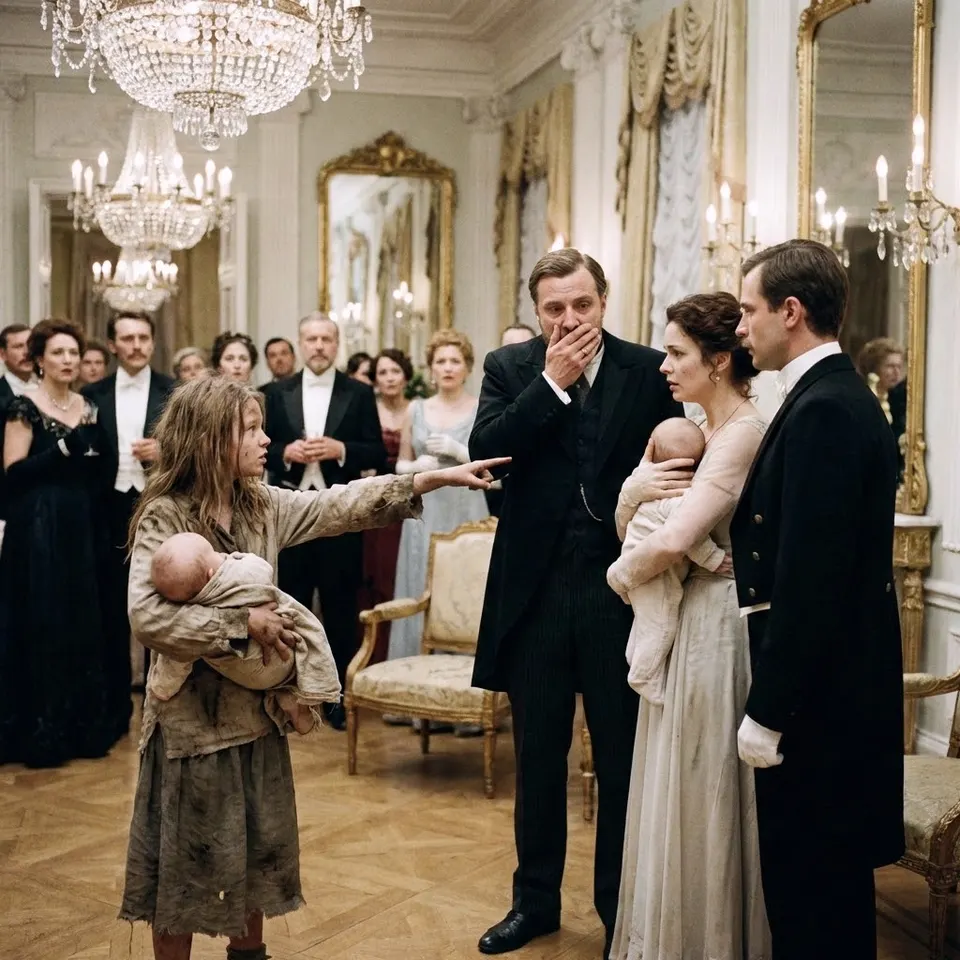
She burst into the ballroom, and her appearance was like a bomb going off. The chatter died instantly. Dana took a deep breath and shouted as loud as she could:
“Why did you do it?! How can you stand there after you left him in the trash?!”
Elizabeth Sterling flinched as if she’d been struck. She looked at the girl, then at the baby in the girl's arms, then at her husband.
“What? What are you talking about?” she whispered, her face turning ashen.
Sarah realized the game was up, but she tried one last desperate move.
She stepped between Elizabeth and Dana, playing the loyal protector.
“Be quiet, you little brat! Security! Get this runaway out of here! She’s clearly high or looking for a handout!”
Guards grabbed Dana’s arms, trying to drag her away.
“Let go! I’m not lying!” the girl screamed, fighting with everything she had.
As they pulled her toward the exit, Dana reached into her pocket and threw the silver chain into the air.
“Look at this!” she yelled.
The silver flashed under the chandeliers and landed with a sharp metallic ring at Elizabeth’s feet.
Everything stopped. Everyone stared at the object on the floor. It was a custom piece. Elizabeth recognized it instantly.
“The bracelet...” she whispered.
Her hand flew to the neck of the baby she was holding. There was no jewelry. Elizabeth looked at the baby in her arms with new, doubting eyes. A mother’s instinct, which had been whispering to her all morning that something felt "off"—the scent, the weight—suddenly screamed. Then she looked at the bundle in Dana’s arms.
Despite the grime, she saw the bright blue eyes—the exact shade of Timothy’s.
“That bracelet was on the baby when she dumped him!” Dana shouted, pointing at Sarah. “She left him in the mud in the middle of the storm!”
“Wait!” Elizabeth’s voice cracked like a whip, stopping the guards.
Trembling, she handed the baby she was holding to her husband, picked up the chain, and read the engraving. Then she turned slowly to Sarah. The maid was backing away, looking for an exit that wasn't there.
“Sarah,” Elizabeth’s voice was low and dangerous. “I put this on my son yesterday. Why does this girl have it? And whose baby am I holding?”
“Answer her!” Timothy roared, stepping forward.
Sarah broke under the weight of the room’s gaze.
“Because he’s mine!” she shrieked, her face twisting with resentment. “That’s my son! You have everything! Millions, mansions, and what do I have? My son deserved this life! I just gave him the chance you were born with!”
The room was silent, stunned by the confession. Sarah turned to Dana, her eyes full of hate:
“And you, you little gutter rat, you ruined it!”
In the silence, Dana’s voice was steady and full of a dignity Sarah would never understand:
“You’re wrong. I have nothing. Last night, I spent my last fifteen dollars on milk for this baby. I’m poorer than you’ll ever be. But I would never hurt a child for money. Being poor doesn't give you the right to be a monster.”
The girl’s words felt like a final judgment.
Timothy Sterling signaled the guards to take Sarah into a side room and call the police. Elizabeth walked slowly toward Dana, her hands outstretched.
“May I?” she asked through tears, looking at the dirty sweater bundle.
Dana nodded and gently handed the baby over.
Elizabeth pulled her real son to her chest, breathing him in—a scent of rain and cheap formula, but he was hers.
“Thank you,” she said, her voice shaking as she gripped Dana’s hand. “Thank you for saving him.”
Timothy wrapped his arms around both of them, his eyes wet.
Dana felt out of place in the family embrace and looked at Sarah’s baby, who was being held by a confused nanny.
“What happens to him?” Dana asked quietly. “He didn't do anything.”
Timothy wiped his face and looked at the innocent child who had been a pawn in his mother’s scheme.
“We’ll make sure he’s taken care of,” he said firmly. “No one gets left behind today.”
An hour later, the chaos had subsided. Sarah was in custody, and the guests had been cleared out. The Sterlings were discussing the future of the other baby.
“I know a place,” Timothy said thoughtfully. “St. Jude’s Children’s Home. It’s a top-tier facility; we’ve donated to their building fund for years.”
“We’ll set up a trust for him,” Elizabeth added, refusing to let go of Leo for even a second. “He’ll have the best care and a fresh start.”
“Can we call him Daniel?” Dana suggested. “He was small, but he was brave.”
“Daniel it is. It’s a strong name.”
Soon, a town car was taking them to the outskirts of the city. The home was a beautiful colonial house with a large garden, nothing like the cold institutions Dana feared. The director met them with warmth and compassion.
The Sterlings handed over the baby along with a commitment that would ensure his education and future were secure.
“We’ll find him a wonderful family,” the director promised, taking the infant.
Dana stood by the window, looking at the bright rooms and the kids playing outside. She felt it was time for her to head back to the streets.
“Dana,” Timothy said, kneeling so he was at eye level with her. “You’re a hero. We want to thank you properly. Tell us what you want. Anything.”
Dana looked at her filthy clothes, then at the warmth of the house. She didn't want a reward that would run out in a week.
She wanted what she’d seen in Elizabeth’s eyes.
“I don’t want money,” she said softly. “I don’t have anyone. Can I stay here? I’ll work, I’ll help out. I just want to be somewhere safe.”
Elizabeth stepped forward and took the girl’s hands in hers.
“Dana, listen to me. You aren't going to a home. You saved our son. You’re part of our family now.”
She looked at Timothy, who nodded without hesitation.
“If you’re willing, we’d like to adopt you. You’ll have your own room, a good school, and a family that loves you. You’ll never have to worry about where your next meal is coming from again.”
“Really? Like a real family?” Dana’s eyes filled with a hope she’d never dared to feel.
“Like a real family,” Elizabeth confirmed, pulling her into a hug. “You’re never going to be alone again.”
Six months later, the garden of the Sterling estate was filled with the sound of laughter. Dana, wearing a bright blue sundress, was playing on the grass with six-month-old Daniel, who was visiting for the weekend from his new adoptive home nearby. Timothy and Elizabeth sat on the patio with Leo, watching them.
“She’s a different person,” Timothy said, watching Dana. “That haunted look is completely gone.”
“She’s the best big sister they could have,” Elizabeth smiled.
Dana ran over to them, holding a dandelion she’d found, her face glowing with health and happiness.
“Mom, Dad! Are we ready for the movie tonight?”
“We sure are, honey. Let’s go inside.”












Share how the story made you feel
0Comments appear after a quick automatic check. Please no links, ads or personal data.
Next to your name we show your country, determined from your IP address; the address itself is never shown, and only a hashed fingerprint of it is kept to stop spam.