
 Let’s Keep It Real

For forty years straight, every single Thursday, my wife Eleanor went to the local credit union. Rain, snow, or even with a fever, she’d put on her coat, grab her handbag, and head out like a soldier on a mission. She never missed a day.

I never asked why. I trusted her implicitly, the way you trust the sun to rise in the morning. I spent my life working hard on major construction sites, building factories and bridges, sweating through summers and freezing through winters to make sure my family had everything they needed.
I assumed she was building a nest egg for our retirement. Or maybe she was quietly donating to a children's hospital. Eleanor always had a soft heart for anyone in need.
I was a blind, naive fool. After she passed away last week, I went through her closet and found the truth. It was tucked under a stack of ironed linens—a simple, cheap spiral notebook with a blue cover.
The entries in that notebook made my blood run cold. The woman I shared my bed, my home, and my life with for four decades had been keeping a second set of books. This secret was about to dismantle everything I thought I knew about my family, my name, and my own son.
Before I tell you what was in that notebook and how I made my son regret his choices, I have to ask: Have you ever felt the floor drop out from under you? If you’ve ever felt that cold knot in your stomach when you realize your loved ones have been lying to your face, then listen closely.
My name is Thomas Miller. I’m seventy-eight years old, a retired civil engineer. I know how to hear the stress in a steel beam before it snaps. I can spot a crack in a foundation long before a house starts to lean.
But on that gray, miserable Tuesday at the cemetery, I didn't see the biggest crack of all. The one running right through my heart. The sky was a heavy, wet blanket over the suburbs.
January has been brutal this year. The snow didn't stay white; it turned into a brown slush under our boots. The wind at the graveside was sharp and biting.
It whipped at the ribbons on the wreaths. "Beloved Mother," "Dear Wife"—the gold letters on the silk ribbons fluttered with a dry, hollow sound. I stood at the edge of the grave and watched the frozen earth hit the casket with a dull thud.
Thump. Thump. Thump. With every hit, something inside me went dark. Like a foreman shutting down a job site, one breaker at a time.
Standing next to me was Greg, my son. He’s fifty-eight now, but he was huddled in his expensive, thin designer coat like a shivering kid. He wasn't looking at the grave. He was scanning the crowd, fidgeting with his scarf, shifting his weight.
You might have thought he was just cold. But I knew that look. That’s the look of a man who just wants to get out of there.
“Dad, let’s get to the car,” he whispered as the groundskeepers started to finish. “You’re going to catch a chill. You shouldn't be out here.”
His voice sounded caring, but there was a false note in it—the kind that always made my jaw tighten. Greg took my elbow, and I felt his hand shaking. A small, nervous tremor.
The house felt wrong when we got back. It smelled of funeral lilies, coffee, and damp coats. The neighbors were already in the kitchen, setting out ham and potato salad. Plates clattered; voices were hushed.
In the dining room, we sat at the big oak table—the one where we’d celebrated every birthday, graduation, and holiday. Now, it was for a wake. I sat at the head of the table.
Eleanor’s chair was empty. Someone had placed a small framed photo of her there. I looked at her smile and wondered how I was still breathing. The air in the room felt thick, like a fog.
“She was a saint, Tom,” a cousin said, patting my hand. “The kindest soul I ever knew.”
I nodded, but the words didn't register. Greg sat to my right. He downed a drink quickly, then immediately reached for the bottle to pour another.
“You okay, Pop?” Greg leaned in, smelling of expensive cologne and bourbon. “Hanging in there?”
I slowly turned my head to look at him.
“I’m fine, Greg. I’m old, but I’m not broken yet.”
My son gave a tight, awkward smile and adjusted his cuff. That’s when I saw it. Peeking out from under his sleeve was a flash of gold.
A watch. A heavy, gold Rolex. Either a very good fake or the real deal. Something clicked in my mind. Three days ago, when Eleanor passed, Greg had called me in the middle of the night. He was crying, saying his consulting business was in a tailspin, his accounts were frozen by the IRS, and he didn't have a dime for the funeral.
“Dad, I’m tapped out. I can’t even cover the flowers,” he’d whined. I paid for everything. The casket, the plot, the service, the catering. I emptied my savings and even borrowed a bit from my friend Bill.
I did it because it was for his mother. And now here he was, drinking my bourbon and wearing a watch that cost more than my car.
“Nice watch,” I said quietly, my eyes locked on his wrist.
Greg flinched as if I’d struck him. He quickly pulled his sleeve down, hiding the gold. His eyes darted around the room.
“Oh, this? It’s… it’s a knockoff, Dad. A high-end replica.”
“A client gave it to me to look the part for a big meeting. You know how it is in business—image is everything.”
He was lying. I knew his tells. His left eyelid gave a tiny twitch when he was being dishonest. It was a habit he’d had since he was a kid stealing change from my dresser.
“Image, huh?” I muttered. “Funny how you had enough for the image but not for your mother’s headstone.”
Greg’s face flushed red. The color crept up his neck.
“Dad, don’t start. You know the situation. I’ll pay you back as soon as this new contract clears…”
He trailed off and poured another drink. The conversation around the table picked up again. Someone was reminiscing about Eleanor’s apple pie. Greg relaxed, thinking he was off the hook. But inside me, a cold suspicion was starting to grow. An hour later, as people started to leave, Greg approached me again.
He was a bit tipsy now, bolder.
“Listen, Pop…” He lowered his voice, glancing toward the kitchen. “Mom mentioned… well, she had a small filing cabinet in her craft room. Some old deeds to the lake house and some tax records.”
“I really need to grab those. There’s a power of attorney form my lawyer needs to see to clear up some paperwork.”
“What paperwork?” I frowned.
“The lake house is in my name. The house here was in both yours and Mom’s. What is there to clear up?”
“It’s just legal technicalities, Dad. You wouldn't understand the fine print.”
His voice had a desperate, sharp edge to it.
“There are some zoning issues. Just give me the key to the room, I’ll grab the folder and be out of your hair.”
He held out his hand, palm up. It was a demanding gesture.
In his eyes, I didn't see grief. I saw greed. A raw, naked hunger that made me feel ashamed just looking at him. The craft room.
It was a small room off the hallway where Eleanor did her sewing and kept her records. She always kept it locked when we had company.
“I just like to keep my projects private, Tom,” she’d always say.
“I have the keys,” I said, looking him straight in the eye. “But I’m going in there myself. Tomorrow. Today isn't the time for paperwork.”
“Dad, I need it now! My lawyer is leaving for vacation tomorrow!” Greg almost shouted, catching the attention of my daughter, Susan, who was drying dishes in the kitchen.
“I said no,” I barked. The sound was like a hammer hitting an anvil. “Sit down and have a drink for your mother. Or leave.”
Greg froze. His face twisted with anger for a split second before he masked it with an insulted pout.
“Fine, Dad. Whatever. I was just trying to help.”
He walked away, but I felt his eyes on my back. A heavy, oily stare.
When the last guest left and Susan kissed my cheek before heading home to her kids, I was alone in the silence. The ticking of the grandfather clock sounded like a drum.
I went to the craft room door and pulled out my keychain. My hands were shaking. Why was Greg so desperate for old records? Where did a "bankrupt" man get a Rolex?
And why had Eleanor, who never kept a secret from me, started jumping every time the phone rang these last few years? I turned the key. The click sounded like a gunshot.
I didn't know it yet, but I was opening a door to a nightmare. The door creaked open, almost protesting. I stepped inside and was immediately hit by her scent.
Lavender, old paper, and the perfume she only wore on Sundays. It was so vivid I almost expected to see her sitting in her armchair by the window, looking up from her knitting to ask, “Tom, why aren't you in bed?”
But the chair was empty. Her gray cardigan was draped over the back. I touched the wool; it was cold. Everything in this room was cold. I flipped the light switch. The yellow glow revealed Eleanor’s private world.
Her sewing machine, stacks of patterns, and the old roll-top desk she’d inherited from her father. I approached it feeling like a burglar. “I’m sorry, Eleanor,” I whispered. “But Greg is hiding something, and I have to know what.”
The desk key turned easily. I lowered the lid.
Inside was the perfect order she was known for. Pens in a cup. Utility bills filed by year. A stack of birthday cards. I started going through the papers. First carefully, then with more urgency.
Lake house documents?
There they were, in a clear plastic sleeve. The deed, the tax assessments—nothing unusual. Just standard papers that certainly weren't an emergency in the middle of winter.
Greg had lied. I opened a small drawer inside the desk. There was a tin of buttons, some old coins, and…
At the very back, tucked under a stack of sewing patterns, I felt something hard. It was a standard spiral notebook. The blue cover had a label that simply said: "Ledger." I sat in her chair. The springs groaned under my weight.
I opened the first page. February 14, 1985. The date was underlined in red. Next to it was the amount: $150. And a short note: “Paid.”
I frowned. 1985. I was a foreman back then, making decent money, but $150 was a lot of cash in the mid-eighties. Where would she be "paying" that much?
I turned the page. February 21, 1985. Thursday. $150. February 28, 1985. Thursday. $150. March 7, 1985. Thursday. $150.
The columns of numbers went on forever. The ink changed from blue to black to ballpoint. The handwriting changed from firm and clear to the shaky script of her later years. But one thing never changed: the regularity.
Every Thursday. Every week. For forty years. I flipped through the pages, watching the history of our lives through dollar amounts.
1995. The amounts went up. $250. $300.
2008. The recession. A note: “Extra for the 'emergency'.” $1,000. Where did she get a thousand dollars in 2008?
I remember that year. We were eating tuna casserole and skipping the heat because things were tight. I wore my work boots until the soles fell off because we "couldn't afford" new ones. And she was paying out a thousand dollars?
To whom? I felt a hot flash of anger. I unbuttoned my collar; I couldn't catch my breath.
2015. $400 a week. 2024. The amounts had stabilized at $500. Every single Thursday.
I grabbed the calculator from the desk. My fingers fumbled over the buttons. I started adding it up.
Adding, multiplying, estimating the totals over the decades. By the time I finished, my ears were ringing. The total was astronomical.
This wasn't just "savings." This was enough to buy a second home in cash. It was the cost of the dental work I’d put off for ten years. It was the European cruise Eleanor always talked about but said we "couldn't afford."
“We have to save, Tom. Times are tough,” she’d always say. Times were tough.
And all that time, she had a black hole where our money was disappearing. My salary, her small pension, our savings. I closed the notebook.
My hands shook so hard the notebook slid to the floor. A small slip of paper fell out. A pawn shop ticket from 2010.
A gold ring with a ruby. It was her grandmother’s ring. The one she told me she’d lost in the garden while weeding. I’d spent hours looking for it, telling her, “Don’t cry, honey, it’s just a thing.” She hadn't lost it. She’d pawned it to make a Thursday payment.
I sat in that quiet room, surrounded by the things of a woman I thought I knew better than anyone. And I realized I’d been living with a stranger. Who was it?
A lover? A blackmailer? A cult? Or.
I remembered Greg’s face. I remembered his shaking hands, his Rolex, his panic over this room. “The lake house papers.”
“No, son,” I rasped, standing up. My legs felt like lead.
“Those aren't the papers you’re looking for. This is your indictment.”
I didn't sleep a wink. I paced the house like a caged animal. That blue notebook felt like it was burning a hole in my pocket.
I re-read the dates, trying to match them to our lives. 1996. Greg goes to college. We sold the second car to pay his tuition. In the notebook: “Extra payment. Week of the 15th.” 2010. Greg starts his first business. Asks for a loan. We gave him everything we had in savings. In the notebook: “$5,000 above the usual.”
In the morning, as the sky turned a bruised purple over the neighborhood, I got dressed. I didn't bother shaving. I put the notebook in my inner jacket pocket, right against my chest, where my heart was thudding a slow, heavy rhythm.
I needed to go to the bank. Morning in the suburbs is always the same. Garage doors opening, neighbors scraping frost off windshields. I joined the flow of traffic.
I walked with my cane—my knee was acting up—and I felt like everyone was looking at me. Like they knew I was the old fool who’d been lied to for forty years. The credit union opened at nine.
I was there at eight-forty. I stood at the glass doors, breathing on the cold pane. A couple of other seniors were waiting, talking about the price of eggs.
“Eleanor used to be here every week,” one of them said, a woman named Nancy from down the street. She recognized me. I flinched.
“Every week, huh?”
“Like clockwork, Tom. We used to joke she had a part-time job here. Always at the same window. Window number three, with Sarah.”
At nine sharp, the security guard unlocked the door. I was the first one in. I didn't take a number. I went straight to the manager’s office.
A young woman with a practiced smile met me.
“I need to see the manager,” I said.
“Do you have an appointment? Mrs. Miller is quite busy.”
“Tell her it’s Thomas Miller. Eleanor Miller’s husband. It’s about her estate. It’s urgent.”
The manager, Mrs. Miller (no relation), was a woman about my age, professional and stern.
She knew Eleanor. She came out five minutes later and invited me in.
“I’m so sorry for your loss, Mr. Miller. Eleanor was a very dedicated member here.”
I sat down, resting my cane on my lap.
“Mrs. Miller, I’m going to be blunt. I found some records at home. My wife was withdrawing cash. A lot of cash. Every single week. I need to know where it went.”
The manager took off her glasses and rubbed the bridge of her nose. She looked uncomfortable.
“Mr. Miller, there are privacy laws. But since Eleanor has passed and you are the executor of the estate…” She sighed and turned to her computer. “Yes, the account is nearly empty. There’s about $42 left.”
“Where were the transfers going?” I asked, leaning forward. “What account?”
Mrs. Miller looked at me over her monitor. There was a mix of pity and hesitation in her eyes.
“There were no transfers, Mr. Miller. Eleanor never did online banking or wire transfers. She said she didn't trust 'invisible money'.”
“Then how? Cash?”
“She always ordered cash in advance. Large bills. Every Thursday. She’d come in, take the envelope, and leave.”
“Leave through the front door?”
“Well…” the manager hesitated. “I shouldn't really say, but the tellers mentioned she often asked to use the side exit. The one that leads to the back alley by the loading docks. She said it was a shortcut to the pharmacy.”
The side exit. The back alley. Where the dumpsters are and where the delivery trucks park. No cameras, a dead end. Perfect.
“Can I…” my voice cracked. “Can I see the security footage? From last Thursday. It was the last time she was here.”
Mrs. Miller bit her lip.
“That’s against policy, Mr. Miller. Usually, we need a police request for that.”
“Please,” I said, using her first name. “I’m not going to the police. Not yet.”
“I just need to understand. For Eleanor’s sake. I’ll lose my mind if I don’t know.”
She was silent for a long minute. I could hear the hum of the computer. Finally, she nodded.
“Okay. Just this once. And just one clip.”
She turned the monitor toward me. Black and white footage flickered to life. Date: Last Thursday. 10:15 AM.
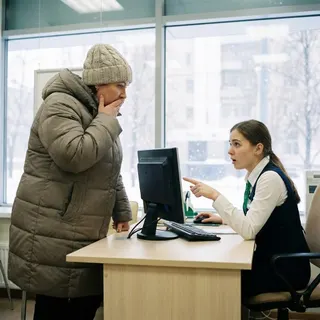
There she was. My Eleanor. In her old winter coat and her knitted hat. She moved slowly, favoring her bad hip. She went to the window. The teller handed her an envelope. A thick one.
Eleanor looked around, her eyes darting. She looked terrified. Hunted. She tucked the envelope into her bag and clutched it to her chest with both hands.
Then she didn't head for the front. She went down the side hallway. To the service door. The camera switched. The hallway.
She pushed open the heavy metal door and disappeared into the snowy alleyway.
“That’s it?” I asked.
“Our cameras don’t cover the alley,” Mrs. Miller said. “That’s public property.”
I walked out of the bank, stumbling. The cold air hit my lungs like a physical blow. The back alley.
I walked around the building. A grim little spot, piled with dirty snow and trash cans. It smelled of exhaust and damp cardboard.
She came here with the money. Someone was waiting for her. I stood there, looking at the packed snow. The tracks were gone, but I could almost see the ghost of a car.
I needed eyes. Eyes that saw what the bank cameras missed. And I knew exactly who to call. I pulled out my phone and dialed a number I’d known since my days at the construction company.
“Bill?”
“Hey, Tom. How you holding up?”
“I need a favor. A big one. Are you at the shop?”
Bill, a retired sheriff’s deputy who now ran a private security firm, was the only man I knew who could get information from a stone. And he was the only one I could trust with this shame. Because if what I suspected was true, I was going to need more than just information.
I was going to need a plan. Bill’s office was in a small industrial park. It was a place where things got done quietly.
I made my way through the slush, leaning on my cane. The temperature was dropping fast. By evening, it would be below zero, and the air already felt brittle.
Bill’s shop was at the end of the row. He was waiting for me. The door buzzed open before I even reached for the handle.
“Get in here, Tom! You’re letting the heat out!” he barked from the back.
Inside, it was warm and smelled of coffee and gun oil. Bill was a big man, silver-haired, with a face like a topographical map. He sat behind a desk cluttered with monitors.
“Sit down, Tom.” He didn't get up—his back was shot—but he offered a hand as solid as a vice. “You look like hell.”
I took off my hat and sat down. On the wall were his old commendations and a photo of us at a company picnic thirty years ago.
“I need a drink,” I said hoarsely.
Bill silently poured two fingers of rye into a glass. I drank it down. It burned, but it helped. Bill watched me, waiting. He knew how to let a man find his words. I reached into my pocket and pulled out the blue notebook.
I laid it on the desk.
“What’s this?” Bill squinted.
“This, Bill, is the price of my marriage. Take a look.”
He put on his glasses and opened the notebook. He flipped through the pages, his eyebrows climbing higher with every flip. He was doing the math in his head.
“Good lord, Tom,” he breathed. “How much is this? Two hundred thousand? Three?”
“It’s Eleanor,” I said, looking at the floor. “She was paying it out. Every Thursday. For forty years.”
“Eleanor?” Bill looked stunned. “Your Eleanor? She wouldn't spend an extra nickel on a loaf of bread. Where was it going?”
“That’s what I need you to find out.”
I told him about the bank, the side door, and the alleyway.
“I need to know who was waiting for her, Bill. My gut is screaming. I’m thinking… a blackmailer? Or some kind of scam?”
Bill frowned and tapped his desk.
“Blackmail is usually a lump sum or a few big hits. Forty years? That’s a lifestyle. That’s a parasite.”
He turned to his computer.
“The alley behind the Credit Union on 5th Street?”
“Yeah.”
“The bank cameras don’t cover it, you’re right. But…” He grinned. “The hardware store across the street has a high-def 4K camera on their loading dock. It points right at those dumpsters.”
“And I happen to do their security.”
“Can you see it?” I leaned in.
“I can pull the cloud archive. Give me a minute.”
Bill’s fingers flew over the keyboard. The room was silent except for the clicking of the mouse. I watched the screen, my heart hammering against my ribs. I almost wanted him to find nothing. I almost wanted it to stay a mystery.
But the truth was already there, waiting in the pixels. Bill found the timestamp. Last Thursday. 10:18 AM.
The footage was crystal clear. The alley was empty. Then, a car pulled in. A black sedan. Dirty, but expensive. A BMW.
It parked near the dumpsters, tucked away from the street view. The engine stayed running. Exhaust puffed out in the cold air. At 10:20, the side door of the bank opened. Eleanor stepped out.
I recognized her immediately. The way she held her bag, the way she hurried. She walked straight to the car.
The back window rolled down. Just halfway. Eleanor reached into her bag and pulled out the white envelope.
She handed it through the window. A hand reached out to take it.
“Pause it! Zoom in!” I rasped.
Bill clicked and dragged. The image enlarged. It was grainy, but clear enough. The hand was a man’s. He was wearing a dark designer coat. On his ring finger was a gold signet ring. A heavy one with a black stone.
And on his wrist… the gold Rolex. My stomach did a slow, sickening roll.
I knew that hand. I’d seen it yesterday at the wake. I’d seen it a thousand times over the years. I’d held that hand when it was tiny and reaching for a baseball.
“Greg…” I whispered.
Bill froze. He slowly turned to look at me.
“Your son?”
“That’s his ring,” I said, my voice barely audible. “I gave it to him for his thirtieth birthday. And those are the watches he was bragging about.”
“Your son was shaking down his own mother?” Bill’s voice was hard, like granite.
“Tom, are you sure? Maybe he was just… picking it up for her? Helping her?”
“Helping her?” I gave a bitter laugh. “Watch the rest.”
Bill hit play. The hand snatched the envelope. Not a gentle take—a grab. Eleanor said something, reaching out as if to touch his face, to get a moment of his time.
But the window rolled up, cutting her off. The car gunned its engine, kicking up slush, and sped out of the alley. Eleanor was left standing there alone in the cold, looking at the empty space where her son had been.
She stood there for a long time. Maybe twenty seconds. Then she lowered her head and walked away.
The video ended. Bill closed the laptop with a sharp snap.
“That piece of work,” he muttered. The contempt in his voice was thick.
“His own mother. He had her on a payroll.”
I sat there, staring at the blank screen. Inside, everything felt dead. There was no more pain, no more doubt. Just a cold, hard resolve.
“Forty years, Bill!” I said, my voice steady and strange. “He started this in 1985.”
He was seventeen then. A senior in high school.
“Blackmail?” Bill asked. “What could he have had on her?”
“Eleanor was a good woman. She didn't have secrets. She didn't have affairs. What could it be?”
“I’m going to find out.”
I stood up. My legs felt strong now. The rye had worn off, replaced by a cold adrenaline.
“Thanks, Bill. You opened my eyes.”
“Wait.” Bill grabbed my arm. “Don’t do anything crazy, Tom. Don’t throw your life away over a rat like him. He’s not worth it.”
“Crazy?” I looked at my friend. “No. Killing him would be too easy. I’m going to make him wish he’d never been born.”
I went home in the dark. The house felt like a tomb. I didn't turn on the lights. I went straight to the kitchen.
I poured a glass of water. It tasted like iron. My son. My firstborn.
I remembered bringing him home from the hospital. The blue blanket. I remembered teaching him to ride a bike.
“Dad, don’t let go! I’m scared!”
“I’ve got you, son. I won’t let go.”
I’d held on to him his whole life. And all that time, he’d been bleeding us dry. Why? The question circled my mind like a shark.
To bleed someone for forty years, you need leverage. Something terrifying. I went to Eleanor’s craft room. I didn't feel like a burglar anymore.
I was an investigator. I opened the desk again. I tore it apart. Every scrap of paper.
Receipts, recipes, letters. Nothing. There had to be an explanation. Eleanor wouldn't just pay.
There had to be a threat. I looked up. The attic crawl space.
In the hallway, there was a small hatch in the ceiling where we kept the holiday decorations and old school projects. I dragged the ladder over. My back screamed, but I didn't care.
I climbed up. Dust filled my lungs. I started tossing boxes aside. Old Christmas lights, a box of my fishing gear, a bag of baby clothes. In the far corner, behind a stack of old suitcases, was a cardboard accordion file.
On the tab, in Eleanor’s neat handwriting, it said: “Greg. History.” I climbed down, clutching the file to my chest. I sat on the floor right there in the hallway, under the dim light.
I opened the file. The first thing that fell out was a piece of notebook paper. Yellowed, lined. Date: February 12, 1985.
The text was written in block letters, shaky, trying to hide the handwriting. But I knew the cadence. I knew the way he crossed his 'T's.
“DEAR MOM, GREG HAS DONE SOMETHING TERRIBLE. HE WAS DRIVING DAD’S TRUCK AND HIT SOMEONE. WE SETTLED IT WITH THE POLICE, BUT NOW HE OWES US. IF YOU DON’T PAY $150 EVERY WEEK, WE WILL TURN HIM IN. HE’LL GO TO PRISON FOR 10 YEARS. DAD MUST NEVER KNOW. IF TOM FINDS OUT, WE KILL GREG IMMEDIATELY. PAY AND STAY SILENT.”
I read it three times. 1985. Greg was seventeen. I remember that year. I was away on a big bridge project for six months.
My Ford F-150 was in the garage. When I got back, there was a dent in the fender. Eleanor told me she’d hit a post while backing out. I believed her. She even had a license, though she rarely drove. He’d taken the truck while I was gone.
Maybe he hit someone. Or maybe he just hit a dog and made up a story. But the letter… “Serious people.”
In 1985? In our town? It was a lie. But Eleanor, my sweet, sheltered Eleanor who grew up on a farm, she was terrified.
“Dad must never know.” That was the hook. She knew my temper back then. She knew I’d have made him face the music. She chose to pay.
To save him. I turned the page. There was another letter. 1995.
“Mom, it’s me. They found me again. Those guys from high school. They’re in the mob now, and the debt has grown. They said they’ll burn the house down if we don’t increase the payment. Don’t tell Dad. His heart can’t take it.”
2005.
“Mom. IRS audit. I might go to jail for tax fraud. I need to pay them off. Regularly. Or I’m gone. You don’t want the grandkids growing up without a father, do you?”
I read the letters. A chronicle of lies spanning a lifetime. There were no "mobsters." There were no "serious people" in '85.
There was only Greg. My son, who at seventeen, realized he could use his mother’s love as a weapon. He saw it worked, and he turned it into a career.
He built his life on her fear. He bought his cars, his vacations, and his watches with the money she scraped together while she wore old coats and skipped the dentist. He looked her in the eye every Thursday and took the envelope, playing the victim.
I felt physically sick. I barely made it to the bathroom before I threw up. I washed my face with freezing water.
I looked at myself in the mirror. A gray-faced old man with eyes full of shadows.
“Well, Greg,” I whispered to the reflection. “You wanted the high life? You’re going to get it. I’m going to give you a finale you’ll never forget.”
I went back to the kitchen and picked up the phone. I called my daughter.
“Susan? Are you awake?”
“Dad? It’s three in the morning. Is everything okay? Is it your blood pressure?” Susan’s voice was thick with sleep.
“I’m fine. Listen to me carefully.”
“Tomorrow, I want everyone here. You, Mike, the kids. And call Greg. Tell him I’m calling a family meeting about the estate.”
“Dad, can’t it wait? We’re all still grieving.”
“Tomorrow, Susan. Six o’clock. Tell Greg I’ve decided to sign over the lake house and the deed to this place. Tell him to bring his ID.”
“You’re… you’re giving it all to him?” Susan’s voice was hurt.
She was used to Greg being the favorite. “Just be here, honey. You’ll understand everything.”
I hung up. Now came the hard part. I didn't sleep. I sat at the table and wrote.
Not a will. I wrote the script for the final act. I laid out the evidence. The notebook. The security stills.
I printed them out on Eleanor’s old printer. Greg’s letters. I found an old photo of us. The three of us at the beach. Happy, tanned. Greg laughing on my shoulders.
I clicked my lighter. I held the flame to the corner of the photo. Greg burned first. Then Eleanor. Then me.
The ash fell into the sink. I washed it away.
“Tomorrow is Thursday, Greg. Payday. And you’re going to get your last envelope.”
I spent the day preparing like I was going into battle. I shaved until my skin was smooth, though it felt like parchment. I put on my best suit, the dark gray wool one I’d bought for my retirement party ten years ago.
It hung loose on me. I’d withered in the last few days. But I tied my tie tight, the knot firm against my throat. It helped me stay focused.
The house was quiet and sterile. I’d cleared the dining table. No lace cloth, no bowls of nuts. Just the bare, polished wood, cold and dark.
In the center of the table, I placed the blue notebook. To the right, the stack of letters. To the left, the security photos. And at the edge, where Greg would sit, I placed a thick white envelope. Bulging. Exactly like the ones Eleanor carried for forty years.
Susan arrived first, at five-forty-five. She was always early, a habit of a woman who didn't want to let anyone down. She saw my suit and the documents on the table and froze.
“Dad? Why are you dressed up? And why is the table so… clinical?”
“Sit down, honey. Have some tea. Everything is fine.”
Susan sat on the edge of her chair, clutching her purse. “Dad, if you’re giving the house to Greg, it’s okay. I don’t need it. We’re doing fine with the mortgage. I just want you to be happy.”
I looked at her and my heart ached. My daughter. The honest one. The one who always took the back seat. “Greg needs it more,” we’d always said. Greg needs the new bike. Greg needs the college fund. Greg needs the help.
“You don’t understand, Susan,” I said softly. “Tonight isn't about giving things away. It’s about settling the bill.”
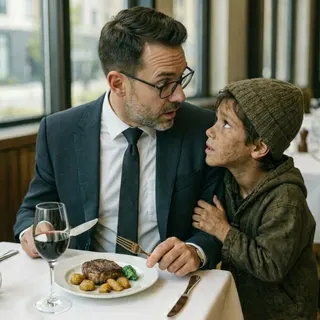
At six-oh-five, Greg burst in. He didn't knock; he had his own key. He walked in like he owned the place, smelling of expensive tobacco and leather.
He was wearing a cashmere overcoat and Italian shoes that probably cost three of Susan’s paychecks.
“Alright, Pop, what’s the big rush?” He didn't even take off his coat. “I had to cancel a dinner. I hope the paperwork is ready.”
He walked into the dining room, leaving wet footprints on the floor. He nodded dismissively at Susan. “Hey, Sis. Hope you’re not here to contest anything. Dad and I have a plan. I need the capital for a new venture. I’ll make it up to you later.”
He sat down across from me and unbuttoned his coat. The gold Rolex flashed under the chandelier.
“So, where do I sign, Dad? The deed?”
I didn't say anything. I just looked at him. I tried to find the boy I’d taught to use a hammer. The one who cried when his hamster died. Where was he?
Sitting across from me was a predator. A parasite who had fed on his own mother’s soul.
“There’s nothing to sign yet, Greg,” I said. My voice was dry, like rust. “First, I want you to read something.”
I pushed the blue notebook toward him. Greg glanced at it with boredom.
“What’s this? Mom’s diary? Dad, I don’t have time for sentimental stuff.”
“Open it. Page one. 1985.”
Greg sighed and rolled his eyes, but he opened it. One second. Two. Three.
I watched his face change. First confusion, then recognition. Then, as he saw the columns of numbers and the dates, his skin turned a sickly, grayish yellow. He slammed the notebook shut.
“So what? Mom kept a ledger. She was frugal. You called me here to show me her grocery math?”
“Grocery math?” I asked. “There are hundreds of thousands of dollars in there, Greg.”
“Money she handed to you. Every Thursday. For forty years.”
Susan gasped. She leaned forward, her eyes wide.
“Dad, what are you talking about? What money?”
“This money!”
I threw the letters onto the table. The first one, in block letters.
“Read it, Susan. Out loud.”
Susan’s hands shook as she picked up the paper. “‘Dear Mom, Greg has done something terrible… we will kill him…’” She stopped, looking at her brother with pure horror. “Greg? What is this? Someone was going to kill you in 1985?”
Greg sat perfectly still. His eyes narrowed into two cold points. He realized this wasn't a meeting. It was a trial.
But he was a gambler. He decided to double down.
“This is garbage,” he spat. “You found some old prank letters. Who knows who wrote that? Maybe Mom was losing it. Maybe she wrote them to herself.”
“To herself?” I laughed. “And did she hand the envelopes to herself too? In the alley behind the bank?”
I laid out the photos. The car. The hand with the ring. The exchange.
Greg went pale. Sweat broke out on his forehead. He stood up, knocking his chair back.
“You spied on me? You hired someone to follow your own son? You’ve lost your mind, old man!”
“Sit down!” I roared. It was the voice I used on a construction site to be heard over the jackhammers. “Sit down, you coward!”
Greg sank back into the chair. He looked like a cornered animal.
The mask of the successful businessman was gone. In its place was a mean, desperate kid caught stealing from the cookie jar.
“Why, Greg?” Susan asked, her voice breaking. “Why would you do this?”
“We were struggling in the nineties. Mom wore the same coat for a decade. And you… you were taking her money?”
“Oh, shut up!” Greg yelled. He’d snapped. “You don’t know what it’s like to try and make it! You, Susan, you’re happy with your little nursing job and your little life. I had to build something! I needed capital! Yeah, I needed money. So what? She’s my mother. She was supposed to help me!”
“Help you?” I stood up. I walked around the table until I was inches from him. “By blackmailing her? By threatening her? You made her believe I’d be killed if she didn't pay.”
“You made her live in fear for forty years. You stole her life, Greg. You stole our peace.”
“She was a fool!” Greg screamed, spittle flying. “She was naive. She believed the story. I just came up with a plan and she fell for it.”
“If she’d just talked to you once, it would have been over. But she was too scared. That’s on her, not me. I just took what was offered.”
The slap echoed through the room. It wasn't from me.
It was Susan. She had stood up and struck her brother across the face. Hard.
“Shut up! Don’t you dare talk about Mom like that! You monster!”
Greg clutched his cheek. His eyes flared with rage. He started to move toward her, but I grabbed his wrist. My grip was like iron.
I might be old, but forty years of manual labor doesn't just disappear. I squeezed his wrist right over his gold watch until he winced.
“Get out,” I said quietly. “Get out of my house.”
“You can’t do this!” Greg hissed, trying to pull away. “I’m an heir. Half of this is mine. I’ll sue you for every penny.”
“I’ll have you committed. I’ll tell the court you’re a predator. You won’t get a dime.”
I let go of his arm. He stumbled back, rubbing his wrist.
“Sue me?”
I went to the table and picked up the thick white envelope.
“You came for your inheritance, Greg? Your payday?”
“Yeah! It’s mine by law!”
“Here!” I threw the envelope at his chest.
Greg caught it instinctively. His eyes lit up with greed. He felt the weight of it.
“What’s this? Cash? You emptied the accounts?”
“Open it.”
He tore the paper open. Inside was a thick stack. He pulled it out. His face fell.
It was a "dummy" stack. Strips of newspaper cut to the size of dollar bills. On the top and bottom were photocopies of his own blackmail letters. And in the middle, one single real bill.
A ten-dollar bill from 1985. A "red seal" note I’d kept as a souvenir. The kind of money he started stealing from my dresser when he was a kid.
“That’s all you’re getting,” I said. “I’ve already seen my lawyer.”
“I’ve signed the house and the lake property over to Susan as a gift. And I’ve updated my will. Everything I own goes to her. To you, Greg, I leave that ten dollars. For the memories.”
“You… you can’t do that,” he rasped. The newspaper strips fluttered to the floor like trash.
“I can and I did. And as for suing me…” I nodded toward the file of photos and letters. “My friend Bill, the former deputy? He’s already shared copies of these with his contacts at the DA’s office. Extortion, elder abuse, fraud.”
“They haven't filed charges yet. But if you ever touch Susan, or try to sue, or even show your face in this town again, that file goes on the prosecutor’s desk. You’ll be looking at ten to fifteen years.”
“You’ll love prison, Greg. They have a lot of 'serious people' there. They’ll show you what a real shakedown looks like.”
The room went silent. The only sound was the hum of the refrigerator and Greg’s heavy breathing.
He knew. He was beaten. He looked at me, and for the first time, I saw pure, unadulterated hatred.
“I hope you rot, old man!” he spat.
“You, your memories, and your dead wife. You ruined my life.”
He turned and stormed out. I heard the front door slam. I heard his car roar to life in the driveway. I heard the screech of tires.
My legs gave out. I sat down. Susan was at the window, her face in her hands, crying silently.
We sat in silence for ten minutes. The floor was covered in newspaper scraps. The "dummy" stack I’d spent all night making was just litter now.
“Dad?” Susan turned to me. Her eyes were red and swollen.
“Are you really going to press charges? Are you going to put him in jail?”
I looked at my hands. Knotted, spotted with age. Hands that built things, not broke them.
“No, honey. I won’t. It’s not right to put your own son in a cage, no matter what he is.”
“God will judge him. But I had to scare him. I had to make sure he never comes back here.”
“What if he does?”
“He won’t. He’s a coward. All bullies are. He broke the second he felt a real threat.”
I stood up and started picking up the paper scraps. Susan rushed to help. We crawled on the floor together, picking up the pieces of our broken family.
“You know, Susan,” I said, tossing the scraps into the trash, “I’m selling everything.”
She froze with a handful of paper.
“Selling? The house?”
“The house, the car, the garage. I can’t live here anymore. Every wall smells like Eleanor. Every floorboard whispers about the lies.”
“I can’t breathe in here.”
“Where will you go? To our place? Mike won’t mind. We have the guest room.”
“No, honey. I’m an old wolf; I need my own space. I bought an RV.”
“What?” Susan’s eyes went wide. “Dad, you’re seventy-eight. You can’t drive an RV across the country.”
“It’s a nice one. A Winnebago. Bill’s cousin was selling it. It’s warm, has a bed, a little kitchen.”
“What else does an old man need?”
“Dad, this is crazy. It’s winter. You’ll get sick. What about your medicine?”
I smiled. For the first time in days, I felt the muscles in my face relax.
“I’m going south, Susan. To the coast. Eleanor always wanted to see the ocean in the winter. She spent her life saving for a dream she never got to have. I’m going to have it for her.”
“I’ll take her favorite scarf and let the sea breeze catch it. And I’ll see it for myself. Maybe I’ll stay down there. South Carolina is nice this time of year.”
“Dad…”
“Don’t argue, honey. My mind is made up. The money from the house sale goes to you. Pay off your mortgage. Put the rest away for the kids’ college.”
“Just live your life. Honestly. Without any secrets.”
She hugged me. Hard, like she did when she was a little girl. She cried into my shoulder.
I stroked her hair, which was already starting to gray, and I thought: this is my real legacy. Not Greg and his Rolex, but this tired, kind woman who knows how to forgive.
The move took two weeks. The house sold fast. It was a good neighborhood, near the park. The buyers were a young couple, excited to start a family.
I watched them walk through the rooms, planning where the nursery would go. I hoped they’d never have a "blue notebook" of their own.
The RV was parked at the curb. A sturdy, well-kept machine. Inside, it smelled of cedar and new upholstery. I took only the essentials.
A suitcase of clothes, my tools, the old photo albums—the ones without Greg—my fishing gear, and a small wooden cross my mother had given me.
On the last day, I went to the cemetery. Eleanor’s grave was covered in fresh snow. The headstone was simple and elegant. Her photo was in a small oval frame.
I cleared the snow with my hands and laid two roses. I pulled the blue notebook from my pocket. Here it was—the ledger of betrayal. I clicked my lighter.
The flame licked the corner of the cover, then caught. The paper, soaked in forty years of lies, burned bright. I held it until the heat reached my fingers.
“Goodbye, Eleanor,” I said to the wind. “I’m not angry anymore. You were a mother. You loved him the only way you knew how. It was a tragic, blind love, but it was yours.”
“Rest now. The bill is paid in full.”
The black ash fell onto the white snow. The wind caught it and carried it away toward the trees.
I turned and walked to the RV without looking back. The interstate stretched out before me like a gray ribbon. Outside the window, the snowy fields and small towns blurred past.
The cabin was warm. The radio was playing something soft. I gripped the wheel, feeling the vibration of the engine. It was the vibration of a new life.
My phone buzzed. A text from Susan.
“Dad, how are you? Did you make it past Virginia? Mike sent some money to your account for gas. We love you. Be safe. Call us tonight.”
I smiled. Everything was as it should be. Life wasn't over. It had just taken a long-overdue turn.
Ahead of me was the ocean. I’d never seen it in the winter. They say it’s gray and powerful, like steel. That’s fine. I think we’ll get along just fine.










Share how the story made you feel
0Comments appear after a quick automatic check. Please no links, ads or personal data.
Next to your name we show your country, determined from your IP address; the address itself is never shown, and only a hashed fingerprint of it is kept to stop spam.