
 Let’s Keep It Real
The biting October wind whipped across Mike Rollins’ face as he steered his weathered fishing boat, *The Hope*, through the choppy waters of the Pacific Northwest. The forty-year-old fisherman from the small coastal town of Fisher’s Cove knew these waters like the back of his hand—every sandbar, every current, every hidden rock. The Pacific, unpredictable and vast, stretched out between the rugged Oregon coastline and the distant horizon.
These waters were once teeming with salmon and halibut, but the sea was a fickle mistress. During the autumn storms, the water temperature plummeted, and by winter, the swells grew so violent that most local boats stayed docked for months. Mike was a third-generation fisherman. His grandfather had worked the canneries back when the industry was the backbone of the county. In those days, the local cooperatives provided steady work for the whole town, with trawlers returning to port with hulls overflowing.
But times had changed. The big commercial fleets moved in, the cooperatives folded, and independent fishermen were left to fend for themselves. “Empty nets again,” Mike muttered, hauling in his last line. It was the third day in a row. His wife, Susan, was waiting at home with their two kids: ten-year-old Alex and seven-year-old Mia. Money was tighter than it had ever been.
The *Hope*, built back in the late eighties, was a constant drain on his wallet. The old diesel engine was temperamental, the hull needed a fresh coat of anti-fouling paint, and his sonar was practically prehistoric. The fish were moving further out, chased away by industrial-scale operations that used satellite tech to sweep the ocean floor clean, leaving nothing for the little guys.
Mike checked his watch: 4:00 PM. In October, the light faded fast, and he hated going home empty-handed. The family budget was at a breaking point. They were two months behind on the electric bill, and Mia’s braces were going to cost a fortune. Susan was pulling double shifts at the local diner, but her tips barely covered the groceries.
He made a split-second decision that would change everything: he turned the wheel toward Ursus Island, a rocky outcrop about 30 miles offshore. The island was a jagged piece of land, barely two miles long, covered in scrub brush and battered by the surf. Most sailors avoided it because of the treacherous shoals and unpredictable riptides, especially when a storm was brewing.
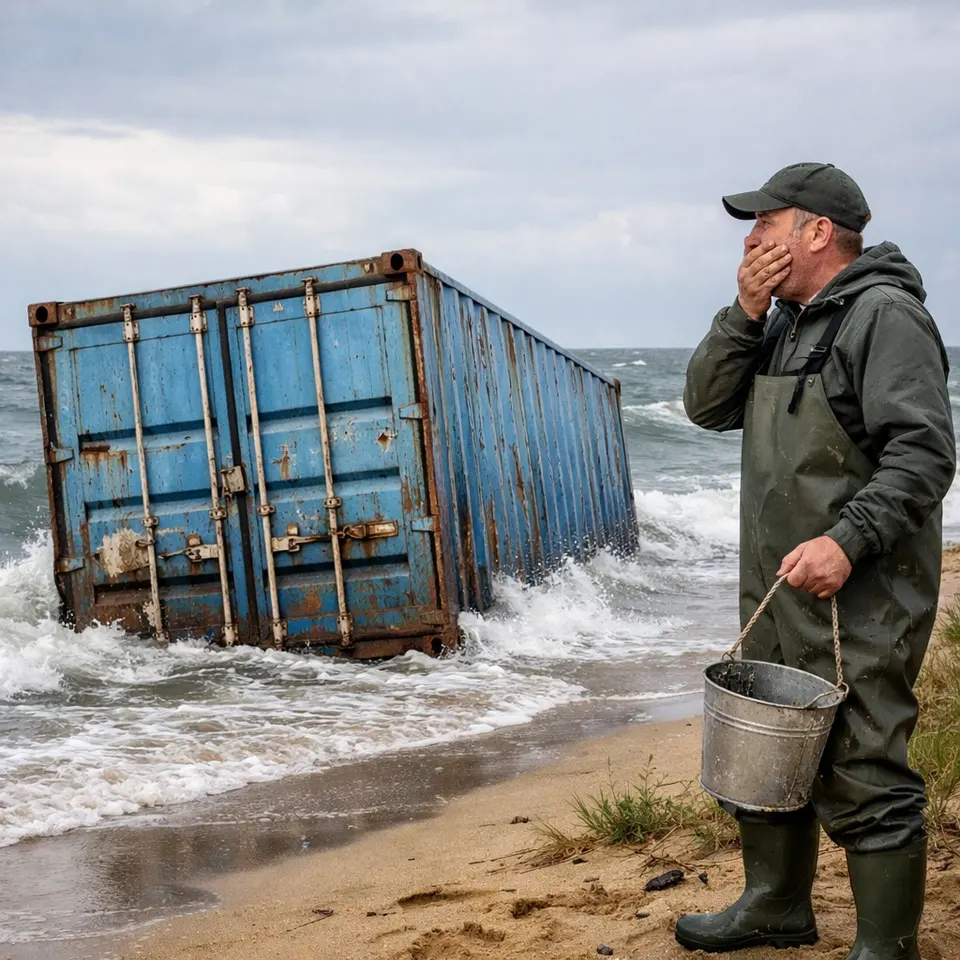
As the island came into view, Mike spotted something unusual on the northern shore. A metallic glint flashed between the gray rocks and tangled kelp. Through his binoculars, he could see a large, man-made object. Curiosity won out over caution. Navigating the rocks carefully, he dropped anchor and rowed his skiff to the beach. There, half-buried in the sand and gravel, sat a massive shipping container.
It was a standard 20-foot steel container, weighing about two tons empty and capable of holding nearly thirty tons of cargo. Rust bubbled under the paint, and the thick layer of barnacles suggested it had been adrift for a long time. It looked like it had been heaved onto the shore during the last big gale. “What are you doing out here?” Mike whispered, circling the metal box.
On the side, he could still make out the faded logo of Maersk, the Danish shipping giant. A serial number was partially visible: “MAMK-789.” The rest had been scrubbed away by salt and sand. Mike tried the heavy doors, but they were secured by a massive industrial padlock, seized shut by corrosion.
He headed back to the skiff for his tool kit. He grabbed a sledgehammer, a cold chisel, and a heavy-duty pry bar. As a fisherman, Mike was used to fixing things on the fly; his kit was a standard collection of "get-it-done" tools. It took nearly an hour of sweating and swearing in the cold air, but finally, the lock snapped. His heart hammered against his ribs as he hauled on the rusted handles.
The doors groaned open, revealing a dark interior that smelled of salt, old metal, and a strange, heavy sweetness. Inside, rows of wooden crates were neatly stacked and secured with heavy-duty nylon straps. The crates were made of high-quality plywood and looked remarkably well-preserved, thanks to the container’s airtight seal.
At first, it looked like mundane industrial cargo. But when Mike pried open the first crate, he froze. Inside, packed in vacuum-sealed bags, were thousands of long, dark pods. Even through the plastic, the aroma was overwhelming—rich, floral, and incredibly sweet. The pods were about six inches long, dark brown, almost oily to the touch.
It took a moment for it to click, but his gut told him this was a jackpot. Vanilla. Real vanilla beans are one of the most expensive spices on earth, second only to saffron. They come from a specific orchid that only grows in tropical climates like Madagascar or Tahiti. The process of growing and curing them is incredibly labor-intensive.
The flowers have to be hand-pollinated, the beans harvested by hand, and then fermented for months to develop that signature scent. On the global market, high-grade vanilla can fetch anywhere from $200 to $500 a pound. When Mike got home and showed a few pods to Susan, her eyes went wide. She’d seen the prices at the high-end bakery where she used to work. “Mike, this is real Madagascar Bourbon vanilla,” she breathed, inhaling the scent. “This is worth a fortune.”
“One pound of this goes for hundreds of dollars in the city,” she said. Mike felt a wave of vertigo. “If there are tons of this in that container, where did it come from?” Susan asked. “It belongs to someone. Should we call the Coast Guard?”
“Hold on,” Mike said, his pragmatic side taking over. “Let’s figure this out first. That container has been in the water for years. It might have been written off as a loss long ago.” Under maritime law, "finds" can be complicated. If property is truly abandoned or the owner is unknown, the finder can sometimes claim a significant portion of the value, but there are rules to follow.
The next day, Mike returned to the island with a flashlight. He counted 48 crates, each weighing about 100 pounds. A quick calculation made his head spin: nearly 5,000 pounds of vanilla. At a conservative market price, that was over a million dollars. But the joy was tempered by a growing sense of unease. A cargo this valuable doesn't just vanish without someone looking for it.
He photographed every marking. Some crates had French labels: *Vanilla Bourbon de Madagascar*. A week later, a stranger pulled into Fisher’s Cove in a blacked-out Chevy Suburban with out-of-state plates. The man, Victor Vance, introduced himself as a private investigator from Seattle. Vance was in his fifties, dressed in a sharp charcoal suit that looked out of place in a fishing village, with a pair of cold, observant eyes.
He spoke with a polite but firm tone. His business card read: *Victor Vance, Asset Recovery Specialist.* “I’m looking for lost property,” he told the locals at the diner. “Three years ago, during a storm, several containers were lost off the freighter *Northern Star*. One of them contained a very specific, very valuable shipment of spices.”
A major hurricane had indeed swept through the coast back in 2016, causing massive shipping losses. It was a plausible story. Vance went from dock to dock, offering a $10,000 reward for any information. He showed photos of a container that looked identical to the one Mike had found. Eventually, he found Mike at the marina. “Mr. Rollins?” Vance asked, leaning against the railing. “I hear you’re one of the few guys who still heads out to the outer islands. Seen anything unusual lately? Metal debris? Shipping crates?”
“Can’t say I have,” Mike lied, keeping his voice steady. “Mostly just driftwood and plastic trash these days.” Vance studied him for a long beat, then handed him a card. “If you remember anything, give me a call. The reward is very generous. Very.” There was a subtle edge to his voice. Mike noticed Vance’s eyes lingering on the *Hope*, as if calculating the boat’s range.
That night, Mike couldn't sleep. Susan was tossing and turning beside him. The house was drafty, and the furnace was making a rhythmic clanking sound that usually meant a $500 repair bill. “Mike, what if that guy is telling the truth?” she whispered. “What if we’re holding onto stolen property?”
“If it’s a legitimate claim, we’ll handle it,” Mike said. “But I want to make sure he’s not a shark first.” Mike knew that "salvage fraud" was a real thing. Scammers would track lost cargo manifests and then bully fishermen into giving up their finds for a fraction of the value. He needed professional advice.
The next morning, Mike drove to the county seat to see an old friend, Sam Peters, who worked for the Port Authority. They’d served in the Coast Guard together years ago. Sam was a straight shooter with access to the shipping databases. “Sam, I need a favor,” Mike said. “Can you check the manifest for a ship called the *Northern Star* from three years ago? Specifically, a lost container of vanilla.”
Sam spent an hour digging through the records. “Here’s the thing, Mike,” Sam said, leaning back. “The *Northern Star* did lose cargo, but it was mostly timber and industrial machinery. No vanilla. And this Vance guy? I’ve heard his name before. He’s been sniffing around ports from here to San Francisco. He doesn't represent any insurance company I know of.”
“So he’s a scavenger?” Mike asked. “Looks like it. He’s probably trying to jump a claim before the real owners—or the state—find out.” Mike felt a brief moment of relief, but it was short-lived. Sam continued: “But there *is* a missing container of vanilla in the system. It’s from five years ago, not three. And it didn't fall off a ship in a storm. It disappeared under... let's say, 'mysterious circumstances' in port.”
Two days later, another group arrived in town. These weren't guys in suits. They were three men in a beat-up Ford Transit. Their leader, a thick-necked man named Tony Russo, had a gold chain and a smile that didn't reach his eyes. He looked like a low-level enforcer for a regional trucking outfit. “We’re from Northwest Logistics,” he claimed. “Looking for our missing shipment. We’ve got the paperwork.”
Russo produced a folder of documents that looked official enough—bills of lading, insurance forms, customs declarations. They showed a shipment of 2.4 tons of vanilla from Madagascar to a distributor in Seattle. “If someone’s sitting on our cargo, that’s grand larceny,” Russo said, his voice dropping an octave. “And we don't like people stealing from us.”
His two companions were silent, but they were built like linebackers and wore heavy work boots. Mike realized he was caught in a pincer movement. Vance was a sophisticated con artist, but Russo looked like he was willing to use a crowbar to get what he wanted. Mike went back to Sam at the Port Authority.
“Check 'Northwest Logistics,'” Mike said. The answer came back quickly: the company had filed for bankruptcy two years ago and was currently under investigation for tax evasion. The documents Russo was carrying were likely forged or "borrowed" from the defunct company’s files. “Mike, this is getting heavy,” Sam warned. “Five years ago, that vanilla was part of a grey-market deal that went south. It was never officially reported as lost because the owners were dodging import duties.”
That evening, Mike sat his family down at the kitchen table. It was time for a serious talk. Susan had made a pot of coffee, and the kids were picking at some cookies. “Alex, Mia, I need you to listen,” Mike said. “Some people are in town asking questions. If anyone you don't know approaches you, you go straight to a teacher or come home. Understand?”
“Is it because of the 'treasure'?” Mia asked. Mike managed a small smile. “It’s not exactly gold, honey. It’s spice. But some people think it belongs to them.” He explained the situation to Susan in plain terms. Under US Maritime Law, if he reported the find to the authorities and no legitimate owner claimed it within a certain timeframe, he could be entitled to a "salvage award," which is usually a percentage of the value. But if the cargo was part of a criminal enterprise, the government might just seize the whole thing.
“I’m not going to let these thugs intimidate us,” Mike said. “But we have to play this smart.” He decided to do some digging of his own. He contacted his brother, Joe, who worked as a customs broker in Seattle. Joe had the connections to look into international shipping manifests that weren't available to the public. “Joe, I’ve got a container number: MAMK-789456. Can you tell me its real history?”
Joe called back a few days later. “Mike, you’ve stumbled into a mess. That container was logged in Brazil five years ago. On paper, it was full of coffee beans. But the insurance claim filed later—privately, mind you—was for high-grade vanilla. Someone was mislabeling the cargo to avoid the 20% import tariff. When the container 'disappeared' near the port, the owners couldn't go to the cops without admitting to customs fraud.”
“So, it’s 'ghost' cargo,” Mike realized. “Exactly. Legally, it doesn't exist. But the people who lost it know exactly what it’s worth.” This explained why Vance and Russo were circling like vultures. They were trying to recover a shipment that was never supposed to be there in the first place.
The pressure in Fisher’s Cove was reaching a boiling point. Vance was offering $50,000 now, trying to tempt a hungry fisherman into talking. Russo’s guys were more direct; they were spotted following Mike’s truck and hanging around the kids’ school. One evening, Russo’s associate, a guy with a faded anchor tattoo on his neck, cornered Mike at the marina.
“Listen, Rollins,” the guy said, leaning in close. “Tony’s a patient man, but he’s not *that* patient. We know you found it. Just give us the coordinates, take a 'finder’s fee,' and we all go home happy. Don't make this about your family.” The threat was thinly veiled. Mike felt a surge of anger, but he kept his cool. “I don't know what you’re talking about, but if you follow my kids again, we’re going to have a very different conversation.”
Susan was terrified. “Mike, let’s just tell them where it is. It’s not worth it.” But Mike was stubborn. He wasn't just fighting for the money anymore; he was fighting against the idea that these bullies could just walk into his town and take whatever they wanted. He needed a different kind of help.
He reached out to a journalist he’d met a few years back, Ellen Moore. She was an investigative reporter for a major regional paper, known for her "David vs. Goliath" stories. Mike met her at a quiet roadside diner twenty miles out of town. Ellen was sharp, professional, and immediately saw the potential in the story. “A fisherman finds a million-dollar 'ghost' shipment and gets squeezed by scammers? That’s front-page news, Mike.”
“I don't want to be a celebrity, Ellen. I want protection,” Mike said. “If this goes public, they can't touch me without the whole world watching.” Ellen agreed to help, but she had her own conditions. She wanted the full scoop. She used her sources in the FBI’s maritime crimes unit to vet Vance and Russo. It turned out Vance was a disgraced former insurance adjuster with a history of fraud, and Russo was linked to a regional smuggling ring.
“Here’s the plan,” Ellen said. “We go to a maritime attorney I know in Portland. We file a formal 'Notice of Salvage' in federal court. Once that’s on the record, the cargo is under the court’s jurisdiction. If Vance or Russo try anything, they’re interfering with a federal case.”
The attorney, Andrew Sullivan, was a specialist in the Law of the Sea. He was a tall, methodical man who didn't blink at the million-dollar figure. “Mr. Rollins, the law is actually quite clear here. Since the original owners committed fraud and the insurance has already been settled, the cargo is technically 'derelict.' You have a very strong claim for a significant salvage award—possibly the entire value of the goods.”
But the scammers weren't going down without a fight. Vance filed a counter-claim, using forged power-of-attorney documents from a shell company in Madagascar. Russo, realizing the legal route was closing, decided to take a more desperate approach. One night, Mike was woken by the sound of breaking glass. Someone had tossed a brick through his front window. Attached was a note: *Last chance.*
Mike didn't call the local sheriff—he called the FBI agent Ellen had introduced him to. The next day, Fisher’s Cove was crawling with federal agents. They picked up Russo and his crew at a local motel. It turned out they were wanted for a string of cargo thefts across the state. Vance, seeing the writing on the wall, skipped town before the feds could knock on his door.
With the immediate threat gone, the legal battle began in earnest. It took six months of hearings, depositions, and international inquiries. The court contacted the original Madagascar exporters, but they had gone out of business years ago. The insurance company, a major firm in London, confirmed they had paid out a claim for "lost coffee" and had no interest in pursuing a claim for "unreported vanilla."
The judge, a no-nonsense woman named Sarah Jenkins, presided over the final hearing. “This is a unique case,” she noted. “But the evidence is clear. The cargo was abandoned, the purported owners have no standing, and Mr. Rollins followed the legal procedure for salvage to the letter.” She ruled that Mike was entitled to 80% of the proceeds from the sale of the vanilla, with the remainder going to the state for administrative and storage costs.
The sale of the vanilla was handled by a specialty spice broker in San Francisco. The final tally was staggering: $1.2 million. After taxes and legal fees, Mike and Susan were left with nearly $800,000. It was more money than Mike would have made in twenty years of fishing. They paid off the house, set up college funds for Alex and Mia, and bought a new, reliable truck.
But Mike wasn't the type to just sit on a beach. He bought a new, state-of-the-art fishing vessel, but he also had a bigger idea. He’d learned a lot about the vanilla industry during the court case. He realized that with the right technology, he could bring a new industry to the coast. He partnered with a French agricultural firm to build the region’s first climate-controlled greenhouse dedicated to high-end spices.
“You’re going from fish to flowers?” his friends at the marina joked. “It’s still about working with your hands,” Mike would reply with a grin. The greenhouse project, *Ursus Spices*, became a major local employer. Mike hired several of the fishermen who had been struggling to make ends meet, giving them steady year-round work. Fisher’s Cove began to thrive again, not as a dying fishing village, but as a hub for specialty agriculture.
Susan opened her own bakery and cafe, *The Vanilla Bean*, which became a destination for tourists traveling the coast. Her signature vanilla cream puffs were famous across the state. Mike still went out on the water every chance he got, but now it was on his own terms. He’d often cruise past Ursus Island, looking at the spot where the rusted container had changed his life.
He knew he’d been lucky, but he also knew that luck was only half the battle. The other half was having the grit to stand your ground when the sharks started circling. As he steered his new boat back toward the harbor, the lights of Fisher’s Cove twinkling in the distance, Mike Rollins felt a deep sense of peace. The sea had finally given him the big catch he’d been looking for all his life—not in his nets, but in a rusted box on a rocky shore.



















Share how the story made you feel
0Comments appear after a quick automatic check. Please no links, ads or personal data.
Next to your name we show your country, determined from your IP address; the address itself is never shown, and only a hashed fingerprint of it is kept to stop spam.