
 Let’s Keep It Real
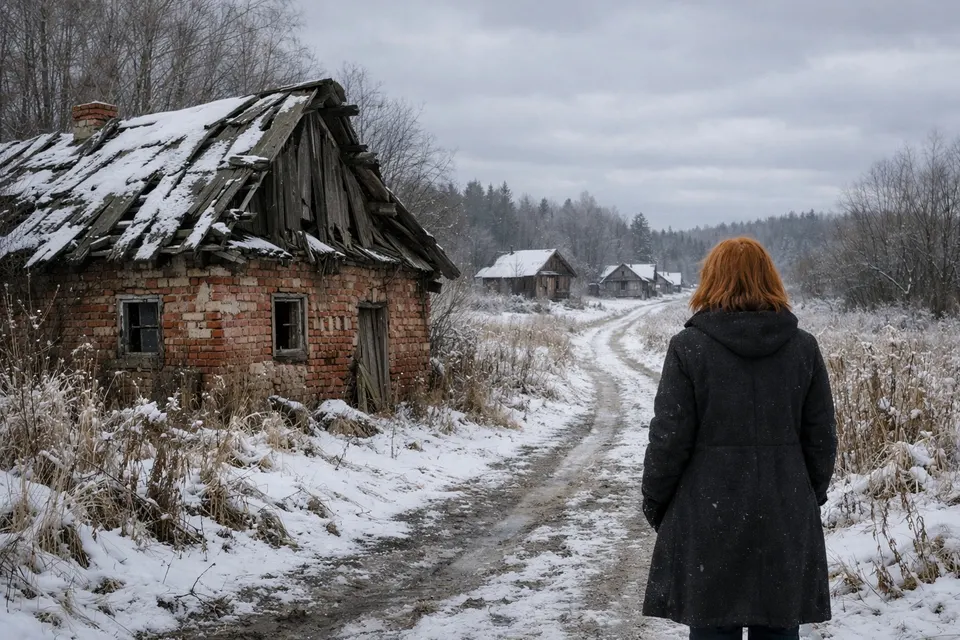
When her mother left her nothing but a lopsided cabin in the woods while her sister inherited a three-story Victorian mansion, Anna Miller just smiled. Her sister, Sarah, laughed out loud right there in the lawyer’s office. But what Anna discovered a year later would overturn everything they thought they knew about their family.
It all began on a cold October morning, under a gray, drizzling sky.
Eleanor Miller passed away quietly in her sleep at sixty-three. Her heart simply stopped, like an old clock that had finally run out of gears.
The funeral was a modest affair: twenty people gathered at the graveside. The two daughters stood side by side, yet a cold, invisible chasm stretched between them—the result of forty years of misunderstanding.
Anna held a simple bouquet of daisies. They were plain and white, the kind her mother always loved. She wore a black wool coat she’d owned for a decade. Her hair was pulled back in a neat bun, her face free of makeup. She didn't sob; she just watched the casket, her lips moving in a silent prayer.
Sarah arrived in a black Range Rover. She stepped out in a designer suit, her stilettos immediately sinking into the soft, muddy earth. she winced but kept her composure. She carried a massive wreath of deep red roses—expensive, ornate, and entirely out of place.
Sarah stood tall, chin up, eyes dry. She never cried in public; she considered it a sign of weakness.
As the casket was lowered, Anna dropped her daisies first. They landed softly on the wood. Sarah followed with her roses. The heavy wreath hit with a thud, scattering a few petals into the dirt.
“Rest well, Mom,” Anna whispered, so softly no one else heard.
Sarah said nothing. She turned and walked back to her car, her heels clicking on the paved path. She stopped at the gate and looked back.
“The attorney is expecting us in an hour. Downtown. You coming?” her voice was flat and businesslike.
Anna nodded.
“I’ll be there,” she replied quietly.
They drove separately. Anna in her aging Ford sedan that rattled at every stoplight, and Sarah in her luxury SUV, which overtook her sister before they even cleared the cemetery gates.
The attorney’s office was on the fifth floor of a glass-and-steel building downtown. It smelled of expensive leather and old paper. A man in his fifties sat behind a mahogany desk, a thick file open before him.
“Please, have a seat,” he said, gesturing to the two chairs. “Anna Miller and Sarah Miller, correct?”
“Yes,” Anna nodded.
“That’s us,” Sarah said, crossing her legs and leaning back.
The attorney opened the file and cleared his throat.
“The Last Will and Testament of Eleanor M. Miller. Executed March 15, 2023. Witnessed and notarized.”
He looked up at the sisters over his spectacles.
“To Sarah Miller, I bequeath the residential property located at 12 Garden Lane, including the three-story house, all outbuildings, and the surrounding half-acre lot. This includes all personal property within the home and the savings account ending in...”
Anna listened, her expression unchanged. Sarah allowed a small, triumphant smile to touch her lips. That Victorian house had been her dream since she was a girl. Her mother had always hinted it would be hers one day.
“To Anna Miller,” the attorney continued, “I bequeath the property located in Pine Ridge, 7 Forest Road, including the cabin and the surrounding five acres of woodland.”
Sarah snorted. She tried to cover her mouth, but a sharp laugh escaped anyway.
“The Pine Ridge shack?” she asked, incredulous. “That old dump?”
The attorney pressed his lips together and continued reading, ignoring the outburst.
“All personal property within the cabin goes to Anna. There is a note from the deceased: ‘I leave Sarah the house because she always dreamed of something grand and beautiful. I leave Anna the cabin because she appreciates the quiet of the woods. I hope, my girls, you understand my choice. Love, Mom.’”
Silence followed. Sarah looked at Anna, a smirk playing on her lips.
“Well,” she drawled slowly, “Mom always knew who belonged where. Honestly, Anna, it’s more than you deserve. A shack in the middle of nowhere. Have you even seen it since the fire?”
“What fire?” the attorney asked, frowning.
“A chimney fire about twenty years ago,” Sarah waved a hand dismissively. “Mom never really fixed it up. She always said she’d get to it ‘someday.’ Well, I guess ‘someday’ is finally here for you.”
She laughed again, a harsh, jagged sound. The attorney looked uncomfortable. Anna sat perfectly still, her hands folded in her lap. Her face was calm.
“I’ll sign whatever is necessary,” Anna said evenly.
Sarah stopped laughing and studied her sister suspiciously.
“You’re really not upset?” she asked, squinting.
Anna met her gaze. Her brown eyes were warm, just like their mother’s.
“Mom always had a reason for what she did,” she said softly. “I trusted her then, and I trust her now.”
Sarah made a face, as if she’d tasted something bitter.
“You were always the weird one,” she muttered, turning away.
The attorney handed over the documents. Both sisters signed. They were handed their keys. Sarah received a heavy ring with five keys and a designer fob. Anna received a single, tarnished brass key on a piece of twine.
They walked out in silence. At the sidewalk, Sarah stopped and turned.
“Look, don’t come asking me for help when the roof caves in. I got my share, you got yours. We’re even,” she said, her tone sharp.
“I understand,” Anna nodded.
Sarah climbed into her car and slammed the door. A moment later, the SUV roared away. Anna stood on the sidewalk, clutching the old key. For a second, a memory washed over her.
She was seven years old, sitting at the kitchen table doing homework. Her mom was at the stove, stirring a pot of soup. Sarah, the older, prettier sister, had burst in wearing a new dress, bragging about a boy at school. Her mother had smiled and patted Sarah’s head. But then she had walked over to Anna, sat down, and kissed the top of her head. “You’re my heart, Anna,” she had whispered so only Anna could hear. “My greatest joy.”
Anna blinked, returning to the present. She smiled through a sudden prickle of tears. She got into her old Ford, started the engine on the third try, and drove home to pack. She didn't feel cheated. She felt a strange sense of peace—a deep, unconditional trust that only exists between a mother and daughter, even when the daughter doesn't yet know the secret of her own life.
Pine Ridge was a two-hour drive from the city. The road wound through the mountains: first asphalt, then gravel, and the last few miles were just a dirt track through the hemlocks. Anna drove slowly, her car groaning over the ruts.
It was mid-October. The forest was a riot of orange and gold, smelling of pine needles and damp earth. Anna rolled down her window to breathe it in. This was the smell of her childhood. She and her mother used to come here to pick blackberries. Her mother had taught her how to track deer and which herbs could soothe a bee sting.
The "town" was just a handful of houses along a single road, most of them boarded up. Life had moved on from Pine Ridge years ago.
Anna stopped at a weathered sign: "Forest Road." She turned right, passed three empty lots, and finally saw it.
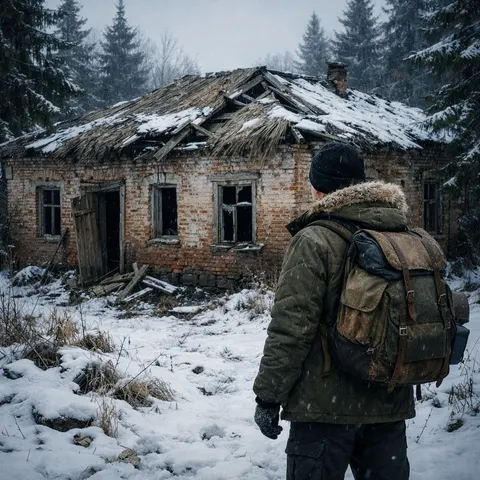
The cabin sat at the very end of the road, backed right up against the state forest. It was a small, log-built structure with a sagging porch. The windows were covered with plywood, and the yard was overgrown with waist-high weeds. The fence had long since rotted away.
Anna stepped out of the car. Sarah was right: after the chimney fire twenty years ago, their mother had only done the bare minimum. A few patches of shingles, some plywood. The house had been slowly surrendering to the woods ever since.
The gate groaned as she pushed it open. She walked up the porch steps—the wood flexed under her weight, but held. Suddenly, she heard a sharp, rhythmic bark.
A dog bounded from behind the cabin. It was a Husky mix, white and copper with a curled tail. It stopped ten feet away, barking not in anger, but in alert. Its tail was wagging furiously.
“Hey there, easy,” Anna said softly, crouching down. “Where did you come from?”
The dog stopped barking. It approached cautiously, sniffed her hand, and then licked her fingers. Its tail thumped against the tall grass.
“Who do you belong to?” Anna asked, scratching behind its ears.
The dog wore a worn leather collar with a small brass tag. Anna turned it over and read the name: “Scout.”
Her heart skipped a beat.
“Scout?” she whispered.
That was the name of the dog her mother had as a girl. Her mother used to tell stories about her first Scout, a dog that had once found her when she got lost in a blizzard. Eleanor always said a good dog was the best guardian a person could have.
Scout licked Anna’s hand again, then trotted to the front door. He sat on the porch and gave a short, expectant yelp.
“You want to show me something?” Anna guessed.
She followed the dog up the steps. She pulled out the brass key and slid it into the lock. It was stiff with rust, but with a firm twist, it clicked. The door creaked open.
Inside, the air was stale and smelled of dust. Anna used her phone’s flashlight to cut through the gloom. The beam hit a small living area—an old rug, a coat rack, a door to a bedroom. Scout walked inside with total confidence, leading her through the kitchen. In the corner of the kitchen floor was a wooden trapdoor with an iron ring.
Scout sat right next to the trapdoor and looked at Anna. He let out a soft whine.
“The cellar?” Anna asked.
She reached down and pulled the ring. The door was heavy, but it opened with a dull thud. A draft of cool, damp air rose from below. Anna shone her light down: wooden stairs, a dirt floor, and something white in the corner.
“What’s down there, boy?”
Scout gave a quiet bark, as if nudging her. Anna climbed down the stairs, the wood groaning under her boots. The cellar was small, maybe ten by ten. In the corner, under a dusty tarp, sat a metal box.
Anna knelt and pulled back the tarp. It was a heavy, vintage lockbox with an ornate latch. She hauled it up the stairs and into the kitchen light. Scout sniffed the box and wagged his tail, then leaned his warm weight against Anna’s leg.
“You knew, didn't you?” Anna whispered, petting the dog. “Did Mom leave you here to wait for me?”
Scout rested his head on his paws, watching her with intelligent eyes.
Anna tried the latch. It was stuck, but she found a screwdriver in a kitchen drawer and pried it open. The lock snapped. As she lifted the lid, something glinted in the dim light. Anna froze. She slowly opened it all the way.
The box was filled with jewelry. Gold chains, heavy bracelets, rings set with deep green emeralds. There was a floral brooch encrusted with small diamonds and a stack of old gold coins. It was an antique collection that looked like it belonged in a museum. It was worth a fortune.
“Oh my god,” Anna breathed. Her hands shook. She picked up a necklace and held it to the light. 18-karat gold. Real stones.
Suddenly, a memory hit her. She was fifteen, sitting at the kitchen table. She had been complaining that the other girls had designer clothes and new phones, while she had hand-me-downs. Her mother had taken her hand. “Anna,” she had said quietly, “real wealth isn't in what you show the world. It’s in what you keep in your heart—and what you save for when it truly matters. Remember that.”
Anna blinked back tears. She looked at the box of gold, then at the dilapidated shack around her. She looked at Scout, who was watching her with such devotion. She realized this was her mother’s final lesson. Not just money, but a chance. A way to build a life on her own terms.
“Thank you, Mom,” Anna whispered. “Thank you.”
Scout whined softly and licked her hand. Anna hugged the dog, burying her face in his thick fur. She sat there for a long time until her heart stopped racing.
Then, she noticed something else. Tucked under the jewelry was a plain white envelope. On the front, in her mother’s elegant cursive, it said: “For Anna. Read this when you are ready.”
Anna pulled the envelope out. It felt heavy, containing several sheets of paper. But she didn't open it. Not yet. Something told her that whatever was inside would change her world forever, and she needed to be ready. She put the envelope back in the box and closed the lid. She stood up and brushed the dust off her jeans.
“Come on, Scout,” she said. “Show me where you sleep.”
The dog bounded toward the door. He led her outside to an old shed where a sturdy doghouse had been built. Inside was a warm wool blanket and a clean water bowl.
“This is your spot?” Anna asked. Scout wagged his tail. “Well, it’s our spot now,” she said softly. “You and me. Deal?”
Scout barked happily. And for the first time since her mother’s funeral, Anna felt a genuine spark of joy. She wasn't alone. Her mother had left her more than a house and gold; she had left her a guardian. Someone to stand by her through the quiet days ahead.
Anna didn't open the letter for three days. The lockbox sat on the kitchen table. Anna walked past it, glanced at it, but didn't touch it. She was afraid—not of the letter itself, but of how it might shift her reality. Her mother’s words always had a way of changing things deep inside her.
She spent those three days cleaning. She pried the plywood off the windows, letting the autumn sun flood the rooms. She scrubbed the floors and polished the wood. She lit the old cast-iron stove, and soon the cabin smelled of woodsmoke and cedar. Scout never left her side. He slept on the rug while she worked and followed her every step outside. He seemed to know she needed the company.
On the fourth day, a cold rain began to fall. Anna sat by the stove, drinking tea from an old ceramic mug. She watched the raindrops race down the glass. Scout lay at her feet, his head on his paws. Anna knew it was time.
She walked to the table, took the envelope, and returned to the warmth of the stove. She sat on the floor, leaning her back against the warm bricks. She tore open the envelope. There were three pages, covered in her mother’s neat, familiar handwriting.
“My dearest Anna,” the letter began. Anna swallowed hard and read on. “If you are reading this, it means I am gone. I’m sorry I didn't tell you this while I was alive. I was afraid. But you deserve the truth. Anna, you are not my biological daughter. Your father and I adopted you when you were only three days old. Your birth mother was a young girl, only eighteen, who died from complications during childbirth. She was alone, with no family to claim you. I was in the hospital at the same time, recovering from my third miscarriage. The doctors told me I wouldn't be able to carry a child to term. I was heartbroken, sitting in that ward, thinking I’d never be a mother again. Then a nurse told me about a baby girl in the next room who had no one. She asked if I wanted to hold you, just for a minute. I took you in my arms, looked into your big brown eyes, and that was it. I knew you were mine.”
Anna stopped. She wiped her eyes with the back of her hand. Scout looked up and let out a soft whine. Anna patted him and continued.
“I told your father: this is our daughter. He was hesitant at first, but once he saw you, he couldn't say no. We finalized the adoption two months later. Sarah was only two at the time; she never knew. To her, you were just her little sister. I never saw a reason to tell her. But I always saw the difference in you. Not in how much I loved you—I loved you both with everything I had. But Sarah was like me, fiery and stubborn. You were different. Quiet, observant, kind beyond measure. I used to wonder what your birth mother was like to have a daughter like you. I was grateful every single day that you were mine. Real family isn't about blood, Anna. It’s about the heart. And my heart beat for you from the moment I held you.”
Anna couldn't stop the tears now. They were hot and fast, but they weren't tears of grief. They were tears of profound gratitude.
“Thank you, Mom,” she whispered. “Thank you for choosing me.”
Scout stood up and rested his chin on her knee. Anna hugged him, burying her face in his fur until she composed herself. Then she picked up the letter again.
“I left you this cabin for a reason. This forest is where I found peace when life got hard. I want you to find that same peace. The jewelry in the box belonged to my grandmother. It’s yours now. Sell what you need to fix the house and live comfortably. This is my last gift to you. I’m sorry I kept the secret, but I never wanted you to feel like an outsider. You were never an outsider. You were my joy. My Anna. I love you. Always. Mom.”
Anna folded the letter and pressed it to her chest. She sat there for a long time, listening to the crackle of the fire and the rhythm of the rain. Scout dozed beside her, warm and steady.
Now she knew. She wasn't unwanted. She wasn't abandoned. She had been chosen. Claimed. Loved.
“I’m your daughter, Mom,” Anna whispered into the quiet room. “And I always will be.”
Scout gave a soft, affirmative woof.
Anna looked out the window. The rain had stopped, and a sliver of sun was breaking through the clouds, lighting up the wet woods. A new life was starting. She didn't know what she would do next—whether she’d tell Sarah or keep the secret. But that could wait. For now, she just wanted to sit by the fire with her mother’s words and her dog, soaking in the feeling of being exactly where she was meant to be.
A week later, Anna drove back into the city. She took half of the jewelry from the box—three gold chains, an emerald bracelet, and the gold coins. The rest she tucked back into the lockbox and hid securely beneath the floorboards in the cellar.
She went to a reputable antique jeweler downtown. The owner, a man in his sixties with thick glasses, spent a long time examining the pieces through a loupe. He kept shaking his head in disbelief.
“These are museum-quality,” he muttered. “Where did you get these?”
“They were an inheritance,” Anna said simply.
He weighed the gold, checked the stones, and made some notes in a ledger.
“I can offer you a hundred and eighty thousand dollars for the lot.”
“Is that a fair price?”
“It’s a very fair price,” he said, taking off his glasses. “I’ll have the wire transfer ready by this afternoon.”
Anna nodded. She didn't want to haggle. She just wanted enough to fix the cabin and have a safety net. She left the shop with a sense of relief. On her way back to Pine Ridge, she stopped at a home improvement store. She bought lumber, roofing shingles, paint, and tools. She hired a local contractor to help with the heavy lifting, and they spent the next month transforming the shack.
Scout was her constant supervisor, wagging his tail as the new roof went up and the porch was reinforced.
“We’re building a home, Scout,” Anna told him. “A real home.”
Scout barked in agreement.
The work was grueling. Anna was there every day, sanding wood, painting trim, and planting a small garden. Her hands grew calloused, and her back ached, but she felt more alive than she ever had in the city. The cabin began to glow—painted a soft sage green with cream-colored shutters. The sagging porch was now a sturdy deck where she could sit and watch the sunset.
One afternoon, she dropped her hammer while working on the fence. It disappeared into the tall grass. She searched for ten minutes before giving up. A moment later, Scout trotted over with the hammer in his mouth, looking very proud of himself.
“Good boy!” Anna laughed, taking the tool. “You’re the best assistant I’ve ever had.”
By the time the first frost hit in November, the cabin was finished. It was cozy, warm, and beautiful. Anna had bought a few pieces of simple, sturdy furniture and hung a framed photo of her mother on the wall.
“We did it, Mom,” Anna whispered to the photo. “It’s perfect.”
Meanwhile, back in the city, Sarah Miller was standing in the middle of her grand Victorian living room, staring at a massive water stain on the ceiling. The roof was leaking. The foundation was settling, causing cracks in the plaster. The "mansion" was becoming a nightmare.
Sarah was drowning. She had three credit cards at their limits, a massive loan on her Range Rover, and a mortgage on a condo she was trying to flip that wouldn't sell. She was spending $5,000 a month just on interest. She had no money for repairs.
“When I sell this place,” she told herself, “I’ll be fine. I’ll pay it all off.”
But the house sat on the market for months. Prospective buyers walked through, saw the structural issues, and walked right back out. The real estate agent told her she’d have to drop the price by a hundred thousand just to get an offer.
“No,” Sarah snapped. “It’s worth more than that. I’m not giving it away.”
One day in early December, Sarah ran into an old family friend, Mrs. Gable, at the grocery store. Mrs. Gable lived near Pine Ridge.
“Oh, Sarah! Have you seen what Anna did to that old cabin?” the woman chirped. “It’s absolutely darling. She’s fixed it up like something out of a magazine. New roof, beautiful garden... I heard she even bought a brand new truck.”
Sarah froze. “A new truck? Anna?”
“Oh yes. And she looks so happy. I wondered where she got the money, honestly. I thought she was just a nurse.”
Sarah’s blood began to boil. Anna? The quiet sister? The one with the "shack"? How could she afford a total renovation and a new vehicle? Sarah pulled out her phone and looked at the photos Mrs. Gable had taken. The cabin looked stunning. It looked... expensive.
“I’m going to find out what’s going on,” Sarah hissed to herself as she walked to her car. “She must have stolen something. Mom must have hidden money there, and Anna kept it all for herself.”
The jealousy was a physical weight in her chest. She called her lawyer that afternoon.
“I want to challenge the will,” she told him. “I think my sister withheld assets from the estate. I want an investigation.”
Sarah drove to Pine Ridge the following Tuesday. She didn't call ahead. She pulled her Range Rover up to the new fence and stepped out, looking like she was ready for a fight. Anna was on the porch, wearing a flannel shirt and jeans, brushing Scout.
“Sarah? What are you doing here?” Anna asked, surprised.
Sarah didn't bother with pleasantries. She walked right up to the porch. “Where did you get the money, Anna? The roof, the paint, the truck... don’t lie to me. You found something in this house, didn't you?”
Anna stood up slowly. “Mom left me this house, Sarah. Whatever was in it belongs to me. That was the will.”
“The will assumed an equal distribution of value!” Sarah shouted. “If there was a hidden stash of cash or jewelry, that’s part of the estate. You owe me half!”
Scout stood up and let out a low, warning growl. He stepped between Anna and Sarah, his eyes fixed on the intruder.
“Easy, Scout,” Anna said, but she didn't back down. “I didn't steal anything. Mom gave me what she wanted me to have. Just like she gave you the mansion.”
“The mansion is a ruin!” Sarah screamed. “It’s costing me a fortune! You got the better deal, and you knew it!”
“I didn't know anything, Sarah. I just trusted Mom.”
“Well, I don’t trust you,” Sarah spat. “My lawyer is already looking into this. And he found something else, Anna. Something you probably didn't even know.”
Anna felt a chill. “What are you talking about?”
Sarah smirked, a cruel, triumphant look. “He went through the old records. You’re not even a Miller, Anna. You were adopted. You’re not blood. You have no legal right to any of this.”
Anna’s heart hammered against her ribs, but she kept her voice steady. “I know I’m adopted, Sarah. Mom left me a letter. She told me everything.”
Sarah’s face fell for a split second, then hardened again. “It doesn't matter. A judge will see it differently when I show them you’ve been hiding assets. I’m taking this house, Anna. I’m taking everything.”
She turned and stormed back to her car. Anna watched her go, her hand resting on Scout’s head. She felt a wave of sadness, not for herself, but for her sister. Sarah was so consumed by greed and debt that she couldn't see the gift she’d already been given.
But Anna remembered the rest of the letter. The part she hadn't told Sarah. The part that explained why Sarah got the mansion in the first place.
The legal battle lasted three months. Sarah’s lawyer tried everything to prove Anna had defrauded the estate. They dug into Anna’s bank accounts and the jeweler’s records. But everything was ironclad. The jewelry had been a specific bequest to "the occupant of the Pine Ridge property," a clever loophole Eleanor had inserted to ensure Anna was taken care of without Sarah knowing.
Finally, the day came for the final hearing. Sarah sat on one side of the courtroom, looking haggard. Her Range Rover had been repossessed, and she was wearing an old suit that didn't fit quite right. Anna sat on the other side, calm and composed.
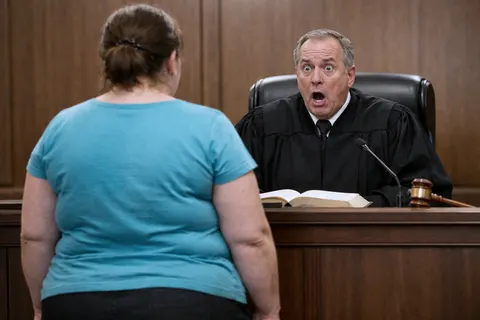
The judge looked over the documents one last time. “The court finds no evidence of wrongdoing. The will is clear. The Pine Ridge property and its contents belong to Anna Miller. The Garden Lane property belongs to Sarah Miller. Case dismissed.”
Sarah slumped in her chair. She looked like she was about to break. Anna stood up and walked over to her sister.
“Sarah? Can we talk? Just us?”
Sarah looked up, her eyes red. “What do you want? To gloat?”
“No. I want to show you the rest of the letter.”
They went to a small coffee shop nearby. Anna pulled out the final page of her mother’s letter, the part she’d kept hidden. She pushed it across the table.
“Read it,” Anna said softly.
Sarah took the paper. Her hands were shaking.
“Sarah,” the letter read. “I know about the debts. I know you’ve been struggling to keep up appearances. I didn't give you the mansion because I thought you were the ‘favorite.’ I gave it to you because it’s worth half a million dollars. I wanted you to sell it. I wanted you to pay off your loans and start over, free from the pressure of trying to be someone you’re not. I knew Anna would be happy in the cabin, and I knew the jewelry would give her enough to fix it. But you... you needed a clean slate. Please, Sarah, stop fighting your sister and start living your life. I love you. Mom.”
Sarah stared at the paper. A single tear fell, smudging the ink. “She knew?” she whispered. “She knew I was failing?”
“She loved you, Sarah,” Anna said. “She wanted to save you, but she knew you were too proud to ask for help. The house was her way of giving you a way out.”
Sarah put her head in her hands and finally, for the first time in years, she sobbed. Not the calculated cry of a victim, but the raw, honest grief of a daughter who realized she’d been loved all along.
“I’ve been such a fool,” Sarah choked out. “I spent all my money on lawyers trying to take what you had, when I already had everything I needed.”
Anna reached across the table and took her sister’s hand. “It’s not too late. Sell the house, Sarah. Pay the debts. Come stay with me at the cabin for a while. We can figure out what’s next together.”
Sarah looked at her sister, truly seeing her for the first time. “You’d let me stay? After everything I said? After I told you that you weren't a real Miller?”
Anna smiled. “Mom said family is about the heart, not the blood. And my heart says you’re my sister.”
Sarah sold the Victorian mansion a month later. After the repairs and the commissions, she walked away with three hundred thousand dollars. It was enough to pay off every cent of her debt and still have a significant nest egg. She moved into the cabin’s guest room for the summer.
She learned how to garden. She learned how to chop wood. And she learned how to play with Scout, who eventually decided she wasn't so bad after all.
One evening, the two sisters sat on the porch, watching the fireflies dance in the woods. The air was cool and smelled of pine.
“You know,” Sarah said, sipping a glass of iced tea. “Mom was right. This place is better than any mansion.”
Anna leaned back in her chair, Scout resting his head on her feet. “She always did know best.”




Share how the story made you feel
0Comments appear after a quick automatic check. Please no links, ads or personal data.
Next to your name we show your country, determined from your IP address; the address itself is never shown, and only a hashed fingerprint of it is kept to stop spam.