
 Let’s Keep It Real
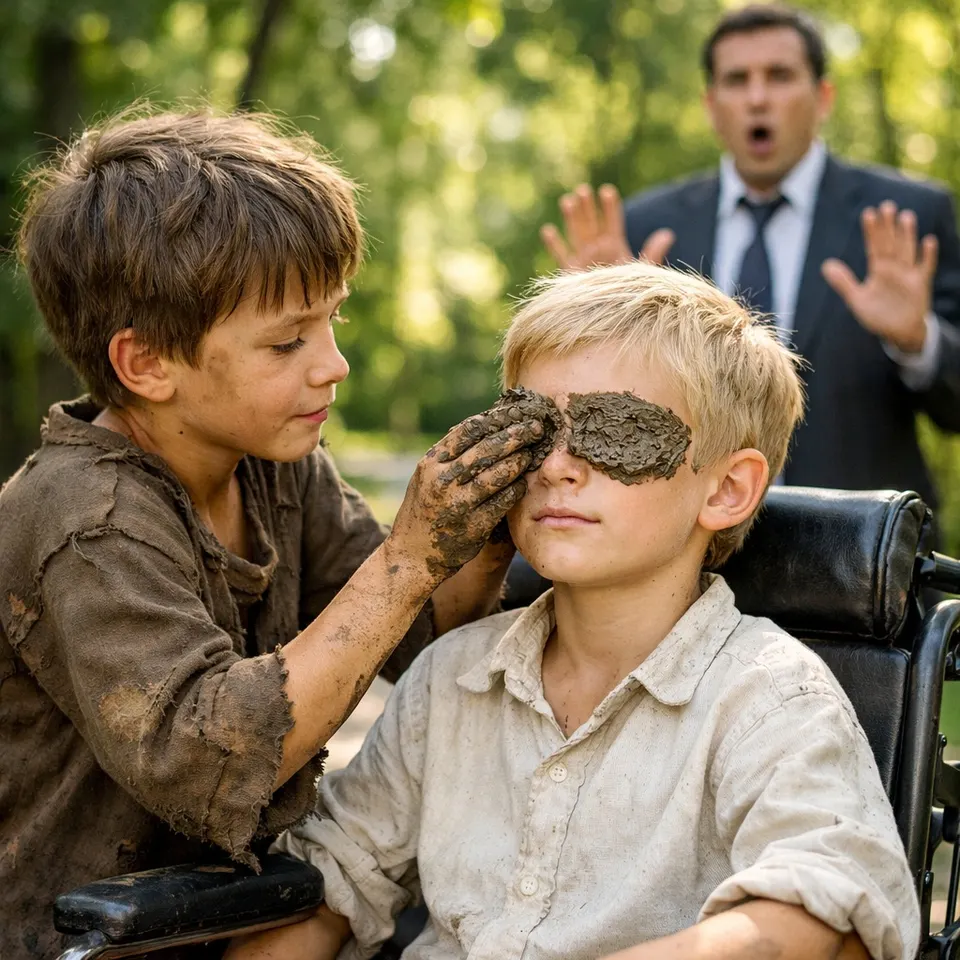
— "I’m going to put mud on your eyes," the boy said. A moment later, something shifted that changed everything.
Andrew Walker never expected a Sunday afternoon at the park to redefine his family's future. It had been two years since the accident that took his son’s sight. Andrew had grown used to the sympathetic glances and the hushed whispers of strangers as he pushed the wheelchair along the paved paths. That was when the kid—disheveled, barefoot, and looking like he’d spent the day in the woods—approached them without a hint of hesitation.
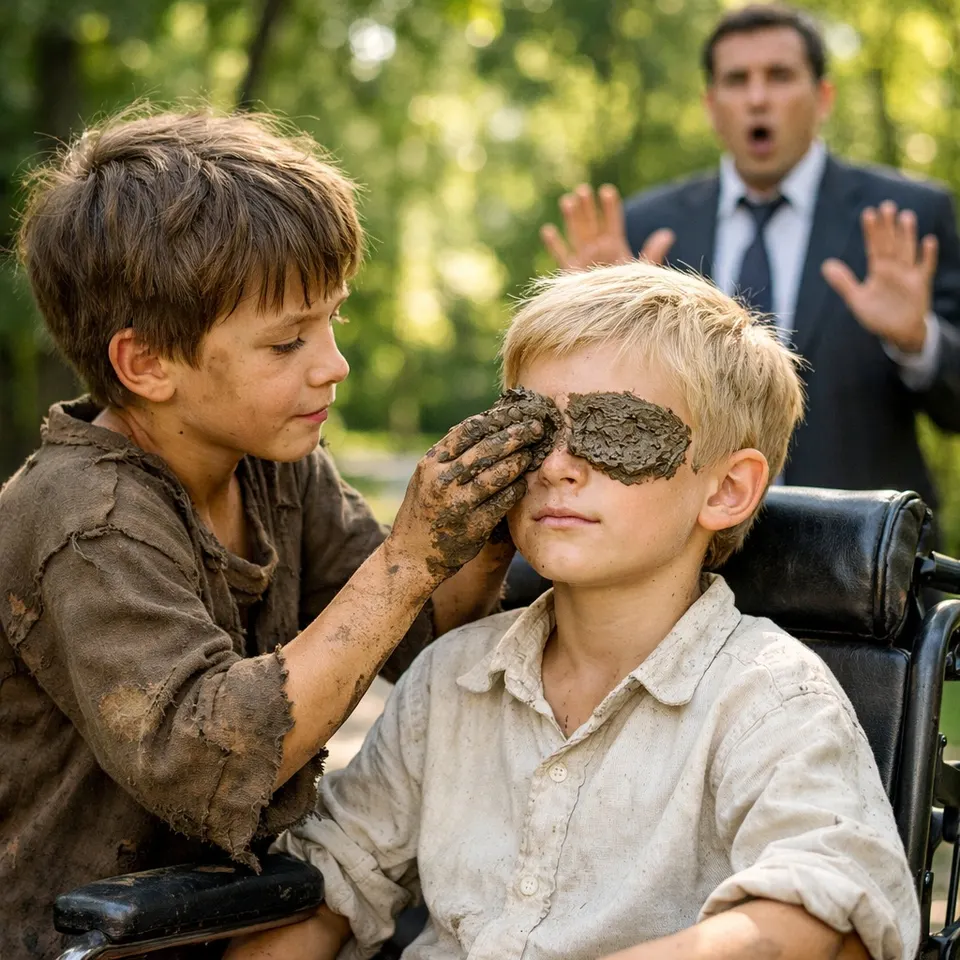
— "I’m going to put mud on your face," the boy repeated, looking directly at Matthew, Andrew’s eight-year-old son, whose pale blue eyes were fixed on nothingness.
Andrew felt his protective instincts kick in. Who was this kid? How did he think he could just walk up and say something like that? He instinctively placed a firm hand on Matthew’s shoulder.
— "Excuse me?" Andrew asked, his voice tight and controlled.
The boy didn’t flinch. His dark eyes held a level of steady resolve that seemed far beyond his years—maybe ten or eleven.
— "My grandmother always said the earth heals. She used it for people who couldn't see well," the boy said, gesturing toward Matthew. "He needs the special clay. I know where to find it."
Andrew looked around. The park was busy for a Sunday—families on the playground, joggers, couples on benches. Everything was perfectly normal, except for this surreal conversation.
— "Look, kid, I don't know who you are, but..."
— "Dad!" Matthew interrupted, turning his head toward the sound of the stranger's voice.
It was the first time in months Andrew had seen his son show a spark of genuine interest in anything.
— "Who is he?"
The boy crouched down next to the wheelchair, bringing himself to Matthew’s eye level.
— "My name is Sam."
— "Is your grandmother still around?" Matthew asked.
Sam shook his head, a brief shadow of grief crossing his face.
— "She passed away last month. But before she went, she taught me a lot. About plants, about the earth, and how to help people who are hurting."
Andrew felt a pang of sympathy. The boy spoke with a sincerity that was hard to dismiss, even if the premise sounded like something out of a folk tale.
— "Sam, right? Listen, I appreciate the thought, but my son has a serious medical condition. He lost his sight two years ago. We’ve seen the best specialists in the country. This isn't something a little dirt can fix."
Sam stood up but kept his focus on Matthew.
— "Did the doctors say there was no cure?" he asked quietly.
Andrew hesitated. The truth was, the doctors had never been able to fully explain it. After the car accident, Matthew had been in a coma for a week. When he woke up, he was blind. Yet, every test showed his eyes and brain were physically intact. It was as if his mind had simply pulled the shades shut.
— "It’s complicated," Andrew replied, unwilling to get into the details with a stranger.
— "Dad, I want to try," Matthew said suddenly, his voice clearer than it had been in weeks.
— "Matthew, buddy, you don't even know what he's talking about."
— "I know I haven't seen anything in a long time. And I know you're sad about it, even when you try to hide it." Matthew reached out toward Sam. "Can I feel your face?"
Sam stepped closer, letting Matthew’s small hands trace his features. Andrew watched, a mix of anxiety and curiosity gnawing at him. Matthew had become so withdrawn since the accident; seeing him reach out to another child was a rare sight.
— "Your hands smell like rain and dirt," Matthew said with the faint trace of a smile.
— "That’s because I was digging by the creek. There’s a specific kind of clay there. My grandmother said that earth has a way of drawing things out because it’s fed by the mountain springs."
Sam spoke with the natural confidence of someone raised on old-world wisdom. Andrew shook his head. This was getting ridiculous. He was a successful tech executive with an engineering degree. He shouldn't be standing here listening to stories about magic mud.
— "Alright, that’s enough. Sam, it was nice meeting you, but we have to get going."
— "Dad, wait!" Matthew gripped his father’s hand tighter than usual. "Please. Just once. What’s the worst that could happen?"
Andrew looked at his son. Matthew rarely asked for anything anymore. Since the accident, he’d become a "perfect" patient—quiet, obedient, and hollow. Seeing a flash of will return to him was both heartening and terrifying.
— "Matthew, I know you’re looking for hope, but this isn't scientific. Mud doesn't cure blindness."
— "My grandmother helped three people this way," Sam insisted. "One was a girl who lost her sight after a terrible fright. The doctors couldn't explain it, but after a few sessions with the clay, she started seeing again."
Andrew was about to shut it down when he heard a familiar voice behind him.
— "Andrew? What’s going on?"
He turned to see Karen, his wife, approaching with a couple of grocery bags. She’d run a few errands while he took Matthew to the park, their usual Sunday routine.
— "Hey, honey. This is Sam. He was just talking to Matthew."
Karen looked Sam over—the worn clothes, the bare feet. Her expression shifted to one of guarded concern.
— "Talking about what?"
Sam, sensing the tension, took a step back.
— "I just wanted to help. I think I can help him see again."
Karen gave a dry, humorless laugh.
— "Is that so? And how exactly do you plan on doing that?"
— "With clay from the mountain. My grandmother taught me."
— "Your grandmother?" Karen looked at Andrew with a 'are you kidding me?' expression. "Andrew, please tell me you aren't taking this seriously."
— "Of course not. I was just..."
— "I want to try, Mom," Matthew interrupted.
Karen knelt beside her son’s chair, her voice softening.
— "Matthew, honey, I know you want to get better. We all do. But that’s not how medicine works. We have to trust the doctors, not..." She glanced back at Sam.
— "But Mom, what if it’s true? What if it works?"
Karen sighed and stood up, looking at Andrew.
— "We’re going home now."
Andrew felt torn. Part of him agreed with Karen—it was absurd. But another part of him, the part that had been grieving for two years, wondered: *What if?*
— "Sam," Andrew said, stopping the boy as he started to walk away. "Where do you live?"
— "Down on the South Side, near the old market. Sometimes I stay at the shelter at the church when my aunt’s place is too full."
Andrew nodded. He knew the area. It was a rough part of town.
— "And this grandmother of yours... she really helped people?"
— "Andrew!" Karen hissed.
— "It’s just a question, Karen."
— "Yes, sir. Everyone knew Mrs. Rose. She never charged a dime. She said her gift was for helping people."
— "And she taught you how to do it?"
Sam nodded enthusiastically.
— "She said I had the right hands for it. That I could feel where the pain was hidden."
Andrew looked at Matthew, who was listening with rapt attention. It was the most engaged he’d been in years.
— "Karen, maybe we could..."
— "No. Don't even think about it." Karen’s voice was firm. "We are going home, and I am not discussing this in public."
She started to push Matthew’s chair, but he grabbed the wheels, stopping her.
— "Dad, please. Just once. If it doesn't work, I promise I won't ask again."
Andrew looked at his son, then at Sam, then at Karen. The tension was thick.
— "Sam," Andrew said finally. "Where exactly do you get this clay?"
— "Andrew!" Karen protested again.
— "It’s just a question, Karen."
Sam pointed toward the foothills bordering the city.
— "There’s a trail that leads to a spring. It’s about a twenty-minute hike from here. My grandmother always went at sunrise."
— "And you go there alone?"
— "Yes, sir. Since she passed, I’ve been looking after a few folks in the neighborhood. Nothing big, just back pain and stuff. But I’ve never tried to help someone who couldn't see."
Andrew made a decision that surprised even himself.
— "Alright. How about you come by our house tomorrow? We can talk about it properly."
— "Andrew, have you lost your mind?" Karen whispered, though loud enough for everyone to hear.
— "Karen, we have a big yard. If he wants to try something, at least it’ll be in a controlled environment. And if it doesn't work, Matthew will know we tried."
Sam smiled for the first time.
— "You’d really let me try?"
— "We’ll talk tomorrow. Do you know where Oak Street is?"
Sam shook his head.
— "It’s in the Heights. Number 47. Big house with the black gate."
— "I’ll find it."
— "Two o'clock tomorrow, then."
Matthew beamed. Karen, however, was visibly fuming.
— "See you tomorrow, Matthew," Sam said, lightly touching the boy’s shoulder. "Take care."
— "Bye, Sam. Thank you."
As they walked to the car, Andrew felt the weight of Karen’s silence. She buckled Matthew in with more force than necessary.
— "Andrew, I hope you know what you’re doing," she said finally as they pulled out of the parking lot.
— "I hope so too," Andrew muttered.
On the way home, Matthew was more talkative than he’d been in months. He asked about the park, the sounds he’d heard, the way Sam’s voice sounded. It was as if something inside him had woken up. Karen remained silent the whole way. Andrew knew he was in for a long night.
When they got home—a beautiful two-story house in a quiet cul-de-sac—Andrew helped Matthew inside while Karen went straight to the kitchen, leaving the groceries on the counter.
— "Dad," Matthew said as Andrew helped him out of his jacket. "Do you really think Sam can help me?"
Andrew paused. It was the million-dollar question.
— "Buddy, I don't know. I really don't. But I know that you look happier today than you have in a long time. And that means something to me."
— "I liked him. He talks differently than other people."
— "How so?"
— "He doesn't sound sorry for me. He talks to me like I’m just a regular kid."
Andrew felt a lump in his throat. He sometimes forgot how observant Matthew was, even without his sight.
— "You *are* a regular kid, Matthew. You’re my son, and you’re perfect exactly as you are."
— "I know, Dad. But it would be nice to see your face again."
That night, Andrew barely slept. He lay there wondering if he was doing the right thing. Rationally, it was nonsense. But emotionally, seeing Matthew’s hope was priceless. Karen was on the other side of the bed, clearly awake but pretending to sleep. He knew she was angry. Around 2:00 AM, he got up and checked on Matthew. The boy was sleeping soundly with a faint smile on his face. Andrew hadn't seen him that peaceful in years.
The next morning, Andrew was in the kitchen early. Karen was already there, nursing a cup of coffee in silence.
— "Morning," he said, trying to keep things light.
— "Morning."
The silence stretched as Andrew made his own coffee. Finally, Karen spoke.
— "Andrew, we need to talk about yesterday."
— "I figured."
— "Are you really going to let this kid perform some kind of ritual on our son?"
Andrew turned to face her.
— "Karen, what are you actually afraid of? That he’ll hurt Matthew? That he’ll make things worse? Or that he’ll prove we gave up too soon?"
— "I’m afraid you’re giving Matthew false hope. He’s been through enough."
— "And you don't think he has a right to choose? He’s asking for a chance."
— "He’s a child. Children don't always know what’s best for them."
Andrew sighed. This was the same argument they’d been having in different forms for two years.
— "Karen, I’m not saying I believe in miracles. I’m saying that for the first time in two years, our son is interested in the world again. Doesn't that count for something?"
Karen was quiet for a long moment.
— "Andrew, I just... I can't watch him get his heart broken again. I’m scared this will just lead to more pain."
Andrew walked over and took her hands.
— "I get it. But what if we don't try, and Matthew spends the rest of his life wondering 'what if'? I couldn't live with that."
Before Karen could respond, they heard Matthew calling from upstairs.
— "Dad! Mom! Is Sam here yet?"
Andrew checked his watch. It was only 9:00 AM.
— "Not yet, buddy. He’s coming at two."
— "Can I come down for breakfast?"
— "Of course."
As Andrew went to help Matthew, Karen stayed in the kitchen, clearly wrestling with her feelings. The morning dragged on. Matthew was restless, asking a dozen questions about Sam. Andrew tried to manage expectations, explaining that nothing might happen and that it was important not to get his hopes too high.
At exactly 2:00 PM, the doorbell rang. Andrew opened it to find Sam standing at the gate. The boy had clearly tried to clean himself up. His clothes were still simple and patched, but they were fresh. He was carrying a small canvas bag.
— "Good afternoon, Mr. Walker. I’m on time."
— "Yes, you are, Sam. Come on in."
Sam looked around as they walked up the driveway. It was obvious he’d never been in a neighborhood like this. His eyes took in the manicured lawn and the impressive facade of the house.
— "Wow, this place is huge," he said, without a trace of envy.
— "We’ve lived here about ten years," Andrew explained, trying not to sound pretentious.
When they entered the living room, Matthew was already waiting on the sofa with Karen beside him. The tension was palpable.
— "Hey, Matthew!" Sam said enthusiastically.
— "Hi, Sam. I’ve been waiting all morning."
Sam walked over and, without asking, sat on the floor next to the sofa, bringing himself to Matthew’s level.
— "How’d you sleep? Have any good dreams?"
— "Yeah. I dreamed I was running on the beach. It’s been a long time since I dreamed I could see."
Sam nodded as if he understood perfectly.
— "My grandmother always said dreams show us what the heart wants most, and sometimes they show us what’s possible."
Karen intervened, her voice polite but cool.
— "Sam, we’d like to know a bit more about you first. Where are your parents?"
Sam looked down.
— "My mom left when I was a baby. My dad... he had to go away when I was five. I lived with my grandmother after that."
— "And now?"
— "Now I stay with my Aunt Rose sometimes. But she has a lot of kids. When there’s no room, I stay at the church shelter."
Andrew and Karen exchanged a look. Sam’s situation was even tougher than they’d realized.
— "And what about this technique of your grandmother’s?" Andrew asked.
Sam opened his canvas bag and pulled out a small glass jar filled with what looked like ordinary mud.
— "It’s special earth. My grandmother said it absorbs the pain and the sadness that gets stuck in the body, especially when someone has lost something important and can't let it go."
— "How does it work?" Matthew asked.
— "Sometimes, when something really bad happens, a person gets so scared that a part of them hides deep inside, like a little animal curling into a ball."
Karen listened intently, despite the skepticism on her face.
— "And how exactly would you apply this to Matthew?" she asked.
Sam looked at Matthew.
— "Can I touch your face again?"
Matthew nodded. Sam gently traced the boy’s features with clean hands.
— "The earth goes on the eyes and around them. It stays for about fifteen minutes. During that time, I tell the stories my grandmother told me. Stories about brave people who found what they thought they’d lost forever."
— "And that’s it?" Andrew asked, genuinely curious.
— "My grandmother said the earth draws out the bad stuff, and the stories remind the person who they really are inside."
Karen shook her head.
— "Look, Sam, I know you mean well, but this sounds like folk magic. There’s no science behind this."
— "What’s 'science'?" Sam asked with genuine curiosity.
— "It’s when doctors can prove something works through research and experiments."
Sam thought for a moment.
— "My grandmother said not everything that works can be proven by a doctor. She said the heart has its own set of rules."
Matthew, who had been listening quietly, finally spoke up.
— "Mom, Dad, I want to try. Please."
Andrew looked at Karen. She was clearly struggling.
— "Karen?"
She took a deep breath.
— "Fine. But if I see even a hint that Matthew is uncomfortable, or if anything seems wrong, we stop immediately."
Sam beamed.
— "Of course. We can stop whenever Matthew wants."
— "Where do you want to do this?" Karen asked.
Andrew thought for a second.
— "How about the patio? It’s quiet, there’s fresh air, and we have the comfortable outdoor lounge chairs."
— "Perfect," Sam said, standing up. "Can I see the spot first?"
Andrew led Sam to the backyard while Karen helped Matthew. The patio area was shaded, overlooking the pool and the garden.
— "This is great," Sam said, looking around. "The sound of the water is good. It helps the energy. That’s what my grandmother said."
When Matthew arrived, Sam helped him get settled in one of the reclining chairs. Andrew and Karen stayed close by, watching every move.
— "Matthew, I’m going to put the clay on your face now. It might feel a little cold at first, but it’ll warm up."
— "Okay."
Sam dipped his fingers into the jar and began to gently apply the clay around Matthew’s eyes. The boy sat perfectly still, breathing calmly.
— "How does it feel?" Sam asked.
— "Cold, but nice. Like I’m at the beach."
Sam smiled and continued applying the clay in soft, circular motions.
— "Now, I’m going to tell you a story my grandmother told me. It’s about a boy who lost his colors."
Andrew and Karen sat in nearby chairs, watching the scene with a mix of doubt and desperate hope.
— "Once upon a time, there was a boy who lived in a town where everything was very colorful. The houses were yellow, blue, and red. The flowers had every color in the world. But one day, something very scary happened to the boy."
Matthew listened intently, his body completely relaxed.
— "What happened?" he asked.
— "A massive storm came through the town. The boy was so scared that he hid under his bed and closed his eyes as tight as he could. When the storm passed and he came out, he couldn't see the colors anymore. Everything was gray."
— "Oh no. What did he do?"
— "At first, he was very sad. He thought he’d never see the colors again. But then, a wise woman in town taught him a secret."
Sam paused to check the clay on Matthew’s face.
— "What secret?"
— "She told him the colors hadn't disappeared. They were just hiding inside him, waiting for him to be brave enough to look for them again."
Andrew noticed that Matthew was completely absorbed. His face was more relaxed than Andrew had seen it in years.
— "And how did he find the colors?"
— "The woman gave him some special earth, just like what’s on your face right now, and she taught him that sometimes you have to remind yourself that you’re brave, that you’re strong, and that you deserve to see beautiful things."
Sam continued the story for another ten minutes, describing how the boy in the story rediscovered the colors one by one, starting with the colors in his own heart. When he finished, he washed his hands in the small decorative fountain in the garden and returned to Matthew.
— "How do you feel now?"
— "Good. A little sleepy, but good."
Sam carefully wiped the clay from Matthew’s face with a warm, damp cloth Karen had provided.
— "Open your eyes slowly," Sam said softly.
Matthew opened his eyes. For a moment, no one said a word. He blinked a few times, turning his head slightly.
— "Matthew," Andrew asked, his heart pounding, "how do you feel?"
— "I... I don't know," Matthew hesitated. "I think... I think I see some shadows. Or maybe it’s just my imagination?"
Sam nodded, as if this was exactly what he expected.
— "Shadows are the start. It means the part of you that was hiding is starting to peek out."
Andrew and Karen exchanged a look. It was hard to tell if Matthew was actually seeing something or if it was just the power of suggestion.
— "Sam," Karen said, "could I talk to you privately for a moment?"
— "Sure, Mrs. Walker."
Later that afternoon, while Matthew was resting, Karen called Sam into Andrew’s home office.
— "Sam, I need to understand what’s going on here."
Sam sat in the large leather chair across from Andrew’s desk, his feet barely touching the floor.
— "What do you want to know?"
— "First, how exactly did you learn to do this?"
— "My grandmother took me with her when she went to help people, ever since I was little. She said I had a way of knowing where the hurt was."
— "And she taught you those stories, too?"
— "Some she taught me, some I make up, but they’re all based on what she told me about how people get sick on the inside."
Karen looked at Andrew.
— "Sick on the inside?"
— "Grandma said sometimes the body gets sick because the soul is wounded. Healing the soul sometimes heals the body."
— "Sam," Andrew leaned forward. "What exactly do you think happened to Matthew?"
Sam paused, choosing his words carefully.
— "Can I ask how the accident happened?"
Andrew and Karen looked at each other. It was a topic they avoided, especially around Matthew.
— "We were driving home from a trip," Andrew began. "It was raining hard, the road was slick, and the car flipped. Matthew... he didn't even lose consciousness. He was trapped in the car for nearly two hours before the paramedics could get him out."
— "And you guys?"
Andrew looked down.
— "I had some broken ribs. Karen was knocked unconscious. Matthew was there alone, hearing her scream and seeing... seeing the blood."
Sam nodded knowingly.
— "He thought you were going to die."
— "Probably," Karen said, her voice cracking.
— "And when you got to the hospital, what was the first thing Matthew asked?"
Andrew thought back.
— "He asked if we were dead. When we told him we weren't, he said he’d seen too many bad things and never wanted to see anything bad again."
Sam nodded again.
— "That’s it, then. He asked not to see anything bad, and his mind took it literally. It just shut everything out."
Karen stood up and walked to the window.
— "Does that make sense to you, Andrew?" she asked without turning around.
— "It makes more sense than anything the doctors told us."
— "Sam," Karen turned back. "If you’re right, how do we help him understand that he’s safe now?"
— "By keeping up the sessions, and mostly by talking to him about the accident. Letting him talk about what he saw without being afraid he’s going to upset you."
— "But he never wanted to talk about it," Andrew said.
— "Because he wants to protect you, just like you want to protect him."
That evening, Andrew decided to try something he’d never done. He went into Matthew’s room before bed and sat on the edge of the mattress.
— "Matthew, can we talk for a minute?"
— "Sure, Dad."
— "It’s about the accident. Do you remember it?"
Matthew tensed up.
— "I don't like talking about that."
— "I know, buddy. But it might be important that we do. I promise I won't get upset, no matter what you tell me."
Matthew was quiet for a long time.
— "Dad, were you almost dead?"
The question was blunt, catching Andrew off guard.
— "No, son. We were hurt, but we weren't dying."
— "But there was so much blood, and Mom wouldn't wake up."
— "There was blood, yeah, but they were just cuts. And Mom was unconscious, but she was okay."
— "How do you know?"
— "Because I was awake. I knew we were hurt, but I knew we were going to be alright."
Matthew started to cry softly.
— "I thought you were going to leave me all alone."
Andrew felt his heart breaking. He took his son’s hand.
— "Matthew, listen to me. Mom and I are never going to leave you. Never. No matter what happens."
— "How can you be sure?"
— "Because being your dad is the most important thing in my life. Nothing in this world could make me leave you."
Matthew cried for a few minutes while Andrew held him. When he calmed down, Andrew continued.
— "Matthew, do you think maybe you closed your eyes that day so you wouldn't have to see the bad stuff?"
Matthew thought about it.
— "Maybe. I remember being so scared of seeing blood again, or seeing you guys hurt."
— "And now? Are you still scared?"
— "A little. But Sam said I’m brave, and that brave people can look at the bad stuff and still see the good stuff."
— "Sam’s right. And you know what? If you decide you want to see again, you’re going to see so many beautiful things. Way more good things than bad."
— "How do you know?"
— "Because there’s a lot of good in this world, Matthew. Sometimes we just forget to look for it."
The next day, Sam held a third session with Matthew. This time, he told a story about a brave boy who had to walk through a dark forest to save his parents.
— "The boy was terrified of the forest," Sam said as he applied the clay. "But he knew his parents needed him."
— "What was in the forest that he was so scared of?"
— "There were animals making strange noises. There were tall trees that blocked out the sun. There were places where he couldn't see where he was stepping." Sam paused. "But do you know what the boy found when he actually went inside?"
— "What?"
— "That most of the noises were just birds singing. That the tall trees protected him from the hot sun. And that even though he couldn't see every step, his feet knew the way."
— "And did he save his parents?"
— "He did. But the most important thing wasn't that he saved them. It was that he discovered he was much braver than he thought."
When Sam removed the clay this time, Matthew opened his eyes and sat very still. Then, he slowly smiled.
— "Dad," he said, "you’re wearing a blue shirt."
Andrew looked down. He was indeed wearing a light blue button-down.
— "Matthew!" Karen cried out. "Can you see me?"
Matthew turned his head toward her and smiled even wider.
— "You’re wearing a yellow dress, and your hair is up."
Karen burst into tears of joy. Andrew knelt by Matthew’s chair.
— "How do you feel, buddy?"
— "Different. Like I was asleep and now I’m waking up."
Sam was standing to the side, smiling quietly.
— "Thank you, Sam," Matthew said. "Your grandmother was right. The earth really does heal."
Sam shook his head.
— "It wasn't the earth, Matthew. It was you. You decided to be brave again."
— "But I didn't do anything."
— "You did. You chose to trust. You chose to stop hiding."
That day, Matthew spent hours looking at everything in the house as if seeing it for the first time. He was fascinated by the flowers in the garden and the fish in the living room aquarium.
— "Everything is so much more colorful than I remember," he told Andrew.
— "Maybe you’re just seeing it with new eyes," Andrew replied.
During dinner, Sam announced that he thought it was time for him to head back to his aunt’s place.
— "But why?" Matthew asked, clearly disappointed.
— "Because my work here is done, Matthew. You don't need me anymore. But I’m glad I could help." Sam looked at Andrew and Karen. "Can I talk to you guys for a second?"
In the office, Sam spoke with a gravity that belied his age.
— "I wanted to thank you for letting me stay and for trusting me."
— "We’re the ones who should be thanking you, Sam," Karen said. "You did what no doctor could do."
— "I just helped. Matthew did the hard work."
Andrew leaned in.
— "Sam, what if you didn't have to leave? What if you stayed here with us?"
Sam’s eyes went wide.
— "You’d let me?"
— "We’d love it," Karen said. "Watching you and Matthew together these last few days... it feels like our family is finally complete."
— "But I don't have anything. I can't pay for anything."
— "Sam," Andrew interrupted. "You gave our son his sight back. You brought joy back into this house. If anyone is bringing something to the table, it’s you."
Sam’s eyes welled up.
— "You really want to adopt me?"
— "Yes," Karen said without hesitation. "If you want to be part of this family, we’d be honored."
— "What about Matthew? What does he think?"
— "Why don't you ask him yourself?" Andrew suggested.
Back in the living room, Sam sat next to Matthew on the sofa.
— "Matthew, your parents asked if I wanted to stay. Like, for real. To be your brother. What do you think?"
Matthew’s smile was the biggest Andrew had seen in two years.
— "I want that, Sam. You can teach other kids the way you taught me."
— "How do you mean?"
— "You can use your gift to help other families who are going through what we went through."
Andrew and Karen looked at each other.
— "That’s an interesting idea."
— "Sam," Andrew said. "Would you like to keep helping people?"
— "I’ve always wanted to. That was my grandmother’s dream. She said God gives people gifts so they can use them for others."
— "Then that’s what we’ll do," Karen decided. "You stay here as our son, and we’ll set up a space where you can help other kids who need it."
— "You’d really do that?"
— "Absolutely. It’ll be our way of paying forward the good you’ve done for us."
Three months later, the Walker house had been transformed. What was once just a beautiful suburban home was now also a foundation for children with emotional trauma manifesting as physical symptoms. Sam—now officially Sam Walker—had become a local hero. Doctors and psychologists came to study his methods, even if they couldn't scientifically explain why they worked.
Matthew was back to his old self—actually, better than before. He was more empathetic, more courageous, and always ready to help Sam with the other kids who came for sessions.
— "Sam," Matthew said one sunny morning, "do you think your grandmother knew all this would happen?"
Sam, who was organizing jars of clay for the day’s appointments, smiled.
— "I think she knew I’d find a family. She always said good people find each other when they need each other most."
— "And she was right," Karen said, stepping onto the patio with a tray of snacks. "You changed our lives."
Andrew joined them, carrying reports on the cases Sam had seen the previous week. Four kids, all with issues doctors couldn't explain, all showing signs of improvement after working with Sam.
— "Sam, Dr. Miller wants to talk to you today. He’s very interested in documenting your process."
— "That’s fine, but I already told him I can't explain how it works. I just feel it."
— "And that’s okay," Karen said. "Not everything needs a scientific explanation to be real."
Just then, the doorbell rang. It was a local mother, Sarah, with her daughter, Lily—a seven-year-old who had stopped speaking after her parents' divorce.
— "Good morning, Sam," Sarah said. "Lily’s been looking forward to today."
Sam knelt down to Lily’s level.
— "Hey, Lily! How are you feeling today?"
The girl didn't answer, but she gave a shy smile.
— "It’s okay if you don't want to talk yet," Sam said gently. "Today, I’m going to tell you a story about a princess who hid her words in a magic castle. Want to hear it?"
As Sam prepared for the session, Matthew helped set up the patio. Andrew watched the two boys working together, feeling a profound sense of gratitude.
— "Andrew," Karen said, taking his hand. "Do you ever think about what our lives would be like if we hadn't given Sam a chance that day?"
— "Every day. Matthew would still be blind. Sam would still be in a shelter. And us? We’d still be trapped in our own grief. Sometimes the best things in life come from the most unexpected places."
Andrew nodded, watching Sam carefully apply clay to Lily’s face while telling one of his stories. Matthew sat nearby, helping create a peaceful environment for the girl. It was amazing how these two boys from completely different worlds had become not just brothers, but partners in a mission of healing and hope.
— "Mom, Dad," Matthew called out, "you want to hear the story Sam’s telling? It’s a good one."
Andrew and Karen sat down nearby. Sam was telling the story of the princess who locked her words away because she was afraid they might hurt someone.
— "But one day," Sam continued, "the princess found a friend who told her that words are like seeds. They can hurt if they’re used poorly, but they can also heal and grow beautiful things if they’re used with love."
Lily was captivated, her eyes bright with interest.
— "And do you know what the princess did?" Sam asked.
Lily shook her head.
— "She opened the castle doors and let her words out, one by one. First, she said 'Thank you.' Then she said 'Please.' Then she said 'I love you.'"
Lily smiled and whispered very softly.
— "Thank you."
It was the first word she’d spoken in three months. Sarah, her mother, gasped, tears welling in her eyes.
— "Lily! You said something!"
The girl looked at Sam.
— "The words came back," she said, a bit louder.
— "They never left," Sam replied. "They were just waiting for you to feel safe enough to use them again."
When the session ended and Sarah and Lily left, Sam sat on the grass next to Matthew.
— "Sam," Matthew said. "Do you ever get tired of helping people?"
— "No. Actually, it’s the opposite. Every time I help someone, I feel stronger. Like my grandmother is right there with me."
— "Do you miss her?"
— "Yeah. But I know she’s happy. She always said she wanted me to use what she taught me to help as many people as possible. And now I can."
Andrew walked over to the boys.
— "Hey guys, how about a road trip this summer? It’s been a while since we went anywhere as a family."
Matthew looked at Sam.
— "Where should we go?"
— "How about we visit the place where Sam grew up?" Karen suggested. "We can visit his grandmother’s grave and meet some of the people she helped."
Sam smiled.
— "You’d really do that?"
— "Of course," Andrew said. "She’s part of our family now, too. If it weren't for her, none of this would have happened."
A week later, they drove to the small rural town in the Appalachians where Sam had lived with his grandmother. It was a modest place—small houses and gravel roads. But the people there welcomed Sam like a returning hero.
— "Sam!" an elderly woman called out from her porch. "Good to see you, boy!"
— "Hi, Mrs. Gable! How are you feeling?"
— "Doing great, thank the Lord! And thanks to that salve your Grandma Rose taught me to make, my joints don't ache anymore."
All day, people came by to say hello to Sam and share stories of how Mrs. Rose had helped their families. Andrew and Karen were struck by how many lives the old healer had touched.
That afternoon, they visited Grandma Rose’s grave. It was simple—a wooden cross with her name and the inscription: *She sowed seeds of healing that bloomed in other hands.*
Sam knelt by the grave and was silent for a few minutes. Matthew knelt beside him.
— "What are you thinking about?" Matthew asked quietly.
— "Just saying thank you. And promising I’ll keep it going."
— "We’ll keep it going together," Matthew corrected him.
Andrew and Karen stood a few yards back, watching. Karen wiped her eyes.
— "Andrew, do you think she knew Sam would find us?"
— "I think people like her see things we can't explain. Maybe she prepared Sam specifically to find us that day."
As they walked back to the car, an old man approached them. It was Mr. Henderson, who had been Mrs. Rose’s neighbor for decades.
— "Sam, son, good to see you looking so well."
— "Hi, Mr. Henderson. This is my new family."
Mr. Henderson greeted Andrew and Karen with a respectful nod.
— "Rose used to talk about you folks," he said, surprising everyone.
— "How’s that?" Andrew asked.
— "In her last weeks, she kept saying Sam would find a family that needed him as much as he needed them. Said he’d have to use everything she taught him to help a boy who’d lost something precious."
Sam and Matthew looked at each other.
— "Did she say anything else?" Sam asked.
— "She said you’d become true brothers, and that together you’d help a lot of other families. Said her gift wouldn't end with her—it would live on through your hands."
Andrew felt a chill. How could she have known all that before Sam even met them?
— "Mr. Henderson," Karen asked, "did she always know things like that?"
— "Always. She had a way of seeing people’s futures. Especially when it came to healing and family."
That evening, at the small inn where they were staying, the family had a conversation that would define their path forward.
— "Sam," Andrew said. "After today, I realized something. What you’re doing isn't just about healing individuals. It’s about bringing families back together, giving them hope, and showing them that miracles can come in simple packages."
— "It’s about connecting hearts," Karen added.
Sam sat on the bed between Andrew and Karen, with Matthew next to him.
— "I want to do something," Sam said. "I want to start a foundation in my grandmother’s name. To help not just kids like Matthew, but whole families who have lost hope."
— "That’s a wonderful idea," Andrew agreed. "How do you see it working?"
— "We can train other people who have a heart for this. We can teach them Grandma Rose’s methods so they can help people in other places."
Matthew got excited.
— "And we can travel and meet other kids who need us!"
Karen smiled.
— "You two have it all figured out, don't you?"
— "Grandma always said a gift is only useful if you share it," Sam explained. "If we only help the people who come to us, so many others will keep suffering in places we don't know about."
Andrew made a decision.
— "Then let’s do it. We’ll start the Rosewood Foundation and take this hope across the country."
Six months later, the Rosewood Foundation was officially up and running. Andrew used a portion of his savings to create a training center where Sam taught his methods to people who showed a natural aptitude for emotional healing. Matthew became Sam’s right-hand man, especially helping kids who were scared of the process. His own story made him incredibly effective at building trust. Karen found her own calling in supporting the families, organizing support groups where parents could share their fears and experiences.
— "Sam," Matthew said one morning as they prepared to welcome a group of kids from out of state, "do you still remember the day we met?"
— "Of course. You were wearing a white t-shirt and looking like you’d lost your best friend."
— "And you were barefoot and covered in mud." Matthew laughed. "Who would’ve thought all this would come from that?"
Sam looked around the center they’d built. There were therapy rooms, a library of the healing stories he’d written, a garden for medicinal plants, and a workshop for preparing the clay according to Grandma Rose’s recipes.
— "You know what I think, Matthew?"
— "What?"
— "That Grandma was right. The right people find each other at the right time. And when we use our gifts to help others, miracles just happen."
Just then, the first bus of the day arrived, bringing fifteen families from a city a few hours away where several children were struggling with trauma-related issues.
— "Good morning," Sam greeted them as they stepped off the bus. "Welcome to the Rosewood Foundation."
A mother approached, holding the hand of a six-year-old girl wearing dark sunglasses.
— "Are you Sam?" she asked, her voice full of hope.
— "I am. And this is Matthew, my brother."
The woman’s eyes filled with tears.
— "My daughter, Chloe, lost her sight a year ago. The doctors can't find anything physically wrong. They said maybe you could help."
Sam knelt down to Chloe’s level.
— "Hi, Chloe. How are you doing today?"
Chloe didn't answer, but she turned her head toward Sam’s voice.
— "It’s okay if you don't want to talk right now," Sam said softly. "I’m going to tell you a story. It’s about a brave girl who lost her colors but found something even more beautiful."
Matthew took Chloe’s other hand.
— "Sam helped me see again," he said. "And now I can see you. You’re wearing a very cool dress."
Chloe smiled for the first time since they’d arrived.
— "How did you lose your sight?" she asked quietly.
— "In a car accident. I was so scared of seeing bad things that my eyes decided to take a break."
— "Me too. I saw something really scary."
Sam looked at Chloe’s mother, who nodded, confirming the trauma.
— "You know what, Chloe? Sometimes scary things happen, but beautiful things happen too. And when we learn to be brave, we can see that there’s way more beauty in the world than fear."
— "How do you know?"
— "Because my grandmother taught me. And because Matthew proved it to me."
Over the next two weeks, Sam worked with Chloe and the other children. Each had their own story, but they all shared a common thread—they’d experienced something that terrified them so much that a part of them had simply shut down. There was Leo, a nine-year-old who stopped talking after witnessing a violent argument. There was Mia, a seven-year-old with chronic headaches after a traumatic event. There was Jake, an eight-year-old plagued by nightmares after a bad accident.
Sam treated each child individually, but always with the same elements—the clay, the stories, and above all, a lot of patience and care. Matthew became an invaluable assistant, especially with the kids who were most resistant. His own journey made him a powerful witness that it was possible to feel okay again.
— "Chloe," Matthew said on the fifth day of her treatment, "you’re starting to see some shadows now, aren't you?"
Chloe nodded shyly.
— "A little. But I’m still scared."
— "What are you scared of?"
— "Seeing that scary thing again."
Sam, who was applying the clay, paused.
— "Chloe, you know that scary thing you saw is over now, right? It’s not happening anymore."
— "I know, but what if it happens again?"
— "Then you’ll handle it," Matthew said, "because you’re braver now, and because you won't be alone. You have your mom, your family, and people who love you."
— "If I tell them what I saw, will they still love me?"
Sam stopped what he was doing completely.
— "Chloe, there is nothing you could tell us that would make us love you less. Nothing."
— "Will Mom be sad if I tell her?"
— "She might be sad because she knows you were hurting. Но she won't be sad *at* you. She’ll be sad *for* you."
Chloe was quiet for a few minutes. Then, very slowly, she began to talk about the night she witnessed a violent incident in her neighborhood. She’d seen things no child should have to see. Sam let her talk without interrupting, just applying the clay with soft, rhythmic strokes. When she finished, he said:
— "Chloe, you were so brave to tell us that. And you know what? None of that was your fault, and none of it defines who you are."
— "It doesn't?"
— "No. You aren't the bad things you saw. You’re Chloe—a smart, brave girl who deserves to see all the beautiful things the world has to offer."
The day Sam removed the clay from Chloe’s face for the last time, something incredible happened. She opened her eyes, and the first thing she saw was Matthew’s smile.
— "You have blue eyes!" she exclaimed.
Matthew laughed.
— "And you have beautiful brown eyes!"
Chloe looked around and saw her mother, who was weeping with joy.
— "Mom! I can see you again!"
Chloe’s mother ran over and hugged her tight.
— "Thank you!" she told Sam through her tears. "Thank you so much!"
Sam smiled.
— "Don't thank me. Chloe did the work. I just reminded her she was brave."
By the end of the two weeks, all fifteen children showed significant signs of improvement. Some, like Chloe, had fully recovered. Others still needed more time, but they were all on the path to healing.
— "Sam!" Andrew said one afternoon after the last family had left. "Do you realize what’s happening here?"
— "What do you mean, Dad?"
— "You’re giving hope back to entire families. You’re changing hundreds of lives."
Sam looked at Matthew, who was organizing the clay jars for the next week.
— "We’re doing it, Dad. Me, Matthew, you, and Mom. It’s a family business."
Karen walked over.
— "Sam, a letter came today. It’s from a major hospital in the city. They want you to come and give a presentation to their doctors and psychologists about your methods."
Sam made a face.
— "I don't really like talking in front of doctors. They always want scientific explanations I can't give."
— "But it might be important," Matthew suggested. "If you teach the doctors, they can help kids in places we can't reach."
Andrew nodded.
— "Matthew’s right. Imagine how many kids we could help if Grandma Rose’s methods were known by doctors all over the country."
Sam thought about it.
— "Alright. But only if Matthew comes with me. And if we make it clear that this isn't just about medicine—it’s about care and connection."
A week later, Sam and Matthew stood in an auditorium at a major medical center in front of about two hundred doctors, psychologists, and health specialists. Sam was visibly nervous.
— "Friends," he began, his voice slightly shaky. "I’m not a doctor. I haven't even finished high school yet. I just learned some things from my grandmother that work."
Matthew stepped up to the microphone.
— "My name is Matthew, and I was blind. Sam helped me see again using the techniques you’re going to learn about today."
A murmur went through the crowd. Seeing Matthew, clearly able to see perfectly, made a strong impression. Sam gained confidence and continued.
— "The first thing my grandmother taught me was that not every illness starts in the body. Sometimes, when the soul is wounded, the body stops working right."
One of the doctors raised a hand.
— "Sam, what you’re describing is well-known in psychosomatic medicine. We’d like to understand how you identify these cases and how you treat them."
Sam looked at Matthew, who gave him an encouraging nod.
— "It’s hard to explain how I identify them. It’s like... you know when someone is sad just by looking at them, even if they don't say anything? It’s like that. I can feel where the sadness is hidden in the body."
— "And the treatment?" another doctor asked.
— "It’s always three things. The clay, the stories, and above all, making the person feel loved and safe."
— "Can you explain each of those in more detail?"
Sam took a deep breath.
— "The clay is made from specific earth found near mountain springs. My grandmother said it draws out negative energy. I can't explain how, but it works. The stories are tales I tell during the treatment. They’re about brave people who lost something but found it again. They help the person remember that they’re brave, too."
— "And the love?" a psychologist asked.
Matthew stepped back to the mic.
— "That’s the most important part. Sam didn't just help me with clay and stories. He helped me because he made me feel like I mattered, that I deserved to be okay, and that there were people who cared about me."
Sam nodded.
— "My grandmother always said medicine without heart is just a chemical. A chemical can treat symptoms, but care heals people."
The auditorium was silent for a few moments.
— "Sam!" a senior physician stood up. "Would you be willing to do a demonstration? Not necessarily a full treatment, but show us how you apply your techniques."
Sam looked at Matthew.
— "We can try, but we need someone who actually needs help. You can't fake this."
— "I have a patient," a psychologist said, raising her hand. "An eight-year-old girl who stopped talking after her parents' divorce. I’ve tried various approaches with no success. Would you be willing to try?"
Sam and Matthew exchanged a look.
— "Can she come up here?" Sam asked.
— "She’s here in the building. I brought her hoping you might be willing to meet her."
Fifteen minutes later, a shy little girl named Lily was brought onto the stage. She was accompanied by her mother and looked at Sam with wide, uncertain eyes. Sam knelt down to her level.
— "Hi, Lily. My name is Sam, and this is Matthew. Want to sit here with me?"
Lily looked at her mother, who gave an encouraging nod. She sat on a small chair on the stage.
— "Lily," Sam began, "you’ve heard a lot of things lately about your parents, haven't you?"
Lily nodded.
— "Sometimes the words you hear make you feel really sad."
Lily nodded again, her eyes filling with tears.
— "You know what? I’m going to tell you a story. It’s about a little princess who hid her words in a safe place because she was afraid they’d make people even angrier."
Sam began to gently apply the clay around Lily’s eyes, telling the story of the princess whose parents were always arguing. The princess thought that if she stopped talking, maybe her parents would stop arguing too, Sam explained. His quiet voice echoed in the silent auditorium.
— "But do you know what happened? The parents kept arguing because their argument had nothing to do with the princess. It was an argument between them, about grown-up things."
Sam paused and looked directly at Lily.
— "And the princess was very sad because she’d hidden her words for nothing. Но then a wise friend appeared and told her something very important."
The entire audience was captivated. The doctors and psychologists watched, fascinated by Sam’s approach.
— "The friend said: 'Princess, your words are yours. They don't cause arguments and they don't stop arguments between grown-ups, but they can bring joy to you and the people who love you.'"
Lily was looking at Sam with rapt attention.
— "And do you know what the princess did?"
Sam continued.
Lily shook her head.
— "She opened the place where she’d hidden her words and let them out again. And the first word she said was 'Thank you.'"
Sam carefully wiped the clay from Lily’s face.
— "Lily, your words are yours. They’re beautiful and important. And no matter what happens between your parents, you can use your words whenever you want."
Lily looked at Sam, then at Matthew, then at her mother in the audience. Very quietly, she whispered:
— "Thank you."
The auditorium erupted in applause. Lily’s mother was crying, as were many of the professionals in attendance. Matthew walked over to Lily.
— "It’s so good to hear your voice, Lily. It’s a very nice voice."
Lily smiled and said a little louder:
— "You have a nice voice too."
After the demonstration, Sam and Matthew were surrounded by doctors with questions. Но Sam was more interested in how Lily was doing.
— "Lily," he asked, "how do you feel now?"
— "Better," she said. "It’s like I swallowed something heavy and now it’s gone."
Her mother approached.
— "Sam, how can I... Lily hasn't spoken in four months."
— "There’s no need to thank me. Lily chose to speak again. I just reminded her she could."
In the following months, the Rosewood Foundation received hundreds of invitations to speak and demonstrate at hospitals across the country. Sam and Matthew always traveled together, bringing hope to families. Two years after that first meeting in the park, Sam had become a well-known figure in the field of children’s emotional health. Scientific papers were written about his methods, documentaries were made about the foundation, and hundreds of health specialists were trained in the basic techniques he’d learned from his grandmother. But for Sam and Matthew, the most important thing wasn't the fame. It was the stack of letters that arrived every day from kids they’d helped.
— "Look at this one," Matthew said one morning, reading a letter. "It’s from a girl in Chicago who started walking again after a session with one of the doctors we trained."
— "And this one," Sam picked up another, "is from a boy in Denver whose nightmares stopped after his mom used the clay technique we taught her."
Andrew walked into the office where they were reading the mail.
— "Hey guys, a very special invitation came today."
— "From where?" Matthew asked.
— "From the Department of Health. They want to officially incorporate Grandma Rose’s methods into a national children’s wellness program."
Sam’s eyes went wide.
— "That means doctors everywhere will learn her techniques."
— "It means millions of kids will have access to this kind of care," Andrew confirmed.
Sam and Matthew looked at each other and cheered.
— "Grandma Rose would be so proud," Sam said, his eyes shining.
That afternoon, walking through the foundation’s gardens, Matthew asked a question that had been on his mind.
— "Sam, do you ever wonder what your life would be like if we hadn't met?"
Sam thought for a moment.
— "Sometimes. I’d probably still be in a shelter, maybe helping a few neighbors, but not able to help so many."
— "Do you think it was fate?"
— "I think it was love. Grandma Rose’s love, your parents' love. I think when you have love in your heart, you always find your way to where you’re supposed to be."
Matthew smiled.
— "You know you completely changed my life, right?"
— "You changed mine too. Before I met you, I thought my gift was just for small things. You showed me it could be for big things."
— "And now..."
Sam looked at the foundation buildings, the gardens where other kids were playing while waiting for sessions, the parents talking in support groups.
— "Now I know that care is the most powerful medicine there is. And when you share it, it just grows."
Just then, Karen walked over.
— "Guys, there’s a family here who wants to meet you. They traveled a long way."
It was a family from a rural town out west. The father, a simple man in worn work clothes, held the hand of a five-year-old girl who kept her eyes tightly shut.
— "Are you Sam and Matthew?" the man asked, his voice thick with emotion.
— "We are," Sam said. "What are your names?"
— "I’m Mike. This is my wife, Linda. And this is our daughter, Rosie."
— "That’s a beautiful name," Matthew noted.
— "We named her that because she was our miracle baby," Linda explained.
— "And she needs some help?" Sam asked, kneeling down to Rosie’s level. The girl didn't open her eyes, but she turned toward Sam’s voice.
— "She stopped opening her eyes after our house burned down," Mike explained. "We lost everything—the crops, the livestock, the house. Rosie saw it all go up in flames, and she hasn't opened her eyes since."
Sam gently touched Rosie’s hand.
— "Hi, Rosie. Can you hear me?"
— "Yes," she whispered.
— "I have something very important to tell you."
— "What?"
— "Your name isn't an accident. You really are the miracle in your family, and I’m going to help you remember that."
Matthew stepped up and took Rosie’s other hand.
— "I was scared of seeing bad things too, but Sam taught me that there’s way more beauty in the world than fear."
— "How do you know?" Rosie asked.
— "Because after I learned to be brave again, I saw my family’s smiles, I saw the flowers, I saw other kids playing, I saw the sun, and I saw that there’s always something beautiful to see, even after something bad happens."
Sam stood up and spoke to the parents.
— "You can stay here for a few weeks. Rosie’s treatment will take some time."
— "We don't have much money," Mike started.
— "Don't worry about that," Andrew said, appearing behind them. "The foundation has housing for families who travel. You stay as long as you need."
Linda started to cry.
— "How can we ever thank you for such kindness?"
— "By letting Rosie get better," Sam replied. "That’s the only payment we want."
Over the next few weeks, Sam worked with Rosie while Andrew helped Mike find some temporary work in town, and Karen helped Linda adjust. Matthew became Rosie’s best friend, spending hours telling her about all the beautiful things she’d see when she was ready.
— "Rosie," Matthew said one day, "did you know there are blue butterflies in the garden?"
— "Blue butterflies?" she asked, intrigued.
— "Yeah, and there are red flowers that smell like vanilla. And a little pond with goldfish."
— "Do you think I’ll be able to see them?"
— "I’m sure of it," Matthew said. "Because you’re brave. Your name already says so."
Gradually, through the daily sessions with Sam and her friendship with Matthew, Rosie began to improve. First, she started opening her eyes when she was alone in her room. Then, when it was just Sam and Matthew. Finally, she was able to open them in front of her parents.
— "Mom!" she cried one day. "Your eyes are brown, just like mine!"
Linda and Mike wept with joy seeing their daughter see again.
— "And Dad," Rosie continued, "you have crinkles by your eyes, but they’re nice because you smile a lot."
Mike laughed through his tears.
— "Baby girl, you’re back with us."
— "I never left," Rosie said. "I was just scared. But Sam and Matthew taught me I could be brave."
When Rosie’s family finally headed back west, Mike had a better job lined up. And through a social program Andrew helped them access, they were promised help with a new home. Sam and Matthew felt the deep satisfaction that always came with a successful recovery.
— "Sam," Matthew said that evening, "how many kids do you think we’ve helped now?"
Sam thought for a moment.
— "Directly, maybe three hundred. But if you count the ones helped by the doctors we trained, probably thousands."
— "Do you think we’ll do this forever?"
Sam looked at Matthew with a smile.
— "Matthew, can you imagine doing anything else?"
Matthew laughed.
— "No. This is the best life I could have."
— "Then that’s what we’ll do. We’ll keep going until every kid knows they can be brave."
Just then, Andrew and Karen walked into the boys' room to say goodnight, as they did every evening.
— "How was your day?" Karen asked.
— "Great!" Sam and Matthew said at the same time, making their parents laugh.
— "You know what?" Andrew said. "I never imagined my life could be as full as it is now."
— "Ours too," Sam said. "But Grandma always said that when you follow the path of care, it always leads you to beautiful places."
— "And she was right," Karen agreed. "Absolutely right."
As they turned out the lights and the family settled in for the night, a sense of gratitude filled the house. In two years, they’d turned pain into healing, loss into family, and despair into hope. And in Sam’s heart, he felt the presence of Grandma Rose, smiling with pride, seeing that her seeds of healing had bloomed into something far greater than she could have ever imagined.
Years passed, and Sam grew into a wise young man, always keeping the simplicity and warmth he’d learned from his grandmother. Matthew became his inseparable companion, not just as a brother, but as a partner in their work. By sixteen, Sam had already written three books on children’s emotional health, all based on the stories he told during treatments. Matthew, at fourteen, became a respected speaker, sharing his own story to inspire other families. The Rosewood Foundation became an international model, hosting visitors from around the world who wanted to learn Sam’s methods. But he never lost sight of what really mattered—each individual child who needed help.
— "Sam," Matthew said one sunny morning, "do you think your grandmother knew all this would happen?"
Sam, who was setting up for the day’s appointments, smiled.
— "I think she knew I’d find a family. She always said good people find each other when they need each other."
— "And she was right."
Karen appeared on the patio with breakfast.
— "You guys completely changed our lives."
Andrew joined them, carrying the latest reports. Four more kids showing signs of improvement after working with Sam.
— "Sam, Dr. Peterson wants to talk to you today. He’s very interested in documenting your methods."
— "That’s fine, but I already told him I can't explain how it works. I just feel it."
— "And that’s okay," Karen said. "Not everything needs a scientific explanation to be real."
Just then, the doorbell rang. It was Sarah, back with Lily, now ten, who had come for a follow-up visit.
— "Good morning, Sam," Sarah said. "Lily wanted to come say hi."
Lily, now a confident and talkative girl, ran over and hugged Sam.
— "Sam, I missed you!"
— "Hey, Lily! How’s school?"
— "Great! I was elected class president. And I help other kids who are sad, just like you helped me."
Sam smiled with pride.
— "That’s wonderful, Lily. Grandma always said the best way to say thank you is to pass the good along."
— "Sam," Matthew said one Sunday morning as they walked through the park where it all began. "Do you remember the first thing you said to me?"
Sam smiled.
— "Of course. I said I was going to put mud on your face. And do you remember what happened a moment later?"
— "You smiled. It was the first time I 'saw' your smile. Matthew stopped and looked at Sam. "You know what the real miracle was that day?"
— "What?"
— "It wasn't that I started seeing again. It was that we became a family. It was discovering that care heals way more than any medicine."
Sam nodded, moved.
— "And you know what the most amazing part is?"
— "What?"
— "That it all started with a simple sentence about mud. And a moment later, our whole lives changed."
They continued walking through the park, watching other families play, other kids running and laughing. And Sam thought about all the kids who still needed help, all the families still looking for hope.
— "Matthew," he said, "our mission is just beginning."
— "I know," Matthew replied. "And I’m ready for it."
Just then, they saw a family sitting on a bench nearby. A man and a woman looked worried, while a girl about six sat between them, staring at the ground. Sam and Matthew exchanged a look.
— "You think...?" Matthew started.
— "I think so," Sam confirmed.
They approached the family.
— "Excuse me," Sam said politely. "Is everything okay?"
The man looked up, his eyes red as if he’d been crying.
— "We’re going through a tough time," he replied.
Sam knelt down to the girl’s level.
— "Hi! What’s your name?"
The girl looked up slightly. Sam noticed her eyes were dull, sad.
— "My name is Luna," she said quietly.
— "What a beautiful name! Like the moon, right?"
She nodded.
— "Luna, can I tell you a story? It’s about a girl who lost her light but managed to find it again."
For a moment, a spark returned to Luna’s eyes.
— "Okay," she said.
And so, on a Sunday afternoon in the same park where it all began, Sam started a new story of healing. With Matthew by his side and the certainty that care would always find a way. Because sometimes the greatest miracles start with the simplest words. And sometimes putting mud on someone’s face is just the beginning of a much larger journey. A journey of healing, love, and family. And the seed planted by Grandma Rose continued to grow, blooming into new miracles every day through the hands of two boys who learned that healing the world one child at a time is the most beautiful mission anyone can have.
Years later, when Sam and Matthew were grown men with their own families and children who also learned the art of emotional healing, they still met in the park every Sunday. Not to find kids in need—the Rosewood Foundation had teams across the country doing that now—but to remember the day their paths crossed.
— "Dad," said Vicky, Sam’s adopted daughter, a six-year-old they’d found in a situation much like his own, "tell the story again about how you and Uncle Matthew met."
Sam smiled, looking at Matthew, whose own kids were playing nearby.
— "Once upon a time," Sam began, "two boys met when they needed each other most. One was in the dark and needed light. The other had too much light and needed someone to share it with."
— "And what happened?"
— asked Mike, Matthew’s son.
— "They discovered that together they could bring light to the whole world," Matthew replied. "And they discovered that family isn't just who you’re born with—it’s who you choose to stand by."
The kids ran off to play, but Sam and Matthew stayed on the bench, watching.
— "Matthew," Sam said, "do you realize how many lives changed because of that day?"
Matthew thought for a moment.
— "Thousands, maybe millions, if you count all the generations that will be affected by the kids we helped. All because you decided to trust a barefoot kid who said he’d put mud on your face."
Matthew laughed.
— "Actually, it’s because you had the courage to walk up. You could have just walked by, but you chose to stop and help."
Sam looked at the sky, where a few clouds were forming interesting shapes.
— "I think Grandma Rose is looking down on all this."
— "I’m sure she is, and I’m sure she’s proud."
Just then, one of the foundation staff members approached. It was Angela, one of the first girls Sam had trained to carry on the work.
— "Sam, Matthew," she said. "A very special letter arrived today from the Department of Health."
— "What does it say?" Sam asked.
— "They’re creating a national program based entirely on the Rosewood methods. It’s going to be called 'The Hope Initiative,' and it’ll help kids in every state."
Sam and Matthew looked at each other, moved.
— "Grandma always said her work would reach every place where there was a child in need," Sam said.
— "And it did," Matthew finished. "Thanks to you."
— "Thanks to us," Sam corrected. "Never forget that, Matthew. Everything we achieved was because we’re a family, and a family gets through everything together."
That evening, as they headed home, Sam thought about all the children yet to be born who might one day need help and who would now have access to Grandma Rose’s teachings through the national program. He thought about all the families that would be reunited, all the fears that would be healed, all the hope that would be sown. And he smiled, knowing that simple phrase "I’m going to put mud on your face" had become the seed of something much larger—a legacy of care that would spread everywhere. Because sometimes the most beautiful miracles start with simple gestures. And sometimes changing the world is just a matter of one child trusting another, and one family deciding to open their arms to someone else who needs love.
And so, the story that began in a park one Sunday afternoon became a story without an end. A story of hope that would continue to be written in the life of every healed child, every reunited family, every heart that learned it’s never too late to believe in miracles again.
Many years later, a young woman came to that same park with her small son. The boy was about seven, sitting in a wheelchair with a vacant stare. On a nearby bench sat an elderly man with kind eyes and silver hair. Next to him sat another man about the same age, quietly telling a story to a group of children gathered around him. The young woman recognized them. They were Sam and Matthew Walker—legends in the field of children’s emotional health. She’d read their books, watched documentaries about them, but never thought she’d meet them in person.
— "Excuse me!" she said timidly. "Are you... are you Sam Walker?"
Sam looked up and smiled that same warm smile he’d given people his whole life.
— "I am. And this is my brother, Matthew."
— "I... my son..." She couldn't finish the sentence. Tears streamed down her face.
Sam stood up and walked over to the wheelchair. He knelt down to the boy’s level.
— "Hi! What’s your name?"
The boy turned his head slightly toward the voice.
— "His name is Andy," the mother said through her tears. "He stopped seeing six months ago, after..."
Sam raised a hand, gently stopping her.
— "You can tell us later. Right now, something else is more important." He gently took the boy’s hand. "Andy, want me to tell you a story? It’s about a boy who thought he’d lost the light forever, but found something even more precious."
Matthew came over and sat nearby.
— "You know, Andy," he said, "many, many years ago, I was a boy who couldn't see, too. And one day in this very park, a barefoot, messy kid came up to me and said a very strange thing."
— "What?" Andy asked quietly.
— "He said he was going to put mud on my face."
Andy smiled slightly.
— "And what happened then?"
Sam and Matthew exchanged the same look they’d shared for over fifty years.
— "Then," Sam said, "the miracle began. But the real miracle wasn't in the mud or the stories. The real miracle was that one boy decided to trust another. And that care turned out to be stronger than any fear."
Andy’s mother watched the scene, unable to believe her eyes. Her son, who hadn't shown interest in anything for months, was now listening intently to these two strangers.
— "Andy," Sam continued, "you know that inside you, there’s a light that never goes out. Sometimes we just forget where the switch is."
— "Can you help me find it?"
Sam smiled.
— "We can show you where to look. But only you can find it. Because that light is yours. It’s always been yours."
Matthew pulled a small card from his pocket.
— "Here’s the address of our foundation. Come by tomorrow. We’ll introduce you to some wonderful people who will help Andy remember how brave he really is."
The mother took the card with trembling hands.
— "Thank you. Thank you so much."
— "Don't thank us," Sam said. "Thank Grandma Rose. She’s the one who taught us that care is the only medicine that truly heals."
As the young woman and her son walked away, Sam and Matthew sat on the bench for a while longer, watching the sunset.
— "Sam," Matthew said, "what kind of story will this one be?"
— "As long as it needs to be," Sam replied. "As long as there’s one child who needs hope, our work isn't done."
— "You ever get tired?"
Sam shook his head.
— "How can I get tired of what gives me life? Every time I see a child smile again, I feel Grandma Rose right there, proud that it was all worth it."
Matthew put a hand on his brother’s shoulder.
— "You know what I often think about?"
— "About what would have happened if you’d walked by that day? If you hadn't stopped? If you hadn't said those strange words?"
Sam thought about it.
— "I think fate would have found another way. Grandma always said people who are meant to meet will meet, no matter what. Maybe we would have met somewhere else, at another time, but we would have met."
— "You really believe that?"
— "I believe in care, Matthew. And care always finds a way."
The sun dipped below the horizon, painting the sky in shades of orange and pink. In the park, kids played, families laughed, and couples strolled. And two brothers—not by blood, but by heart—sat together, as they had for over half a century. Two boys who once found each other when they needed it most. Two men who turned pain into healing, loneliness into family, and despair into hope.
— "Time to head home," Matthew said, standing up.
— "Yeah," Sam agreed. "Tomorrow’s a new day, new kids who need us, new families looking for hope. And we’ll be there, just like always."
They walked slowly toward the park exit. On the bench where they’d been sitting, a small inscription remained, carved many years ago: *The miracle started here. S. & M. W.* And every day, people walked by that bench, never knowing that right there, years ago, a barefoot boy approached a blind child and said the words that changed not just two lives, but thousands of others.
Share how the story made you feel
0Comments appear after a quick automatic check. Please no links, ads or personal data.
Next to your name we show your country, determined from your IP address; the address itself is never shown, and only a hashed fingerprint of it is kept to stop spam.