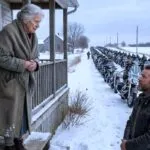

Zhora’s men tailed them from the front steps, staying two cars back and updating me every five minutes. Volkov got into his black tinted sedan, the same one I had seen outside the station the night before, while Igor and Maxim drove off in a marked patrol car that by every rule should have been back in the station garage. Rules had stopped meaning anything to those boys a long time ago. Volkov’s first stop was home.
He lived in a new apartment building on the other side of town, in a one-bedroom place far nicer than a lieutenant’s salary should have allowed. But Volkov could afford better housing because his money came from sources that never show up on a tax return. Zhora’s men watched him go upstairs, stay about twenty minutes, then come back down in civilian clothes, expensive sneakers, and a leather crossbody bag.
He looked rested, pleased with himself, and completely certain the day ahead would be just as good as the night before. He had no idea that the previous night had been the last night of his old life. By nine in the morning, I got the first sign of trouble.
Volkov tried calling Denis. Once, twice, three times. Denis’s phone was dead because Timur had destroyed it, and Denis himself was in a place where cell service was as useless as begging for mercy.
Volkov wrote in their group chat, which Timur was now monitoring through the data he had pulled: “Den, where are you? Send me last night’s files. Client’s waiting.” The word client caught my eye. That meant the videos were not just for personal use and blackmail.
That meant they had a buyer, someone paying for the recordings. And as I had already suspected, that buyer was Deputy Prosecutor Peshkov. I told Zhora to tighten surveillance on Volkov and at the same time begin working on Peshkov.
Peshkov was a different class of target. Fifty-three years old, twenty-five years in the prosecutor’s office, connections in the appellate courts and in the capital, a reputation as a hard but fair prosecutor that concealed rot so deep it disgusted even me, and I’ve seen plenty. Peshkov was careful.
He never showed up at the station in person, never contacted Volkov by phone, and handled everything through an intermediary—the same station chief, the tired man in his fifties I had seen behind the glass desk the night before. The station chief, Major Sychev, was the link. He looked the other way while Volkov and his crew ran wild, and in return he got protection from Peshkov and regular envelopes of cash.
By ten in the morning, Volkov was genuinely worried. Denis wasn’t answering calls or messages, his location couldn’t be found, and for all his stupidity, Volkov was beginning to sense that something was wrong. He drove to Denis’s apartment, went upstairs, rang the bell, and got no answer.
Then he came back down and saw Denis’s car still sitting there with the driver’s door unlocked. That was the moment, according to Zhora’s watchers, when Volkov’s face changed for the first time. It wasn’t panic yet, but it was close—the first crack in his shell of confidence.
Volkov called Igor and Maxim and told them to come over. The three of them stood in the courtyard discussing the situation. One of Zhora’s men was parked nearby with a directional microphone and recorded the conversation.
Volkov said Denis had probably gone off with some girl and shut off his phone. Igor guessed he might have driven to see his parents in another region. Maxim, who turned out to be the smartest of the three, said something that made me respect him for at least having a functioning brain.
“What if that guy who came for his daughter wasn’t just some nobody?” Volkov waved it off and said I was just another scared civilian who had nearly wet himself. Maxim shook his head but didn’t argue.
That was the moment we could have taken all three of them at once. Quiet courtyard, no cameras, three of my cars within a hundred yards. But I gave no order, because grabbing them off the street would have meant war with the police—three missing officers, a manhunt, noise, attention…