
 Let’s Keep It Real
Anna Kornilova felt the air in the meeting room grow thicker with each passing minute. She sat at a long, dark oak table, her tablet placed in front of her, diligently recording every word Stanislav Kochetov said. The director spoke measuredly, clearly emphasizing each phrase as if he had already thought about how his words would appear in the meeting minutes.
“The deliveries must be coordinated by the fifteenth,” he said, looking around at those present. “No postponements. Anna Vasilyevna, please note this as a separate item.”
She nodded, but her fingers suddenly felt heavy. The tablet keys seemed to recede, and the letters blurred before her eyes. Anna tried to focus, but the sensation only intensified.
A throbbing started in her temples, and a strange pressure built in her chest, as if someone had placed a heavy stone on her ribs and was slowly pressing down. “It will pass,” she thought. Just sleep-deprived.
The last two weeks had been exhausting. The quarterly report, negotiations with new partners, endless calls and approvals. Anna was used to the workload: working as the assistant to the director of a large logistics company demanded complete dedication.
Stanislav Dmitrievich Kochetov was a demanding but fair manager. He valued her punctuality, her ability to anticipate his needs, and her capacity to keep dozens of processes under control simultaneously. In her three years with the company, Anna had become an indispensable link.
She knew all the intricacies of document management, remembered the names of key clients, and managed to coordinate the work of several departments at once. Her colleagues respected her for her professionalism and the calmness with which she resolved even the most complicated situations. But today, something was wrong.
She looked up at Stanislav Dmitrievich. He continued speaking, gesturing with his hand:
“Irina Dmitrievna, you need to involve the HR department in the matter of staff expansion. We will need two additional client managers. Preferably with experience in international logistics.”
Irina Kochetova, the HR director and Stanislav's sister, was writing something in her notebook. Her face remained impassive, business-like. Anna had always admired her composure. Irina Dmitrievna knew how to maintain her distance even in the most tense situations. Fifty years old, an impeccable reputation, a tailored suit, and a neat hairstyle. She was the embodiment of order and discipline.
Suddenly, the room swayed. Anna pressed herself sharply into the back of her chair, trying to keep her balance. Her heart began to pound in a frantic rhythm. Her breathing became rapid and shallow, as if there wasn't enough air in her lungs. A cold sweat broke out on her forehead, and dark circles swam before her eyes.
“Anna Vasilyevna, can you hear me?” Stanislav Dmitrievich's voice sounded as if it came from far away.
She raised her head, forcing herself to smile.
“Yes, of course. I’m sorry, it’s just a little warm in here.”
“Should we open a window?” Irina Dmitrievna offered solicitously, putting down her pen.
“No, thank you. I’d better step out for a minute to get some fresh air. I’ll be right back.”
Anna stood up from the table, trying to move confidently, but her legs were treacherously weak. She could feel the gazes of her colleagues on her – concerned, curious, sympathetic. Leaving the meeting room, she closed the door behind her and leaned against the corridor wall. The cool surface was calming, but not for long. Her vision darkened, and her hands trembled even more.
“I need to go outside,” she decided. It would be easier out in the open air.
Anna walked past her workspace – a neat corner desk with two monitors, stacks of folders, and a pot of violets she diligently watered on schedule. She took her phone and handbag from the desk, threw a light cardigan over her shoulders, and headed for the elevator.
The receptionist, a young woman named Svetlana, called out to her:
“Anna Vasilyevna, are you not feeling well? Can I get you some water?”
“Thank you, Sveta, no need. I’m just stepping out for five minutes.”
She pressed the elevator call button, and a few seconds later, the doors slid open soundlessly. The mirrored walls of the cabin reflected her pale face with beads of sweat on her forehead. Anna didn’t recognize herself: she usually looked composed and well-groomed, but now she appeared sick and exhausted.
After reaching the ground floor, Anna stepped out of the business center. The air hit her face with a light breeze, carrying the scent of blooming buds. But it brought no relief. On the contrary, her weakness intensified. Her legs refused to obey, everything was a blur before her eyes, and she barely managed to make it to the nearest bench at the entrance of a small park next to the building.
Anna sank onto the wooden seat, closing her eyes. Her heart continued to pound as if it wanted to break out of her chest. She tried to breathe deeper, but each breath was a struggle. There was a ringing in her ears, and the world swam before her eyes. In the distance, she could hear the voices of passersby, the noise of cars, someone’s laughter. But it all seemed unreal, as if happening in another dimension.
“What is happening to me?”
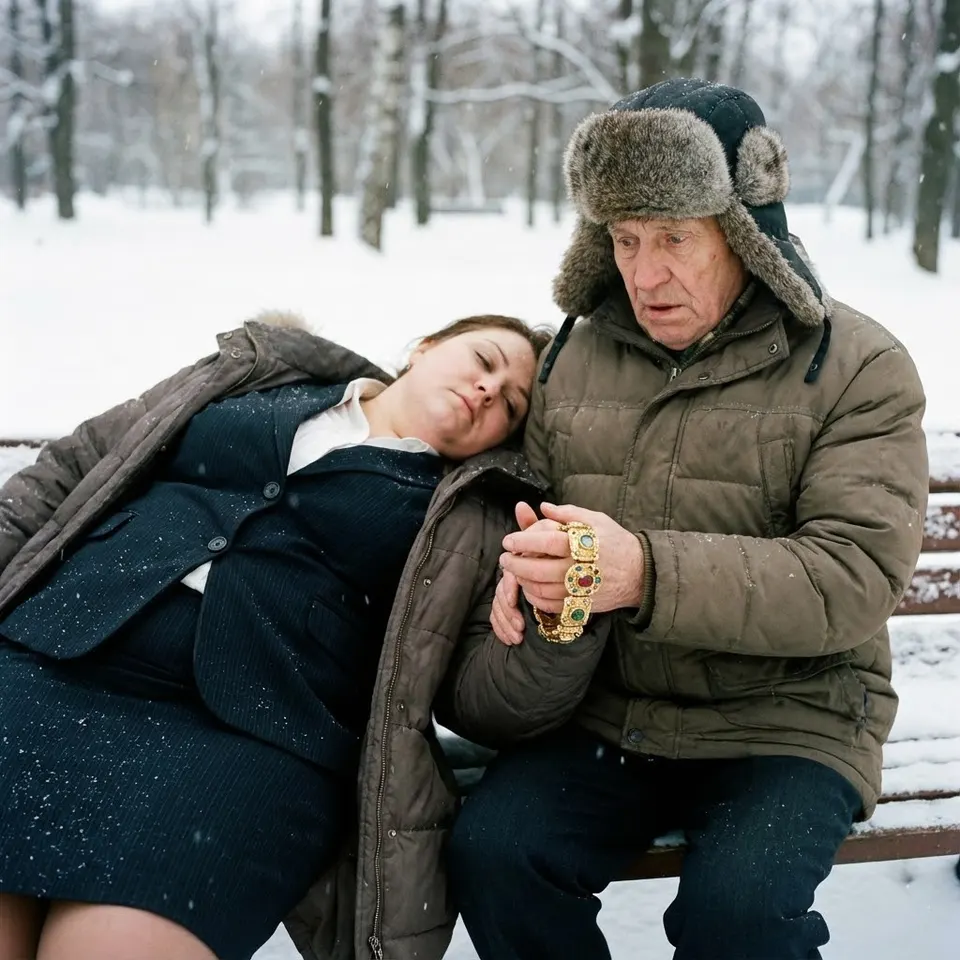
She fluttered her eyelids open and saw the blurry outline of a person leaning over her. The man was elderly, in his seventies, wearing a simple gray jacket and a knitted hat. His wrinkled face expressed concern, and his hands, strong despite his age, reached for her wrist.
“What are you doing?” Anna snatched her hand away, frightened.
“It's a gift from my husband!”
The man didn't back down. He looked at her intently, almost studying her, and said quietly:
“You feel ill because of this bracelet. Look here.”
Anna glanced down at her wrist in confusion. A thin metal bracelet, which Vladimir had given her three months ago, shimmered there. An elegant chain with small magnetic inserts, as he explained, was supposed to improve blood circulation and support heart function. The bracelet was expensive. Vladimir had ordered it through an acquaintance, assuring her it wasn't just jewelry but a genuine medical device.
“You wear this constantly,” the old man continued. “And you shouldn’t.”
“How do you know?” Anna’s voice trembled. “Who are you anyway? Why were you trying to take off my bracelet?”
The man straightened up, pulling a worn-out ID in a dark red cover from his pocket.
“Arseny Petrovich Volsky. I’m a doctor. Or rather, I was a doctor before I retired. I worked as a cardiologist for forty years at City Hospital Number Seven. And I’ve seen many cases where such jewelry did more harm than good.”
Anna struggled to focus on the document. The old doctor’s ID, issued back in the nineties, indeed confirmed his words. A photo of a young man with a serious gaze, a stamp, the chief physician’s signature.
“But my husband said the bracelet helps,” she argued weakly. “He wouldn’t…” Her voice wavered and broke off.
Arseny Petrovich shook his head, sitting down next to her on the bench.
“Listen, young lady. I don’t know who your husband is or what he told you. But I see your condition. You can barely breathe, you’re as pale as a sheet, and your hands are shaking. This is not just fatigue. Take off the bracelet for at least an hour, and you will feel the difference.”
Anna hesitated. Vladimir had always insisted that she wear the bracelet without taking it off. He said the effect was only achieved with constant use. Every morning he would check if she had it on and would get upset if he noticed she had forgotten. Once, she took it off before a shower and forgot to put it back on. Vladimir only noticed in the evening and became very agitated, spending almost an hour explaining how important it was to wear the bracelet constantly.
“I don’t know,” she muttered. “My husband said I shouldn’t take it off.”
The man sighed.
“Alright. Let’s do this then. How long have you been wearing it?”
“Three months. Since about mid-January.”
“And when did the attacks start? Like the one you're having now.”
Anna thought back. The first time she felt ill was about two weeks after Vladimir gave her the gift. She had attributed it to stress at work (the preparation for the annual audit was just beginning, and all departments were working in a rush). Then the attacks became more frequent: once a week, then twice, then almost every day. She paid them no mind, dulling the headaches with pills and continuing to work.
“About two weeks later,” she answered quietly. “Rarely at first, then more and more often.”
“You see?” Arseny Petrovich nodded. “A coincidence? I don’t think so. These magnetic bracelets are a controversial thing. For some, they are harmless, but for others, they can be contraindicated. Especially if a person has a tendency towards arrhythmia or blood pressure spikes. Do you have any heart problems?”
Anna felt a knot form in her stomach. She remembered having a check-up a year ago, and the doctor had noted a slight tachycardia. Nothing serious, they said then, just to watch her routine and avoid overexertion. Vladimir knew about it. He was with her at the appointment, holding her hand, calming her down.
“Yes,” she admitted. “I have tachycardia. A mild case.”
The man frowned.
“Did you tell your husband about this?”
“Of course. He was with me at the doctor’s.”
“And he still bought you a magnetic bracelet?” There was bewilderment in Arseny Petrovich’s voice. “That’s strange, to say the least. Any doctor will tell you that with heart rhythm disorders, such things should be used with great caution. Or better yet, not used at all.”
Anna was silent, not knowing what to say. Her thoughts were jumbled, and Vladimir’s voice echoed in her head: “I worry about you. This bracelet will help. Trust me.”
Her phone vibrated in her pocket. Anna took it out with a trembling hand and saw her husband’s name on the screen.
“Vladimir, hello?” her voice sounded alarmed.
“Why aren’t you at work?” His tone was laced with irritation. “Stanislav Dmitrievich called, said you stepped out and didn’t come back. What happened? Where are you?”
“I felt ill. I went out for some air. I’m sitting on a bench near the office.”
“Again?” Vladimir sighed with unconcealed annoyance. “Did you take off the bracelet?”
Anna looked at her wrist, where the thin chain still gleamed.
“No.”
“Then what’s the problem? You know it helps you. You’re probably just overworked. Ask for time off. Come home, get some rest. I’ll finish early, pick up some groceries, and make dinner. Okay?”
“Okay,” she replied mechanically and hung up.
Arseny Petrovich looked at her with sympathy.
“Was that him?”
Anna nodded.
“Take my advice. Go to a clinic. Today. Get a check-up and find out the truth. And at least take the bracelet off for a while, until you get the results. See how you feel without it.”
She slowly unfastened the clasp and took off the bracelet. The metal was warm from her skin, pleasantly heavy. Strangely, within a minute, her breathing became a little steadier, and the pressure in her chest eased. Whether it was a placebo effect or real relief, Anna didn’t know, but she felt the difference.
“Thank you,” she whispered, putting the bracelet in her jacket pocket. “Thank you so much.”
The man smiled gently, paternally.
“Take care of yourself, young lady. Health is the only thing that truly belongs to you. Don’t let anyone manage it for you. Not even the people closest to you.”
He got up from the bench, adjusted his hat, and slowly walked away down the alley, leaving Anna alone.
She sat for a few more minutes, feeling her strength gradually return. Her thoughts were a mess, but one pushed through the fog with particular persistence. What if Vladimir actually knew? No, that was absurd. Her husband loved her. He cared for her. He couldn’t have… But then why did he insist on the bracelet? Why did he get angry when she forgot to wear it? Why did he never agree when she suggested going to the doctor to check her heart?
Anna stood up from the bench, feeling much better. Her head had cleared, and her heart was beating steadily. She took out her phone and dialed Stanislav Dmitrievich’s number.
“Anna Vasilyevna?” his voice sounded concerned. “How are you feeling?”
“Better, thank you. Stanislav Dmitrievich, I’m sorry for interrupting the meeting. May I take the day off? I need to see a doctor.”
“Of course, of course. Take care of your health. Everything else can wait.”
She hung up and slowly walked to the parking lot where she had left her car. The doctor’s words echoed in her head: “Don’t let anyone manage your health for you.”
Anna sat in her car, hands on the steering wheel, staring into space. The engine was off. Silence surrounded her, broken only by the distant noise of the avenue. The bracelet lay in her jacket pocket, and she kept catching herself mechanically reaching for her wrist to check if it was there. Habit. Over three months, it had become a reflex—touching the cool metal as if it were a part of her.
Vladimir had gotten her used to it subtly, day by day, repeating, “Don’t forget to wear the bracelet. It’s important for your health.” She remembered that January evening when he gave her the gift. They were sitting in the kitchen after dinner, the apartment smelling of the apple pie Anna had baked especially for his return from a business trip. Vladimir pulled a small velvet box from his pocket and handed it to her with a smile:
“Open it.”
Inside, on a white cushion, lay an elegant bracelet, a thin chain with neat magnetic inserts, each the size of a grain of rice. It shimmered in the light of the chandelier, looking expensive and stylish.
“This is for you,” Vladimir said, taking her hand. “I’ve been wanting to find something special for a while. You know, after that visit to the cardiologist, I kept worrying. You work so much, you’re stressed, and your heart… I found a specialist who deals with these things. This isn’t just jewelry. The magnetic field helps improve circulation, stabilizes the rhythm. Wear it constantly, and you’ll feel better.”
Anna was touched then. Vladimir had always been attentive, caring. He remembered her health better than she did herself. She hugged him, thanked him, and he fastened the bracelet on her wrist himself.
“Now, don’t take it off. The effect will only work with constant wear. Promise?”
“I promise.”
And she kept her promise. For three months, she never parted with the bracelet for a minute. It stayed on her wrist even at night. Vladimir made sure of it. Every morning, as he saw her off to work, he would kiss her and always check.
“Did you put on the bracelet?”
“Yes.”
“Good girl. I worry about you so much.”
At first, it seemed touching. Then, it became routine. And now, sitting in the car with a bare wrist, Anna suddenly realized: it was strange. Why did he insist so much? Why did he get angry if she forgot to wear it even once? Why did he never suggest going to the doctor again to see if the device was helping?
She took out her phone and dialed the number of the private clinic where she had her check-up a year ago. The receptionist answered on the third ring.
“Medical Center ‘Cardiology Plus.’ How can I help you?”
“Hello, this is Anna Kornilova. I had a check-up with you a year ago. Can I make an appointment with a cardiologist? Preferably today, if possible.”
“Let me check… Yes, we have an opening at 4:30 PM. Does that work for you?”
“Perfect. Thank you.”
Anna looked at the clock: it was only half-past eleven. She had more than four hours until her appointment. She didn’t want to go home. Vladimir probably already knew she had left work early and would be asking questions, calling, worrying. And she wasn’t ready for that conversation yet. She needed time to think.
She started the car and drove towards the embankment. There, by the river, was a quiet café where she sometimes liked to sit alone with a book or just watch the water. After parking, Anna entered the small establishment, ordered a mint tea, and settled at a table by the window.
The river flowed slowly, reflecting the gray April sky. On the opposite bank, the roofs of old houses were visible, and clouds drifted somewhere in the distance. Anna wrapped her hands around the warm cup and closed her eyes, letting her thoughts flow freely.
When did her condition start to worsen? Right, about two weeks after she put on the bracelet. At first, just weakness in the mornings, then dizziness, a racing heart. She blamed it on work, lack of sleep, the spring vitamin deficiency. Vladimir supported this theory. “You work too much. You need rest.” But when she suggested taking a vacation and going somewhere, he found reasons to postpone the trip. “Now is not the best time. Let’s go in the summer. Or fall.”
When she said she wanted to see the cardiologist again, he talked her out of it. “Why waste money? You’re wearing the bracelet, it’s helping you. Just get some proper rest.” And when she once took the bracelet off, Vladimir threw a fit. “Do you understand you’re risking your health? I didn’t spend so much money for nothing. This is a medical device, not a toy. You must wear it constantly.”
Back then, Anna was scared of his anger and apologized. She thought he was just worried. Now, she was starting to see the picture differently.
The phone vibrated. A message from Vladimir.
“I finished early. I’m on my way home now. Where are you? How are you feeling?”
Anna looked at the screen and slowly typed a reply:
“Decided to take a walk. Needed some air. I’ll be home soon.”
“Okay. I’m worried. Call me when you’re heading home. Love you.”
She put the phone on the table and sighed. “Love you.” He said it every day. He cared for her, cooked dinner, asked about her day, gave her gifts. He was the perfect husband. So why was she feeling more and more anxious?
Anna remembered how they had met two and a half years ago. She had just started working as the director's assistant, and at a corporate event, she was introduced to Vladimir, a successful sales manager from a partner company. He was nine years older than her, self-confident, charming. He courted her beautifully: flowers, restaurants, compliments. Six months later, he proposed.
Anna was happy. She felt she had found the one person with whom she could build a family. Vladimir was reliable, stable. He handled all the household problems, took charge of finances, planned their future together. She felt protected.
But gradually, his care began to turn into control. Subtly at first. He would ask who she talked to at work. He was interested in where she went after work. He asked her to let him know when she was leaving the office and when she would be home. All of this was presented as concern. “I’m just worried. You never know what might happen.” Anna didn’t object. It seemed normal for a husband to worry about his wife.
But over time, the control intensified. Vladimir didn’t like it when she stayed late at work. He would frown with displeasure if she planned to meet up with friends. He got irritated when she spent too much time on her phone.
And then the bracelet appeared. And the attacks. Anna looked at her wrist. Could he have known that the bracelet was dangerous for her health? No. That was absurd. He loved her. But if he loved her, why didn’t he want her to get a check-up? Why did he insist on her wearing the bracelet even though he saw she was getting worse?
The phone vibrated again. A call. Vladimir. Anna pressed the green button.
“Hello?”
“Anya, where are you?” his voice sounded anxious. “I’ve been home for half an hour, and you’re still not here. You said you’d be home soon.”
“I’m walking along the embankment. I need to be alone.”
A pause. Then Vladimir spoke slowly, with a hint of irritation:
“Alone? You were feeling ill, and you decided to walk alone? Anna, that’s irresponsible. What if you feel sick again? Who will help you?”
“I’m feeling better now.”
“Are you wearing the bracelet?”
She gripped the phone tighter.
“No.”
“Why?” Vladimir’s voice rose. “Do you want the attack to happen again? Anna, I don’t understand what’s wrong with you. I’m trying to take care of you, and you’re ignoring my requests.”
“Vladimir, I made an appointment with a cardiologist. Today at 4:30 PM. I want to check if this bracelet is helping me.”
Another pause, a longer one. When Vladimir spoke again, his tone had changed, becoming softer, almost affectionate.
“Why do you need doctors? You know they just want your money. They’ll order a bunch of unnecessary tests, prescribe a ton of medicine. And for what? The bracelet is a proven remedy. Just put it back on and don’t stress. Stress is what’s bad for you.”
“I’m still going to the doctor,” Anna said firmly.
“Fine,” Vladimir sighed. “If it makes you feel better. But put the bracelet on. Please. For me.”
She glanced at her jacket pocket, where the ill-fated piece of jewelry lay.
“No. I want the doctor to examine me without it. To compare my condition.”
“Anna,” a threat crept into his voice. “You’re not listening to me. This will end badly.”
“What exactly will end badly?” She felt everything inside her tense up.
“Your health!” Vladimir almost shouted. “Without the bracelet, you’ll get even worse. I’m telling you this as someone who cares about you.”
Anna closed her eyes. The old doctor’s words echoed in her head: “Don’t let anyone manage your health for you.”
“Vladimir, I have to go. I’ll see you tonight.”
She hung up without waiting for a reply and silenced her phone. Her hands were shaking. Her heart was beating fast, but not like it had in the morning. This was fear. Fear of what she was beginning to understand. Her husband wasn't caring for her. He was controlling her. And the bracelet was a tool for that control.
Anna finished her cold tea and looked at the clock. Three hours left until her appointment. She took a notebook and a pen from her bag, opened a clean page, and started writing. Everything she remembered. All the oddities that had previously seemed like minor details.
- January: gave me the bracelet. Insisted I wear it constantly.
- End of January: first dizzy spell.
- February: attacks became more frequent. Vladimir talked me out of seeing a doctor.
- March: condition worsened. Vladimir got angry when I took the bracelet off.
- April: today. An old doctor said the bracelet is harmful.
She reread what she had written and added another line:
“Vladimir knew about my tachycardia. He was with me at the cardiologist appointment.”
The picture was becoming clearer. And more terrifying. The phone vibrated silently on the table. Vladimir was sending message after message. Anna didn’t read them. She needed to wait for the appointment, to learn the truth. And then… then she would decide what to do next.
She got up from the table, paid her bill, and went outside. The air was fresh, the sky was beginning to clear, and rays of sun were breaking through the clouds. Anna walked slowly along the embankment, feeling it become easier to breathe with every step. Without the bracelet on her wrist, she felt free for the first time in three months.
At half-past three, Anna was at the medical center, a modern building of glass and concrete in the city center. The lobby smelled of antiseptic and freshly brewed coffee. The same young woman who had scheduled her appointment over the phone was sitting at the reception desk.
“Anna Vasilyevna Kornilova?” she confirmed.
“Yes.”
“Room 307, third floor. Dr. Malakhova is waiting for you.”
Anna took the elevator up, found the right office, and knocked. A woman in her mid-forties with a short haircut and an attentive gaze sat at the desk in a white coat. She took Anna's medical chart.
“Hello, Anna Vasilyevna. Please come in and have a seat. What seems to be the problem?”
Anna sat down in the soft chair opposite the doctor and began to tell her story. Everything: about the bracelet, the attacks, the old doctor’s words, how her husband had insisted she wear the jewelry constantly. Dr. Malakhova listened attentively, asking clarifying questions from time to time.
“Show me the bracelet,” she requested.
Anna took it out of her pocket and placed it on the desk. The doctor picked up the item, turned it over in her hands, and held it up to the light.
“Magnetic inserts. Quite strong, judging by the weight. You have a history of tachycardia?”
“Yes. It was diagnosed a year ago.”
“Who recommended you wear this?”
“My husband. He said it would help.”
Dr. Malakhova shook her head.
“Anna Vasilyevna, with tachycardia, such items can be dangerous. A magnetic field can affect the heart rhythm unpredictably. For a healthy person, it might be harmless, but with rhythm disorders, it is strictly contraindicated. We’ll do an ECG now to check your condition, and then I’ll give you my conclusion.”
Anna nodded, feeling a cold certainty grow inside her. Vladimir knew. He couldn’t have not known.
The electrocardiograph hummed quietly, printing out a long strip of paper with jagged lines. Anna lay on the couch, staring at the white ceiling, trying to breathe steadily. The cold sensors on her chest felt heavy, like anchors holding her in place. Dr. Malakhova leaned over the machine, studying the readings, and her expression gradually grew more serious.
“You can get dressed now,” she said finally.
Anna sat up, removed the sensors, and pulled on her blouse. Her hands were still trembling slightly—not from weakness, but from inner tension. She was afraid to hear the diagnosis and, at the same time, longed to know the truth.
Dr. Malakhova returned to her desk, placed the ECG printout in front of her, and studied it in silence for a few seconds. Then she looked up.
“Anna Vasilyevna, your rhythm is within the normal range right now. There is a slight tachycardia, but it’s manageable. Tell me, how long have you been without the bracelet? Since this morning?”
“About five hours, maybe.”
“And how are you feeling?”
Anna thought for a moment. The dizziness had passed while she was on the embankment. The pressure in her chest was gone. She felt tired, but it was a normal fatigue, not the debilitating weakness of the past few weeks.
“Better,” she admitted. “Much better.”
The doctor nodded.
“I thought so. You see, magnetic bracelets are a pseudoscientific medical device. Their effectiveness has not been proven, and under certain conditions, they can cause harm. You have tachycardia, which is a tendency for a rapid heartbeat. A magnetic field can provoke additional rhythm disturbances, causing dizziness, weakness, shortness of breath. Everything you described.”
“So the bracelet is contraindicated for me?” Anna’s voice was quiet.
“Absolutely. Moreover, I recommend you never wear such things again. I’m going to give you a referral for additional tests now. A 24-hour Holter monitor, an echocardiogram. We need to check if the prolonged wearing of the bracelet has caused any serious damage.”
Anna felt a chill run through her. Serious damage. For three months, she had been wearing something that was slowly destroying her health. And Vladimir knew about it. He couldn’t have not known.
“Doctor,” she frowned, “who could have recommended such a bracelet? My husband said he bought it from a specialist.”
Dr. Malakhova paused to think.
“A ‘specialist’ in quotation marks. These devices are all over the internet, sold as medical instruments. Usually, it’s outright charlatanism. Either your husband simply didn’t understand and fell for a scam. Or…” she didn’t finish, but Anna understood. Or he knew what he was doing.
“Thank you,” she breathed out. “I’ll get all the tests done.”
“Good. Here is the referral. We can fit the Holter monitor tomorrow morning. You’ll wear it for 24 hours. We’ll do the echo the day after. And for now, here is my conclusion.”
The doctor handed her a sheet of paper with the clinic's seal. Anna took it and read:
“Patient Kornilova A. V. Age thirty-one. Diagnosis: sinus tachycardia. The use of magnetic products is strictly contraindicated due to the risk of exacerbating heart rhythm disturbances. Further examination is required.”
She folded the paper and put it in her bag. It was a document. Official confirmation that the bracelet was harming her. Proof.
“Anna Vasilyevna,” Dr. Malakhova looked at her intently. “Forgive the personal question, but who exactly insisted that you wear the bracelet?”
“My husband,” Anna barely whispered the word.
“Did he know about your diagnosis?”
“Yes. He was with me at the appointment a year ago.”
The doctor was silent for a few seconds, then said quietly:
“You understand, I have no right to interfere in your personal life. But as a doctor, I must warn you: if someone knowingly gives you something that harms your health, knowing about the contraindications—that is very serious. Perhaps you should consult not only a cardiologist but also a psychologist. Or a lawyer.”
Anna nodded, at a loss for words. She stood up, thanked the doctor, and left the office. The corridor was quiet. Anna sat down on a couch, took out her phone, and turned the sound on.
The screen exploded with notifications. 17 missed calls from Vladimir, 23 messages. She opened the chat and began to read.
“Where are you?”
“Why aren’t you answering?”
“Anna, I’m worried. Call me immediately.”
“This isn’t funny. I’m your husband, I have the right to know where you are.”
“If you’re at the doctor’s, at least text me. I’m going out of my mind.”
“Are you ignoring me? After everything I do for you?”
“Fine. Be silent. But I’ll remember this.”
The last message had been sent 10 minutes ago. Anna exhaled and typed a short reply:
“I was at the cardiologist. I’m on my way home. We need to talk.”
The response was instant:
“Finally. I’m waiting.”
Anna put her phone away and left the clinic. She knew a conversation she dreaded was about to happen. But she couldn't put it off any longer. There were too many questions, and she had a right to answers.
She arrived home, went up to the fifth floor, and opened the door with her key. The apartment smelled of fried onions and garlic. Vladimir was cooking dinner, just as he had promised. She took off her shoes, walked into the living room, and saw him in the kitchen. He was standing at the stove, stirring something in a pan, and turned around when he heard her footsteps. He finally smiled, but the smile was strained.
“I was starting to think you weren’t coming back at all.”
“Why wouldn’t I come back?” Anna remained standing in the kitchen doorway.
Vladimir shrugged.
“You’ve just been acting so strangely today. Not answering calls, ignoring messages. As if I’m a stranger to you.”
“Vladimir, we need to have a serious talk.”
He turned off the stove and faced her.
“I’m listening.”
Anna took the medical report from her bag and handed it to him.
“Read this.”
Vladimir took the paper, skimmed the text, and his expression slowly changed. First surprise, then irritation, then something resembling anger.
“What is this nonsense?” He threw the paper on the table. “Some doctor decided the bracelet is harmful. On what grounds?”
“On the grounds that I have tachycardia, and magnetic products are contraindicated with this diagnosis,” Anna replied firmly. “You knew that.”
“I didn’t know anything!” Vladimir raised his voice. “I bought you an expensive gift to help, and you’re interrogating me.”
“You were with me at the cardiologist a year ago. You heard the diagnosis. You knew.”
Vladimir spun around and slammed his fist on the table.
“What do you think you’re doing? Are you accusing me of trying to harm you? I am your husband. I take care of you!”
“Care isn’t forcing me to wear something that’s destroying my health.”
“It’s not destroying it. These doctors don’t know what they’re talking about. I’ve read studies, articles. Magnetotherapy helps.”
“It’s contraindicated for tachycardia,” Anna felt anger boiling inside her. “And you know it. Why did you insist? Why did you get angry when I took the bracelet off? Why did you talk me out of seeing doctors?”
Vladimir stepped towards her, his face contorted.
“Because you don’t know how to take care of yourself! Because you can’t manage without me. You work yourself to the bone, you don’t watch your health, you forget to eat. I’m trying to control you because you’re not capable of it yourself…”
“Control?” The word cut through Anna like a knife. “You want to control me?”
“Yes,” Vladimir shouted, “and there’s nothing wrong with that! I’m your husband, I know what’s best for you.”
“You don’t know,” she raised her voice too. “You’re not a doctor. You just want me to be weak and dependent on you.”
Vladimir fell silent. His breathing was heavy, his hands clenched into fists. Then he exhaled and said more quietly, almost tenderly:
“Anya, you’re tired. You’re stressed. Let’s eat, rest, and everything will be fine. I don’t want to fight with you.”
“I’m not tired,” Anna shook her head. “I’ve just finally understood. You don’t care about me. You control me. The bracelet is just a tool. You wanted me to be sick. So I would be scared and dependent on you.”
“That’s ridiculous,” Vladimir turned away. “You’re overthinking it. The doctors have filled your head with nonsense.”
Anna took the bracelet from her pocket and placed it on the table.
“I’m not wearing this anymore. And I won’t listen to your instructions. My health is my responsibility.”
Vladimir spun around abruptly, grabbed the bracelet, and clenched it in his hand.
“You’ll regret this. You’re nothing without me. Who will help you when you get sick? Who will take care of you?”
“I’ll take care of myself.” Her voice trembled, but she held her ground. “And if I need help, I’ll go to doctors. Real doctors, not a husband who gives me dangerous things.”
Vladimir stepped towards her, looming over her.
“You’re ungrateful. I’ve done so much for you. I married you, I provide for you, I take care of you. And this is how you treat me?”
Anna took a step back.
“Care is not control. Love is not manipulation. You have no right to decide about my health.”
“I do!” Vladimir roared. “I’m your husband.”
“For now,” Anna said quietly.
A heavy silence fell. Vladimir looked at her, and in his eyes, she saw something new—not anger, not irritation. Fear. The fear of losing control.
“What are you trying to say?” he said slowly.
“I’m saying I need time to think. I need to be alone.”
“Where are you going?” Vladimir’s voice became sharp.
“To a friend’s house. For a few days. I need to sort out my feelings.”
She turned and walked into the bedroom. Vladimir followed at her heels.
“You’re not going anywhere. We’ll sort this out right now.”
Anna took a sports bag from the closet and started packing—a few changes of underwear, jeans, a sweater, a makeup bag. Her hands were shaking, but she forced herself to move. Vladimir stood in the doorway, blocking her exit.
“Anna, stop it! You’re not going anywhere.”
“Move!” she looked at him.
“No.”
“Vladimir, I said move!” He didn’t budge. Anna felt a knot of fear tighten inside her, but she forced herself to take a step forward.
Vladimir grabbed her arm.
“You’re staying here. We’ll talk properly.”
“Let go of me!”
“No.”
Anna yanked her arm away, pushed him in the chest, and ran out of the bedroom. She grabbed her large bag and purse with her documents, the car keys, and bolted for the exit. Vladimir caught up with her at the door, but she had already thrown it open and dashed out onto the landing.
“Anna! Come back immediately!” his shout echoed through the stairwell.
She didn’t look back. She ran down the stairs, almost sprinting to her car, got behind the wheel, and started the engine. Vladimir ran out of the building, but she was already pulling out of the courtyard. Only when she was on the main road did Anna allow herself to exhale. Her hands were shaking. She pulled over, turned on her hazard lights, and just sat for a few minutes, trying to calm down and catch her breath.
The phone vibrated. A message from Vladimir:
“You will regret this. Without me, you are nothing.”
Anna blocked his number, put the phone in her bag, and drove to the only person she could trust right now – Irina Dmitrievna Kochetova.
The HR director lived a 20-minute drive away, in a quiet neighborhood with low-rise buildings. Anna called her on the way.
“Irina Dmitrievna, I’m sorry to bother you in the evening. May I come over? I need help.”
“Of course, Anna. Come over. I’m home.”
When Anna arrived at the house, Irina Dmitrievna was already waiting for her on the porch. Seeing her red eyes and trembling hands, she hugged the young woman and led her into the house.
“Tell me what happened.”
And Anna told her. Everything: about the bracelet, the attacks, the doctor, the medical report, Vladimir. Irina Dmitrievna listened in silence, nodding occasionally. When Anna finished, the HR director poured her some tea and said quietly:
“You did the right thing by leaving. This is called domestic abuse, Anna. Psychological abuse. He controlled you, manipulated you, undermined your health. You need legal help and support. Tomorrow, we will arrange a week’s leave for you. In the meantime, stay here. I have a guest room.”
Anna nodded, feeling tears well up in her eyes. For the first time in three months, she felt safe.
On Saturday, Anna woke up to bright light filtering through the light curtains. For a moment, she didn't know where she was, then she remembered: the guest room in Irina Dmitrievna's house. A simple, cozy room with white walls, wooden furniture, and the scent of lavender. On the nightstand was a glass of water she hadn't finished the night before.
She looked at her phone: 8 a.m., Saturday. The screen showed 27 missed calls from an unknown number and three messages. Vladimir, of course. She had blocked his main number, so he was calling from another one.
Anna opened the message:
“Anna, this is foolish. Come home. We can discuss everything calmly. You can't just leave like this. I am your husband. We have obligations to each other.”
“Fine. You want to play the silent game? Go ahead. But remember: everything you have is because of me.”
The last message was sent at 6 a.m. Anna deleted the conversation and blocked the new number. She didn't need his words, his manipulations, his attempts to regain control.
There was a soft knock on the door.
“Anna, are you awake? Breakfast is ready.”
She got up, put on the robe she had borrowed yesterday, and went to the kitchen. Irina Dmitrievna was at the stove, flipping pancakes. Honey, sour cream, and fresh berries were already on the table.
“Good morning,” Anna said, sitting down.
“Good morning,” Irina Dmitrievna smiled. “How did you sleep?”
“Better than I have in weeks.”
“That's good. Here, have some breakfast. I'll call Stanislav and arrange your leave officially.”
Anna nodded, pouring herself some tea. She felt strange: simultaneously liberated and lost. Everything that had seemed stable and reliable in her life had crumbled in a single day. The husband she trusted had turned out to be a manipulator. The home she had lived in for two years was no longer a safe place. The future she had planned had vanished into thin air.
Irina Dmitrievna returned 10 minutes later.
“It's all settled. Stanislav will grant you two weeks of leave. He said health is more important and you should rest properly. I also got the number of our family lawyer. Here, write it down. Her name is Elena Grigoryevna Tarasova. A very competent woman.”
Anna saved the number in her phone.
“Thank you. I don't know what I would have done without you.”
“It's nothing, don't thank me. Just take care of yourself. And remember: you are not to blame for anything. What your husband did is abuse. Psychological abuse. You have every right to protect yourself.”
Anna nodded silently. The word “abuse” sounded unfamiliar, almost foreign. She had always thought of abuse as beatings, shouting, overt aggression. But what Vladimir did had long looked like care. He didn't hit her. He didn't constantly yell at her. He just controlled her. Manipulated her. Undermined her health.
After breakfast, Anna called the lawyer. Elena Grigoryevna turned out to be a woman in her fifties with a confident, calm voice. They scheduled a meeting for the next day.
Anna spent the rest of the morning in the guest room, sorting through documents. The marriage certificate, bank statements, medical records. She made a list of things to discuss with the lawyer. And with each line, she understood—there was no going back.
At lunchtime, Irina Dmitrievna suggested a walk. They went to a small park nearby, strolling along the paths. The air was warm, smelling of spring and freshness. Anna breathed deeply, and it suddenly seemed to her that she had forgotten what it was like to breathe freely.
“You know,” Irina Dmitrievna began, “I was once in a similar situation myself. A long time ago, about twenty years ago. My ex-husband was also very caring. Too caring.”
Anna looked at her in surprise.
“Are you serious?”
“Absolutely. He controlled my every move. He called ten times a day, checked who I was talking to, what I was eating, where I was going. He said he was worried, that he loved me, that I couldn't manage without him. And I believed him. For three years, I believed him. Until I realized I was suffocating.”
“And how did you leave?”
“I packed my things and went to my sister’s. He also called, wrote, begged me to come back. Promised to change. But I knew: people like that don't change. They just learn to better hide their need for control. I filed for divorce. He resisted, but eventually, it was over. And you know what? For the first time, I felt alive. Real.”
Anna listened, and something warm spread inside her. She was not alone. She was not crazy. What was happening to her had happened to others. And there was a way out.
“Did you have any regrets?” she asked quietly.
“Not for a second. My only regret was not leaving sooner.”
They returned home in the evening. Anna felt tired but calm. She had dinner, took a shower, and went to bed early. Tomorrow was an important meeting with the lawyer.
In the morning, Anna arrived at Elena Grigoryevna's office—a small space on the third floor of a business center. The lawyer greeted her warmly, sat her down at the table, and listened attentively to her entire story. Anna spoke, sometimes faltering, sometimes pausing to gather her thoughts. She told her about the bracelet, the attacks, the medical report, the control, the final argument.
Elena Grigoryevna took notes, asking clarifying questions. When Anna finished, she put down her pen and looked her in the eyes.
“Anna, what you've described is a classic case of domestic psychological abuse. Your husband used methods of control, manipulation, and undermining your health. You have a medical report confirming the harm from the bracelet. This is an important document.”
“What should I do next?” Anna’s voice trembled.
“First, ensure your safety. Are you staying with acquaintances now?”
“Yes.”
“Good. Do not return home alone. If you need to retrieve your belongings, do so in the presence of witnesses or the police. Second, we file for divorce. Under the Family Code, you have the right to dissolve the marriage without the other spouse's consent if cohabitation has become impossible. Third, we document all his attempts to contact you. Calls, messages, visits. All of this may be needed if he starts to threaten or stalk you.”
Anna nodded, writing down the main points.
“And how quickly can the divorce be finalized?”
“If he doesn't agree, the process could take several months. The court allows time for reconciliation, usually one to three months. But given the circumstances—the psychological abuse, the medical documents—we may be able to expedite the process. The main thing is your firm position.”
“I've made up my mind,” Anna straightened up. “I'm not going back to him.”
Elena Grigoryevna smiled.
“Excellent. Then let’s start preparing the documents. I will draft the petition now. You’ll sign it, and we will file it with the court next week. In the meantime, avoid all contact with your husband. Don't answer his calls, don't meet with him alone.”
They spent another hour discussing the details: division of property, financial matters, alimony. Anna had no children with Vladimir. The apartment was his, acquired before the marriage, but she had a right to a share of jointly acquired property. Her car was hers, bought before the marriage. This simplified things.
When Anna left the office, she felt lighter. She had a plan. A clear, understandable plan of action. She was no longer fumbling in the dark, trying to figure out what to do. Now she knew.
The phone rang. An unknown number. Anna stopped by her car, hesitated, then answered.
“Hello?”
“Anya, it’s me,” Vladimir’s voice sounded tired, almost pleading. “Please, don’t hang up. I need to talk to you.”
She gripped the phone tighter.
“We have nothing to talk about.”
“We do. Please, just hear me out. I realized I was wrong. I really was too controlling. But I did it out of fear. Fear of losing you. I love you so much, Anya. Please, let’s meet, talk things over calmly.”
“Vladimir, I’m filing for divorce.”
A pause. A long, drawn-out pause. Then his voice changed, becoming sharp and cold.
“Are you serious?”
“Absolutely.”
“You’ll regret this. Do you think it’s so easy to leave me? I won’t give you a divorce. I’ll fight to the end. You are my wife and you will remain my wife.”
“The law is on my side. I have the medical report. I have proof of your control. You can’t hold me.”
“A medical report?” he laughed maliciously. “Some doctor wrote a piece of paper, and you think that means something? I’ll find ten doctors who will say the opposite.”
“Do whatever you want. I’m not afraid of you anymore.”
“Not afraid?” A threat was in his voice. “You should be. You’ve forgotten who I am. I can have you fired from your job. I can ruin your reputation. I can…”
Anna hung up. Her hands were shaking. Her heart was pounding, but not from weakness, from anger. She got in her car, took a deep breath, and drove back to Irina Dmitrievna’s.
That evening, they sat in the kitchen, drinking chamomile tea, and Anna recounted her conversation with Vladimir. Irina Dmitrievna frowned.
“He threatened you?”
“Yes.”
“You need to document this. Write down everything he said while you remember. If he calls again, record the conversation. Threats are a serious matter. You can report them to the police.”
Anna nodded. She felt cornered, yet stronger than ever. Vladimir was trying to break her, to scare her, to bring her back under his control. But she wouldn't give in.
The next day, Anna went to the clinic to have a Holter monitor fitted. A small device was attached to her chest, which would record her heart's activity for 24 hours. The doctor explained that this was necessary to get a complete picture and understand how much damage wearing the bracelet had done to her health. Wearing the monitor was not very comfortable, but Anna endured it. She went about her usual life – walking, reading, helping Irina Dmitrievna around the house. And all the while, the little device recorded every beat of her heart.
Twenty-four hours later, she returned to the clinic, had the monitor removed, and received the results a few hours later. Dr. Malakhova invited her into her office and laid out the printouts on the table.
“Anna Vasilyevna,” she began, “the results show that you did indeed have episodes of rhythm disturbance. Tachycardia, a few extrasystoles. But overall, your heart is in good condition. The main thing is that you took off the bracelet in time. If you had continued to wear it for another month or two, the consequences could have been more serious.”
Anna exhaled.
“So, everything will be okay?”
“Yes. Provided that you take care of your health, avoid stress, and, of course, never wear such items again. Here is an updated report. You can give it to your lawyer.”
Anna took the document and thanked the doctor. Now she had another piece of evidence. Official confirmation that the bracelet had indeed harmed her.
In the evening, she met with Elena Grigoryevna and gave her the new report. The lawyer reviewed it and nodded with satisfaction.
“Excellent. This strengthens our position. Now we have not only the contraindications but also confirmation of actual harm. The petition is ready, sign here and here. We will file it with the court tomorrow.”
Anna signed the documents with a steady hand. She was taking a step from which there was no return. And she was ready.
The next morning, Elena Grigoryevna called her:
“The petition has been filed. The court date will be set for next month. Vladimir will be served with a summons.”
“Thank you,” Anna felt a sense of relief. Now, all she had to do was wait.
The following days passed in a strange calm. Vladimir no longer called or texted. Anna lived with Irina Dmitrievna, helped her with housework, read books, and walked in the park. For the first time in a long while, she felt free. Stanislav Dmitrievich dropped by a couple of times, bringing fruit and asking about her well-being. He was tactful, didn't ask unnecessary questions, simply letting her know she was not alone, that she had support. Anna appreciated it. She finally understood what true care meant—the kind that doesn't suffocate, doesn't control, doesn't demand. The kind that is simply there, like a warm blanket on a cold evening.
The court hearing was scheduled for May 10th, a warm spring day when the city was awash in greenery and blooming chestnut trees. Anna woke up early, before her alarm, and lay for a long time staring at the ceiling of the guest room. Today, everything would be decided. Today, she would either gain her freedom or she wouldn't. She didn't want to think about the other option.
Irina Dmitrievna knocked on the door around eight in the morning.
“Anna, breakfast is ready. You need to eat before court.”
She came down to the kitchen. Anna drank a cup of strong tea with honey and ate half a piece of toast. Her stomach was in knots with anxiety.
“Everything will be fine,” Irina Dmitrievna placed a hand on her shoulder. “You have all the documents in order, the law is on your side. The main thing is to stay confident.”
Anna nodded, trying to believe those words.
She arrived at the courthouse half an hour early. Elena Grigoryevna was already waiting for her at the entrance, holding a folder of documents. The lawyer was impeccably dressed, her appearance exuding calm and confidence.
“Ready?” she asked.
“Yes,” Anna nodded, though everything inside was trembling.
They passed through the metal detector, went up to the second floor, and sat on a bench in the corridor. Vladimir had not yet arrived.
“Don’t worry,” Elena Grigoryevna said quietly. “We have all the documents in order. The medical reports, Irina Dmitrievna’s testimony, recordings of the threats. The court will be on your side.”
Vladimir appeared in the corridor. He walked confidently, in a sharp black suit, a crisp white shirt, and a burgundy tie. With him was a lawyer, a middle-aged man with a cold, detached face and an expensive leather briefcase in his hand. Vladimir cast a brief glance at Anna, and she saw a mixture of anger and contempt in his eyes. He walked past without even a greeting and sat on the opposite side of the corridor.
Anna turned away. Her heart beat steadily, without any irregularities. Without the bracelet, without fear, without the pressure on her chest. She was breathing freely.
The courtroom door opened, and the clerk invited them in. The room was small, with high ceilings and wooden panels on the walls. They sat on opposite sides: Anna with her lawyer on the left, Vladimir with his on the right. The judge took her seat and opened the session.
“The case of the dissolution of the marriage between Vladimir Sergeevich Kornilov and Anna Vasilyevna Kornilova is now in session,” she announced in a clear voice. “The plaintiff is Anna Vasilyevna Kornilova. Please state the grounds for the claim.”
Elena Grigoryevna rose.
“Your Honor, my client requests the dissolution of the marriage due to the impossibility of continued cohabitation. The marriage was concluded two years ago. There are no joint children. As grounds for the divorce, we present the following evidence: a medical report on the harm to health caused by the defendant's actions, witness testimony, and recordings of threats from the defendant.”
She handed the judge the folder of documents. The judge began to study them, flipping through the pages, occasionally making notes. Vladimir sat tensely, his lawyer whispering something in his ear, pointing to a paper.
“Defendant, do you object to the dissolution of the marriage?” the judge asked, looking up at Vladimir.
Vladimir stood, straightening his shoulders.
“I object, Your Honor. I believe my wife is acting under the influence of emotions and misunderstanding. I have always cared for her, provided for the family, and supported her in everything. All my actions were dictated solely by love and concern for her well-being. The bracelet mentioned in the claim was a gift intended to improve her health. I was not aware of any contraindications.”
“Do you have proof that you were not aware of the contraindications?” the judge specified.
Vladimir’s lawyer stood up, placing his hands on the table.
“Your Honor, my client is not a medical professional and could not have known the specifics of the interaction between magnetic products and cardiac pathologies. He purchased the bracelet based on the seller’s recommendation, who assured him of the product’s safety. My client acted with the best intentions, wishing to help his wife.”
Elena Grigoryevna immediately countered:
“Your Honor, the case file contains an extract from the plaintiff's medical record, which documents a diagnosis of ‘sinus tachycardia’ made in April of last year. The defendant was present at the cardiologist appointment, which is confirmed by the entry in the reception log of the ‘Cardiology Plus’ clinic. He knew about the diagnosis. Furthermore, after the plaintiff's health symptoms worsened, he actively prevented her from seeking medical help, insisted on the constant wearing of the bracelet, and applied psychological pressure. And after the plaintiff left their home, he threatened her over the phone, which has been recorded.”
The judge turned the pages, carefully examining the medical documents.
“Indeed, there is a conclusion from cardiologist Dr. Malakhova stating that magnetic products are strictly contraindicated for the plaintiff with this diagnosis. And the results of the Holter monitoring show episodes of cardiac rhythm disturbance during the period the bracelet was worn. Vladimir Sergeevich Kornilov, can you comment on this data?”
Vladimir stood up.
“I am not a doctor, Your Honor. I just wanted to help my wife. If the bracelet turned out to be harmful, it was an unintentional mistake, not an intent to cause harm.”
“And the threats against the plaintiff after she left home?” The judge looked at him sternly. “How do you comment on those?”
“I was in an emotional state, Your Honor. I didn't want to lose my family. Perhaps I was harsh, but I had no serious intention of threatening her. They were just words spoken in the heat of the moment.”
The judge played the audio recording. Vladimir's voice, recorded by Anna, filled the courtroom:
“You’ll regret this. Do you think it’s so easy to leave me? I won’t give you a divorce. I’ll fight to the end. You are my wife and you will remain my wife. I can have you fired from your job. I can ruin your reputation. I can…”
The recording stopped. Silence hung in the room. The judge continued:
“Mr. Kornilov, is that your voice?”
Vladimir turned pale, sweat beading on his forehead.
“Yes, Your Honor, but I didn't mean… It was just emotions. I had no intention of acting on those words.”
“That’s enough,” the judge cut him off in a cold tone. “I see sufficient grounds for the dissolution of the marriage. Considering the circumstances of the case, the systematic psychological pressure on the plaintiff, the harm caused to her health by insisting on wearing a contraindicated item, and the threats made against her, I find the preservation of this family impossible. I will not grant a period for reconciliation due to the obvious impossibility of restoring the family relationship. The marriage between Vladimir Sergeevich Kornilov and Anna Vasilyevna Kornilova is hereby dissolved. The decision will take effect one month from today’s date.”
Anna felt something inside her snap. Not from pain, but from relief. An enormous, all-consuming relief that washed over her entire body in a wave. She was free. Officially, legally free.
Vladimir leaped from his seat, his face contorted with rage.
“This is unfair, Your Honor! I will appeal. You can’t just destroy my family.”
“You may file an appeal in accordance with the law,” the judge replied calmly. “But the decision in this case has been made based on the evidence presented and the norms of the Family Code. This session is adjourned.”
She struck the gavel on the table, and the sound echoed through the hall like a final verdict.
Anna walked out of the courthouse, feeling as if her legs were moving on their own. The sun was shining brightly, dazzlingly; the air was warm and fresh, smelling of lilac and new leaves. Elena Grigoryevna walked beside her, smiling.
“Congratulations, Anna Vasilyevna. You are free. In a month, the decision will take effect, and you will receive your certificate of divorce.”
“Thank you,” Anna hugged her, feeling tears stream down her cheeks. “Thank you for everything. I couldn’t have done it without you.”
“You would have managed,” the lawyer smiled. “You are a strong woman. Sometimes we just need support to realize it.”
A month later, when the court's decision came into effect, Anna received her certificate of divorce. She stood by the window in the apartment she had rented a week ago—a small one-bedroom in a quiet neighborhood near a park. The apartment was modest, but she was the only one living there. No one controlled when she came and went. No one checked what she ate or who she talked to. No one forced her to wear something that harmed her health. Anna held the document in her hands, official proof that she was a free, independent woman. And she smiled. Life was starting anew.
She returned to work in mid-June. Stanislav Dmitrievich greeted her warmly, shaking her hand firmly.
“Glad to see you back in action, Anna Vasilyevna! I hope you are feeling well?”
“Yes, thank you. I’m ready to work.”
Irina Dmitrievna gave her a motherly hug.
“If you need anything, just ask. You know where to find me.”
Her colleagues congratulated her on her return without asking too many questions. They all understood she had been through something difficult and respected her choice not to share the details. Anna resumed her duties—scheduling meetings, coordinating departments, leading briefings. Work consumed her, but now it wasn't an escape from problems, but a return to her true self. She felt her strength, confidence, and joy in what she was doing return with each passing day.
At the end of June, something unexpected happened. Stanislav Dmitrievich called her into his office and offered her a promotion—the position of Deputy Director for Administrative Affairs. Anna was stunned.
“I value your work,” he said. “You are a professional one can rely on. And after everything you’ve been through, you’ve become even stronger. Think about my offer.”
Anna thought for two days and accepted. It was a new chapter in her career, new opportunities, a new life.
One day in early July, she was sitting on the very same bench near the business center where she had first met Arseny Petrovich. It was her lunch break, and Anna was drinking coffee from a paper cup and reading a book, enjoying the warm summer day. And suddenly, she saw a familiar figure. The man was walking down the path, leaning on a cane.
“Arseny Petrovich!” she called out, jumping up from the bench.
He turned, looked closely at her face, and smiled broadly.
“Ah, the young lady with the bracelet! How are you doing?”
“Excellent!” Anna walked up to him. “Thanks to you! You saved my life back then, and I want you to know that.”
He came closer, sat down next to her on the bench, placing his cane beside him.
“I just stated the obvious. You were the one who made the decision. It’s your achievement, not mine.”
“Thank you anyway!” Anna sat down beside him. “I got divorced. Started a new life. Without the bracelet, without control, without fear. I got a promotion at work. I rented my own apartment. I’m happy!”
Arseny Petrovich nodded, his wrinkled face glowing with kindness.
“You’re breathing differently now.”
“I can see that.”
“When we first met, you could barely breathe. And now—freely and easily.”
Anna smiled. Yes, she was indeed breathing differently. Freely, deeply, without looking back. Without the fear that someone was controlling her every breath.
The man stood up, leaning on his cane.
“Take care of yourself, young lady. And remember—your health, your life, your choice. No one has the right to take that away from you. No one, ever.”
He slowly walked away down the path, and Anna watched him go, feeling a warmth in her chest. “It’s over. The past is behind me.”




Share how the story made you feel
0Comments appear after a quick automatic check. Please no links, ads or personal data.
Next to your name we show your country, determined from your IP address; the address itself is never shown, and only a hashed fingerprint of it is kept to stop spam.