That evening Maggie fell asleep fast, worn out from happiness. Eleanor and Mike sat alone in the kitchen.
He smoked by the open window, blowing the smoke out through the screen.
“Tell me how it was over there,” she said quietly.
Mike shrugged. “Same as always. Gunfire, mines, letters home. Nothing worth repeating.”
She nodded, and they sat in silence for a while.
“How about here?” he asked.
Eleanor looked down at her hands. Her fingers were trembling. “Fine. Teaching. Maggie’s growing.”
He put out the cigarette on the sill. “You’ve lost weight. And your eyes are different.”
“I’m tired. End of term.”
Mike didn’t answer. He just looked at her.
A week passed. He fixed the fence, went to the county office about lumber for the roof, helped Eleanor’s mother split firewood. Neighbors stopped by often, congratulating him on coming home, bringing bottles and casseroles.
Mike drank very little, smiled politely, and kept his answers short. At night he woke suddenly, soaked in sweat, though he never cried out.
Eleanor could feel him lying beside her, awake, staring at the ceiling.
On the night of December 30, Maggie finally fell into a deep sleep. Eleanor and Mike lay in their room on a narrow bed under an old blanket.
He put an arm around her from behind. “Ellie,” he said quietly, “what’s going on?”
She was silent a long time. Then she turned to face him.
“There’s something I have to tell you.”
Mike didn’t move. “Tell me.”
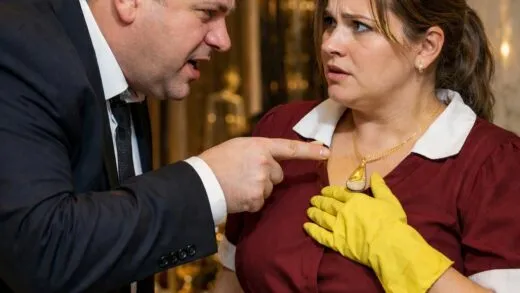
Eleanor started with the last phone call, then shook her head. “No. Earlier than that. From when the three boys arrived. How they signed up for tutoring. How on the fourth session they locked the door.”
She told him everything. Plainly. No tears. Like reading from a statement. The desk. The blows. The threats. The letter overseas. The photos. Maggie.
Mike lay still, but his breathing grew heavier.
When she finished, the room went silent.
Then he asked, “What date?”
“August 28.”
“Did you go to the police?”
She said yes. Filed the report. Three days later it was closed. They said it was consensual. The fathers took care of it.
Mike sat up slowly, threw off the blanket, crossed to the duffel bag in the corner, and opened it. He took out an army knife with a black handle. The blade was worn but razor sharp. He set it on the table.
“Names,” he said.
Eleanor sat up too. “Victor Cole. Sean Morris. Daniel Lewis.”
He nodded, picked up the knife, and tested the edge with his thumb.
“Where do they live?”
“Cole is in the new house near the county offices. His father works for the state. Morris lives in the apartment attached to the sheriff’s building. Lewis lives out by the farm property. His father runs the ag college.”
Mike slipped the knife into the pocket of his hanging coat.
“They still in school?”
“No. They finished out by special arrangement. Now they just drift around. Motorcycles, the rec hall, girls.”
He nodded again.
“Did you say anything to them after?”
“No. I kept teaching. They don’t come near me. They just watch sometimes.”
Mike walked to the window and looked out into the dark.
“Over there,” he said, “I learned how to remove people so thoroughly they were never found. No body. No trail. No questions.”
Eleanor got up and went to him. “Mike, no. Please. They’ll put you away. Maggie will grow up without a father.”
He turned sharply. “If not me, then who? The sheriff? The prosecutor? The county board? They’ll cover for them again. And next time—”
He stopped.
Eleanor took his hand. “I’m asking you to think about us.”
He looked straight at her. “I am thinking about you. Every day over there. Every day here.”
He pulled his hand free and went to the table. He took out a notepad and an old army pencil and began writing down addresses, habits, routines.
Where Victor filled up his motorcycle. Where Sean ran in the mornings. Where Danny met girls near the rec hall.
Eleanor stood beside him and watched him write. The letters were neat and square.
“When?” she asked softly.
“Not right away. I need to watch. Learn how they move. Find the weak spots.”
She nodded.
“Just promise me you’ll come back to us.”
Mike looked up. “I always come back.”
He closed the notebook and laid it beside the knife.
Then he came over and held her tightly, the first real embrace since he’d been home.
“Try to sleep, Ellie. Tomorrow’s New Year’s Eve.”
She lay down, but she never really slept. She listened to him breathing beside her, slow and steady, and thought: He’s already decided. And I can’t stop him.
On New Year’s Day Maggie woke first, shouting about presents and Santa. Under the tree were three packages: a doll for Maggie, a scarf for Eleanor, and a carton of cigarettes for Mike.
He smiled for real that time. But when Maggie ran off to play, he said quietly to Eleanor, “Today I start watching. Just watching for now.”
Eleanor nodded. In that moment she understood there was no turning back.
Mike began surveillance on January 3. Every morning he left the house carrying an ax, as if he were headed for firewood, then took the long way past the agricultural college property.
Danny Lewis lived in a small separate house near the office. His father had arranged it so he wouldn’t be underfoot at home. The boy slept late, usually until eleven, then came out in gym shorts and smoked on the porch.
After that he’d start his motorcycle and ride either into town or over to see girls in the next county. Within a week Mike knew his routine cold.
On Saturdays Danny rode out to a hay field across the river. His father kept land there, and Danny was supposed to be helping. In reality he drank beer by the haystack and slept until evening.
Alone. No friends. No one watching. Ideal.
On Friday night Mike told Eleanor, “Tomorrow I’m leaving early. Tell your mother I went hunting for rabbit.”
She looked at him. “Danny?”
“Yes.”
“Be careful.”
He nodded. “I always am.”
On the morning of January 16, Mike left at five. He took a backpack, the knife, a length of rope, and two heavy stones wrapped in cloth. He wore a dark work jacket and a plain knit cap.
He cut through the woods for about three miles and reached the river an hour before sunrise. He hid in a stand of fir trees across from the haystack where Danny usually stopped.
At 10:30 he heard the motorcycle.
Danny came around the bend without a helmet, leather jacket on, a case of beer and a fishing pole strapped behind him. He killed the engine by the haystack, opened a bottle, and drank half in one pull.
Then he stretched out on the hay and lit a cigarette.
Mike waited another forty minutes. Danny drifted off. The bottle slipped from his hand.
Mike came out of cover without a sound. He walked up behind him. Danny never heard him.
Mike crouched, looked once at the sleeping face—young, smug, even in sleep.
He struck once at the base of the neck. There was a crack. Danny jerked, eyes opening, but no air came.
Mike forced his face into the hay and held him there until the body went still. Twenty seconds, maybe less. Then came the ugly part.
He dragged the body to the river, about thirty yards. Stripped it down so it wouldn’t trap air and rise too fast. Tied the stones to the ankles with a figure-eight knot, checked the tension, hauled the body to the bank, and pushed.
It entered the water with barely a splash. The current took it at once, the stones pulling it under.
Mike watched until the ripples disappeared. Then he went back to the motorcycle and started the engine, leaving it running to suggest the boy had only stepped away for a minute.
He put the keys in Danny’s jacket pocket and left the jacket on the hay. He tipped over the beer case so bottles rolled into the grass. He stuck the fishing pole into the soft ground.
Then he left through the woods the same way he’d come.
He was home by lunch. Eleanor met him in the mudroom with the question already in her eyes.
“Done?”
“Done.”
She didn’t ask for details. She just held him.
Maggie asked where Daddy had been.
“Tell her I was chasing rabbits through the woods.”
That evening Mike sat on the porch cleaning his knife.
Maggie ran up to him. “Daddy, did you catch one?”
“Nope. Smart rabbit got away.”
She laughed. “Did you see Danny? He said he’d bring me candy.”
Mike froze for half a second. “No, didn’t see him. Maybe tomorrow.”
She ran back into the yard.
Three days later the town was buzzing: Danny’s motorcycle had been found by the river. The engine had died, but the tank was full. The beer case was empty. The fishing pole was stuck in the ground.
His jacket was still on the haystack. Danny himself was nowhere.
His father came out in person, red-faced and furious, demanding a search. Deputies arrived the next day and combed the riverbank and fields, but found nothing.
A young investigator interviewed neighbors. One said he’d seen Danny ride out alone that Saturday morning. The investigator wrote it down and asked about the boy’s drinking.
After a week the search was scaled back. No body. Officially, the assumption was drowning: drunk, went into the water, current took him.
People in town said he’d probably had too much and gone in after a swim. Young and foolish. Nobody connected it to Eleanor.
She kept teaching, telling students Danny had gone to stay with relatives for a while.
That evening Mike told Eleanor, “One down. Two left.”
She nodded. “Will they be nervous now?”
“Yes. Sean was already asking around at the rec hall yesterday. Victor’s keeping quiet, but he’s watching over his shoulder.”
Eleanor took his hand and asked him not to rush. He told her he had no intention of rushing.
“Sean’s next. He runs alone every morning.”
Mike stood, put the knife away, and said he’d start mapping the route tomorrow.
Eleanor said nothing. She just held his fingers tighter.
That night she slept badly. She dreamed of Danny, wet and pale, stones tied to his feet, standing at the window and simply looking in.
Mike slept soundly, as if nothing unusual had happened.
Two days after the search for Danny was called off, Sean and Victor met outside the rec hall. They stood by their motorcycles smoking.
Sean kept tugging at the zipper on his jacket and talking in a low voice about the missing body. Victor spat and said he’d heard Danny’s father had demanded divers from the state.
Sean glanced around and said it didn’t add up. Danny could swim.
Victor gave him a cold look and asked who, exactly, would dare do something like that.
Sean shook his head and said maybe they should stop going around alone for a while.
Victor nodded, but said he wasn’t giving up his morning runs. Didn’t want to get soft.
They rode off.
Mike heard about the conversation from a neighbor who’d happened to overhear them. On the morning of January 18, he left at six with an old bicycle.
He rode out along the dirt road Sean used every day. Mike knew the route by then: from the sheriff’s apartment to the old bridge, about three miles out and back. The quietest stretch was between mile two and three, where thick brush crowded the road and almost nobody passed through.
Mike hid the bicycle in the brush, walked another two hundred yards, and found the right spot: a bend where the road sloped downhill and a large mossy rock sat just off to the side.
He crouched behind a tree and waited.
At 7:05 he heard the rhythm of running shoes. Sean came along in a tracksuit, headphones on, a small tape player clipped at his waist. His breathing was steady. He never looked back.
Mike stepped onto the road the moment Sean drew even with him.
Sean pulled one earphone free. “Who are you?”
Mike stepped closer and said his name.
Sean frowned. “How do you know me?”
“I know.”
Sean stopped fully and looked at the tall man in the dark jacket.
“You’re the teacher’s husband. Smith?”
Mike didn’t answer. He just moved forward.
Sean understood at once and turned to run. Mike was faster. He grabbed Sean by the shoulder, spun him back, blocked the swing that came at him, and swept his legs out.
Sean hit the ground on his back and shouted, “Don’t!”
Mike dropped to one knee, pinned his chest, and struck hard at the temple. There was a crack. Sean jerked once, then again, and went still.
His eyes stayed open. The pupils were blown wide.
Mike checked for a pulse. Nothing.
He dragged the body to the rock and struck the temple against it hard enough to draw blood. Blood came quickly. He smeared some on the stone and arranged the head so it looked like a fall.
Sean’s bicycle was in the brush nearby. Mike rolled it closer and laid it on its side to complete the picture.
Then he stepped back into the brush and waited ten minutes. No one came.
He returned to his own bicycle and rode home.
Eleanor was waiting in the kitchen.
“Did you do it?”
“Yes.”
She poured him coffee and asked how it happened.
“Temple strike. Then I staged a bike fall. Blood on the rock.”
Eleanor nodded. “Did he suffer?”
“No. It was quick.”
She looked down into her mug. Now only Victor was left, and he would be the most frightened of all.
At nine that morning a local farmer found the body, shouted for help, and ran back toward town. Within an hour deputies arrived, though not the sheriff—Sean’s father had been taken to the hospital with chest pains.
An investigator from the county questioned witnesses, but no one had seen anything. He told the medical examiner it looked like a fall from a bicycle. The examiner agreed: fatal head trauma, death on impact.
Sean’s mother arrived and collapsed beside the body, refusing to believe it was an accident. But there was no evidence to say otherwise.
The town started whispering about a curse. Two dead in one week. Some said it was the wages of bad living and too much drinking.
Victor heard the news that evening at the rec hall and went pale. He turned, walked to his motorcycle, and his hands were shaking.
He locked himself in his room and chain-smoked, thinking of his two dead friends and that afternoon in the biology classroom.
He came to one conclusion: either the teacher or her soldier husband was behind it.
Victor decided to wait until morning and tell his father, who was out of town. Meanwhile Mike sat in the kitchen with Eleanor and said the last one understood now.
Eleanor asked him not to rush the third.
Mike said, “I’ll give him a couple of days. Let him sit with it.”
She asked about the autopsy findings. He said it had all gone down as an accident.
Quietly, she asked, “Is this hard for you?”
Mike answered, “Harder to leave them alive.”
That night Eleanor didn’t sleep. She dreamed of Sean running.
After the funeral, Victor stayed inside for three days. His father returned from the state capital on January 24 and went straight into his son’s room.
Victor, half-hysterical, said his friends had been murdered.
His father asked who told him that.
Victor admitted they had hurt a teacher, and her husband—a combat veteran—had come home for revenge.
His father demanded proof. There was none.
He told Victor to leave town and stay with an aunt in the city. He’d send him in the black county sedan with a driver. Victor agreed immediately. His father planned to remain behind with private security.
Mike heard about the plan from a loose-tongued neighbor.
That evening he told Eleanor the last boy was leaving in his father’s car with a driver.
Eleanor went still. “What about the driver?”
“If I have to, I have to.”
He left at two in the morning with a backpack, homemade metal spikes, a gas can, and the knife. He walked four miles to the state highway.
He chose a stretch just past a curve where the road sloped downhill and the pavement was slick from rain. He laid the spikes across the road in three rows and hid in thick brush.
At five a.m. he heard the engine of the black sedan. The car hit the spikes at speed. Tires blew in sharp bursts. The sedan fishtailed, slid into the ditch, and slammed into a tree.
Mike came out and approached the wreck. The driver was dead from the impact. Victor, in the back seat, was dazed but alive…