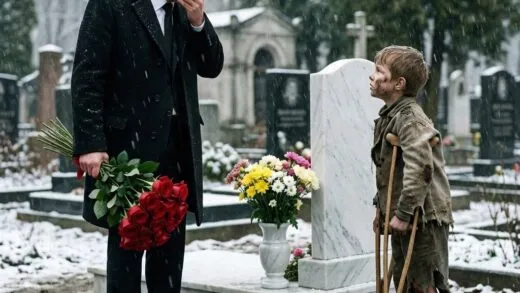
My son-in-law wiped his feet on my daughter and told the guests she was a crazy maid.
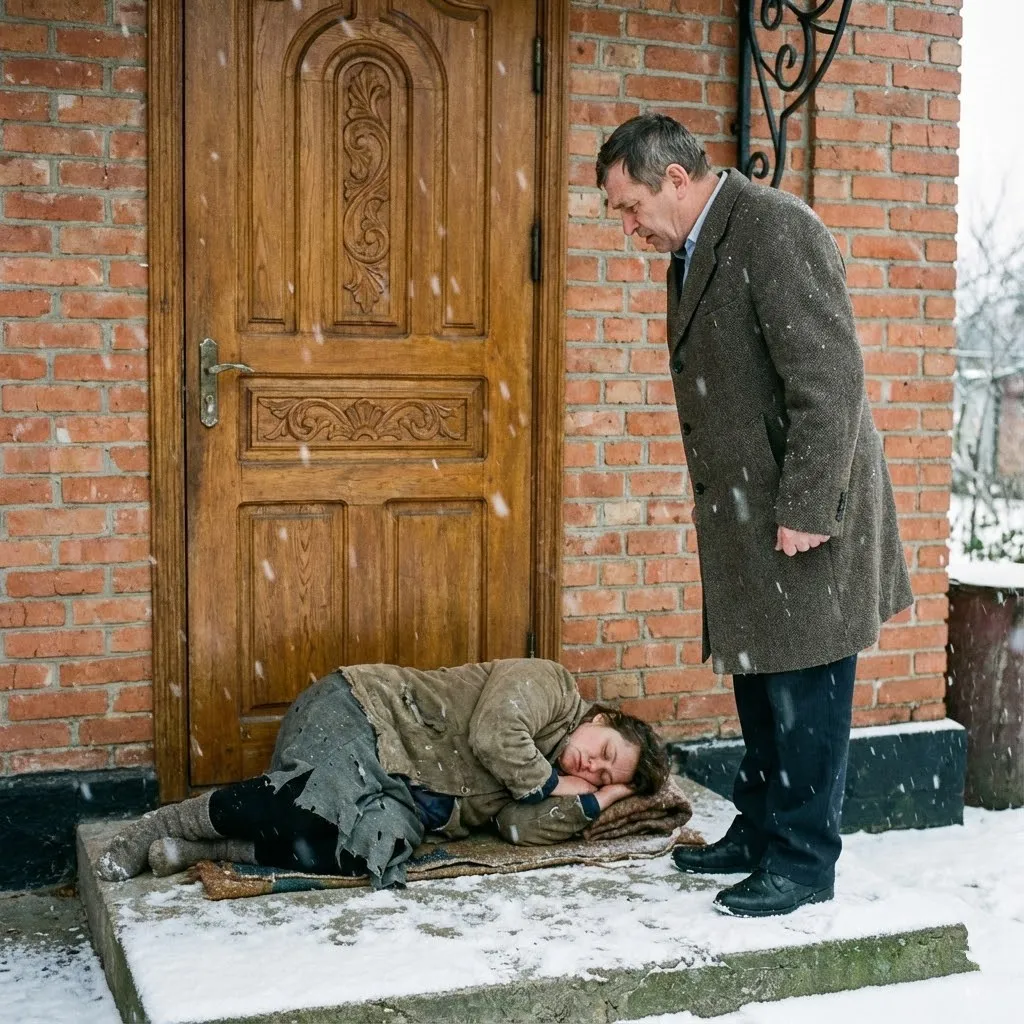
I unexpectedly arrived to visit my daughter. She was lying on the mat by the door, dressed in torn old clothes. Her husband wiped his feet on her and said to the guests: “This is our crazy maid.”
I didn’t scream. I took a step forward, and everyone froze because one of the guests dropped his glass and stared at me as if he had seen a ghost. Twenty years ago, I saved his life. I held his intestines with my hands on the operating table for four hours. He swore he would repay the debt. The time had come.
But I didn’t know the most important thing yet. I didn’t know that my daughter married this man because he looked like me. I didn’t know that she had spent her whole life looking for a man who would control her, humiliate her, break her, because I taught her that this is what love is. Her husband turned out to be me, only louder, only more honest. And now, to save my daughter, I will first have to admit that I destroyed her myself.
The taxi stopped three hundred meters before the mansion, and the driver killed the engine, making it clear he wouldn’t go any further. Viktor Sergeyevich looked at him in the rearview mirror and saw the stubbornly set lips of a man who had made a final decision and wasn’t going to change it.
“I can’t go any further,” the taxi driver said without turning around. “The owner of this house doesn’t like strange cars at the gates. Last time I came here, security slashed my tires. I still need to work with this car.”
Viktor didn’t argue. He paid, took a small travel bag from the back seat, and stepped out onto the roadside of the country lane. The October wind hit his face, bringing with it the smell of rotting leaves and distant smoke.
The mansion towered on a hill, surrounded by wrought-iron gates and a hedge that looked perfectly trimmed even on a gloomy day. The taxi turned around and drove away, leaving Viktor alone on the empty road. He stood for a minute, examining the house where his daughter lived.
Three floors, white columns, panoramic windows—wealth that was supposed to signify happiness. A year and a half ago at the wedding, he looked at Anya and thought she had finally found what she deserved: a young, successful, courteous husband, a house that looked like a palace. A future in which she would never have to count money until payday, as her mother had done.
A year and a half ago. Since then, Anya had stopped answering calls. At first, she didn’t pick up, then she sent short messages: “busy, will call later.” Later never came. Viktor wrote emails, but the replies became shorter and more formal until they stopped altogether. He called the home number, but a polite female voice always answered, stating that Anna Viktorovna was resting and could not come to the phone.
Three weeks ago, Viktor received the last message from his daughter. Just two words: “Dad, help.” He called back immediately, but the number was unavailable. Since then, Anya’s phone had been silent.
And here he was. Without warning. Without an invitation. A sixty-year-old retired military surgeon who had seen a lot in his life but had never felt such cold in his chest as now, looking at this beautiful white house.
Viktor threw his bag over his shoulder and walked along the road toward the gates. With every step, the cold in his chest grew stronger, though he couldn’t explain why. Everything looked normal. A well-kept garden behind the fence. Expensive cars in the driveway. Lights in the first-floor windows. Sounds of music and laughter drifting from inside.
There was a security booth at the gates, but it was empty. Viktor pressed the buzzer and waited. No one answered. He pressed it again, longer. Silence again. Then he pushed the wicket gate next to the main gates, expecting it to be locked, but it yielded easily.
Viktor entered the grounds and moved up the driveway toward the main entrance. Now he heard the music more clearly—some jazz—and the voices of many people. There was clearly a party going on in the house. Climbing onto the porch, he rang the doorbell. Waited. Rang again. The door didn’t open, although noise could be heard behind it.
Viktor walked around the house to the right, following the wall. The music got louder. Around the corner, he found a terrace with panoramic windows, through which a large hall full of people was visible. Men in expensive suits, women in evening dresses. Waiters with trays. A sparkling chandelier under the ceiling. He scanned for his daughter but didn’t find her among the guests.
Further along the wall, Viktor found a small door, clearly a service entrance meant for staff. He pushed it, and it turned out to be unlocked. Inside was a narrow corridor with white walls smelling of cleaning detergent. A corridor for service staff leading to the main rooms. Viktor walked down it, opened another door, and found himself in the mansion’s foyer.
And then he saw his daughter.
Anya was lying on the floor near the front door, right on a decorative mat with the inscription “Welcome.” She was wearing a washed-out gray T-shirt and sweatpants with holes in the knees. Her hair, once thick and shiny, hung in tangled greasy strands. She didn’t move, just stared at the ceiling with empty eyes, as if she saw and heard nothing around her.
Guests walked past her as if she were a piece of furniture. Someone stepped over her legs. Someone walked around her without looking down.
And then a young man in a perfectly fitting gray suit came out of the living room. Viktor recognized him. Arkady. Anya’s husband, whom he had seen only at the wedding and who had then given the impression of a well-bred, self-confident man.
Arkady walked to the door without looking at his feet. He stepped right onto Anya, onto her stomach, and began to wipe the soles of his patent leather shoes. He rubbed first one, then the other, as if she were not a human being but an ordinary doormat.
“Ladies and gentlemen,” he said loudly, addressing the guests in the foyer. “Pay no attention, this is our crazy maid. The poor thing is out of her mind, but we take care of her.”
“Charity, you see,” one of the guests chuckled. Someone shook their head with feigned sympathy. No one objected.
Viktor stood in the doorway of the service corridor, and the world around him narrowed to the size of this scene. To his daughter’s body on the floor. To the polished shoes on her stomach. To the laughter that sounded like glass scraping against glass.
He didn’t scream. He didn’t rush forward. He took one step, just one step toward the foyer, and at that moment someone in the living room dropped a glass. The sound of glass hitting the marble floor made everyone turn their heads.
In the doorway of the living room stood a gray-haired man of about sixty-five in an impeccable dark blue suit. A glass of champagne lay at his feet, and a light puddle was spreading across the floor. But he didn’t notice it. He looked at Viktor as if he had seen a man risen from the grave.
Viktor recognized him too. He had seen those eyes twenty years ago when they opened after a multi-hour operation. Grekov. Igor Petrovich Grekov.
Back then, he was a young businessman who had been in a terrible accident on a mountain road. Ruptured spleen, liver damage, multiple internal hemorrhages. Any other surgeon would have refused, would have said there were no chances. Viktor operated for four hours straight, literally piecing the man back together. When Grekov regained consciousness, he cried and repeated: “I will repay the debt. Whatever the cost. I am in your debt for the rest of my life.”
Now this man stood in the middle of a party and looked at Viktor with eyes full of horror.
“Viktor Sergeyevich,” Grekov whispered. And his voice trembled…