
 Let’s Keep It Real

The oval mirror in an oak frame, inherited from the previous owners of the mansion along with a pair of armchairs and a heavy chandelier in the living room, reflected a woman in a beige dress with a collar right up to her throat. Exactly the kind Arthur would have approved of, if he ever noticed what she wore. If he had looked at her even once in recent years as a living person and not as a piece of furniture. Veronica ran her fingers over her cheek, studying her face the way one studies a map of a forgotten land.
Her features were still young—35 is no age—but her gaze held something of boarded-up windows, of houses where the lights had long gone out and which were slowly sinking into the ground, forgotten by all. Outside, a December blizzard raged, hurling snow against the cottage windows with the fury only a northern winter is capable of, and this white shroud cut off the elite community from the rest of the world more reliably than any fence. Any security, any wrought-iron gates with video intercoms.
Her life over these years had become an expensive fabric from which her husband had tailored not a dress, but a furniture cover—convenient, practical, inconspicuous against the backdrop of the decor. 3,650 days. She kept this count with the same frightening precision with which prisoners scratch marks on their cell walls.
And every day of silence lived was deposited somewhere inside her, turning into a strange kind of capital, the value of which she herself did not yet understand. But she felt it: it was accumulating, maturing, waiting for its moment. An invitation lay on the vanity table in a thick envelope with gold embossing.
The name "Rheinmetall Industries" stabbed her under the ribs so sharply that she had to close her eyes for a second and remember how to breathe. An economic forum, 8 years ago. A different life, a different her.
Back then, she sat in the simultaneous interpretation booth, her voice flowing into the headphones of ministers and industrialists, turning German speech into their native tongue so smoothly that the listeners forgot the interpreter even existed.
The door flew open without a knock. Arthur never bothered with such formalities in his own home, which he loved to call "My fortress," forgetting that every fortress has a dungeon.
"Standing here, admiring yourself?" He scanned her figure the way a dealer assesses a car at a car market, looking for hidden defects, scuffs, signs of careless use. "Turn around."
Veronica obediently turned, squaring her shoulders out of habit, and her husband stepped closer, tugged at her collar, smoothing out a non-existent crease.
The movement was sharp, more like an attempt to strangle than a gesture of care, and she felt his fingers scratch her neck.
"It'll do," he finally pronounced, stepping back. "Although you still look like a village shopgirl who won the lottery and doesn't know what to do with the money. You chose the dress yourself, but what's the point? Even Dior would look like it's from a flea market on you."
Arthur took a velvet box with a jewelry house logo from his jacket pocket and snapped it open.
"Put this on. The Germans need to see that I'm serious."
The diamond necklace lay on her neck with a cold weight. Fifty thousand dollars turned into an elegant collar with a clasp she couldn't undo herself. Veronica felt the stones press on her collarbones, the metal chilling her skin, and thought that slaves in ancient times must have felt something similar when their masters adorned them before a sale. The gold on their necks changed nothing about their status, only emphasized their ownership.
"Keep your mouth shut at the banquet," Arthur continued, fastening the necklace's clasp and checking if it held securely. "Herr Schmidt is bringing a whole delegation, serious people are there, it's not for you to understand. You will be silent and smile. Got it? The last thing I need is for you to embarrass me in front of our European partners with your kitchen German."
"I remember: be silent and smile."
"And don't offer your hand first. Your palms are always damp, like a milkmaid's after her shift. The Germans don't appreciate that, they're a squeamish people."
He walked out without looking back, his heavy, proprietary footsteps echoing on the stairs—the steps of a man accustomed to the world parting before him.
Veronica was left alone with the mirror and the diamonds, which were worth more than her annual salary in that former life. Although no, in her former life, she earned one and a half, and on good days even two thousand dollars per shift, so the necklace would have been about a month and a half of good work, no more.
When her husband's footsteps had completely faded, she opened the closet and, pushing aside a stack of woolen sweaters that he had also chosen himself, took out a wooden box with a carved lid. A gift from her mother for her university graduation.
Inside lay her true face, her authentic biography, hidden from her husband so carefully that he never even suspected its existence. A red diploma from the translation faculty of the State University with honors in all special disciplines. A DAAD certificate with a Gothic font title and the Heidelberg University crest. Simultaneous interpreter accreditations with the logos of international economic forums and energy giants. A photograph in a thin frame of a young woman in a strict suit next to the German ambassador at a reception for the opening of a trade mission. And separately, in a transparent sleeve, a worn badge with the blue UN emblem and her name, typed in the official font of international documents.
Eight languages at a professional level: German, French, English, Japanese, Italian, Spanish, Chinese, and sign language, which she had studied as an elective because the instructor said that a true translator must be able to work with any audience. Three of them—with Hanoverian, Kansai, and Tuscan accents, because the professors believed that a good simultaneous interpreter must adapt to regional speech patterns, catch dialectal nuances, and feel the difference between Berlin and Munich pronunciation.
Veronica ran her finger over the glossy surface of the diploma and remembered the sanatorium in the mountains, the pine-scented air, the crunch of snow under her feet, and her own reflection in the ward window—pale, exhausted, empty.
She had come there more than ten years ago, broken, gutted, having lost her child in the fourth month after three consecutive conferences, after a series of night flights across time zones, after weeks of sleeping 4 hours a night and living on coffee from vending machines. The doctors said her body couldn't handle the load. She told herself: "You killed him with your work, your ambitions, your desire to be the best."
Arthur appeared then like a savior—attentive, generous, showering her with flowers and promises, vowing to protect her from all the world's anxieties and take care of her as she deserved. She didn't notice the moment when "protect" turned into "lock up," when "take care of" became "decide for her," when his love turned into total control over her every step, every word, every breath.
He had met her already broken, depressed, having given up her career for her health, and decided that she had always been like this: quiet, obedient, grateful for every handout. It was more convenient for him to think that his wife was a former secretary who knew a little bit of languages, who had accidentally drawn a lucky ticket in the lottery of life. He wasn't interested in what she did before meeting him. What was her job, what had she achieved? All that remained outside the bounds of his curiosity. It was more convenient for him not to know, more convenient to consider her a nobody.
Veronica closed the box and put it back, behind the stack of sweaters, where Arthur would never look because he never put things there himself. Then she went to the mirror, took out a dark red lipstick from her makeup bag—a gift to herself on her last birthday, a secret, unapproved purchase made stealthily at the mall—and carefully applied it to her lips, watching how her face changed, how something of the old Veronica appeared in it. It was her small rebellion, a tiny act of defiance that Arthur might not even notice, but which she herself would feel all evening.
She looked at her reflection: a beige dress, a diamond necklace, dark red lips. And the sound of the door closing behind her husband seemed to her a harbinger of something inevitable, a tectonic shift that had already begun and could not be stopped.
The interior of the Bentley smelled of leather and her husband's cologne—heavy, amber, as self-assured as its owner, filling the entire space and leaving no room for anything else. Arthur stared out the window at the passing lights of the central avenue, at the snow swirls in the lamplight, at the dark silhouettes, and dictated the rules without turning his head. Why look at his wife when he could look at the city he considered almost his own?
"You stay to my left. Not in front, not behind, to the left, half a step away. When I'm talking to someone important, you don't interrupt, don't comment, don't put on an intelligent face. If someone addresses you directly—you smile, you nod, you say 'yes, yes, of course.' Nothing more. Understood?"
"Alright."
"Karina will be translating. By the way, she graduated from a prestigious academy, knows two languages, not like country bumpkins like you. With her, I don't have to blush in front of foreigners."
Veronica silently watched the snow swirls outside the window, the city lights flickering like sad meteors, her blurred reflection in the glass. A month ago, she had checked his card statement. Not on purpose: the envelope was lying on his office desk, she went in to get a cup, and her gaze accidentally fell on the lines with the sums. A downtown department store, a jewelry boutique, a Cartier bracelet for ten thousand dollars. The date of purchase coincided with his last business trip. She had never seen this bracelet, which meant it wasn't for her.
"Are you even listening to me?"
Arthur's voice cut through her thoughts. "Half a step to the left. Smile, nod. That's a good girl. Maybe you've finally learned something in ten years."
At the entrance to the Marriott, a woman of about twenty-seven in a burgundy dress with a deep neckline, showing off tanned skin and a gold chain, was waiting for them. Karina rushed to Arthur before the car had completely stopped, and a smile bloomed on her face, intended for him alone. A smile that women give not to bosses, but to lovers. Intimate, promising, leaving no doubt.
"Arthur, finally! Herr Schmidt is already in the VIP area, getting nervous, checking his watch." She lowered her voice to a half-whisper, leaning so close that her perfume, sweet, heavy, completely unsuitable for a business event, enveloped him. "I ordered him schnapps, as you said, but he's still frowning. Germans are such pedants."
"It's fine, we'll sort it out." Arthur covered her hand with his, holding the touch a second longer than necessary.
Only after that did Karina deign to turn to Veronica, giving her a look one gives to a servant who has forgotten her place, or to old furniture that should have been thrown out long ago but there was never time.
"Oh, Veronica! What a modest outfit," her voice rang with mockery, poorly disguised as social courtesy. "At first, I thought it was our driver Michael who brought his wife to the banquet for a dance."
She laughed brightly, confidently, with the laughter of a woman who knows her place in this hierarchy. And on her wrist gleamed that very bracelet: ten thousand dollars, Cartier, white gold with a diamond clasp.
Arthur chuckled along with her, not even glancing at his wife, and took Karina's arm with the same gesture men use for women they are proud of.
"Let's go, darling. It will do Veronica good to walk a bit, stretch her legs after the car. Her doctors recommended more movement."
They moved towards the elevators ahead, shoulder to shoulder, like the hosts of the evening, like a couple that belongs together. And Veronica trailed behind, a few steps away, feeling the indifferent gaze of the doorman in a livery with golden buttons.
Ten years. Ten years of her youth, a buried career that her colleagues had envied, a child she had lost and mourned alone. And this was the result. Walking behind her husband's mistress like a freeloader, like a poor relative from the provinces invited out of pity.
But something inside her didn't break in that moment. On the contrary, it fell into place, like a vertebra that had been displaced for years and suddenly snapped back into its correct position. The Veronica who had argued with university professors and won, who had received grants in Heidelberg, beating a hundred applicants, who had translated speeches for ministers and was not afraid to correct a diplomat if he misquoted Goethe. That Veronica hadn't gone anywhere. She had just been sleeping. For ten years.
The banquet hall on the top floor shone with lights, and beyond the panoramic windows, the night city stretched out. A scattering of lights to the horizon, traced by the dark ribbon of the river and the twinkling dots of car headlights on the bridges.
Arthur pointed to a round table behind a decorative column wrapped in artificial ivy and a garland, in the farthest corner of the hall, away from the main guests.
"Sit here. Eat. Drink. Don't stick your neck out," he said in the tone one uses to command a misbehaving dog, without looking it in the eye. "If I need you, I'll send Karina, she'll find you."
"Of course," Veronica replied and sat down on a chair with velvet upholstery, ordering still water with a slice of lemon from a passing waiter.
The spot behind the column turned out to be a perfect observation point. From here, the entire hall was in plain view, and no one paid her the slightest attention. Because who is interested in a gray mouse in a beige dress when there are so many bright outfits, so many loud voices, so many important people wanting to be noticed? "The cheap seats in the theater," she thought, bringing the glass to her lips, "the cheapest seats, but the best view."
The German delegation was seated at the main table in the center of the hall. Six men in identical dark suits sat with the straight posture of people accustomed to expensive chairs and the attention of others. At the head sat Herr Schmidt—gray-haired, tall, lean, with the face of a man accustomed to the world adapting to him, not the other way around, and who tolerated no objections.
Veronica recognized him immediately, although eight years had passed. The Hanoverian accent with its characteristic pronunciation of consonants, the habit of tapping his index finger on the table when his interlocutor was saying something foolish, and an intolerance for unprofessionalism that made working with him both challenging and exciting.
Next to Schmidt sat a young man with a leather folder and a notepad—obviously a translator sent by some capital firm or hired through an agency. The guy had clearly been hired from an ad for "cheap, urgent, on-site," and he was already losing this race by a landslide. Sweat beaded on his forehead, his tie was askew, and his eyes held the expression of someone who realized he had boarded the wrong train but it was too late to jump off.
The Germans exchanged glances with an expression of polite bewilderment, which in business circles means "we are wasting our time," and in those glances one could read what people of her former profession called "the syndrome of an impending catastrophe." The premonition of a failure that could not be averted.
Arthur, oblivious to everything, smiled broadly, gestured energetically, and said something, occasionally patting the nearest German on the shoulder with a familiarity that Europeans cannot stand. Karina translated, stumbling over every third word and mixing up cases, and it was clear how Schmidt's face was becoming more and more stony with each of her phrases.
Veronica took a sip of water and leaned back in her chair, feeling for the first time in many years not fear, not shame, not the usual melancholy, but a thrill. The same thrill that used to grip her in the simultaneous interpretation booth, when milliseconds counted, when million-dollar contracts and people's fates depended on the precision of a single word, when she was balancing on the edge of the possible and the impossible. And it was the best feeling in the world.
The catastrophe was approaching inexorably. She saw it as clearly as an experienced doctor sees the symptoms of a disease long before the patient feels anything. An incompetent translator. The growing irritation of the Germans. Arthur's blind self-confidence, who didn't even realize that everything was going wrong. It all added up to a picture of inevitable failure, and for the first time in 10 years, Veronica found herself not fearing this failure. She was waiting for it. She was ready for it.
The disaster began with something small, with a single wrong word thrown into the silence of the banquet hall. Arthur, flushed with champagne and his own importance, was waving his arms in front of the German delegation, talking about mutually beneficial cooperation and the joint use of licenses. The young translator tried to keep up with the stream of words, stumbling over every other phrase. From her spot behind the column, Veronica could see the beads of sweat on his forehead, how he frantically flipped through his notepad in search of the right term, and she knew: something was about to happen.
"We propose the joint use of manufacturing licenses," Arthur smiled broadly, patting the nearest German on the shoulder. "Translate for them that it's beneficial for everyone."
The translator swallowed and squeezed out a sentence in which, instead of "licensing," the words "full transfer of ownership rights" were heard. In a legal context, this meant that the host party was laying claim to the intellectual property of the German concern.
Chairman Schmidt's face, which had previously maintained an expression of polite boredom, turned crimson so rapidly that for a second Veronica feared he might have a stroke right there, in the middle of the New Year's banquet. He slammed his palm on the table—sharply, briefly—and a champagne glass overturned, spilling its golden liquid onto the pristine white tablecloth.
The music stopped. One hundred and fifty guests froze, turning their heads towards the epicenter of the storm.
"This is an outrage!" Schmidt hissed in German, addressing his colleagues. "We're packing up. We're leaving. Immediately."
He turned to the French consultant sitting on his right and switched to French, loudly, without hiding, confident that no one in this room would understand him:
"These locals take us for idiots. I should have trusted my intuition and not gotten involved."
Arthur turned so pale that the freckles on his nose, usually unnoticeable, stood out like ginger specks on a gray background. He didn't understand a word, but he could see: the Germans were gathering their documents, buttoning their jackets, rising from the table. The twenty-five-million-dollar contract, the biggest deal of his life, for which he had been courting these arrogant Europeans for half a year, was crumbling before his eyes.
"Karina!" he grabbed his assistant's elbow. "Do something! Tell them!"
Karina began to rattle off in her English, mixing up tenses and articles. But the Germans didn't even turn their heads. They were already walking towards the exit, with Schmidt leading the procession with the air of a man deeply offended.
Veronica placed her glass of water on the table. The sound was not loud, but it seemed to her that the whole room heard this clink, like the bang of a judge's gavel before a verdict is announced. She adjusted the collar of her beige dress—the same modest dress her husband had chosen for her—squared her shoulders, and stood up. Her feet carried her through the parting crowd of guests before she had time to consider the consequences.
Her walk changed on its own. These were no longer the timid steps of a housewife accustomed to looking at her feet and hugging the walls. This was the confident stride of a woman who knows her worth and is not going to apologize for her existence.
"Where are you going?!" Arthur lunged at her, grabbing her shoulder. "Sit down! Don't you dare embarrass me! Veronica, are you out of your mind?!"
Karina clung to her elbow, and the Cartier bracelet scratched her skin. Veronica didn't turn around. She calmly freed her arm, not with a jerk, but in a way that Karina's grip loosened on its own, and continued walking straight towards Schmidt, who had almost reached the banquet hall doors.
"Chairman Schmidt!" she spoke in German, and her voice sounded clear, with a flawless Hanoverian accent that Germans consider a sign of true education. "Please, one moment of your patience. There has been an unfortunate misunderstanding in the translation..."
The hall fell silent. One hundred and fifty people stopped breathing, stopped whispering, stopped clinking their glasses, and in this sudden silence, Veronica's words hung like notes in a concert hall after the final chord.
Schmidt stopped. His eyebrows shot up, and he slowly turned, examining the woman before him the way one examines an unexpected find in an antique shop: with surprise turning into professional interest.
"Who are you?" he finally asked in German.
"Veronica Polyakova," she replied in German and gave a slight nod—not the subservient bow of a petitioner, but the polite greeting of an equal. "I am Mr. Polyakov's wife, but today I am here as someone who understands the true value of this contract. Your interpreter made a grave error. Licensing and transfer of ownership are completely different concepts in German patent law. You are a lawyer, you understand the difference."
Schmidt was silent for a few seconds, studying her face, and Veronica met his gaze calmly, without looking away, just as she had once met the gazes of ministers and ambassadors in negotiation rooms.
"You speak German beautifully," he finally said, a hint of surprise in his voice.
"A Hanoverian accent, if I'm not mistaken? Heidelberg University, a DAAD scholarship," she replied, the corner of her mouth twitching into a barely perceptible smile. "Many years ago. But one does not forget a language."
Schmidt nodded to his delegation, and the Germans, after exchanging glances, returned to the table. He gestured for Veronica to take a seat next to him—the very seat that the hapless interpreter had occupied a minute ago.
The French consultant, Tailing, a tall, lean man with the thin lips of a skeptic, leaned back in his chair and spoke in French, clearly intending to put this upstart in her place:
"Let's assume, madam, that you speak German. But how do you plan to deliver the equipment under the current circumstances? The traditional routes are closed."
Veronica turned to him and answered in French—in that impeccable Parisian French taught to her by Professor Dupont at the university, who made her repeat every phrase until her accent was indistinguishable from a native Parisian's:
"Monsieur Tailing, we propose an alternative route through Asia. The international transit corridor allows for customs clearance in 72 hours. If you wish, I have the exact figures and calculations."
Tailing dropped his pen. It rolled across the table and fell to the floor, but he didn't even notice.
The Japanese strategist, Tanaka, who had been silently observing the proceedings, leaned forward and spoke in Japanese—quietly, with the slight smile of a man who has decided to conduct one final test:
"And what are your thoughts on cultural adaptation? What are the complexities of implementing German technology in the local market?"
Veronica smiled and replied in Japanese, politely, with a slight Kansai accent she had picked up from her Tokyo professor:
"One doesn't bring one's own rules to another's monastery, Tanaka-san. You have a similar proverb, correct? I propose creating joint engineering teams: local and German specialists working side by side."
Tanaka leaned back and began to applaud slowly. The Italian consultant, Romano, couldn't contain himself and threw his hands up:
"Madonna mia! I've never seen anything like it in my life."
"Thank you, Signor Romano!" Veronica turned to him and replied in Italian. "I consider myself a builder of bridges. Connecting different worlds—that is my job."
The applause started with Schmidt—slow and appraising at first, then growing louder—and spread through the hall like a wave, engulfing the tables, making people rise from their seats. Veronica sat in the center of this storm of recognition, feeling how the diamonds on her neck—the very ones that had felt like a collar an hour ago—now shone differently: not as a symbol of ownership, but as the adornment of a victor.
Schmidt stood up, and the hall fell silent.
"I want everyone to know..." He spoke in the host country's language with a strong accent, carefully enunciating each word. "Today, I was going to cancel the deal. The level of preparation on your side was unacceptable." He gave Arthur a long, hard look. "But thanks to Mrs. Polyakova, I have changed my mind. This contract is her achievement, entirely and completely."
He signed the documents, handed the pen to Arthur for the formal signature, and he signed mechanically. His hand moved on its own, and his face took on the expression of someone who had come to his own party only to find the cake had already been eaten without him.
Then Schmidt took a gold-trimmed business card from his breast pocket and handed it to Veronica.
"Mrs. Polyakova, Rheinmetall Industries is looking for a strategic advisor in this region. I cannot think of a better candidate." He paused, and something akin to respect flickered in his eyes. "The annual salary is something your husband won't earn in five years."
The journalists, the very ones Arthur had invited to cover his triumph, began snapping pictures, not of him, but of Veronica shaking hands with the German billionaire. In tomorrow's photos, he would be just a blurred silhouette in the background of his own celebration. Karina stood by the wall, biting her lip so hard that her lipstick smeared on her teeth. Her two languages and the red diploma from a prestigious academy, of which she was so proud, suddenly seemed pathetic, like children's scribbles next to a master's painting.
After the ceremony, as guests dispersed around the hall with glasses of champagne and excited chatter, Arthur grabbed Veronica's wrist and dragged her into an empty service corridor, where no one would see, no one would hear. He pushed her against the wall, and she felt the cold plaster dig into her shoulder blades through the thin cashmere of her dress.
"What the hell was that?!" His face was contorted: rage and fear vied for dominance, and it was unclear which was stronger. "You embarrassed me on purpose! How do you know German?! How do you know French, Japanese?!"
He raised his hand to slap her, his arm flew up, and Veronica saw his eyes—very close, bloodshot, furious. She didn't flinch, didn't raise her hands to defend herself, didn't cower as she had for ten years whenever he shouted, threw plates, called her a brainless chicken and a country bumpkin. She just looked him straight in the eyes, without blinking, and for the first time in a decade, her gaze did not fall.
"If you hit me, you'll lose everything." Her voice was calm, without a tremor, without a plea. "Schmidt is still in the building. He is very interested in me. Imagine tomorrow's headlines: 'Businessman Beats Wife After Signing Billion-Dollar Contract'."
His hand froze in mid-air.
"You... all this time..." He was breathless, unable to find the words. "You were pretending!"
"I was silent for ten years, Arthur." She spoke as she had an hour ago in the negotiations: measured, clear, without emotion, every word weighed. "But not because I had nothing to say, but because you never once asked. You wanted a doll, not a partner. You wanted a shadow that wouldn't eclipse your brilliance. Your love was built on my weakness, and only on that."
She saw his face change: from rage to confusion, from confusion to something like terror.
"You chose me when I was broken, Arthur. After the miscarriage, in depression, ready for anything for the illusion of a family. For ten years, you convinced me that I was a nobody. And you know what? I almost believed it."
His hand slowly lowered. Arthur looked at her, at this woman in a beige dress with diamonds around her neck, whom he had considered his property, his convenient accessory, his tame shadow, and for the first time in all these years, he saw the real her. And it scared him more than a torn contract, more than public humiliation, more than any threat he could imagine.
Veronica unclasped her handbag—the very one Arthur had bought her three years ago for some anniversary and which she had never used, considering it too expensive for a housewife—and took out a white envelope, thick, with the embossed logo of a law firm in the corner.
"This is for you." She handed the envelope to her husband, and her voice did not tremble.
Karina burst from around the corner—disheveled, with smeared mascara, obviously having eavesdropped on the entire conversation—and rushed to Arthur, grabbing his jacket sleeve.
"Arthur, don't listen to her! She's blackmailing you! It's all a lie, a provocation!"
Veronica didn't even turn her head in her direction.
"This is a conversation between a husband and a wife. Secretaries have no place here."
Karina opened her mouth, closed it, opened it again, and said nothing. For the first time in their acquaintance, she had nothing to say.
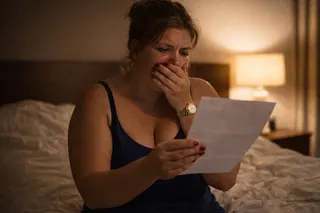
Arthur opened the envelope with stiff fingers, pulled out the folded sheets, scanned the first few lines, and his face turned as gray as the plaster on the walls of this service corridor.
"A divorce petition?"
Veronica nodded at the paper.
"Already signed on my part. Tonight was not about saving your deal, Arthur. It was about reclaiming what belongs to me: my voice, my life. I'll see you in court."
She turned and walked down the corridor towards the elevators, hearing Karina's scream and her husband's indistinct muttering behind her. But she didn't look back, because there was nothing to look back at. Her past was there, and she was walking into the future.
Outside, a blizzard was raging, and the frosty air—minus 25, at least—burned her face when she got into a taxi and asked the driver to open the window. The cold seeped through the thin cashmere of her dress, but it wasn't cold. It was freedom.
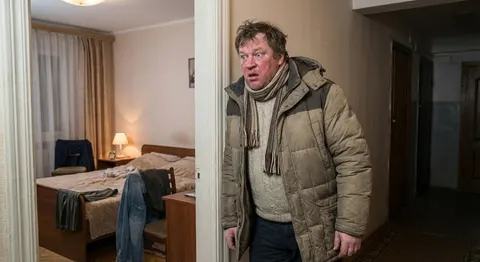
The next morning, Arthur burst into the mansion as Veronica was packing her last things into a suitcase. Without a jacket, without a tie, with the wild eyes of a man who had lost everything he believed in overnight.
"Veronica!" He fell to his knees right on the bedroom threshold, grabbed her legs, pressed his face to the hem of her robe. "Forgive me! Stay! I'll fix everything, I swear!"
She looked down at him, at this man who for ten years had called her a chicken, a country bumpkin, a shopgirl from the sticks, and felt nothing but exhaustion.
"I'll make you vice president of the company!" He clung to her knees. "I'll fire Karina today! I'll buy you anything you want! We'll go to Paris, to Milan, wherever you say!"
"Schmidt offered me a job with an annual salary of two hundred thousand dollars," Veronica gently freed herself from his grasp. "Bonuses. Plus an apartment in Berlin. I don't need your handouts."
Arthur rose from his knees, and his face changed. Pleading was replaced by anger, despair, the familiar contempt.
"Fine, leave!" He straightened up, squared his shoulders, trying to reclaim the last remnants of his dignity. "But you won't take anything from this house. This is my house. I built it."
Veronica opened her bag, took out a document folded in four with an official seal, and unfolded it in front of her husband's face.
"Certificate of ownership. Owner – Veronica Polyakova. Date of registration – 2012. Two years before our wedding."
Arthur snatched the paper from her hands. He stared at the lines, read them once, twice, a third time, and slowly sank onto the edge of the bed, because his legs refused to hold him.
"I bought this house with my own savings." Veronica took the document back and put it in her bag. "I earned enough in three years as a simultaneous interpreter. I let you live here to save you face: you were so proud of your mansion in front of your partners. You have one week, Arthur. Pack your things and move out. Otherwise, it's bailiffs and the police."
She left the bedroom with her suitcase and in the living room came across Karina, who was standing in the middle of the room with the air of a mistress, arms crossed and chin jutting forward.
"You're not going anywhere!" Karina jutted her chin even higher. "You think you're the smartest one here? Arthur will deal with your forgeries in no time. You'll be jailed for slander!"
Veronica put down the suitcase, opened her bag, and threw a folder of documents on the coffee table, a hefty one, bulging with papers.
"Here's your correspondence with Arthur about spying on me." She listed calmly, bending her fingers. "'She went to the library again, suspicious.' Photos of your meetings with a representative of a competing company. Statements of embezzlement. Business trips to Milan that never happened. Purchases at the central department store, written off as business expenses. And the last document—the results of a DNA test."
Karina turned pale.
"You're pregnant, Karina. Congratulations. But Arthur is not the father. He was on a business trip in Munich at the time of conception. I checked his tickets."
Arthur, who had appeared in the living room doorway, snatched the folder from Veronica's hands and began to frantically flip through the pages. His face changed: from disbelief to fury, from fury to something like hatred, now directed not at his wife.
"Is this true?"
He turned to Karina. "Answer me!"
"Arthur, it's a lie, she set it all up!" Karina burst into tears, smearing mascara across her cheeks. "She hates me, she wants to drive us apart!"
But Arthur was no longer listening. He threw the folder on the floor, the papers scattered across the parquet, and the screams, accusations, and sobs merged into a single hysterical chorus that Veronica left behind as she walked out of the house.
On the driveway, two people intercepted her. A portly woman in her mid-sixties with an imperious face and a younger woman, who resembled Arthur in features, jumped out of a black SUV.
"Stop, you ungrateful wretch!" Tamara, her mother-in-law, spread her arms, blocking the way. "Where do you think you're going? We took you in, pulled you out of the gutter, and you destroyed the family!"
"This is Arthur's property!" Ksenia, her sister-in-law, grabbed the handle of the suitcase. "You're not taking anything from here, you thief!"
Veronica took the ownership document from her bag, the same one, and handed it to her mother-in-law.
"Tamara, please read this carefully. The owner of this house is me, since 2012. It was your son who lived in my house, not the other way around."
Tamara clutched her chest, Ksenia dropped the suitcase handle and took a step back, looking at Veronica as one looks at a ghost.
"If you want to help Arthur, hire him a good lawyer. He's going to need one. Now, get out of my way, I have a flight to catch."
She got into the waiting taxi and saw in the rearview mirror how Tamara sank onto the snow-dusted driveway, and Ksenia was sobbing into her phone, pressing the receiver to her ear with both hands.
Two weeks later, after signing the contract with Rheinmetall, Veronica returned to Arthur's company office. But no longer as the owner's wife, but as an official representative of the German concern, accompanied by three German lawyers and two auditors with laptops.
"Gentlemen, Rheinmetall is concerned about the financial stability of its partner." She interrupted a meeting, walking into the conference room without knocking, and placed a power of attorney with Schmidt's signature on the table. "We demand a full audit."
The three-day audit revealed embezzlement of half a million dollars. Shell companies, fictitious contracts, Karina's personal expenses written off as business trips. At an emergency shareholder meeting, the largest of them, an old friend of Arthur's, demanded his resignation and criminal prosecution.
Three months later, Veronica sat in the district courtroom as the chief witness for the prosecution, looking at the defendant's dock where Arthur and Karina sat side by side. They didn't look at each other—haggard, broken, like random fellow travelers on a train to nowhere.
"I was silent, hoping to save my family," she answered the questions of the defense attorney, who was trying to portray her as a vengeful wife. "I spoke up only when silence became impossible."
The verdict: six years in prison for Arthur for embezzlement, three and a half years for Karina for complicity.
Outside, it was spring, March, dripping eaves, the first thawed patches on the sidewalks. A northern spring, late, but bright. The divorce decree was handed to her in the same courthouse—a thin sheet of paper with a blue seal, in which ten years of life were summed up in a few official lines. She went out to the square, took off her wedding ring, and put it in her pocket. She would think about what to do with it later.
She dialed a number, squinting in the bright sun:
"Herr Schmidt? I'm ready to start work."
A year later, she stood on the stage of the European Business Forum in Berlin in front of a thousand people, in an elegant dress, confident, radiant, telling her story.
"Never let others define your worth," her voice echoed under the high arches of the conference hall. "Sometimes, collapse is the beginning of rebirth. Sometimes, you have to burn down to rise from the ashes."
Ovation. Schmidt came up on stage with a bouquet of white roses and whispered to her in German:
"I am proud of you, Veronica."
After her speech, she went out onto the terrace, where she was found by Mark, a linguistics professor from Humboldt University who had helped her adapt during her first year.
"You were amazing." He smiled, stumbling over the word. "Amazing. I'm inviting you to a restaurant, the best in Berlin."
Veronica laughed.
"Just not a Russian one. I'm craving currywurst."








Share how the story made you feel
0Comments appear after a quick automatic check. Please no links, ads or personal data.
Next to your name we show your country, determined from your IP address; the address itself is never shown, and only a hashed fingerprint of it is kept to stop spam.