
 Let’s Keep It Real
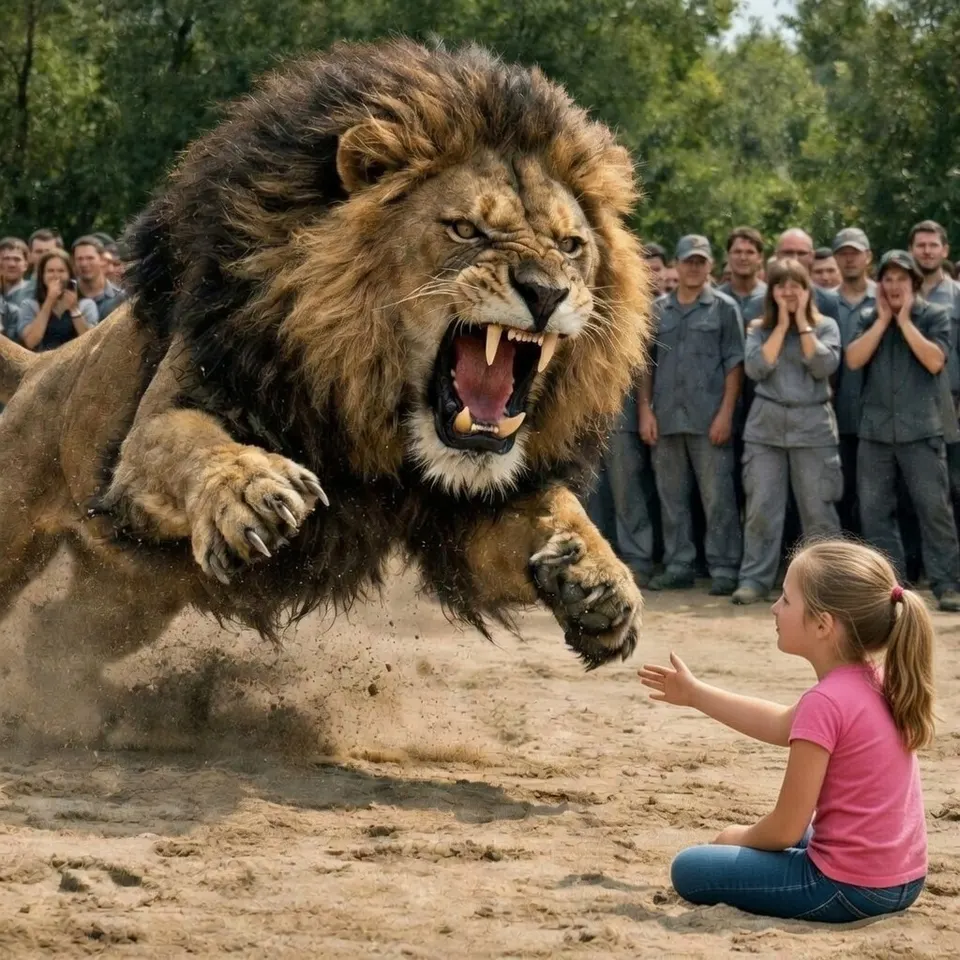
Years ago, in a remote stretch of the African wilderness, a young girl found an exhausted lion cub hidden in the tall grass. It happened during a family trip to the Serengeti, a moment where fate brought together two beings who were equally fragile and alone. Her name was Emily Carter.
Emily was only eight years old, but she had already spent much of her life fighting a brutal battle with leukemia. Her body was frail, and her hair had thinned from rounds of aggressive chemotherapy, but her eyes held a quiet, adult-like grit. When she saw the abandoned cub, suffering from severe dehydration, she knew instinctively: if they walked away, he wouldn't last the night.
The golden savannah grass nearly swallowed the small body, which barely shuddered with each shallow breath. Emily knelt down, ignoring the dry brush scratching at her pale skin. She reached out a steady hand and touched the matted fur, feeling the faint, flickering warmth of a life nearly spent.
Despite the strict park regulations and her parents' initial hesitation, the decision was made to save the cub. His mother had likely fallen victim to poachers, leaving the little one for the scavengers. Thanks to the intervention of a local wildlife biologist, Dr. Lewis Howard, the family secured special dispensation to assist in the animal's initial rehabilitation.
Dr. Howard saw something more than just a rescue. He noticed how Emily seemed to find new energy when she was allowed to care for the creature. For a girl who had spent too much time inside hospital walls, this cub became a living symbol of her own will to survive.
They named the lion Cairo—after the city where Emily had once undergone an experimental treatment. So began their shared journey of recovery. Eventually, the Carters returned to the United States, settling on their ranch outside Billings, Montana.
There, Cairo grew from a helpless ball of fur into a powerful young lion. Emily’s father, Daniel, an architect, designed a state-of-the-art, secure enclosure using reinforced materials to ensure safety. Her mother, Susan, who had a background in veterinary medicine, meticulously managed the predator’s health and vaccination schedule.
The enclosure’s massive windows looked out over the Montana big sky, a constant reminder of the wild world Cairo belonged to. Daniel built timber platforms for climbing, while Susan checked Cairo’s teeth and claws every evening, always marveling at the big cat’s unusual patience with the family.
But Emily remained the center of Cairo’s world. She handled his feedings with military precision and kept a detailed journal of his growth and weight. She would sit by the enclosure and read aloud from books about the African plains, as if reminding him of his heritage and the life he was meant to lead.
On the difficult days following Emily's treatments, Cairo would lie quietly against the fence, sensing her fatigue with an uncanny animal intuition. He would rest his heavy head near her, allowing her to reach through the safety gap and bury her fingers in his developing mane. In those moments, Emily’s pain seemed to take a backseat to a profound sense of peace.
Their bond was undeniable, though it defied logic to most outsiders. The lion seemed to read Emily’s every expression, and she knew the meaning behind every low rumble he produced. However, as Cairo matured, it became clear that a Montana ranch was no place for a full-grown apex predator.
His natural instincts were sharpening. Cairo was no longer the cub that could fit in a laundry basket; he now weighed over 150 pounds and possessed a strength that was becoming difficult to manage in a residential setting. His playful leaps were becoming dangerous, and his toys were easily shredded by his powerful jaws.
When Cairo turned a year old, state wildlife officials raised concerns about keeping a large predator in the area. The Carters knew that holding onto him any longer would be a disservice to his nature. It was time for him to be among his own kind.
After months of searching, they found a specialized sanctuary in Wyoming—a massive, protected habitat that simulated the wild while providing professional oversight. The parting was heavy-hearted, marked by a final, long look in the glow of a Montana sunset before the transport team arrived.
Emily headed to Denver for continued medical care, while Cairo began his transition back to a semi-wild life in the shadows of the Rockies. Their paths diverged for seven years, separated by hundreds of miles and two very different worlds. Each faced their own struggle for survival.
During those years, Emily transformed from a sick child into a resilient young woman. Her battle with cancer was long, involving setbacks and months of hospitalization that tested her spirit. By the time she was fifteen, her doctors finally delivered the news they had prayed for: she was in full remission. It was nothing short of a miracle.
The girl who had saved a lion cub was now a woman with an unbreakable inner strength. She took up wildlife photography, capturing the beauty she had first seen in Africa. Emily also began volunteering at animal rescue centers, studying the ethics of human-wildlife interaction.
Her articles on conservation began appearing in regional magazines. She used her platform to advocate for those who couldn't speak for themselves. Her personal history with Cairo occasionally resurfaced in the news, a testament to a bond that people still found hard to believe.
Then, word came from Wyoming that the sanctuary was facing a crisis. A dip in funding had put the facility at risk, and the staff was struggling. More concerning was the report on Cairo. The adult lion had become withdrawn and aggressive toward other males, refusing food and showing signs of severe psychological distress.
Experts suggested that his early bond with humans had left a permanent mark on his psyche, making it difficult for him to fully integrate into a pride. He was failing to thrive, and the sanctuary directors were running out of options.
In a final attempt to reach him, the sanctuary invited Emily to Wyoming. They hoped that a familiar scent or the sound of her voice might snap him out of his downward spiral. For safety, the meeting was scheduled to take place behind reinforced observation glass.
There was to be no direct contact—only observation. Emily stepped into the viewing area, her heart hammering against her ribs. When Cairo finally paced into view, he was unrecognizable from the cub she had raised. He was a massive, scarred, and formidable king of the mountain.
His mane was thick and dark, and his face bore the marks of sanctuary life. At first, he didn't look her way, staring apathetically toward the treeline. He seemed like a ghost of a lion, his spirit dimmed by years of isolation and confusion.
Emily felt a lump in her throat as she watched him. She stepped closer to the glass and spoke the same words she used to whisper to him back in Montana. The lion froze. His ears twitched, catching a frequency he hadn't heard in nearly a decade.
Cairo turned and approached the barrier, his amber eyes locking onto Emily’s face. He pressed a massive paw against the glass and let out a low, vibrating sound—not a roar, but a recognition. He sat down directly in front of her, just as he had as a cub, watching her with what could only be described as reverence.
Suddenly, the moment was shattered by a perimeter alarm. A group of intruders had breached the far gate with trucks. These weren't activists; they were poachers looking to capitalize on the sanctuary's financial instability by capturing high-value exotic animals for the black market.
In the ensuing chaos, Emily, driven by a protective instinct she hadn't felt in years, slipped through a side door toward the inner enclosure area. Security was spread thin, occupied by the breach at the main gate. She knew Cairo was a prime target and feared the poachers would use tranquilizers or worse.
She found herself in the secondary safety zone just as two armed men emerged from the brush. They were startled to see a civilian, but they didn't lower their weapons. As they moved to deploy a capture net, the very air seemed to vibrate with a deafening roar.
Cairo exploded from the shadows, his muscles rippling like steel cables. He was a blur of golden fur and raw power, ready to tear into anything that threatened his space. But as Emily called out his name, begging him to stay back, the great beast skidded to a halt, chest heaving.
That split second of hesitation allowed the panicked poachers to scramble back toward their vehicle. However, Cairo wasn't finished. He cut off their retreat, leaping onto the hood of their truck with a force that crushed the metal and shattered the windshield, pinning the vehicle in place.
The poachers were trapped inside until the sanctuary rangers and local police arrived to take them into custody. Throughout the entire ordeal, Cairo stood as a living shield between Emily and the threat. He didn't growl at the arriving authorities, but his eyes never left the woman who had saved him all those years ago.
The sanctuary staff stood in stunned silence. They had just witnessed a wild predator prioritize the safety of a human over his own hunting instincts. The quiet that followed was more powerful than any scientific explanation could ever be.
It was clear to everyone present: a bond built on genuine compassion doesn't just disappear. It might change form, but it remains etched into the soul. Emily stepped toward Cairo, and despite every safety protocol in the book, she reached out. The lion closed his eyes, leaning into her touch with a deep, rumbling sigh of relief.
That day changed everything. Cairo’s health rebounded almost immediately; he eventually took his place as the dominant male of a new pride, his confidence fully restored.
Emily went on to establish a national foundation for sanctuary funding, ensuring that Cairo and animals like him would always have a safe place to call home. She visited him often, though always with the respect due to a wild king.
Their story became a local legend, a reminder that kindness isn't limited by species.





Share how the story made you feel
0Comments appear after a quick automatic check. Please no links, ads or personal data.
Next to your name we show your country, determined from your IP address; the address itself is never shown, and only a hashed fingerprint of it is kept to stop spam.