
 Let’s Keep It Real
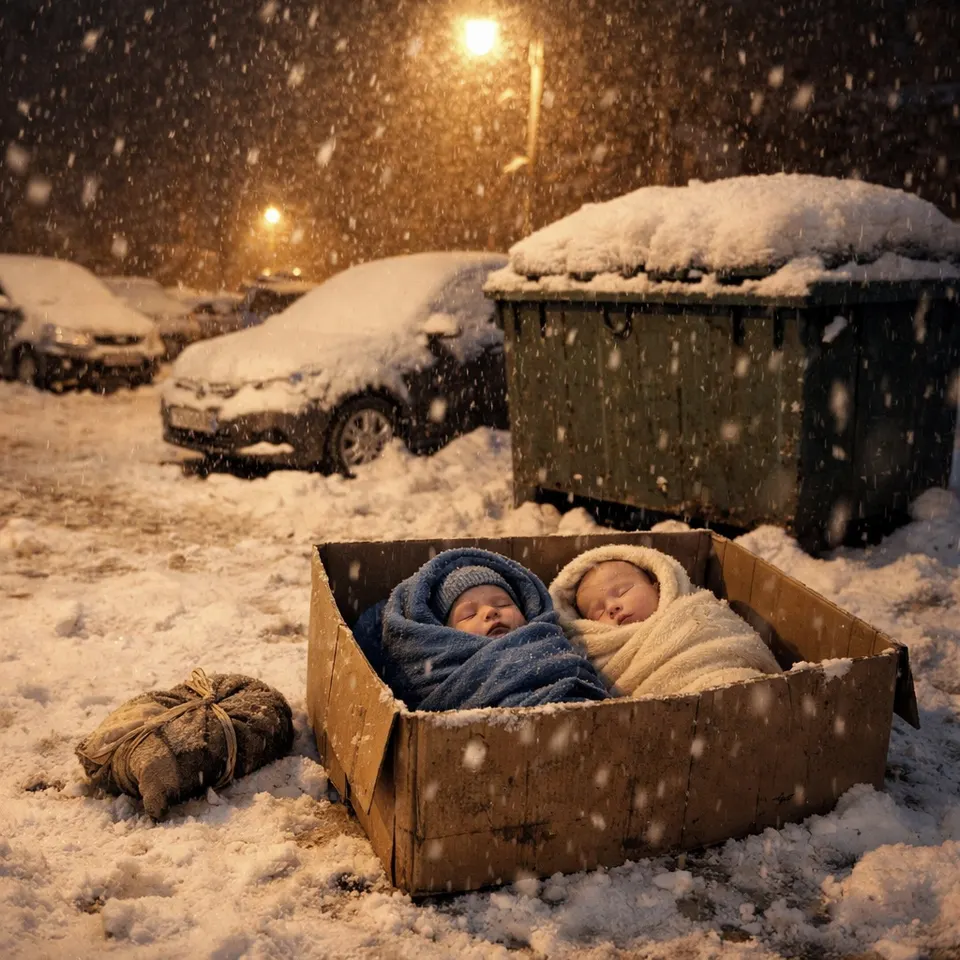
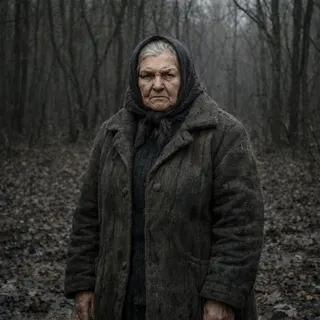
A brutal winter chill settled over the city without warning, catching the evening commuters off guard. A biting wind whipped snow through the empty streets, blurring the white flakes with the dim, flickering glow of the streetlights. A lone woman, wrapped tightly in a worn wool coat, struggled along the icy sidewalk.
Her legs felt like lead as she navigated the frozen pavement, her face hidden deep within a heavy hood. Only her eyes, clouded with a quiet, desperate grief, revealed the weight of the choice she was about to make.
Every movement seemed to cost her an immense effort, as if she were battling more than just the freezing temperature. In her stiff, numb arms, she cradled two small bundles, both shivering against the penetrating cold.
The newborns, barely a few days old, were wrapped only in thin blankets that offered little protection against the sub-zero wind.
She slowed her pace near a rusted metal dumpster in a quiet alley. She stood there for a long time, staring at the cold steel as if searching for any other way out of her impossible situation.
Finally, seeing no other option, she leaned down and placed the infants on the frozen metal. Her fingers lingered on the fabric for a second, a final, agonizing hesitation before she forced herself to let go.
The woman turned quickly, her eyes darting down the empty street.
It was as if she were waiting for a sign—for someone to step out of the shadows and stop her, to tell her there was another way. But the street remained silent and indifferent.
Only the wind continued its low howl, drowning out the sound of her heavy, ragged breathing.
She whispered a choked apology to the two small souls she was leaving behind.
Her voice cracked, barely audible over the gusting snow. She took one uncertain step back, then another, until her figure finally vanished into the darkness of the winter night.
A few minutes later, the crunch of boots on snow broke the silence. A man in his mid-forties, wearing a heavy parka, was heading home after a grueling double shift.
The wind bit at his face, making him pull his collar up as he hurried toward the warmth of his apartment. Suddenly, a faint, thin sound—the cry of a child—pierced the air, stopping him in his tracks.
"Am I hearing things?" he muttered, squinting through the swirling snow. But the sound came again—a weak, rhythmic wail coming from the direction of the alley. He turned toward the dark silhouette of the dumpster. His first instinct was to keep walking, to tell himself it was just a stray cat or the wind. But something wouldn't let him move.
He walked closer, his heart thumping against his ribs. He reached the bundles and saw a slight movement. His breath hitched. He carefully pulled back the edge of one blanket and saw a tiny, shivering face, eyes squeezed shut and fists clenched tight.
The baby’s lips were already tinged with blue, but he was breathing. The man quickly checked the second bundle and found another infant, just as cold and vulnerable. "My God," he exhaled, the shock hitting him like a physical blow.
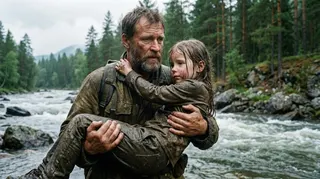
He gathered both infants into his arms, tucking them inside his parka against his own chest, trying to share his body heat. His hands shook, and his pulse raced.
"What do I do?" he thought frantically. "How do I save them?" The cold was biting through his layers, but the babies, pressed against him, began to breathe a little more steadily. In that moment, something shifted inside him.
The world he knew—his quiet, predictable life—ended right there. The snow continued to fall, covering the empty streets and erasing the footprints of the woman who had been there just moments before.
The man stood still for a second, looking toward the end of the alley where the woman had disappeared. He wanted to shout, to demand an answer for why this had happened, but the night offered nothing.
This was the beginning of a new story, one where no one could predict where the road would lead. The coming dawn brought both a flickering hope and a deep, unsettling uncertainty.
The man who had saved the infants didn't sleep a wink that night. Sitting in his small apartment, he watched over the babies as they slept, wrapped in his warmest fleece blankets. "What’s the right move here?" he wondered, his mind racing through the possibilities. He thought of his own upbringing—no silver spoon, just hard work—and he wanted something better for these two.
The next morning, he took them to the local hospital, which set in motion a life-changing series of events. A well-to-do couple, Charles and Eleanor, heard about the "dumpster twins" on the local news and felt an immediate pull to help.
They were in their late forties and had spent years trying to start a family of their own. Charles ran a successful commercial real estate firm, and Eleanor was deeply involved in local community boards.
Their home was a sprawling estate in the suburbs, the kind of place with manicured lawns and a quiet, dignified atmosphere. The walls were lined with books, and the house was filled with the kind of warmth only a long-awaited child could bring.
They decided to adopt one of the boys, confident they could give him every advantage in life. They saw him as a miracle and raised him with every comfort imaginable. The second child, however, was placed into the state foster care system due to a series of bureaucratic complications and a lack of immediate private placements.
The state facility was an older building, clean but sterile, with drafty hallways and the constant hum of industrial heaters. It was a place where kids learned to wait their turn and where personal belongings were few and far between.
For the second boy, this was the start of a life defined by resilience. He grew up surrounded by the noise of other kids and the revolving door of social workers, learning early on that nothing in life was guaranteed.
He was shaped by the shared struggles of his peers and the occasional kindness of a dedicated mentor.
Years passed. The boy raised by Charles and Eleanor was named Max. He grew up in a world of private tutors, summer camps, and high-end electronics.
His bedroom was a suite filled with everything a teenager could want—the latest tech, sports gear, and a clear path to an Ivy League education.
Eleanor made sure he had the best piano teachers and language coaches, wanting him to be a well-rounded young man.
However, within that bubble of privilege, Max began to develop a sense of entitlement.
He rarely heard the word "no" and assumed the world was designed to cater to his needs. Charles saw Max as his successor, often telling him, "You’re meant for big things, son."
Meanwhile, the boy in the system was named Alex. His "toys" were often discarded gadgets he found and fixed with his own hands.
With limited individual attention, he became fiercely independent and practical.
Despite the hardships, Alex grew into a remarkably grounded and empathetic young man. He had big dreams: he wanted to become an engineer, to build things that lasted, unlike the temporary world he grew up in. On clear nights, he’d look out at the city skyline and think, "There’s a whole world out there, and I’m going to make my mark on it." The contrast between the two brothers grew sharper every year.
Max lived a life of controlled environments—tennis lessons, country clubs, and family vacations on the coast. Alex, on the other hand, found joy in the small wins: a good grade on a tough exam, a shared laugh with a friend, or a successful repair on a broken engine. They were moving through life on parallel tracks, completely unaware of each other’s existence.
Charles and Eleanor were proud of Max’s accomplishments. "He’s got so much potential," Eleanor would say, watching him perform at a school recital. But she sometimes worried about his lack of perspective on the real world. Charles would just wave it off: "He’s just confident, Eleanor. That’s what it takes to win." Max, for his part, took his success for granted, rarely stopping to think about the luck that had placed him in that home.
In the foster system, Alex became a leader among the younger kids. He’d help them with their homework, share his snacks, and tell stories to keep their spirits up. "He’s a good kid," one of his long-term caseworkers noted. "I just wish he’d had a permanent family to call his own." Alex often wondered about his biological parents, but he eventually learned to live with the silence of his past.
These two worlds existed side-by-side, like two different shores of a wide river. They were connected by blood but separated by everything else. Life kept moving, preparing a collision course for the two brothers. The city was a sprawling maze, but fate has a way of narrowing the paths. It was a place of extremes, where high-rise penthouses overlooked the gritty industrial districts.
On the outskirts, old warehouses stood as relics of the past, while downtown, glass towers reached for the clouds. Thousands of people moved through the streets every day, lost in their own lives. Somewhere in that chaos, Max and Alex were living in the same city. Max had become a successful entrepreneur, owning a boutique restaurant group. He was proud of his brand and his status.
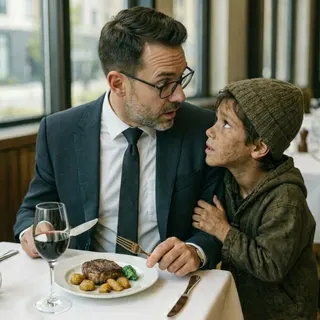
His life was a blur of meetings, menu tastings, and networking events. His flagship restaurant was the place to be for the city’s elite. His name was well-known in business circles, and he enjoyed the respect that came with it. But beneath the polished exterior, there was a restlessness he couldn't quite explain.
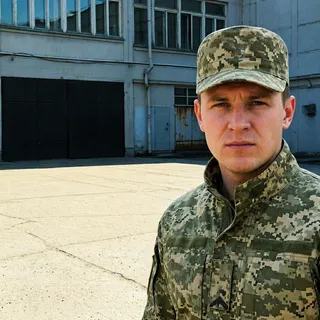
"Success is the only thing that matters," he told himself. Alex, meanwhile, was working as a supervisor at a large shipping warehouse. His days were filled with physical labor and logistics. He managed crews, moved freight, and kept the supply chain moving. Despite the exhaustion, he took pride in his work. His coworkers respected him for his fairness and his ability to stay calm under pressure.
In his spare time, he studied engineering manuals he bought at used bookstores, still dreaming of a bigger future. Sometimes, he’d think back to his childhood and wonder, "Is there anyone out there who looks like me?" Then, on an ordinary Tuesday, their paths finally crossed. Alex had stopped by a high-end grocery store near a job site to grab a quick lunch.
He was browsing the aisles, checking prices and sticking to his budget. He noticed a man in a tailored suit struggling with a paper bag that had just given way. Apples, a bottle of wine, and expensive cheeses were rolling across the floor. Without thinking, Alex stepped in to help.
"Here, let me give you a hand," he said, quickly gathering the items. The man looked up. His sharp features, the set of his jaw, and his light-colored eyes were a mirror image of Alex’s own. "Thanks, I appreciate it. This bag wasn't up to the task," Max replied with a polite, slightly distracted smile. He looked at Alex, and for a split second, he felt a jolt of recognition, as if he were looking at a version of himself from a different life.
They locked eyes, and a strange, heavy silence fell between them. They had the same eyes, the same build, the same way of standing. But in the moment, they both brushed it off as a weird coincidence. "No problem. Glad I could help," Alex said, handing over the last of the groceries. Max nodded, thanking him again, but he felt a lingering sense of unease.
"Funny how much we look alike, isn't it?" Alex joked, but Max felt a sudden tension. "Yeah, small world," Max replied, trying to shake off the feeling of déjà vu. After the encounter, Alex couldn't stop thinking about the man in the suit. Images of the foster home and the old files he’d seen flashed through his mind.
"Why did he look so familiar?" he wondered that evening in his modest apartment. He tried to tell himself it was just a fluke, but the feeling wouldn't go away. Max, back at his office, couldn't focus either. The comment about their resemblance echoed in his head. He realized how little he actually knew about where he came from, having always focused on the future.
Something had been triggered inside him, a door to the past that had been shut for decades. The city hummed outside his window, but the gears of fate were already turning. They didn't know it yet, but that brief meeting was the first thread of a much larger story. Soon, they would uncover a truth that would change everything they thought they knew about their lives.
Max couldn't let go of the encounter at the store. He felt an urgent need to talk to his parents. That evening, over dinner, he brought it up. "I saw someone today. A guy who looked exactly like me," he said, his voice careful. A sudden, heavy silence fell over the table. The sound of a fork hitting a plate seemed incredibly loud in the quiet room.
His father, Charles, set his glass down and cleared his throat. Eleanor looked away, her hand trembling slightly as she reached for her napkin. Finally, Charles spoke. "Max, there’s something we should have told you a long time ago." His voice was low but steady. "We wanted to wait for the right time, but I think that time is now," he added, finally meeting his son's eyes.
"You were adopted." The words hit Max like a physical weight. He sat frozen, his mind racing. He tried to speak, but the words wouldn't come. Eleanor reached out, her voice soft. "We only wanted to protect you, Max. We wanted you to have a life without the shadow of where you started." She had tears in her eyes, but she didn't look away this time.
"You were found as an infant," Charles continued. "And you weren't alone. You had a twin brother." Max looked at his father, trying to process the information. "But we weren't able to take both of you. At the time, the legal hurdles and our own circumstances made it impossible to adopt two infants at once. We did what we could to give you the best life possible."
Every word felt like a blow to Max. He felt a surge of confusion and a sharp, stinging resentment. "Why did you wait so long? Why didn't I know I had a brother?" His voice shook with a mix of anger and hurt. Eleanor tried to take his hand, but he pulled back. "We didn't know much ourselves," Charles said sadly. "The only thing we have is the name of the agency that handled the case. They might have more records."
Max spent the night staring at the ceiling, his world turned upside down. Memories of being told he "didn't look like his parents" now made perfect sense. He felt a driving need to find the truth. "I have to know," he told himself. The next day, he went to the social services office Charles had mentioned. His heart was pounding as he walked through the doors.
The office was a maze of grey cubicles and the smell of old paper. He waited for what felt like hours while a clerk searched the archives. He felt like he was on the verge of a discovery that would rewrite his entire identity.
Finally, the clerk returned with a thin, yellowed file. "We found the record," she said. The documents were old, the ink fading in places. As Max scanned the pages, he saw his brother’s name and a last known address from a few years back. With shaking hands, Max dialed the number. When Alex answered, his voice was cautious but steady.
"We need to meet," Max said, his voice cracking slightly. There was a long pause on the other end, then a quiet, "Okay." They agreed to meet at a park in the center of the city. The sound of kids playing and the smell of fresh-cut grass felt surreal given the gravity of the moment. Max watched Alex walk toward him, seeing his own gait, his own posture.
Max took a deep breath. "You’re my brother," he said, his voice barely a whisper but filled with certainty. He handed Alex the copies of the records. Alex took them, his hands trembling. "Is this for real?" he asked, but as he looked at the papers and then at Max, the truth settled in. His eyes welled up, and the shock on his face turned into a profound realization.
They talked for hours. Max spoke about his life of luxury and the parents who had given him everything. Alex talked about the foster system, the hunger for a family, and the hard-won independence he’d built. He spoke about the nights he spent wondering if anyone was looking for him. He talked about finding happiness in the small things because that was all he had.
Each story revealed a new layer of their shared history. They realized how different their paths had been, but those differences only seemed to make their connection stronger. Max felt a pang of guilt for his privilege, while Alex felt a strange sense of relief that at least one of them had been spared the struggle.
"We need to find out about our mother," Alex said, his voice firm. "She left us, but I want to know why. I want to understand." Max nodded. For the first time, they had a shared purpose. As they stood to leave, they looked at each other—two halves of a whole, finally reunited. They knew the road ahead would be difficult, but they were no longer walking it alone.
After their meeting in the park, Max and Alex were determined to find out who their biological mother was and what had happened that night. Their first stop was a return to the social services office, hoping for more than just a name. They stood in the small, cramped office, surrounded by the weight of thousands of untold stories. The staff was helpful, but the records were sparse.
"All the file says is that you were found near a dumpster on a sub-zero night," a social worker told them, her voice full of sympathy. "The police handled the initial investigation, so their old records might have more detail." She gave them the name of the precinct and the detective who had been assigned to the case decades ago.
The brothers headed straight to the precinct. The detective, now long retired, agreed to meet them at a nearby diner. He was a sturdy man with a sharp memory and a weary but kind face. When they told him who they were, he nodded slowly. "I remember that night. It’s one of those cases that stays with you."
He took a sip of his coffee and began. "It was one of the coldest nights on record. According to the report, a man coming off a late shift found you. He heard crying and, thank God, he didn't just keep walking."
"He took you back to his place to get you warm, then called us first thing in the morning. When we got to the scene, he showed us where he’d found you—an alleyway behind a grocery store. The wind was brutal, and the snow was so thick you couldn't see your own hand in front of your face. The doctors said you were minutes away from not making it."
The detective looked at them with a heavy expression. "But there’s more. That same morning, just a few blocks away, we found a woman. She was deceased. No ID, no personal items. Nothing to tell us who she was." He paused, letting the weight of the words sink in. "The medical examiner concluded she had given birth very recently. We were certain she was your mother."
"Our theory was that she was running from something, or someone. She left you in a place where she hoped you’d be found before she succumbed to the cold herself. We never found out who she was or what she was running from. No one ever came forward to claim her." Max listened, his heart aching. Alex sat with his jaw set, his hands clenched into fists.
They looked at each other, the reality of their mother’s sacrifice hitting them with full force. "You never found out who did it?" Max asked, his voice low.
"No," the detective replied, shaking his head. "It was a tragic end to a mystery. But you two... you were the miracle that came out of it. You survived against all odds." The brothers left the diner in a daze. Alex, who had spent his life feeling abandoned, now felt a complex mix of grief and a strange, new respect for the woman who had given them a chance.
Max, whose life had been so orderly, felt his world shifting again. As they walked to their cars, Alex said quietly, "If this is true, we owe it to her to find out where she is. She deserves to be remembered." Max nodded, his eyes fixed on the horizon. They were close to the end of their search, but the final piece of the puzzle was the most painful one of all.
Max and Alex drove to a small, quiet cemetery on the edge of town where the "Unknown Woman" had been laid to rest. The autumn wind blew dry leaves across the grass, the only sound in the stillness of the afternoon. The grey sky hung low, matching the somber mood in their hearts. In the distance, a church bell tolled, a lonely sound that seemed to mark the passing of time. They stopped in front of a simple, weathered marker.
It bore no name, only the words: "Unknown Woman." Below it was the date: "Found December 12th." The inscription was faded, but to the brothers, it was the most important thing they had ever seen. Max stood in silence, his mind filled with questions. Who was she? What kind of life had she led? Could things have been different? Alex closed his eyes, trying to feel a connection to the mother he had never known.
He wanted to piece together the fragments of her story, to give her a place in his heart. "She did what she had to do," Alex finally said, his voice thick with emotion. "If she gave her life to make sure we were found, then she loved us the only way she could. It was a sacrifice, not an abandonment." Max remained silent for a long time.
He felt the anger and confusion he’d carried since his parents’ confession begin to dissolve, replaced by a profound sense of gratitude. "It was an impossible choice," he said softly, looking down at the earth. "She deserves our forgiveness. And our thanks." Alex nodded. His face was solemn, but there was a new peace in his eyes.
"Now we know," Alex said. "She tried to save us, even at the cost of her own life. We’re her legacy, and that means something." They stood together for a few more minutes, two brothers united by a tragedy and a miracle. Alex placed a small bouquet of flowers at the base of the marker.
"Thank you," he whispered. The word seemed to hang in the cold air, a final tribute to a woman who had given everything. As they turned to leave, Max looked back one last time. He realized that this moment was the true beginning of his new life. He understood now that you can't control everything, and that some things are meant to be accepted with grace.

Share how the story made you feel
0Comments appear after a quick automatic check. Please no links, ads or personal data.
Next to your name we show your country, determined from your IP address; the address itself is never shown, and only a hashed fingerprint of it is kept to stop spam.