
Elena hung up. Slot machines. Debts. So, it wasn’t about another woman, not about her getting old and unattractive. Just money. Just gambling and stupidity. For some reason, that didn’t make it any easier. Maybe another woman would have been better—at least some human explanation. But this way, he had simply sold their life for his debts.
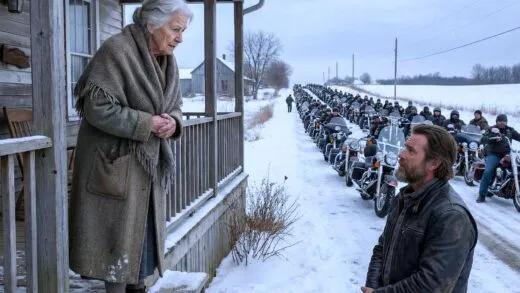
Spring arrived unexpectedly early. In late March, the snow melted in a few days, revealing blackened earth and the first green shoots of grass. Elena stood at the kitchen window with a cup of coffee in her hands, looking at the yard where, on a cold December night, a stranger’s footprints had been left. Footprints that changed her entire life.
The trial was quick. Victor received a 2-year suspended sentence plus an obligation to pay Elena compensation in the amount of 300,000 hryvnias. The lawyer explained that it was difficult to get more—there was no actual damage. The deal hadn’t gone through, the house remained hers. Victor paid the money immediately. In court, he stared at the floor, never raising his eyes. He offered no apology.
The divorce was finalized a month later. Victor moved in with his brother. He collected his things while Elena was out; she had deliberately gone to a friend’s house to avoid seeing him. When she returned, the house was empty. Half of the wardrobe gaped with empty shelves, and on the wall was a light patch where his photograph had hung. Elena took down the other photographs, put them in a box, and stored it in the attic. She couldn’t bring herself to throw them away—a third of her life together—but she didn’t want to look at them anymore.
The first few weeks after the divorce were strange. The silence in the house was deafening. No one slammed the door. No one demanded dinner. No one grumbled. Elena walked through the rooms, not knowing whether to be happy or to cry. Her neighbors were supportive. Maria Ivanovna came by every day with pastries and news. The Petrovs invited her for tea. The officer, Grigory Petrovich, dropped by a couple of times to ask if everything was okay.
“You’re doing great, Elena Alexeevna,” he said once over tea. “Not every woman your age decides to start her life over. But you’re managing.”
“What choice do I have?” Elena chuckled. “Sit around and feel sorry for myself?”
“Many do just that. But you’re holding on. That’s worth a lot.”
Elena thought about getting a job. Her pension was still a long way off, and what would she live on? The compensation and savings wouldn’t last forever. She didn’t want to sell the house; it was all she had left. She looked through job ads. At her age, the options were few: sales assistant, cleaner, security guard. The requirements were daunting: “under forty-five,” “work experience,” “computer skills.” Where did that leave her, a housewife with thirty years of experience?
In early April, she got lucky. The local library was looking for a librarian’s assistant. Part-time, a small salary, but close to home. Elena went for an interview with the head librarian, Nina Sergeevna, a pleasant woman in her sixties.
“Do you have experience working with books?”
“No, but I read a lot. All my life. I love books,” Elena said sincerely. Reading had been her escape for all those years.
“That’s enough,” Nina Sergeevna smiled. “I need someone who loves books, not just someone who’s punching a clock. You can start on Monday.”
The library turned out to be a quiet, cozy place. An old building with high ceilings, creaky parquet floors, and rows of shelves. It smelled of paper and comfort. Elena quickly got the hang of it, helping readers, shelving books, mending covers. The work was simple but pleasant.
Gradually, she got to know the regular visitors. Grandmothers for romance novels. Schoolchildren for the classics. Young mothers for fairy tales. A retired elderly military man for history books.
One of the regular readers, Vera Nikolaevna, a woman in her seventies, lingered at the counter one day.
“Elena, my dear, are you by any chance the one Masha Petrova was talking about?”
“Maria Ivanovna? Yes, we’re neighbors.”
“She told me your story. About your husband who wanted to sell the house. How awful!”
Elena pressed her lips together. The gossip had spread throughout the neighborhood.
“That was in the winter. It’s in the past now.”
“But you did well not to put up with it,” Vera Nikolaevna placed a hand on her shoulder. “I put up with mine for thirty years. He drank, cheated, raised his hand to me. I stayed silent, raised the children. He died of cirrhosis ten years ago. And only after his death did I realize how one can live. Freely, without fear. You still have a long life ahead of you,” she continued. “Fifty-eight is young. My friend got married at sixty-two, she’s as happy as a schoolgirl. Don’t give up.”