
Chief Michael Reynolds looked up from the incident report that had just been handed to him. The missing-person report was filed under Margaret Grant; the basic note read: husband gone, no traces, no special circumstances. What caught his eye was that the woman who brought the report was not Margaret but her neighbor, Fiona Daniels. With Fiona was a four-year-old girl clutching a well-worn teddy bear, her face pale and quiet.

“She didn’t want me to take the little girl out of the house,” Fiona said, voice tight. “But the child said something strange. You should hear it.” Michael sat down and softened his tone when he looked at the child. “What’s your name, sweetheart?” he asked. “I’m Annie,” the girl whispered.
“Do you know where your daddy went?” the chief asked. Annie hesitated, then lifted big dark eyes. “Daddy’s under the kitchen floor,” she said slowly. The room seemed to draw a breath. Michael glanced at Fiona, who went pale.
A young officer near the door cleared his throat, trying to keep steady. “What did you say?” Michael leaned forward, measured. “Daddy’s under the kitchen floor,” Annie repeated. “Where the tile is lighter, and he’s very cold.” For a moment everyone in the room was quiet.
Michael signaled Detective Ryan Miller to come closer. “Bring Margaret Grant to the station and assemble a response team. I want the house checked within the hour.” In less than thirty minutes Margaret arrived at the station, composed in a white blouse and black slacks, hair neatly pulled back. She showed none of the panic Michael had expected.
“He has a habit of taking off for a few days without telling me,” Margaret said calmly when questioned. “He always comes back.” Michael studied her. “And you never thought that was unusual?” she shrugged. “No. I figured he’d be back, like always.”
Ryan spoke up: “Neighbors reported a fight and the sound of things breaking that night.” Margaret sighed. “We argued. Who doesn’t?” Michael asked: “Have you recently done work on the kitchen floor?” Margaret hesitated a little.
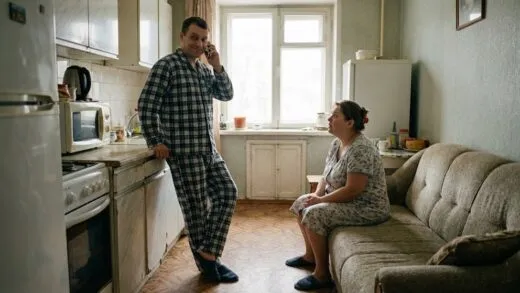
“I re-tiled the kitchen myself because of mold. I watched tutorials online,” she said. “You did it yourself?” Michael asked. “Yes.” Ryan produced a USB drive. “Your neighbor, Edward Morris, provided door-cam footage.”
“The video shows you leaving the house with Annie around three in the morning and returning alone with building materials. Care to explain?” Margaret bit her lip. “I took Annie to a friend’s place. I didn’t want her breathing the mold. The materials were for the floor repair—I wanted to do it myself.”
Michael raised an eyebrow. “No receipts, no contractor, no permits. And your daughter says her father is under the kitchen floor. That’s an odd coincidence.” Margaret clenched her hands and went hot. “Are you accusing me of hurting my own husband?”
“We’re asking questions, not making accusations,” Michael answered. “But your story has inconsistencies.” Margaret turned sharply to Ryan. “You’re an investigator. Do you know what a bad marriage looks like? He used to hit me.” Michael interrupted: “Do you have any medical records or prior reports?” Margaret was silent for a moment, then let out a breath. “I never went to the hospital. I put up with it.” Ryan leaned in and spoke to Michael in a low voice: “Get a search warrant. The cement still smells fresh. Her tone is off.”
Michael nodded and ordered the paperwork. Forensics would be on-site first thing in the morning. The next day, officers arrived at a modest house at the end of Maple Lane. Chief medical examiner Laura Palmer, steady and professional, crouched low to smell the newly laid tile. “The cement is still fresh, not fully cured. There’s something down there,” she said to the technician.
“Start drilling where the tile color changes,” she directed. Margaret was held in the living room under guard. Annie wasn’t there—Fiona had driven the child to her grandmother’s house at Michael’s request. Laura pointed. “Take the lighter tiles up first.” The drill whined into the quiet air.
About thirty minutes later the first layer of tile was removed. A piece of dark fabric showed under gray mortar. Laura stopped the crew. “Careful. Switch to hand tools.” Gloved hands began to clear the cement. One of the junior officers stifled a sound when something solid appeared under the rubble.
Michael stepped forward, then turned to Margaret. “Anything to tell us?” he asked. She said nothing and looked away. Laura’s voice was direct: “A body wrapped in cloth. Signs of severe blunt force trauma to the head.” Ryan photographed the scene, then crouched to pick up a small broken object nearby.
“It’s a phone. The screen is shattered but we might recover data,” he said. Michael nodded. “Send it to techs. And get a hold on your stomach if you need fresh air,” he added when a young officer hurried outside.
Laura didn’t comment on emotional reaction—she was clinical. “This wasn’t an accident. It was deliberate,” she said. Turning to Ryan, Michael ordered: “Arrest Margaret Grant on suspicion of homicide and evidence tampering.”
Ryan read her rights. “Margaret Grant, you’re under arrest. You have the right to remain silent.” Margaret let out a short, bitter laugh. “Silent?” she said. “You have no idea how long I’ve been silent.” Michael answered simply: “That silence ends now.”
The click of handcuffs rang against the dust. Margaret didn’t resist. She looked at the opened patch of floor where the terrible secret had been revealed, her face empty as though there was nothing left to hold on to. On the ride back to the lockup, Ryan glanced in the rearview mirror. Margaret sat statue-still; Ryan thought: some people snap in a moment, but others plan every step.
Back at the precinct, Michael called an emergency briefing. Forensics and digital-recovery specialists were there, along with Deputy District Attorney Rose Martin, sharp-minded and practical. Laura led off. “The victim, Andrew Grant, died from blunt force trauma to the head. There are no defensive wounds—no sign of a struggle.”