I tied three men to trees out in the woods, poured honey over them and drove off. My name is Andrew Parker, I’m 44, and before you decide I’m a monster, hear me out to the end.
Seven years ago I went to prison for a crime I didn’t commit. When I got out, my mother was gone and my fiancée was a different person — she was being used and kept in my own apartment by the very men who’d promised they’d look after my family while I was away. Before I begin, ask yourself one question. Answer honestly, to yourself.
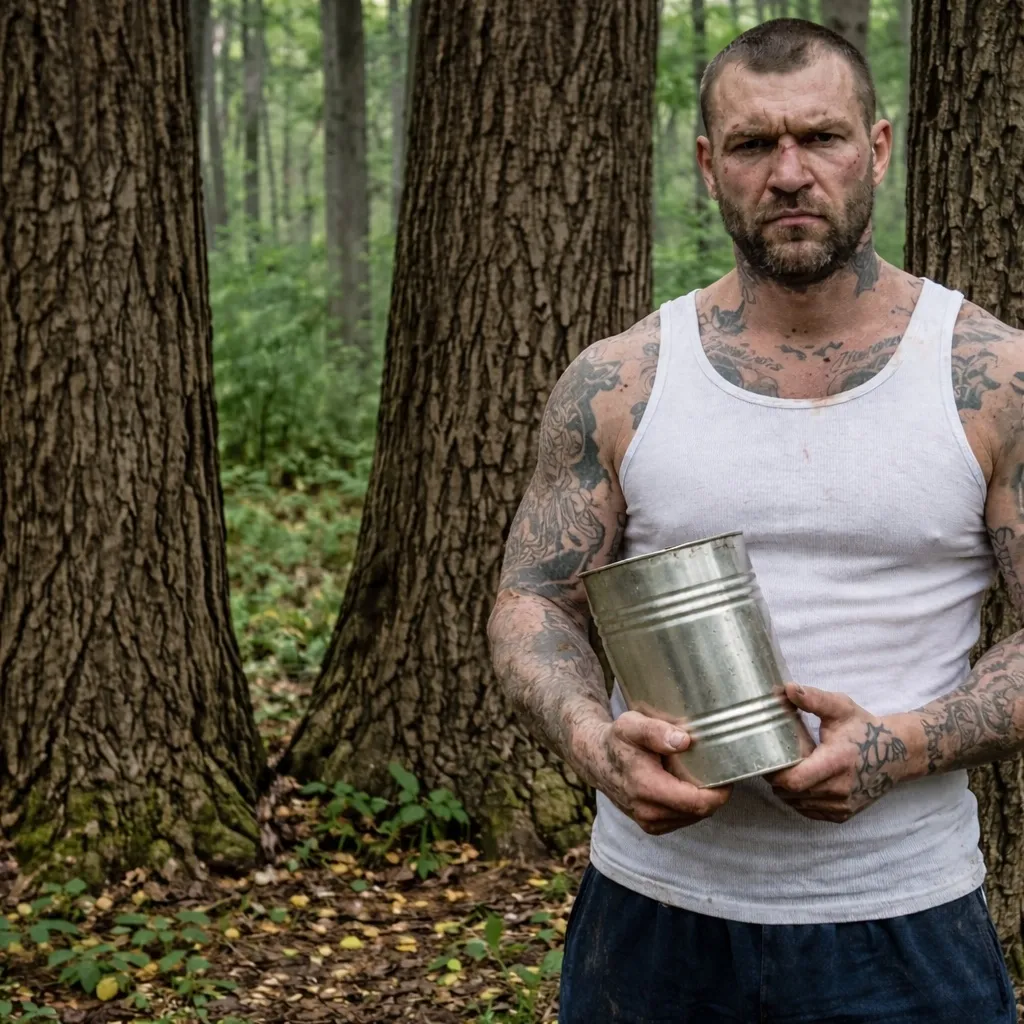
If you were released after seven years behind bars for someone else’s crime, and you found your mother buried without you there and your fiancée treated like property by the very people who said they’d protect your family, what would you do? Call the police? The same police who put you away? Keep your answer in mind. By the end, tell me if it changed.
When they read my release order at the correctional facility, I felt nothing. Literally nothing.
I stood in the warden’s office, watching his fingers move papers with stamps, listening to official phrases about “in accordance with the law” and “subject to release,” and inside it was empty. Like an old can that someone opened, scraped out and left by the side of the road. Seven years ago, when I walked through those gates the first time, I was full: anger, fear, resentment, hope — that a lawyer would fix it, that I’d be out in a year, two, maybe three, but not seven.
Seven years later I signed the paper, walked out with a canvas bag — change of clothes, a bottle of water, a photo of my mother — and still felt nothing. Outside the prison gates there was a bus stop, a shabby bench and a timetable with half the routes crossed out. It was January.
It was minus twenty-two that day. I sat on the bench and waited. Nobody came to meet me.
I hadn’t told anyone I was coming home. Not because I didn’t want to, but because there was no one to tell. During those seven years I never got a single letter from the people who promised to look after my mother and Katie.
Not one. At first my mother wrote every week in a tidy, steady script. Then the letters slowed and then stopped entirely.
I made excuses — the mail must be mixing things up, she’s ill, the administration didn’t pass them on. My mind refused the real reason. An hour later a county bus arrived.
An old bus, rattling and smoky. I sat by the window. A man in a wool coat with a bag that smelled of fish sat down next to me.
He glanced at my canvas bag, at the tattoo on my hand, and asked, “Going home, son?” I nodded. He asked, “Waiting for anyone?”
I said my fiancée and my mother were waiting. He smiled and said it was a good thing — that having someone to come home to mattered more than almost anything.
I turned away from the window because I didn’t want him to see my face. I didn’t cry. I stopped crying in the second year.
My face made some expression I couldn’t control — the one people get when they sense something irreversible but can’t put it into words. Four hours to town. I watched the white wall of pines and thought about how honest the woods are.
The woods don’t make promises. They are just there. Harsh, but honest. Remember that. You’ll see why.
I arrived in town in the evening. The bus depot hadn’t changed much — just a new kiosk and a digital payment terminal. I stood and breathed the city air, trying to recognize a smell. I couldn’t.
The city smelled different. Or I had changed. Probably the latter. I didn’t go straight home.
First I needed to find my mother. Not her house — I already suspected the worst.
I’d known something was off since the letters stopped. On the inside you push away the truth to survive: you pile routine on top of it — work detail, roll call, lights out — and pretend the thought isn’t true. I went to see Mrs. Grace Miller, my mother’s neighbor.
Grace had been a middle-school teacher for thirty years. If anyone would know where my mother was, it would be her.
Grace opened the door, stared for a few seconds and then recognized me. She grabbed my arm and pulled me into the kitchen, put on the kettle. We both sat, silent, giving the moment a chance because words make things real.
Then she told me. My mother died a year and a half after I was arrested. Heart failure.
She’d been sick for a long time. Chronic heart failure. She needed medication, regular tests — things that cost money. When I went away I believed the promises: they said they would provide $2,000 a month, pay for her meds and exams, and keep my apartment. They said Katie would be fine and an attorney would get me out in a year. They looked me in the eye and promised. I was thirty-seven then, an auto mechanic, not used to dealing with people like them.
They came once.
They brought groceries and $5,000 the first month. Mom was relieved. She called from the prison phone — it was the last time I heard her voice unbroken. After that they vanished.
No more visits. Calls to the number they gave her went unanswered. Messages were read and ignored. Within months their number was blocked.
Mom was left alone. Grace helped with what she could; a teacher’s pension doesn’t go far. Over the next eighteen months Mom went to the hospital 14 times. Each time she was told she needed to be admitted. Each time she declined because she had no way to pay.
In her chart the last entry read: “Declined hospitalization due to inability to pay.” Two weeks later my downstairs neighbor called the ambulance because water was leaking from the ceiling. They found her on the kitchen floor. She’d fallen while filling the kettle and died instantly, the medics said. I want to believe them.
Grace handed me an envelope she found when she helped clear out Mom’s apartment. It was addressed to me in my mother’s neat, steady script, but her hand was shaking. I kept it in my pocket like a live grenade and didn’t open it for a long time.
I went to the cemetery that afternoon. Plot number 327. A simple wooden cross with Mom’s name — Eleanor Parker — and dates. No fence, no flowers. Snow covered the mound and, if not for the little plaque, you might walk right past.
I knelt in the snow. My jeans got wet but I didn’t care. I touched the plaque and felt something inside move — not a flood of tears, because I had stopped crying, but a crack in the concrete wall I’d built around my feelings. It wasn’t a collapse, just a narrow fissure.
I whispered, “I’m sorry, Mom.” The ground didn’t answer. It never does. I stood up, brushed my jeans and went home — to my apartment of fifteen years, the place my grandmother had left me, the place Katie and I planned to live after our wedding. The wedding was supposed to be a month after that night seven years ago.
The door wasn’t mine. A young man I didn’t know answered. Music thumped inside, a smell of smoke and cheap cologne. He sneered when I said I lived there and invited someone from the room. Then Vince walked out.
Vince Davenport. I recognized him even after seven years. He’d put on weight and gained a smug, satisfied look. Behind him were Tim Carter and Ike Saunders, the two who’d been there the night I went down. They’d made promises. They’d broken them.
On the couch was Katie. My Katie. The woman I’d loved since my late twenties. She was thirty-six but looked fifty. Thin, sunken cheeks, wrists marked from ropes. Her eyes were open and empty — like a fish on the counter.
She glanced at me for a beat, then away. Tim laughed and made a joke about me — the idiot who took the fall for Vince — like he was describing a car problem. Katie did not respond. She wasn’t there. She was somewhere else, a place people go when addiction and debt and control have chewed them down to a shell.
Vince clapped me on the shoulder — too much like a handshake from a man who thinks the world owes him. He said they’d taken care of Katie, that clients liked her, that she had to “work off” some debts. He said it as if he were talking about a piece of furniture.
I stood there for a long moment. If I’d lost control then, I would have killed them. Not because they didn’t deserve it, but because it would have been too easy. No — I walked out, silent. Vince yelled that I had nowhere to go. Tim snorted as if it was a joke.
Outside it was bitterly cold. I breathed slowly — the trick an old cellmate taught me: when you want to explode, breathe and count to a hundred. The first time I did that I was learning to survive. I counted. Then I went to the one person in town I trusted.
Luke Warren had been my cellmate for two years. He lived in a crooked house on the edge of town with a dented garage where he fixed cars for cash. In prison, you learn each other differently: you hear someone sleep, you watch them eat, you see what breaks them and what puts them back together. In two years I learned Luke more than some guys I’d known my whole life. We weren’t friends back then — we were brothers.
I knocked on his gate late and he opened without surprise. He hugged me like a man who knew the world had just tilted under both of us. He put the kettle on and handed me a strong, sweet black tea. No whiskey. Tea was the thing we’d agreed on during our stretch: a simple ritual that kept us honest.
I told Luke everything — the cemetery, the apartment, Katie on the couch, the names. He listened and watched. When I finished he went to the garage and came back with keys.
“There’s an old UAZ in the back,” he said. “It’ll do.” They call that boxy truck a Bu—whatever. Old, loud, pulls like a mule.
I asked about Frank Lawson. Frank, a 73-year-old former woodsman and my other old cellmate, had come up in our talks. Frank had been a forest ranger once and knew the land like a pocket. Luke gave me an address: a cluster of houses at the edge of the national forest, 130 miles out.
I left early the next morning. The truck rattled and smoked but got us there by noon. Frank’s place was the last house before the trees swallowed everything: sagging porch, a pile of split wood to the roof. He opened the door, hugged me like a son and set a samovar on the table. He talked about hunting and traps and ants the way some men talk about children — with attention and patience.
Frank knew the woods and its creatures. He spoke about the big mound ants — Formica rufa, the red wood ants — that build huge hills and operate like a single organism. He’d seen them break down anything they could get going. He told stories like bedtime tales, but I was listening for something practical.
When I told him what I needed he didn’t jump to conclusions. He studied me the way he studied a trail and then unfolded a hand-drawn map. Crosses, circles, a jagged line — a clearing three days’ travel from the nearest road, three big cedars and, next to each, a massive ant hill he’d noticed years ago while setting traps.
“Nobody goes there,” he said. “Too far, too quiet. The forest leaves it alone.”
I paid attention to every mark. I took the map and put it next to the envelope from Mom that I still hadn’t opened. Two small burdens in my jacket pocket: a letter I couldn’t read yet and a map to a place people don’t go.
On the way back I stopped at a country farm stand and bought a twenty-liter jug. Then I stopped at a beekeeper on the highway and bought twenty liters of honey. The man with the beard laughed when I said I needed that much and I told him it was for the sauna. He winked and packed it into the truck.
In town I bought a few more odd things: three bottles of water, long plastic straws and three plain white postcards and a black marker. At the truck I wrote on the cards: “Gregory Mullen. High-school teacher. 58. Killed.” On the second: “Eleanor Parker. Mother. 67. Died alone.” On the third I stopped and thought a long time before writing: “Kathryn Daniels. 29. Alive — but broken.” I put 29, because that was the last year she was herself.
Then I watched. For three days I watched them live their lives. Vince went to Platinum every Friday and stumbled out the back door; he always ordered a car off the record so the cameras wouldn’t record him. Tim trained every morning at IronCore Gym and parked in the underground lot where the cameras were “out of service.” Ike drove two evenings a week to a suburban house to see someone he shouldn’t, in a neighborhood where neighbors mind their own business.
I wrote down the patterns and then burned the paper to keep it in my head. After seven years without a phone, you remember differently: you learn routes, times and faces the way people once did, before GPS.
Luke’s garage supplied the tools: wide nylon cable ties, heavy contractor’s tape and three black garbage bags. I found a sedative we could use. The last night before I started Luke and I drank tea and said nothing. He didn’t ask questions. He’d been through it. When I asked him one thing — to go to my apartment and take Katie when I gave the cue — he nodded.
“When?” he asked.
“I’ll call,” I said. He agreed.
I slept poorly and woke at five. I loaded the truck: honey, straps, tape, sedative, water, cards. Photo of Mom in my jacket. Frank’s map in the glovebox. I drove to where Vince left Platinum.
Vince was predictable. Regular routine is a vulnerability. At 1:30 a.m. he staggered out the back door, phone in hand, swearing at the taxi app. I’d blocked the easy routes in the apps the week before — petty and effective. He couldn’t get a ride. He swore, and he didn’t hear me come up behind him.
Four minutes. That’s how long it took. A cloth with the sedative, hold it until it works, load him, tie him. The back of the truck smelled of oil and old leather. I left him at an abandoned lake house about forty miles out. I locked the door and drove back for Tim.
Tim was a fighter — big and trained. I couldn’t take him on at a bar. I found him at a gym parking garage at ten on a Saturday morning where the cameras conveniently didn’t work and grabbed him as he came out of the elevator. He didn’t scream. He couldn’t. I hauled his weight into the truck and labeled the bag on his head with one word: “Debt.”
I told Luke to take Katie that night. He did. He fed her, cleaned her up and drove her to a rehab center on Pine Ridge where they’d take her for the $3,000 a month I had saved — forty thousand dollars I’d earned in years of factory work. I didn’t go to see her yet. Not until I finished.
Ike — the one who understood what they did — was the worst. He was thin, jumpy, the kind of guy who looks over his shoulder even when he’s alone. Vince and Tim did their damage; Ike chose silence back then. He could have said a word and saved me and my mother and Katie. He didn’t. He had been sleeping with that guilt for seven years.
I waited in his car for two hours on a Tuesday night. He came out, saw me in the rearview and for the first time in seven years the relief on his face was like a man hearing a verdict he’d avoided his whole life. He didn’t fight. He didn’t try. It was as if he wanted it to be over.
I took him to the same lake house. That night the truck held three tied and quiet men and on the ride home I felt nothing — not triumph, not satisfaction. Just a blank. Like the day I walked out of prison; only this time, there was work to be done.
At dawn I drove three hundred miles to the clearing Frank had shown me. Nine hours. The last two were overland where the track disappeared and the UAZ bumped and groaned and carried me toward three old cedars and three huge ant hills. Frank had been right. The place was remote and untouched and, under the thin crust of a winter morning, the ants were waiting for spring.
I tied them to the trees carefully. Hands and feet secure. I put the postcards in place — stapled to the bark above each man — and then poured honey over them, slowly, so every exposure was sticky. I left bottles of water with straws so they wouldn’t die of thirst before their lesson began. I wanted them alive. Not out of mercy, but because my mother’s slow decline deserved them to know what waiting feels like.
The first ants found the scent and tested. At first there were scouts — a dozen, then a hundred. Then the hill came alive and streams of red moved like a tide. Pain came with time, subtle and inevitable. The woods did what the woods do. They don’t judge. They just act.
I didn’t stay. I left as the first cries rose and slid into the trees and away. On the drive back the truck felt lighter. I don’t know why — a quiet, not the hollow I had felt the day they released me years before, but an empty room cleared of debris. I slept at Luke’s place and he was waiting with tea.
Three days later the news picked it up. A low-flying state helicopter had spotted something unusual on that remote clearing and a search team went out. They found the three men tied to trees and the postcards stapled above them. The headlines said it was gruesome, oddly formal and cold. Local cops called it the most disturbing thing they’d found in years.
I went to the station and turned myself in. The same precinct where they took my statement seven years before — the same fluorescent lights, the same institutional paint. The young desk officer looked up and I asked to see the investigator on the case with the clearing. I told him I was the one who did it.
The interrogation room had a different investigator this time, younger than the old man who wrote up my last confession. I told the whole story: the accident, Vince at the wheel, the deal, the money that never reached my mom, the apartment and Katie, the four months of planning, Frank’s map, the honey, the cards. He recorded it all then asked if I understood what I faced.
I did. I told him I had already done seven years for someone else, and I was ready to accept whatever came next if it meant I had set things right in my way. He looked at me with a mix of horror and something like admiration, then left to make phone calls. The story leaked out and the town divided the way towns do.
People debated on the news and online: was I a monster or a man who had been failed by the system? An attorney named Miriam Lewis — a public defender who worked pro bono on cases like mine — read my statement and took the case. She dug up evidence that would change everything: the original accident file had been altered. The test that placed me at the wheel had different fingerprints now than it did back then. Vince’s prints were there.
We learned the investigator who handled my old case retired to Europe a year later and the lawyer for the developer had connections. The courtroom filled and then emptied as pieces came together. Katie testified about what had happened in my apartment and what they did to her. She told it clearly, without theatrics. She spoke about how they’d “helped” at first and then taken over her life.
The jury took its time. The judge handed down sentences: fifteen years for the three men. Not life, but a long time. People yelled “too much!” and “not enough!” in the hall. I nodded. I didn’t cheer. I met Katie’s eye; she was in the third row, thin and tired but alive. I mouthed one word: “Live.” She nodded and cried.
The rest fell into a quieter kind of justice. Investigations followed. The investigator who’d faked the records was found living abroad and was extradited and convicted. The lawyer who manipulated the evidence lost his license and went to prison for fraud. Vince’s father lost his construction company in the scandal and died of a heart attack a year later.
I went back to prison — this time for what I did. They said I’d get a long sentence, but the men in my cell treated me with a different sort of respect. A guy in a next bunk clapped me on the shoulder and said, “Right thing.” That was worth more than any headline.
In the jail kitchen they brought me a double portion without me asking. A kid on the wing sat with me on the top bunk and asked if it was hard to accept fifteen years. I told him the difference: when I first went in, I had been given a foreign sentence for someone else and every day was a knife because it wasn’t mine. Now the sentence was mine. It wasn’t light, but I knew why I did it. I could sleep.
The hardest thing was the envelope from my mother. For months I had carried it without opening it. That night, sitting on the bunk, I slid the letter out and read her tidy, wavering handwriting. I won’t tell you every word. They’re ours.
She didn’t beg for help. She didn’t demand money. She wrote to tell me to hold on, to live and to find Katie and be happy. In the last line she wrote four words I’ll keep to the end of my life. A single tear ran down my cheek — the first in all those years — and I let it fall on the paper. I folded the letter and tucked it back under my pillow beside her photo.
Katie finished a full rehab program. She got a job, married two years later and had a daughter she named Eleanor, after my mother. The investigator who altered the records was caught and punished. The attorney lost his standing. Vince’s father collapsed the company and didn’t make it through the scandal.
I’m serving my time in a maximum-security facility. They say I keep to myself, that I answer letters from Katie and get a photo of the girl in the mail once a month. The granite marker for my mother sits polished and upright; Luke paid for it and had the inscription I asked for carved: “Mom, forgive me for being late.”
This story is complicated and awkward. It doesn’t fit neat boxes of hero or villain. I am not a hero and not a monster — I am a man who was ground down by a system and by people who acted like they owned other lives. I followed a course I thought right. Whether it’s right or wrong is for you to decide.