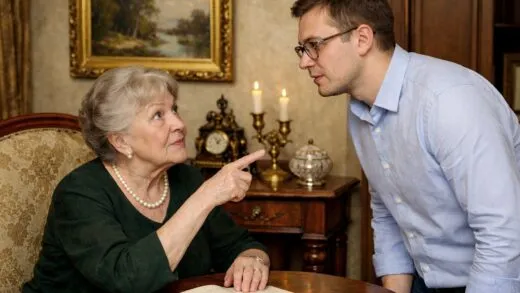
That they’ll take Michael? That everything we’ve done was for nothing?
David covered her hand with his.
“It won’t be for nothing. Even if we lose, Michael now knows what it feels like to be happy. No one can take that memory away from him.”
Vera looked at him.
“You’ve changed, David.”
“Yes, I have. Thanks to you. Thanks to Michael.”
She smiled. A faint smile, but a smile nonetheless.
“Do you know what I’ve realized over these past few months?”
“What?”
“The scariest thing for a parent isn’t losing a child physically. The scariest thing is losing them emotionally. When they’re right there, but so far away. When they’re breathing, but not living.”
David nodded.
“I lost Michael three years ago. The night Kate died. I buried my son along with my wife. And you brought him back to me.”
“He came back on his own. I just helped.”
“No. You did more than that. You showed me what it means to love.”
Vera looked down.
“I had a younger brother. Nick. He was born deaf, like Michael. My parents were ashamed of him. They kept him at home. Didn’t send him to school, didn’t let him play outside. They said they were protecting him from a cruel world.”
Her voice trembled. “He died when he was fourteen. Pneumonia. The doctors said if he had spent more time outside, been more active, lived… maybe he would have survived. But he didn’t live. He existed. In a cage.” Tears streamed down her cheeks. “I swore I would never let another child suffer Nick’s fate.”
“That’s why I became a teacher for the deaf. Why I do what I do. Why I couldn’t stand by and watch you lock Michael in a golden cage.”
David stood up and put his arms around her. Vera buried her face in his shoulder and cried. For the first time, she let herself cry.
“We’re not going to lose,” he said softly. “I promise, we won’t lose.”
But they both knew that promises don’t always come true.
The October morning greeted Chicago with a chilling rain. David woke at five, having barely slept. He’d tossed and turned all night, replaying the upcoming hearing in his mind. The first hearing in the custody case. He got up and went to Michael’s room. The boy was asleep, curled up, hugging that same muddy bird he’d never let go of.
David sat on the edge of the bed and gently stroked his son’s hair.
“I’m sorry for dragging you into this,” he whispered.
The boy didn’t hear. But as if sensing him, he turned in his sleep, reaching for his father. David took his small hand and sat there until dawn. At nine a.m., they were at the Cook County Circuit Court building.
A gray building, long hallways with peeling paint, the smell of dampness and bureaucracy. David held Michael’s hand. Vera walked beside them, pale, her lips pressed into a thin line. David’s lawyer, Paul Miller, a seasoned family law attorney, met them at the courtroom entrance.
“Ready?” he asked.
“No,” David answered honestly. “But we don’t have a choice.”
They went inside. The courtroom was small. At the plaintiff’s table sat Eleanor with her lawyer—a woman in her fifties with a hard face and steel-gray eyes. The defendant’s table was on the right. Eleanor looked at Michael. The boy instinctively pressed closer to his father.
“Michael shouldn’t be present for this,” she said. “It’s traumatic for a child.”
“Michael has a right to be here,” Paul countered. “This is about his future.”
“Your Honor,” the plaintiff’s lawyer addressed the judge, a middle-aged woman in robes, “we request that the child be removed from the courtroom. These proceedings could cause psychological harm.”
The judge, a Judge Samuelson, looked at Michael, then at David.
“The child can stay. But if I see he’s becoming distressed, I’ll ask you to take him out. Agreed?”
David nodded.
The hearing began. Eleanor’s lawyer, a Ms. Matthews, stood and began to state the plaintiff’s case.
Her voice was clear, confident, and merciless.
“Your Honor, we contend that David Solomon is failing in his duties as the parent of a child with special needs. Michael Solomon, age seven, is diagnosed with bilateral sensorineural hearing loss, fourth degree. In layman’s terms, he is profoundly deaf. A child like this requires a specialized approach, systematic instruction from qualified professionals, and a stable environment.”
She pulled out a folder of documents.
“Instead, what we have is this: a father who works fourteen hours a day, effectively absent from his child’s life. His upbringing is entirely delegated to a nanny who lacks the proper qualifications. Vera Vance, twenty-eight, holds a degree from a state university and her only prior experience was at a preschool that was shut down for violations.”
“That’s not true!” Vera couldn’t help herself.
“Quiet,” Paul placed a hand on her arm.
Ms. Matthews continued:
“We have video evidence of the child in unsanitary conditions, playing in mud, getting soaked in the rain while wearing expensive clothing, which was ruined. This demonstrates a complete lack of supervision from the father and gross negligence from the nanny.”
She turned on a projector. The video appeared on the wall. Michael, Vera, and David in the puddle. Playing, laughing, making mud figures. David looked at the screen and saw something entirely different. He saw happiness. His son’s first real smile in three years. But Ms. Matthews painted another picture:
“Look at the child. He is covered in filth. Soaking wet. In October, when the temperature is barely above freezing.”
“This is a direct threat to his health. And the father not only fails to stop this behavior, he participates in it.”
The judge watched the screen silently.
“We insist,” Ms. Matthews concluded, “that Michael Solomon needs a stable, controlled environment. His grandmother, Eleanor Vance, a retired hospital administrator and a woman of impeccable standing, is prepared to assume guardianship of her grandson.”
“She has all the necessary resources: a spacious home in Boston, connections to the best rehabilitation centers, and the time and desire to care for the child. We ask the court to limit David Solomon’s parental rights and grant custody to the grandmother.”
She sat down. A heavy silence filled the room. David could feel Michael squeezing his hand tighter and tighter. He looked at his son.
The boy was pale, his lips trembling.
“It’s going to be okay,” he signed.
Michael didn’t answer. He just clung to his father’s hand.
Paul Miller stood, adjusted his glasses, and opened his folder.
“Your Honor, allow me to present our position. Yes, David Solomon works long hours, like millions of other parents in this country. But that does not make him a bad father.”
“Over the past three months, he has fundamentally changed his approach to raising his son. And the results are clear.”
He played another video. Michael in a session with Vera. Counting rocks, studying trees, laughing, asking questions in sign language.
“This is the same child. But look at his face. He’s alive. He’s happy. He’s learning not from a textbook, but from life.”
Paul produced the report from the independent experts.
“We have evaluations from three specialists who worked with Michael personally. All of them confirm: during Vera Vance’s employment, the child has made significant progress. His communication, emotional stability, and cognitive engagement have all improved. This isn’t ‘playing in the mud.’ This is a modern teaching method utilizing sensory experience.”
He turned to Ms. Matthews.
“As for Ms. Vance’s qualifications. No, she did not graduate from an Ivy League school. But she has something that many credentialed specialists lack. A genuine love for the child and an understanding of his needs.”
“Love is no substitute for professionalism,” Ms. Matthews retorted coldly.
“And professionalism without love is a death sentence,” Paul shot back.
The judge raised a hand.
“Counselors, let’s maintain decorum. Please continue, Mr. Miller.”
Paul nodded.
“We also have evidence that the expert opinions presented by the plaintiff were compiled with bias. I have recordings of the phone conversations.”
“Objection!” Ms. Matthews jumped to her feet. “Those recordings were obtained illegally.”
“They were obtained during private conversations in which I informed the parties they were being recorded,” Paul replied calmly. “Completely within the law.”
The judge took the recordings and listened to a few excerpts. Her face remained impassive.
“The court will take this evidence into consideration.”
Ms. Matthews paled.
Paul continued: