A year ago, Marina secretly started giving money for medicine to an elderly cleaning lady, Vera Ivanovna. But today, the old woman grabbed her by the sleeve:
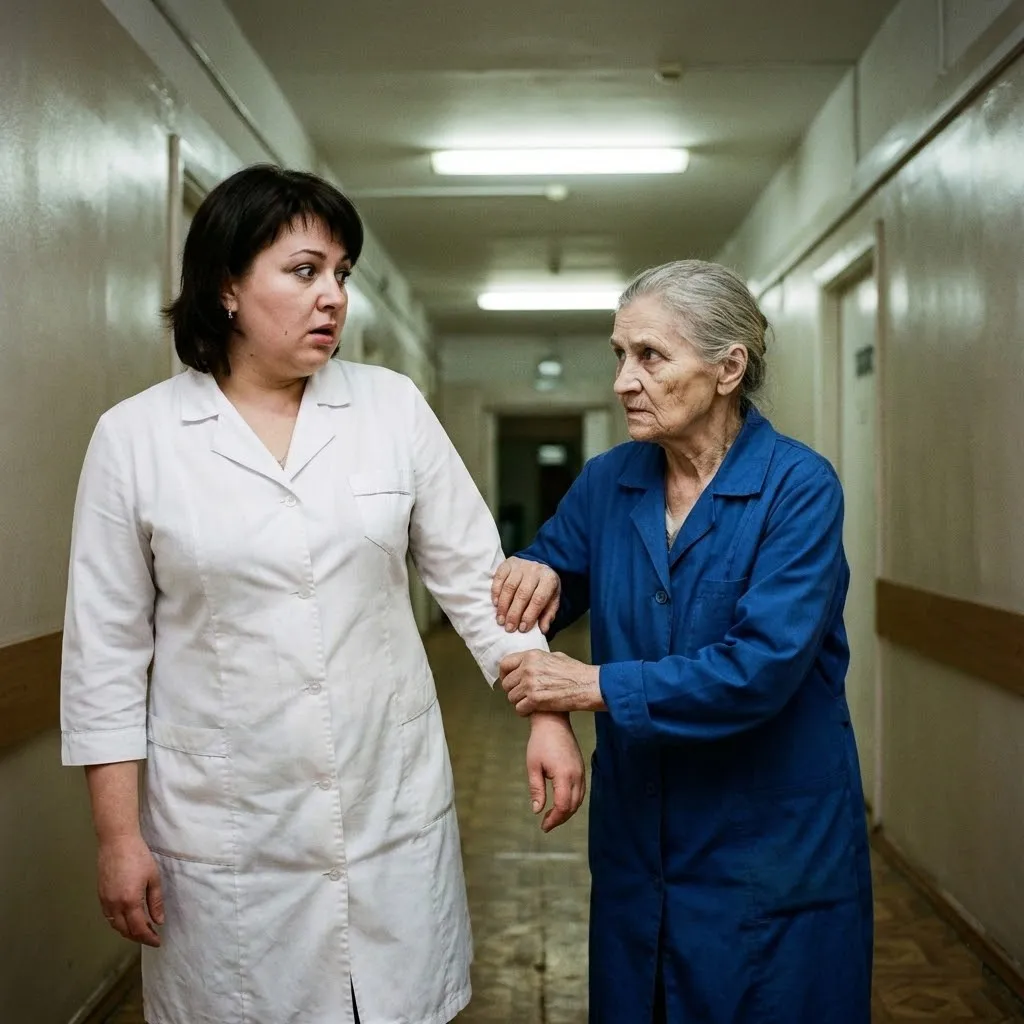
— Tomorrow, enter the hospital only through the service entrance. Not the main one, under any circumstances. Believe me, it’s important. I’ll explain everything the day after tomorrow.
Marina Voronova woke up to her alarm at half past five in the morning. It was still dark outside, and only a few streetlights illuminated the deserted residential street. She stretched, feeling the familiar heaviness in her shoulders after yesterday’s twelve-hour shift, and got up quietly, trying not to wake her father in the next room.
In the kitchen, Marina turned on the kettle and listened. A cough came from behind the wall, then the creak of a bed. Her father was awake. She quickly brewed some strong tea, cut two slices of bread, and got butter and cheese from the refrigerator. It was a modest breakfast, but there was neither time nor money for more until the next payday.
Entering her father’s room, Marina smiled out of habit:
— Good morning, Dad! How was your night?
Pyotr Semyonovich was lying in his high-headboard bed, covered with a warm blanket. The right side of his face was slightly distorted from the stroke he’d had three years ago. His left arm lay motionless on top of the blanket.
— It was okay, sweetie, — he answered hoarsely. — But my back started hurting towards the morning. And I needed the toilet, but I didn’t want to wake you.
Marina placed the breakfast tray on the nightstand and helped her father sit up, propping pillows behind his back. Then she brought a bedpan, helped him relieve himself, cleaned him up, and changed him into clean pajamas. It all took about twenty minutes, but she did everything calmly, without rushing, even though she knew she was running late.
— You should eat first, — her father said, looking at her with tired eyes. — You’ve gotten so thin.
— I’ll eat at work, Dad. I’ll bring you your porridge now.
She quickly heated up yesterday’s buckwheat, added a little butter, and patiently fed her father with a spoon. He chewed slowly, as half of his mouth didn’t work well, and Marina wiped the corners of his lips with a napkin when food fell out.
— Our neighbor Tamara promised to stop by during the day, — Marina said, collecting the dishes. — I’ll leave the key under the doormat for her. She’ll feed you and check if everything is okay.
— Just don’t tell her about the money, — her father requested. — It’s embarrassing in front of people.
Marina didn’t answer. Money was indeed a problem. Her salary as a nurse at the private clinic “Medlife” was 23,000. Her father’s disability pension was 11,000. From this, they had to pay for the apartment, buy food, medicine for her father, and also pay for a caregiver at least twice a week when Marina had night shifts. Her neighbor, Tamara Ivanovna, helped for free, out of kindness, but Marina always tried to thank her with pies or a jar of jam.
At half past six, Marina left the house. It was a ten-minute walk to the bus stop, then another forty minutes on a stuffy bus to the outskirts of the city where the clinic was located. She made it to her bus and settled by the window, gazing at the gray November morning. A light drizzle was falling outside, and people with gloomy faces hurried to work.
The “Medlife” clinic was located in a three-story building that used to be a kindergarten. Once, there were bright murals on the walls and playgrounds, but now the facade was painted white, a blue sign was hung, and the playgrounds were paved over for parking. The clinic was considered private, but in reality, it was small and not particularly prestigious. Mostly, residents of the nearby districts came here, those who found it inconvenient to travel to the city center or wanted to avoid the queues at the state polyclinic.
Marina entered through the main entrance, nodded to the security guard, Semyon, who was dozing at his desk, and went up to the second floor, where the therapeutic department was. In the staff room, she changed into a white coat, pinned her dark hair into a bun, and began her workday. There was a lot of work: she had to make the rounds in the wards, check the patients’ conditions, distribute morning medications, measure blood pressure and temperature, give several injections, and change IV drips. Marina worked quickly and efficiently, though fatigue accumulated with each passing day. The clinic was constantly short of nursing staff, and the nurses had to take on a double workload.
During a break, around eleven in the morning, Marina went down to the utility room on the first floor for clean linen. There, among the shelves of sheets and towels, she saw Vera Ivanovna. The old cleaning lady was sitting on a low stool, wiping her eyes with a handkerchief.
— Vera Ivanovna, what happened?