
 Let’s Keep It Real
the major hissed. “Steel, huh? Fine. Let’s see how your steel handles a real test.”
He turned sharply to the extraction team leader. “We’re done here.” “What about them?” the masked officer asked.
“Leave them. Let them rot. But…” The major paused in the doorway. His look promised them a hard road ahead.
“Turn off the heat in Cell 33. Shut off the water. Kill the lights. Open the window all the way. It’s ten below outside.
“Let’s see how your famous steel holds up when you’re frozen solid.” The heavy door slammed shut, and the outside bolt snapped into place. A minute later, the weak bulb overhead went dark, and the cell dropped into blackness.
Another minute passed, and a guard outside used a long pole to knock the bars loose from the window latch. The vent window flew open with a crack. Winter air rushed in, carrying stinging snow dust with it. In the pitch dark, Sever found Lom’s hand.
“You still with me?” he asked. “Yeah,” Lom answered quietly. “But it’s going to get cold in here, old-timer. We could freeze to death.”
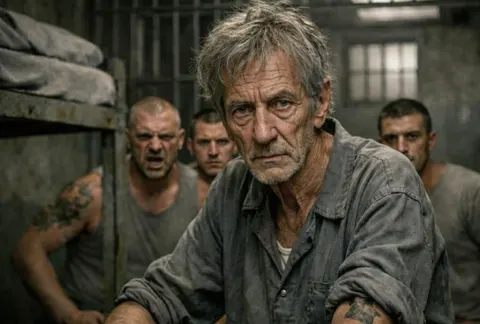
“Cold only scares the body,” Sever said calmly. “What ought to scare a man is warmth bought with betrayal. Everybody up. Tight group. Get on the bunks, back to back, and keep each other warm.
“If somebody slips down, pull him back up right away. This is the real test, boys. And we’re going to pass it.”
Brutal cold in a concrete box isn’t weather. It’s an executioner. It works slowly, without hurry.
First it bites your toes. Then it creeps under your clothes and locks up your muscles. Then, little by little, it starts freezing your thoughts.
Three hours later, the temperature in the cell had dropped to match the outside air. Ten below. Frost coated the walls. The water in the toilet froze solid.
The eight men on the lower bunks had become one shaking knot of flesh. “I can’t do this,” Needle whimpered. His teeth were chattering so hard it sounded like castanets.
The junkie was in full withdrawal now, layered on top of serious hypothermia. “Officer, open up! I’ll sign whatever you want! I’m freezing to death!” He tried to break from the circle and run for the steel door, ready to pound on it.
Panic is the most contagious thing in the world. If one man ran, the rest would follow. Their formation would fall apart, and the cold would finish them one by one.
Lom, sitting on the outside edge, caught Needle with one huge arm. “Sit down,” he growled. “Where do you think you’re going?”
“Sure, it’s warm out there. But that’s where traitors go. You want to be one of them?” “I’m going to die in here,” Needle cried.
“No, you’re not.” Sasha Sever’s voice came from the center of the human knot. It was the quietest voice in the room, but it carried a strange calming force.
“A person can survive more than he thinks. Right now we’ve built ourselves one fine winter coat out of body heat. The warmth isn’t leaving us. Just breathe steady.”
Then Sever began telling stories. Not about prison. Not about suffering. He talked about a deep pine forest, a campfire in the woods, the crackle of dry logs.
He described sparks rising into the night sky, the smell of pine sap and fresh hot bread. He painted warmth so clearly, so concretely, that the freezing men, eyes closed, began to believe it. Their minds—desperate for anything to hold onto—started helping their bodies survive.
Some of them swore they could almost smell smoke. That terrible night dragged on that way. It was the longest night of their lives.
They kept rotating positions to stay alive. The men on the outside, who took the worst of the cold, crawled toward the center. The ones who had warmed a little moved outward to hold the line.
Lom, the former brute, gave up his place in the middle twice to the beaten worker. “Warm up, buddy,” he muttered. “You’re too skinny. Wind’ll blow right through you.”
By early morning, the icy wind finally eased. Pale, indifferent sunlight showed itself through the open vent. At eight o’clock, the bolt on the door clanged.
The major was sure he’d find corpses. Or at least broken men crawling on their knees with frostbite. He had even brought a doctor along to officially record death by “heart failure.”
The door opened slowly. Thick steam rolled out into the cold hallway, like a sauna door opening. The major stepped inside—and stopped cold.
Eight men sat packed together on the lower bunks. Their eyelashes and brows were white with frost. Their faces were bluish from the cold.
But they sat upright. In the center was Sever, who slowly lifted his head. “Morning, Chief,” the old inmate said hoarsely.
“We’re just cooling off in here. Thought maybe you’d turn the heat on, but I guess the state’s saving money.” The doctor behind the stunned major let out an audible breath.
From a medical standpoint, surviving that kind of cold in light prison clothes should have been impossible. But these men had survived. Shared body heat and shared resolve had done what the major thought couldn’t be done.
The major stared at Lom in disbelief. Lom sat shoulder to shoulder with Sever and looked back at the officer with open hatred. Not fear. Hatred. The clear hatred of a free man.
And in that moment, the major understood. He had lost control of this cell for good. The cold hadn’t broken these men apart. It had welded them together.
“Close that window!” the major barked at a guard, trying hard to hide the shake in his voice. “Turn the heat back on. Now.”
Share how the story made you feel
0Comments appear after a quick automatic check. Please no links, ads or personal data.
Next to your name we show your country, determined from your IP address; the address itself is never shown, and only a hashed fingerprint of it is kept to stop spam.