
 Let’s Keep It Real
Dawn over the rolling hills of rural Kentucky arrived slowly, painting the horizon in soft shades of peach and rose. Out of a habit forged over decades, Bill Miller woke up at exactly five in the morning. After forty years of farm life, his internal clock was more reliable than any Swiss watch, making his old bedside alarm clock nothing more than a dusty relic. Shaking off the last of his sleep, Bill dressed in his worn flannel and headed out to check on the property.
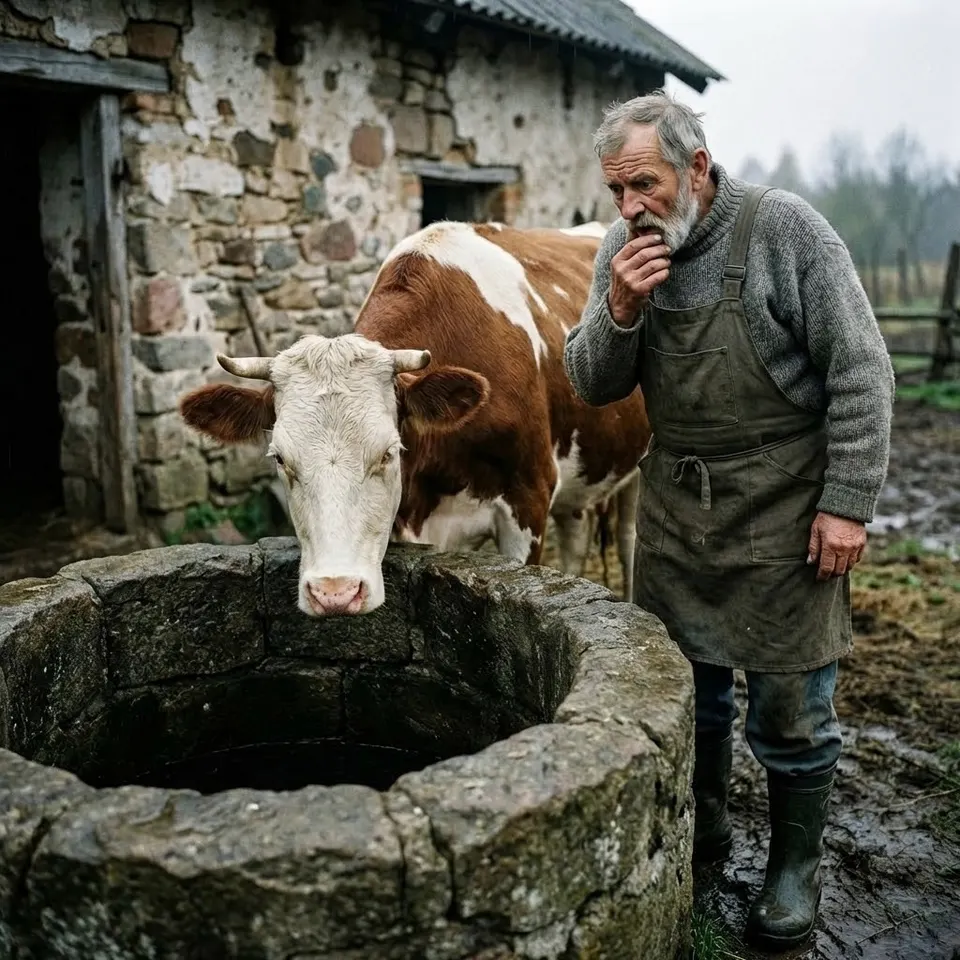
Stepping onto the porch of the sturdy farmhouse his father had built back in the fifties, Bill surveyed the yard. In the main paddock, twelve dairy cows were contentedly chewing hay, while the pigs in the barn let out the occasional satisfied grunt. A few hens scratched at the dew-damp earth, hunting for early worms. But Bill’s attention was immediately drawn to a familiar, puzzling sight: his best cow, Bessie, was standing perfectly still by the old, boarded-up well at the edge of the property.
This strange scene had repeated itself every morning for the last five years, and it remained a total mystery to Bill. Bessie was the pride of the farm, known for being exceptionally calm and gentle. Bill had bought her as a tiny calf from a neighbor and bottle-fed her himself. That bond meant the cow usually understood him with just a whistle, but when she was at the well, she was in her own world.
For five years straight, as soon as the sun hit the horizon, Bessie would walk to that abandoned shaft and stare into the darkness for hours. At first, Bill thought it was just a quirk—maybe she liked the shade or the quiet corner. But as the years went by, the eerie consistency of her morning vigil began to settle in his gut like a heavy stone. It wasn't just a habit; it looked like a duty.
The well itself was a piece of family history. Bill’s grandfather, Silas, had hand-dug it back in 1923. Family legend said Silas spent an entire summer hacking through heavy clay and limestone to reach water. It went down nearly sixty feet, and for decades, it provided the cleanest water in the county. When the town finally ran water lines out to the farms in the nineties, the old stone structure was capped and forgotten, slowly disappearing behind a curtain of weeds.
Bill let out a short, dry chuckle as he walked toward her. "What are you looking for today, girl?" he asked. Bessie didn't even flick an ear. She remained frozen, her large brown eyes fixed on the dark gaps between the stones. Her breath came in steady plumes of mist in the cool morning air. She stood like a statue, oblivious to the flies or the world around her, focused entirely on whatever was happening deep underground.
Bill leaned over the edge of the stone wall, trying to see what could possibly fascinate an animal for half a decade. Below him was nothing but a pitch-black void. He picked up a small pebble and dropped it. A few seconds later, there was a faint, muffled *plink*. There was still a bit of liquid down there, despite the well being "dry" for years.
Just then, his wife Mary called out from the back porch, telling him breakfast was on the table. Mary, his partner of twenty-two years, was the practical backbone of the operation. A former schoolteacher, she had a sharp mind and a no-nonsense attitude. She had chosen the farm life over a career in the city, and Bill knew he’d be lost without her steady hand and quiet wisdom.
She was his sounding board for everything, from crop rotations to raising their son, Alex. Bill called back that he was coming, but he lingered for another minute. It bothered him that the other cows avoided the well entirely, preferring the open pasture or the shade of the oaks. Only Bessie had this obsessive, almost ritualistic connection to the old shaft.
Over coffee and eggs, Bill brought it up again. Mary poured him a refill and suggested that maybe Bessie could hear an underground spring. She reminded him that animals have instincts humans lost a long time ago—they can feel vibrations and shifts in the earth that we completely miss.
Bill shook his head skeptically. He’d been down that well three years ago to pull out an old pump, and there was nothing but a few inches of stagnant, foul-smelling sludge. Mary then joked that maybe there were rats nesting in the stones, and Bessie was just being nosy. Bill didn't laugh. To him, the behavior was too deliberate, too focused to be about a few rodents.
What struck him most was the timing. Bessie was as precise as a clock. Every morning at 6:00 AM, she took her post. At 11:00 AM sharp, she would let out a single low moo, turn around, and rejoin the herd as if nothing had happened. For the rest of the day, she was a perfectly normal cow.
There were no signs of illness. Her milk production was the highest in the herd, her coat was glossy, and her appetite was healthy. Mary finally suggested they call Doc Peterson, the local vet, just to rule out any neurological issues. She hoped a professional opinion would finally put Bill’s mind at ease.
Doc Peterson was a man who had seen everything in his thirty years of practice. He listened to Bill’s story while stroking his gray beard, looking thoughtful. Eventually, he told Bill that animals often develop "stereotypical behaviors"—harmless quirks that don't have a medical cause. He suggested there might be a high-pitched hum from the old pipes or a specific scent that Bill’s nose couldn't catch.
The vet gave Bessie a full physical and found her to be in peak condition. Heart, lungs, and reflexes were all perfect. He told Bill it was likely just a "security blanket" behavior and nothing to worry about.
The vet’s verdict was that it was a harmless habit, like a person who taps their pen or paces when they think. But Bill wasn't satisfied. The "habit" was too intense. It felt less like a quirk and more like a vigil.
The seasons bled into one another. A rainy autumn turned into a brutal Kentucky winter, but Bessie didn't change. Even when the wind chill dropped below zero, she would trudge through the snow to stand by that well. When Bill tried to keep her in the warm barn, she would pace and bellow until he let her out. She would rather freeze by the well than be comfortable in her stall.
Watching her plow a path through waist-deep snow just to stand by a hole in the ground finally got to Mary. She asked Bill if there was something actually *down* there. She brought up stories of dogs sensing earthquakes or cats leaving a house hours before a fire. She wondered if Bessie was sensing a danger they couldn't see.
That conversation was the turning point. Bill decided that with the first thaw of spring, he was going down. He gathered a heavy-duty climbing rope and a high-lumen tactical flashlight. He started by lowering the light on a string, deep into the shaft.
When the beam hit the bottom, about fifty feet down, he saw the same thing he’d seen years ago: a few inches of dark water. It wasn't deep enough to explain a cow's thirst. The walls were covered in slick moss and grime. Nothing looked out of the ordinary. But as he pulled the flashlight back up, a faint, strange odor hit his nose.
It was a sharp, acrid smell—something familiar, but out of place on a farm. Mary worried it might be a gas leak from an old natural pocket. Bill didn't know what it was, but it didn't smell like any swamp gas he’d ever encountered. It smelled... industrial.
They decided to go to the county records office to see if there were any old mining maps or utility lines they didn't know about. They met with a clerk named Miller, a man who looked like he hadn't enjoyed a day of work in twenty years. Miller listened to the story about the cow and the smell and simply shrugged.
He told them the county didn't have "cow psychologists" on staff and that the land was private, so whatever was in the well was Bill's problem. Bill asked about old mineral rights or abandoned pipes. The clerk shut him down, saying the records were incomplete and it wasn't the government's job to inspect old farm wells. It was clear the bureaucrat thought they were just bored seniors looking for attention.
When Mary asked what they should do next, the clerk suggested calling a private environmental firm—at a cost of thousands of dollars. Leaving the office empty-handed, Bill made a decision. He wasn't going to pay a firm to tell him what he could find out himself. He was going down into the dark. He spent the next few days prepping, his mind filled with a mix of dread and determination.
He found his old heavy-duty tow rope and checked every inch for frays. He bought a new headlamp and backup batteries. For safety, he called his oldest friend, Jim, a retired mechanic who lived three miles down the road. They had been friends since grade school, served in the same National Guard unit, and trusted each other with their lives.
Jim, a man of practical logic and grease-stained hands, thought Bill had finally lost his marbles. He couldn't understand why Bill would risk a broken neck over a cow’s weird behavior. Bill just looked him in the eye and said, "Bessie’s been telling me something for five years, Jim. I’m finally going to listen."
Jim warned him about "bad air"—methane or carbon monoxide that could settle in old shafts. But Bill was stubborn, trusting the stonework his grandfather had laid. Realizing he couldn't talk Bill out of it, Jim agreed to man the rope. They set the date for Sunday morning, hoping to get it done before the neighbors were up and asking questions.
Mary was a nervous wreck. She made Bill promise to come up the second he felt lightheaded. He kissed her cheek and told her he’d be back in ten minutes with an answer. He sounded more confident than he felt.
Sunday morning arrived with a thick blanket of fog. Bessie was already at her post, but she stepped back as the men approached with the gear. Jim tied the rope to a massive old oak tree near the well, a tree that had stood for a century and wasn't going anywhere. He gave the rope a hard tug, satisfied with the anchor.
One last time, Jim asked if Bill wanted to reconsider. Bill just nodded, clicked on his headlamp, and stepped over the edge. The descent was slow. The air grew cold and damp, smelling of ancient stone and wet earth. The walls were slick with a black, oily moss that felt like grease under his gloves.
About thirty feet down, the smell changed. It wasn't just damp anymore; it was that sharp, chemical scent again, much stronger now. It stung his nose and made his eyes water. He hung there for a moment, breathing through his shirt, trying to place the scent. Jim’s voice echoed down the shaft, distorted and hollow, asking if he was okay.
Bill shouted back that he was fine and kept going. Finally, his boots hit the soft, silty bottom. He stood in about six inches of murky water. He panned his light around the base of the well, and that’s when he saw it. It wasn't a gas leak, and it wasn't a dead animal.
Coming directly out of a fissure in the limestone rocks was a thick, dark, shimmering liquid. It was oozing slowly into the water, creating brilliant, swirling rainbows on the surface. Bill’s heart hammered against his ribs. He reached out, dipped his gloved fingers into the sludge, and brought it to his face.
It was jet black, incredibly slick, and smelled exactly like a mechanic's shop. It was crude oil. Pure, unrefined "black gold" was seeping into his grandfather’s well. Bill realized in a flash that his humble farm was sitting on top of an oil pocket. He fumbled a plastic water bottle out of his pocket—one he’d brought just in case—and filled it with the dark liquid.
He shone the light higher and saw the oil was weeping from several cracks in the stone, suggesting there was significant pressure behind it. This wasn't just a spill; it was a reservoir. Jim’s voice boomed down again, sounding panicked this time. Bill signaled for the pull, and Jim began the slow process of hauling him back to the surface.
The trip up felt like it took an hour. His mind was racing with the implications. He’d seen the news stories about the oil booms in North Dakota and Texas. He knew what this meant for his family’s future. When he finally scrambled over the edge, Jim was pale from the effort, ready to hear the bad news.
Bill didn't say a word. He just handed Jim the plastic bottle. Jim unscrewed the cap, took one whiff, and his eyes went wide. "Is that...?" Bill just nodded. "Oil. High grade, by the look of it." They stood there in the fog, two old friends realizing that the world they knew had just shifted under their feet.
Bill knew this kind of secret wouldn't stay secret for long. He made Jim swear to keep it quiet until they knew how to handle it. He knew that once the word got out, their quiet life would be over. But when he walked into the kitchen, Mary took one look at his oil-stained clothes and his trembling hands and knew something life-changing had happened.
He sat her down and showed her the bottle. At first, she thought he was joking, then she was thrilled, but then a shadow of fear crossed her face. She was a smart woman; she knew that where there was big money, there were dangerous people. She worried that their peaceful life was about to be invaded by lawyers, landmen, and corporate vultures.
Bill tried to reassure her, but he felt the same weight. He knew he needed professional proof before he did anything else. The next morning, he drove to the state university in the city, looking for a geologist. He found a lab run by a man named Dr. Henderson, a gray-haired academic who looked skeptical when a farmer walked in with a water bottle full of sludge.
Henderson took the sample, promising a full analysis. He warned Bill that "seeps" happen all the time and rarely mean there’s a commercial-grade field underneath. He told Bill it would take a week and cost five hundred dollars. Bill paid it without blinking, knowing the stakes were much higher than a few hundred bucks.
While he waited for the results, Bill tried to go about his business, but he couldn't stop looking at the well. Bessie was still there, every morning, like a silent guardian of the family fortune. He realized now that she wasn't just smelling the oil; she was likely reacting to the subtle vibrations of the pressurized pocket deep below.
He decided to tell his son, Alex, who was away at the state agricultural college. Alex was a tech-savvy kid, and when he heard the news, he immediately started talking about "generational wealth," new equipment, and retiring his parents. Bill had to tell him to slow down. He reminded his son that they didn't own the oil yet—they just owned the hole it was leaking into.
Alex’s excitement was contagious, but Bill kept his feet on the ground. On the fourth day, Dr. Henderson called. His voice had lost its academic chill; he sounded genuinely stunned. He asked Bill to come to the lab immediately. When Bill arrived, the doctor laid out a series of charts and chemical breakdowns.
He told Bill the sample was "Sweet Crude"—the highest quality oil, low in sulfur and easy to refine. More importantly, the pressure readings Bill had described suggested a massive "anticline" formation under his property. If the pocket was as big as Henderson suspected, Bill was sitting on millions of barrels of oil. The estimated value was in the tens of millions of dollars.
Bill felt a wave of vertigo. He was a man who worried about the price of diesel and hay, and now he was being told he was a multi-millionaire. Henderson warned him that the legal process would be a nightmare. He’d need to secure mineral rights, deal with state regulators, and find a drilling partner who wouldn't rob him blind.
Bill thanked the doctor and headed home, but when he pulled into his driveway, his heart sank. A sleek, black SUV was parked near his porch. Two men in expensive-looking outdoor gear were standing by his gate, looking at the well. One of them, a man with a polished smile who introduced himself as Mr. Sterling, handed Bill a business card for a major regional energy firm.
Sterling’s partner, a silent, burly man named Rick, didn't smile. Sterling said they were "scouting for a new pipeline route" and wanted to make Bill a generous offer for his back forty acres. Bill played dumb, asking why they wanted his rocky hillside. Sterling gave a canned speech about "infrastructure and progress."
Bill told them the land wasn't for sale. Sterling’s smile didn't falter, but his eyes turned cold. He offered Bill $100,000 on the spot—way above market value for the acreage. Bill refused again. Rick, the silent partner, made a comment about how "accidents happen on old farms" and how it would be a shame if Bill’s luck ran out. It was a blatant threat.
After they left, Bill realized the leak was out. Someone at the lab or the county office had talked. He gathered Mary and Alex and told them they were in for a fight. He bought a security system and a dashcam, and he started carrying his old hunting rifle in the truck. He wasn't going to be bullied off his own dirt.
The harassment started small. A gate left open, a fence line cut. Then, one of his younger heifers went missing in the middle of the night. Jim, the mechanic, came over to help search, but they found nothing. It was a clear message: *We can get to your animals whenever we want.*
Bill went to the local Sheriff, a man named Miller who had been in office too long. The Sheriff took the report but seemed strangely dismissive. He suggested Bill just "take the payout" and move to the city, saying it wasn't worth the headache to fight big energy companies. Bill realized then that the local law was likely in the pocket of the developers.
A week later, Bill found sand in the fuel tank of his primary tractor. The repair cost him five thousand dollars and a week of work. Mary was terrified, begging Bill to just sell and move somewhere safe. She didn't care about the millions; she just wanted her husband back. But Bill’s grandfather had bled for this land, and Bill wasn't about to let some corporate thugs steal it.
The breaking point came when his hay barn was set on fire. If it hadn't been for a lucky shift in the wind and Jim’s quick arrival with a water truck, the whole farmhouse might have gone up. The fire marshal called it "faulty wiring," even though Bill had just replaced the panel. Bill knew better. This was war.
He decided to go public. He contacted a high-powered attorney in the state capital, Sarah Vance, who specialized in property rights. He also reached out to a local investigative reporter, Elena Ross. Elena smelled a story—the "Little Guy vs. Big Oil." She ran a front-page story about the harassment and the discovery in the well.
The story went viral. Suddenly, the "pipeline developers" couldn't operate in the shadows anymore. State regulators were forced to step in, and a team of independent geologists confirmed Bill’s find. The "Sweet Crude" under the Miller farm was part of a massive, untapped field that could power the whole region.
Under the glare of public scrutiny, the energy company was forced to negotiate fairly. With Sarah Vance’s help, Bill signed a deal that gave him a massive signing bonus and a 20% royalty on every barrel pulled from the ground. He made sure the contract included strict environmental protections for the rest of his land.
The first check was for five million dollars. Bill used it to set up a trust for Alex, pay off every debt in the county for his friends, and build a state-of-the-art veterinary clinic for the community. He bought Mary the quiet life she wanted, but they didn't move to the city. They stayed right there on the farm.
Bessie lived out her days as the most pampered cow in Kentucky. She never had to produce another drop of milk. She had her own private paddock right next to the old well, which was now a small, high-tech pumping station. Even in her old age, she would still walk over to the fence every morning at 6:00 AM and watch the machinery work, as if making sure they were doing it right.

















Share how the story made you feel
0Comments appear after a quick automatic check. Please no links, ads or personal data.
Next to your name we show your country, determined from your IP address; the address itself is never shown, and only a hashed fingerprint of it is kept to stop spam.