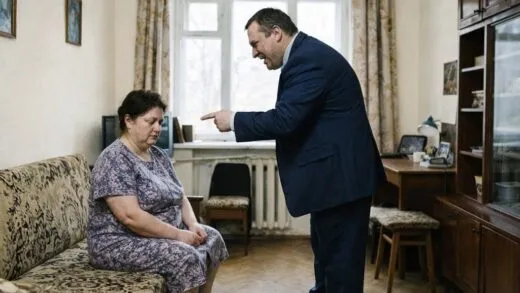

Stan had thrown her out of the apartment. He had taken her savings. He thought he had stripped her of everything and left her with nothing but cold pavement.
He thought power was a notarized paper and walls covered in expensive wallpaper. But real power doesn’t live in drywall and granite countertops. Real power is when people come to you when the lights go out.
When they’re scared. When they need protection. Anna slowly closed the notebook.
The fear that had been choking her for the past day disappeared. In its place came a cool, steady certainty. She was not some stray dog kicked into the street.
She was her grandmother’s granddaughter. And she had an army of her own. Maggie tugged at her sleeve.
“Mom, are we going home?” Anna looked into her daughter’s eyes. “Yes, sweetheart. We are. One way or another.”
She tucked the recipe notebook into the inside pocket of the jacket, close to her heart. It was time to call in debts. Time to find out what else Grandma Vera had been keeping to herself.
Anna stood, took her daughter’s hand, and headed for the park exit with purpose. She had one more stop to make. She needed to meet with the attorney.
And this time it would not be to hand over money. Anna pushed open the heavy door with the brass plate that read “Attorney at Law.” Inside, the air smelled of old paper, sealing wax, and strong black tea.
Maggie clung to her mother’s hand, shy and tired. Behind a massive oak desk sat Michael.
He looked nothing like a sleek, successful lawyer. In a rumpled tweed jacket, horn-rimmed glasses sliding down his nose, and unruly gray hair, he looked more like a distracted college professor. When he saw Anna, he slowly stood, removed his glasses, and rubbed the bridge of his nose.
“Hello, Anna. Come in, sit down. Your daughter might be more comfortable in the waiting room. There are coloring books and crayons on the couch out there.”
Anna nodded. She crouched, straightened Maggie’s scarf, and gently nudged her toward the leather sofa in the small reception area. “Color for a little while, honey. I’ll be right here.”
She went into the office and sat down on the stiff visitor’s chair. Deep inside, hope still flickered. Small, cautious hope that Grandma had left her at least a little money.
Maybe $5,000. Maybe $10,000. Enough to rent a tiny one-bedroom on the edge of town, buy Maggie a new bed and warm clothes to replace what had been thrown out, and get through the first month while she figured out the rest. She wasn’t asking for much.
Michael walked to the office door and, to Anna’s surprise, turned the key in the lock. The click sounded loud and final. He returned to the desk but did not sit down.
Instead, he came around and stood close to her. His warm, dry hand rested on her trembling shoulder. The gesture was so fatherly, so full of sympathy, that Anna felt her eyes sting again.
“Anna,” the attorney said quietly, but very firmly, “I know what happened yesterday. I know about the apartment, and I know about the curb.”
Anna jerked her head up. “How? How do you know?”
Michael gave a grim little smile. “Your husband, Stanley, called me this morning. He wanted me to speed up the paperwork on your waiver of the joint funds.”
“He was very pleased with himself. Said you’d come in, sign everything, and the problem would be solved. He thinks he threw a penniless woman onto the street—a powerless helper who would just cry and go along.”
Anna’s hand curled into a fist. The silver coin in her pocket dug into her palm. “I’m going to sign that waiver,” she said dully.
“I need Maggie. I can’t go to war with them right now. I have nothing. Did Grandma leave me anything at all? The lake house? A savings account? Anything?”
Michael removed his hand from her shoulder, crossed to the heavy wall safe, and opened it. He took out a thick cardboard file tied with string and dropped it onto the desk in front of Anna with a solid thump. “Smile, Anna,” he said, looking straight at her.
There was steel in his voice now. “Your husband has no idea what your grandmother’s final arrangements were. As of this morning, you are the wealthiest woman in town.”
Anna blinked at him. “What? Wealthiest? What are you talking about?”
“Your grandmother collected a modest Social Security check and sold jam at the farmers market for appearances,” Michael said as he slowly untied the file.
“She wasn’t really selling jam, Anna. She was keeping an eye on her holdings. In the nineties, people around here called her the Queen of Market Street.”
“No one remembers exactly how the nickname started, but the most influential people in this town used to say it under their breath. Your grandmother owned sixty percent of the commercial real estate around the central market district. The butcher row, the covered produce hall, the administrative building, and the surrounding storefronts—it all belonged to her companies.”
“And now it belongs to you.” Anna stopped breathing. The room seemed to tilt.
The smell of sealing wax turned overpowering. “That… that has to be a mistake,” she whispered, gripping the edge of the desk with white fingers. “That can’t be right. We lived so modestly.”
“She never… she wouldn’t even buy herself a new coat.” “She was a wise woman,” Michael said gently. “And she understood money.”
“She understood what it does to people—especially people like the Vargases.” He pulled a dense legal document from the file, covered in fine print and stamps.
“This is the will. And there’s a special clause in it. We called it the cruelty clause. Vera knew that the moment she died, Stanley and Gloria would try to get rid of you.”…