
 Let’s Keep It Real
Three months ago, everything was different. Polina was returning home after long negotiations that made her head buzz, thinking about how September Kharkiv smelled completely different from the summer. Instead of dusty stuffiness, there was now a scent of decaying leaves and smoke from bonfires in the dacha plots outside the city.
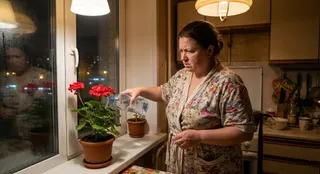
The promotion, hinted at since spring, finally materialized into an offer to head the logistics hub in Odessa: a 40% higher salary, prospects she could only have dreamed of five years ago when she first joined the company as a regular dispatcher. At the entrance to her building, she was intercepted by Zinaida Pavlovna, a neighbor from the first floor, one of those spry pensioners who know everything about everyone and consider it not curiosity, but a civic duty.
— Polinka, wait a minute, — she called out, holding the shabby entrance door. — I have to tell you something.
— Good evening, Zinaida Pavlovna. — Polina stopped, although her feet were aching, and she wanted only one thing – to take off her shoes and lie down.
— Your husband came by today. With his mother and that pregnant sister of his. — The old woman lowered her voice, though there was no one in the courtyard. — They were looking at your apartment, walking around, measuring the rooms, discussing who would live where.
— What do you mean, measuring?
— Literally, my dear. His mother was talking so loudly, the whole building could hear: 'We'll give this room to Ulechka, we'll make a nursery here. And Polinka will put up with it, where else would she go?'
Zinaida Pavlovna pursed her lips with the look of someone who always knew this wouldn't end well.
— And she also said you have terrible taste. The room, she says, needs to be repainted, this poisonous color will hurt the baby's eyes.
Polina was silent. The wind blew yellow leaves across the asphalt, and one of them stuck to her shoe, but she didn't move.
— The main thing is, don't stay silent, — the neighbor continued. — You tell them that this is your apartment, that your father gave it to you. I remember when you moved in, you were still single, doing the renovations.
— Thank you, Zinaida Pavlovna. — Polina finally moved. — I'll handle it.
She didn't make a scene that evening. She went up to the apartment, kissed her husband on the cheek, and heated up dinner. Viktor talked about work, his idiot boss, and his salary being delayed again. She nodded, her mind elsewhere.
She thought about how three weeks ago, he had brushed off the conversation about moving to Odessa: "What about Mom? She's all alone." How a month ago, when Ulyana announced her pregnancy, he had said: "She was abandoned, you understand? She needs help." How six months ago, her mother-in-law first mentioned that a large apartment was too spacious for two, while "we have so many empty rooms." Now the puzzle was complete. Viktor wasn't just delaying a decision — he had already decided. With his mother. Without her.
— Why are you so quiet? — he asked as she was clearing the dishes.
— Just tired. The negotiations were tough.
— Oh, well, get some rest then.
He kissed the top of her head and went to watch football. Polina stood by the sink, looking at her reflection in the dark window, and felt something inside her slowly shift, like a mechanism that had been motionless for years had finally started working.
For four years, she had believed that family was about compromise, that love required sacrifice, that if she was patient, everything would work out. For four years, she had turned a blind eye to her mother-in-law's unannounced visits, to the money Viktor sent his mother from their joint budget, to his constant "Mom said," "Mom thinks," "Mom knows best." But now she realized she wasn't going to tolerate it anymore.
The next morning, after her husband left for work, Polina called a realtor she knew.
— Petya, remember you said you had a client for a three-room apartment in the center, Shcherbakov? Yes, he's still looking. He wants to gift it to his son for his wedding? Then show him mine.
October was spent in negotiations. Ignat Romanovich Shcherbakov, a heavyset man with a short haircut and the attentive eyes of someone used to noticing details, inspected the apartment twice: first with the realtor, then with his son and daughter-in-law. The young couple liked it: a good neighborhood, a 10-minute walk to the Lopan embankment, high ceilings, a convenient layout.
— Seven million eight hundred thousand, — said Shcherbakov. — With furniture and appliances, it'll be easier for the young ones.
— Agreed, — Polina shook his hand. — But I must warn you: on the day the keys are handed over, there might be people in the apartment who won't want to leave.
Shcherbakov smirked, and in that smirk, one could read: "We've seen worse."
— I have a friend, a police captain. If needed, I'll ask him to come by. This isn't the first time we've dealt with such issues, Polina Timurovna.
November. A preliminary agreement was signed, a deposit of 500,000 hryvnias in cash received. Polina began to quietly move her things out: first documents, then photos, then jewelry and her favorite clothes. Viktor didn't notice anything, too busy organizing his mother's move.
— Are you carrying boxes again? — he asked once, finding her in the hallway with bags.
— Just sorting through junk. Giving it to charity, — she replied.
He nodded, no longer listening, engrossed in his phone.
In Odessa, she found a studio to rent near her new office and looked at an apartment in a building under construction. The down payment for the mortgage was more than covered. Her business trips became more frequent. Officially, it was for handing over her duties and preparing for the transfer. Viktor was only too happy, as it meant fewer questions and more freedom.
— When will you be back? — he would sometimes ask. — When you're done? Maybe mid-December? Okay, say hi to Mom.
And he would go back to his phone, where a group chat was discussing what curtains to hang in the nursery.
In early December, the main contract was signed. The documents were sent for registration. Polina left for Odessa, officially on a business trip, but in reality — for good.
Zinaida Pavlovna called every day.
— They've moved in, — she reported in an excited whisper. — Your mother-in-law, your pregnant sister-in-law, they brought three carloads of stuff. They hired painters, they're painting the room.
— What color? — Polina asked, though she already knew the answer.
— Pink. A pale one, like milk with jam.
This morning, picking up the extract from the State Register of Property Rights at the Administrative Services Center in Odessa, Polina saw a new name in the "right holder" field: Shcherbakov Ignat Romanovich. She took an evening flight back to Kharkiv, two hours over snow-covered steppes and woodlands. And all that time, she thought about why she was returning.
She could have not come. Shcherbakov would have handled it himself with his experience and connections. She could have handed over the keys through the realtor, stayed in Odessa, and forgotten the whole thing like a bad dream. But she needed to see their faces.
For three months, she had played the role of a submissive wife, smiling, nodding, swallowing humiliations. For three months, she watched her husband plan her life without her, her mother-in-law command her home, her sister-in-law try on her rooms for size. For three months, she remained silent. She had earned the right to put an end to it personally.
December Kharkiv greeted her with a blizzard and minus twenty degrees. Polina took a taxi to the familiar building entrance, went up to the third floor, and stopped in front of the door of her — now former — apartment. The key turned in the lock easily, familiarly, for the last time.
The first thing she saw in the hallway was someone else's shoes. Many pairs of someone else's shoes. Men's work boots with caked-on snow, women's large-sized winter boots, pink Uggs with fur trim. Polina kicked off her own boots into a corner, set down her travel bag, and sniffed the air. The sharp smell of paint mixed with her mother-in-law's cloying perfume — the cheap market kind that Larisa Semyonovna considered European and doused herself in as if the bottle cost pennies.
Polina didn't call for her husband. Quietly, trying not to make the parquet floor creak, she walked down the corridor towards the smell of paint — to the guest room. The very one she had decorated in her favorite emerald green. Expensive wallpaper from Kyiv, handmade light fixtures, matching curtains.
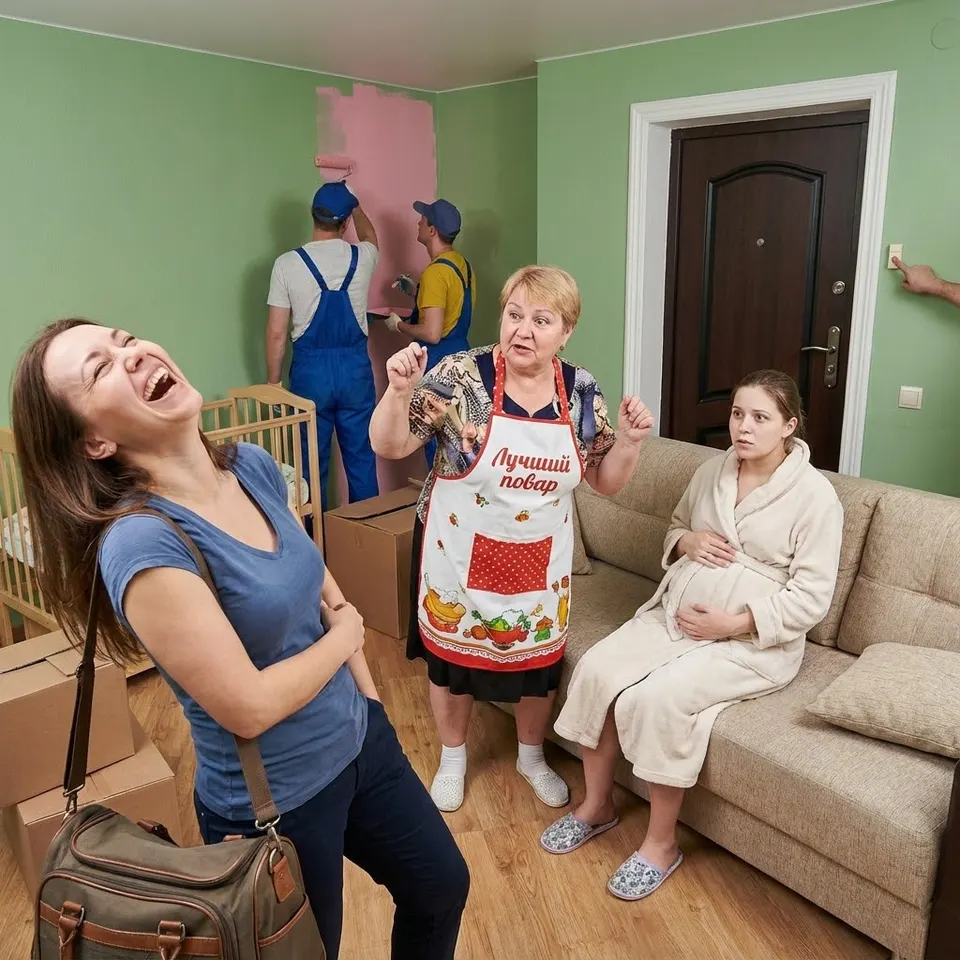
Now the door was wide open, and Polina froze on the threshold, unable to tear her eyes away from what she saw. Two painters in paint-splattered overalls were rolling the walls. Pale pink paint was being applied evenly, shining glossily under the light of a bare bulb. Her emerald wallpaper lay in a dirty heap on the floor — torn off, crumpled, ruined. In the corner stood a stack of paint cans. By the window was a brand-new crib in its transparent packaging. White, with carved headboards, and a label on the box: "From birth to three years."
Dishes clattered in the kitchen. Larisa Semyonovna's voice commanded someone unseen:
— Give me the big pot, I'll make borscht. Not that one, you idiot, the other one! The one with handles.
Polina peeked into the living room. On her sofa, the one she had spent six months choosing and had transported from Odessa, Ulyana was half-reclining. Seven months pregnant, a round belly under a house robe. Under her robe, by the way — a silk one, brought back from a business trip to Turkey. Her sister-in-law was flipping through a glossy magazine and absentmindedly stroking her belly, not noticing Polina in the doorway.
In the bedroom, the final piece of the picture was revealed. A folding cot. A narrow, army-style one, covered with a plaid blanket. On a chair nearby, her mother-in-law's things were laid out: sweaters, skirts, underwear. Larisa Semyonovna was planning to sleep here. In the same room with her and Viktor.
Polina stood in the middle of her apartment — the very one her father had gifted her 15 years ago with the words "this is your safety net" — and looked at it all with complete composure. They had gone further than she thought. The crib meant they had no intention of leaving. The cot in the bedroom meant her mother-in-law planned to control her every breath. The pink walls instead of emerald meant they were destroying everything that was hers.
"Terrible taste," she remembered her mother-in-law's words. "It will hurt the eyes." They didn't even hide their contempt. They decided for her, cut up her life like cheap fabric, and were sure she would swallow this too.
But the main feeling now wasn't anger, not resentment, not pain. It was a calm, almost cheerful satisfaction. They were digging their own grave, diligently and with enthusiasm, unaware of how deep it would turn out to be.
Polina took out her phone and snapped a few pictures: the room with the painters, the stripped wallpaper, the crib in its packaging, the cot in the bedroom. Just in case. Then she put the phone away and coughed loudly to announce her presence.
Her mother-in-law was the first to hear her. She emerged from the kitchen, wiping her hands on Polina's apron — the one with the inscription "Best Chef," which she had once brought back from a trip to Lviv. A fleeting moment of confusion flickered across Larisa Semyonovna's face, but it was quickly replaced by her usual expression of being in charge — the one she had worn for 30 years in the factory cafeteria, commanding cooks and dishwashers.
— Oh, Polinka is back. — Her voice sounded as if Polina were a guest in her own home. — We're just settling in comfortably here. You can't imagine what a mess you had. It's a good thing I came to tidy up.
Polina remained silent, and this silence hung in the air like pre-storm humidity.
— The boys are almost finished, — Larisa Semyonovna nodded towards the guest room. — Pink is for a girl, it's calming. Your green was just awful, a child's eyes would hurt from such a color. Doctors say you can't have bright colors in a nursery. It's a good thing I intervened in time.
— What doctors?
— What? What doctors said that about the colors? — Larisa Semyonovna blinked, not used to her statements requiring proof, and waved her hand in irritation. — What difference does it make which ones? Everyone knows bright colors are harmful. You better sort out your things, I've cleared a space for you in the bedroom, three shelves in the wardrobe.
— Three shelves, — Polina repeated flatly.
— Well, what did you expect? Ulechka needs a place for the baby's things, and I need a place for mine. You'll have to put up with it for a while, you understand the situation.
Ulyana floated out of the room, supporting her lower back, with the air of a martyr, although she was still two months from her due date, and her belly, for all its size, was unlikely to be putting that much pressure on her spine. Polina's silk robe, brought from a business trip to Turkey, looked out of place on her: the sleeves were too short, the belt barely closed.
— Oh, Polya, hi! — Her voice was sickly sweet, with that special intonation Ulyana used whenever she wanted something. — When did you get here? Sorry we started without you, but the doctor said I shouldn't get stressed. And the painters were only available today.
She caressed her belly. This gesture had become her main argument, her shield and sword at once.
— The room will be wonderful, bright, and calm. Perfect for the little one.
— For your little one, — Polina specified.
— Well, yes, whose else? — Ulyana giggled and then stopped short, meeting her sister-in-law's gaze.
Polina looked at them both: at her mother-in-law in her apron, at her sister-in-law in her robe — and thought about how easily they had written her into their script. The role was simple: the submissive wife who would tolerate, who would understand, who would make room. For four years, they had been rehearsing this play, and she, the fool, had been playing along to their tune.
The lock on the front door clicked.
— Mom, I bought everything! — Viktor's voice from the hallway. — I got the pork mince you like for the varenyky. And sour cream.
He appeared in the corridor with bags from "ATB," saw Polina, and broke into a wide smile. The same smile she had once thought was sincere, but now saw right through.
— Polinka, you're home already! What a surprise! — He dropped the bags and hugged her shoulders, not noticing she stood motionless like a mannequin. — We're preparing a family evening. All together, just like I wanted.
— Just like you wanted, — she repeated.
— Well, yeah. Look how great it's turning out. Mom and Ulka are here. We rented out Mom's apartment — 22,000 hryvnias a month, by the way. Ulka's due soon, and the maternity hospital is 10 minutes from here. Mom will help with the baby. Everyone wins.
He spoke with the enthusiasm of a man who genuinely believes in his own genius. And Polina suddenly realized that in four years of marriage, she had never truly known this man. She saw before her a 32-year-old construction materials sales manager who still asked his mother which socks to wear.
— Vitya, — she said very calmly, — you decided everything. Without me.
— Well… — he faltered. — We wanted to make you happy. A surprise, you see? A surprise. Yes. You arrive, and everything's already set up, the nursery is almost done, Mom is making borscht.
— And my room?
— Which room of yours? The guest room that I decorated. I ordered wallpaper from Kyiv, picked out the light fixtures.
Viktor waved his hand dismissively:
— Oh, that one? Well, it was a guest room, it was empty anyway. And now it's a nursery. It's better this way, right?
Larisa Semyonovna nodded with the air of someone who had finally received deserved recognition for her wisdom:
— I told you Polinka would understand. She's a smart girl.
Polina stood in the middle of the corridor, looking at the trio. At her husband with his stupid bags, at her mother-in-law in a borrowed apron, at her sister-in-law with her belly on display. And she felt something strange rising inside her. Not anger, not resentment, not pain, but laughter. At first, it was quiet, almost soundless — just a shudder of her shoulders. Then louder. And then she burst out laughing, throwing her head back, so hard that tears came to her eyes.
— Polinka? — Viktor backed away. — What's wrong with you?
She didn't answer, continuing to laugh. And there was something in this laughter that made Larisa Semyonovna turn pale, and Ulyana instinctively placed both hands on her belly.
— Stop it! – the mother-in-law snapped. — Why are you cackling like a madwoman?
— Hysterics! – whispered Ulyana. — Mom, she's hysterical! Maybe we should call an ambulance?
Polina stopped laughing as suddenly as she had started, wiped her eyes with the back of her hand, and looked at all three of them. Calmly, almost with a smile.
— I'm perfectly fine! – she said. — More than fine!
And she took out her phone.
— Who are you calling? – Viktor tensed up. — Your mother to complain?
— I'm calling the people who have more right to this apartment than you do!
Her fingers confidently found the right contact, and she put the call on speakerphone, placing the phone on the chest of drawers. The ringing echoed through the corridor, and everyone fell silent, staring at the screen.
— Hello! — The voice on the phone was low, business-like. — Ignat Romanovich?
— Polina Timurovna, good evening! — The voice warmed up. — Yes, everything's on. Yegor and I have left, the boxes are in the car. Sinitsyn will be there too, as we agreed. We'll be there in 10 minutes.
The painters in the guest room stopped working, and out of the corner of her eye, Polina saw Lyokha taking off his gloves.
— Excellent! I'm waiting! — She ended the call and put her phone away.
The silence became so thick you could almost touch it. Larisa Semyonovna opened and closed her mouth, unable to utter a word. Ulyana clung to the doorframe.
— Polina! — Viktor swallowed hard. — What does this mean? What boxes?
— It means, Vitya, that in 10 minutes, the new owner of this apartment will be here. With his things. And with a friend from the police, just in case.
— What owner? — Polina spoke slowly and clearly, like a teacher explaining the multiplication table to a slow student. — This apartment is my personal property. My father bought it in 2008, during the construction phase, and gave it to me when I graduated from university. Four years before I met you. Your consent for the sale was never required.
He turned pale.
— Yes, Vitya, I sold this apartment. Ignat Romanovich Shcherbakov is the new owner. The deal was registered this morning. The extract from the State Register of Property Rights is in my bag if you want to see it.
— You're lying, — shrieked Larisa Semyonovna, finally finding her voice. — It's joint property! You're married! I know the law!
Polina turned to her with polite sympathy.
— Property received as a gift before marriage is not considered joint property. That's Article 57 of the Family Code of Ukraine. You can check.
— I feel sick, – moaned Ulyana, clutching her stomach. – I feel very sick.
Polina didn't even glance in her direction.
— While you, Vitya, were moving your mom's things and discussing which room to give to whom, I was signing the purchase and sale agreement. Seven million eight hundred thousand hryvnias. A good price for a three-room apartment in the center, near the embankment.
Larisa Semyonovna slowly slid down the wall to the floor, her legs unable to support her. She sat on the parquet floor that Polina had replaced two years ago, staring blankly ahead.
The painter Lyokha came out of the guest room, no longer in his overalls, with a bag of tools in his hand.
— Seryoga, pack it up. We're leaving.
— What about the walls? — came a voice from inside. — We haven't finished, we weren't paid in full for this. We signed up to paint, not to star in a TV show.
— Hold on, let me finish watching, — Seryoga peeked out of the room with a roller in his hand. — You don't see this stuff on TV.
Lyokha grunted as he passed Viktor:
— Vityok, when you called us, you said it was a side job for your sister. But I see this is a whole different movie.
— Lyokha, we took an advance, — Seryoga reluctantly put down the roller.
— An advance for the work. Family dramas have a separate price list, and I don't have one.
— Where are you going? — Larisa Semyonovna tried to get up from the floor. — I paid you.
Lyokha shrugged without slowing down:
— You paid for painting a room in this apartment. And this apartment, as I understand it, is no longer yours. It means we were working on someone else's property without the owner's permission. That's a question for the lawyers, not for me.
He headed for the exit, and Seryoga followed, glancing back one last time at the group frozen in the hallway.
— That was a good show, – he said with sincere regret. — Too bad it was short.
The door closed behind them. Viktor rushed to Polina and grabbed her by the shoulders.
— What have you done? This is our home! Our family!
Polina calmly removed his hands.
— Your family, Vitya. Your mother, your sister. In this family, I'm the maid who is supposed to put up with things. Three shelves in a closet – that's my place according to you.
— But I… we… — He was gasping, unable to find the words. — You could have said something, talked to me!
— Talk? — She scoffed. — To whom, Vitya? To you, who lied to me for three months about your mother's 'business trips'? To her, who threw out my dishes and called my taste terrible? To Ulyana, who put on my robe and lounged on my sofa? This could have been resolved! You had already resolved everything. Without me.
The doorbell rang, loud and insistent. Viktor flinched.
— Don't open it. Let's talk. I'll cancel everything, I'll tell Mom that…
— It's too late, Vitya. — Polina stepped towards the door. — The lease for your mother's apartment has been signed. The tenants have moved in. I've signed everything too. The only difference is, I sold.
She turned the handle and threw the door open. Three men stood on the threshold. Ignat Romanovich Shcherbakov was a sturdy man who stood tall and looked at you the way people who have worked 20 years in law enforcement do. Next to him stood his son Yegor, in his 30s, in a nice coat, holding a box. The third was Police Captain Sinitsyn, an old friend of Shcherbakov's. He was off-duty, in a civilian jacket over his uniform shirt, but he still held a folder of documents under his arm. Polina had warned there might be trouble, and Shcherbakov decided to be prepared.
Ignat Romanovich quickly scanned the hallway and understood everything without explanation. A woman on the floor with empty eyes, a pregnant woman by the sofa looking like a stunned fish, a pale man against the wall, and the half-painted pink walls in the doorway of a room.
— Polina Timurovna, — he handed her a folder, — here is the extract from the State Register and the contract, everything is ready, you can check.
Viktor stared at the documents as if they might bite him, seeing one line with devastating clarity: Shcherbakov Ignat Romanovich, owner.
Sinitsyn walked into the apartment, and his gaze fell on the army-style folding cot in the bedroom, covered with a plaid blanket.
— What's this, a mobile operations headquarters? — he asked with curiosity.
Larisa Semyonovna, still sitting on the floor, lifted her head.
— That's my sleeping place. I am the owner's mother.
Sinitsyn took out a notebook and a pen.
— Right, location of deployment — a folding cot. Do you have documents for residence?
— What documents? — the mother-in-law shrieked. — I'm his mother!
— Are you registered at this address?
— No. But…
— A rental agreement?
— What agreement? We're family!
Sinitsyn looked up at her.
— You see, the fact that you're family is irrelevant to the case. The owner of the premises is right here, — he nodded towards Shcherbakov. — And you are here without any legal basis.
Viktor tried to intervene, his voice breaking:
— But I'm her husband! This is our family, our home!
— You are the husband of the former owner, — Sinitsyn said patiently. — Former. The ownership has been transferred to the new owner. If you want to dispute it, go to court. That is your right. But until a court decides otherwise, this is Ignat Romanovich's property, and he is the boss here.
Sinitsyn walked over to the sofa where Ulyana was sitting and opened his notebook again.
— And who might you be, ma'am?
Ulyana blinked her eyes, looking lost and helpless.
— I'm Viktor's sister… and I'm pregnant.
— I can see that. Where is the child's father?
— He's on a work rotation, in Poland.
— What's his name?
— We broke up. By mutual agreement.
Sinitsyn raised an eyebrow:
— So, is he on a work rotation or did you break up?
— Well, he was always sort of temporary… — Ulyana got completely tangled up.
— Shut up, you fool, — Larisa Semyonovna hissed from the floor.
— We'll sort it out later. — Sinitsyn imperturbably wrote something in his notebook and said aloud, as if dictating to himself: — Father of the child is temporarily absent on a permanent basis.
Yegor, Shcherbakov's son, turned to the window, his shoulders shaking suspiciously. Even Viktor looked at his sister with bewilderment, as if for the first time considering what he had been dragged into.
Polina glanced at her watch.
— You have 30 minutes, — she said in a steady voice. — Pack your things.
The next half hour turned into a humiliating farce that none of those present would ever forget. Under the supervision of Sinitsyn and the new owners, Viktor, Larisa Semyonovna, and Ulyana stuffed their belongings into bags, getting tangled in their own possessions, dropping small items, and bumping into each other in the narrow corridor. The mother-in-law muttered under her breath, not caring if anyone heard: "Snake, warmed on our chest, ungrateful wretch…" Viktor silently folded the cot, his face ashen.
— I'm not supposed to get stressed, — Ulyana repeated, sitting on the sofa without moving. — The doctor said I'm not allowed.
Polina looked at her without a hint of sympathy.
— Your child is your responsibility, not mine.
The baby crib remained in the corner of the unfinished room — white, in its transparent packaging, needed by no one. Ignat Romanovich waved his hand:
— Let it stay. Yegor and his wife can use it, they're planning to have children too.
The bags were packed. Viktor made one last attempt, his voice tinged with something like desperation:
— Polina, where are we supposed to go? It's the middle of the night. Ulka is pregnant, she can't be out in the cold.
— Market relations, Vitya, — Polina replied calmly. — You rented out your mother's apartment, now rent a hotel. 22,000 hryvnias a month — that's enough for a hostel.
And then Ulyana said quietly, but distinctly:
— She's right.
Everyone turned to her. In the silence, you could hear water dripping from the faucet in the kitchen.
— Mom. She's right. We went too far.
Larisa Semyonovna turned to her daughter, her face contorted with rage:
— You shut up! This is all because of you! Getting knocked up by a married man…
Ulyana flinched as if struck.
— I thought you were supporting me.
— I am supporting you! I told you three years ago: don't get involved with a married man! You didn't listen! Now deal with it!
The semblance of family unity crumbled before their eyes. In the stairwell, Larisa Semyonovna snatched her phone from her pocket and dialed a number with trembling hands.
— Tolya! — she screamed into the phone. — Tolya, they've thrown us out on the street! Your son, your pregnant daughter, we're standing in the cold!
The voice on the phone was calm, even cheerful:
— Lara, I told you when we divorced: your problems are your problems. Vitka is a grown man, let him sort it out himself. Ulka knew who she was getting involved with.
— Tolya, you're their father!
— A father, not an ATM. I did my part, I raised them. From now on, they're on their own. Good luck, Lar.
Short beeps. Larisa Semyonovna stared at the phone as if she couldn't believe what was happening.
— That… bastard.
— Mom, — Viktor said quietly, — maybe you shouldn't have called him?
— And you just keep quiet! Some protector you turned out to be!
She was the first to leave, dragging a suitcase with a broken wheel behind her, and she gave Polina a look that made the air between them spark.
Viktor stopped at the threshold.
— Polina, I really thought this was for the best. For everyone.
— You thought it was more convenient. For you all. Those are different things, Vitya.
He left, hunched over. Ulyana was the last to linger. She turned at the doorway, tears glistening in her eyes.
— I'm sorry.
The first sincere word of the entire evening. Polina nodded, not forgiving, but acknowledging. A crash and a muffled curse came from the stairs. Viktor had tripped over his mother's bag and tumbled down the steps.
— Idiot! — came Larisa Semyonovna's voice from below. — Be careful! You dented my cot!
Polina quietly closed the door and turned to the new owners.
— Ignat Romanovich. — She took out a set of keys. — Here is everything. For the front door, the intercom, the mailbox. The meter readings are in the folder in the kitchen.
— Thank you, Polina Timurovna. — His handshake was firm, respectful. — Do you need help, a taxi called?
— No need. Someone is waiting for me.
Viktor, who had returned for a forgotten bag, heard these words and froze in the doorway.
— Who's waiting for you?
Polina turned to him one last time.
— My flight to Odessa, Vitya. I have a new job there. And a new life.
She left the apartment with a single travel bag, because everything important had been moved out long ago, and she didn't look back.
December Kharkiv greeted her with frost and lights. A taxi was already waiting at the entrance. And for the first time in four years of marriage, she felt she could breathe freely.
A week later, as Polina was settling into her rented studio in Odessa — small, but her own, with a view of the gray winter sea — her phone rang.
— Polina Timurovna, this is Shcherbakov. We were removing the wallpaper in the storage closet, wanted to re-paper it, and found an envelope behind the baseboard. Money. Forty-seven thousand hryvnias. It says 'for a rainy day.' Is it yours?
Polina remembered. Dad's secret stash. He had put it there when he gave her the apartment. "Just in case, daughter. You never know." She had completely forgotten.
— Ignat Romanovich, keep it as a thank you for your help.
— I can't. — The voice on the phone was firm. — Taking what isn't mine is not how I was raised. I'll send it by transfer tomorrow.
Polina hung up and smiled. There are still honest people in the world.
Another week later, she had a video call with her parents. Timur Sergeevich and Elena Mikhailovna appeared on the screen, both in their 60s, both retired, in their house in the Kharkiv suburbs, with a cat in the background.
— Polinka, we are so proud of you, — her father said, his voice trembling. — You did the right thing. I bought that apartment so you would have a safety net. And it worked.
— Dad, Mom, I can bring you here. Odessa has good doctors, the sea is nearby, the air is fresh.
Her mother shook her head.
— Honey, we've lived here our whole lives. Our friends, neighbors, our dacha. Where would we move in our old age? You come visit us more often. And we'll visit you in the summer, at the seaside.
— If you need anything, at any moment.
— We know, we know. You're a good daughter, no matter what.
Polina laughed, for the first time in a long while — easily, without bitterness.
A month and a half later, a message came from Viktor: long, rambling, full of typos. He wrote that he had been an idiot, that his mother had been pressuring him for years and he hadn't noticed, that he had betrayed the only person who was on his side. He didn't ask for forgiveness, saying he didn't deserve it. He just wanted her to know. He understood everything now.
Polina didn't reply immediately. She thought for a week, weighing everything, remembering. Then she called.
The conversation lasted three hours. Viktor explained: his mother and Ulyana had rented an apartment on Lychakivska Street and were living off the rental income. Ulyana was about to give birth. He had moved in with a friend and barely spoke to his mother, as she still blamed him for his weakness and for betraying the family.
— Polina… — His voice sounded hollow. — Can I come to Odessa? Just to talk.
A long pause.
— Come. But you'll stay in a hotel. And if your mother ever shows up in my city — the conversation is over forever.
— She won't. I told her everything I think.
March brought the first spring sun to Odessa and the smell of the sea, cutting through the winter dampness. Polina stood at the window of her new apartment in a new building overlooking the Gulf of Odessa. The down payment was made, and the mortgage seemed ridiculously small after the sale of the three-room apartment in Kharkiv. She watched the ships at anchor in the roadstead.
In the kitchen, Viktor was making dinner. Clumsily, but diligently, getting confused with the spices and asking again how much salt to put in the pasta. He had arrived a month and a half ago for a week — to talk — and had stayed. He found a job at a construction company, proving every day that he had changed.
A photo arrived from Ulyana. She had given birth to a girl, named her Milana. Viktor looked at it, nodded, wrote a short congratulatory message, and put his phone away. His mother hadn't called. He had blocked her number a month ago.
— Polin, it's ready! — he shouted from the kitchen, his voice filled with the pride of a man who had done something himself for the first time in his life.











Share how the story made you feel
0Comments appear after a quick automatic check. Please no links, ads or personal data.
Next to your name we show your country, determined from your IP address; the address itself is never shown, and only a hashed fingerprint of it is kept to stop spam.