
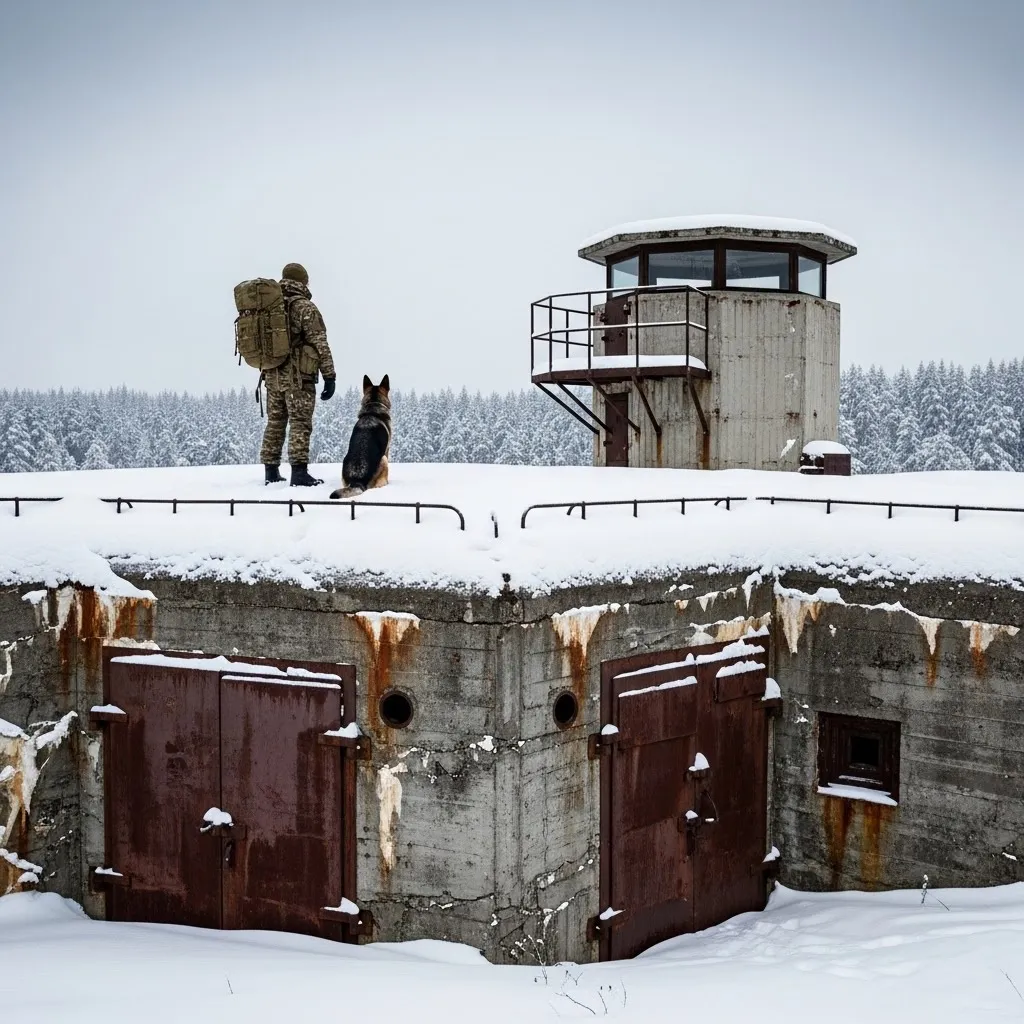
Mike Frost, a former special operations soldier, spent his last few hundred dollars on an abandoned Cold War–era bunker tucked in a stand of pines in the Appalachians. He expected nothing more than solitude, a roof over his head and a warm corner for his aging husky, Blizzard. On the second night, when a raw wind pushed through the ventilation, Blizzard began scratching at a far concrete wall and barking like something had been found. Mike grabbed his flashlight and froze when a dull metallic sound answered the animal’s claws — as if something had been sealed behind that wall for decades.
The north wind hummed through the frozen pines like a long-remembered tune. Mike piloted his beat-up Ford Econoline — the local folks called it “the Breadbox” — down a narrow logging road that disappeared into the Appalachian woods. The van rattled over every rut, but it kept him moving. Blizzard sat beside him, a five-year-old husky with a thick gray-and-white coat and steady blue eyes that flicked from sound to sound. The dog’s ears kept twitching, picking up every whisper of the forest.
Mike was in his early forties: broad-shouldered, stubbly and weary. Years in special operations had left him on edge — a flattened look in his eyes, tight movements, a habit of holding his back straight as if someone might always be watching. A pale scar ran along his left temple — a reminder of an explosion that took some teammates. He hadn’t slept well since leaving the service; every sudden noise still made his heart jump.
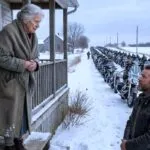
He was heading for Northcross, a tiny town buried in the hills, where a rundown bunker on the edge of town was listed on a county map. He’d bought the place with his last savings not out of desperation but because he wanted to disappear — to get away from daily reminders of combat. In the county office he met a woman handling land sales: Agnes Harper, a thin woman in her seventies who ran the local real estate desk. Her face was weathered, her gaze sharp as someone who’d learned to read people.
She wore a heavy gray sweater, an apron over her skirt and a scarf tucked over one ear. “Mike Frost?” she asked, adjusting her glasses. “Yes, I’m here about the property,” he said. She flipped through a stack of yellowed papers with a bony finger. “This place is odd,” she said, frowning. “No one’s lived there since engineer Arthur Sullivan went missing.”
“People say he went a little off in that bunker,” she added. Mike didn’t offer much of a reply — he’d heard wild stories about deserted places before — but he didn’t put much stock in ghosts. His own demons were practical, human things. Agnes sighed and said, “If you’re going up there, be careful. The woods aren’t kind to folks who come unprepared.” By evening Mike reached the coordinates she’d given him.
The wind cut like a knife, the snow cracked under his boots and the pines stood like sentries. Blizzard jumped out and immediately became alert; the hair along his neck rose. The clearing held a circular steel hatch — a heavy, seventies-era lid. Rust had eaten the edges, weld marks ringed its rim, and the handle looked like it hadn’t been turned in years.
Mike ran a hand over the cold metal. “All right, old man,” he muttered, and he worked the handle. The hatch protested with a grating sound, and a breath of cold, stale air rolled up. He descended a metal ladder into the bunker, feeling the walls close in and his own breath echo in the dark. Blizzard followed, pawing carefully and sniffing the air.
Inside the bunker the silence was heavy but orderly; dust lay in even sheets, and there were no cobwebs. The room looked as if someone had left in a hurry but intended to return. Metal cabinets lined the walls, an old desk and a broken communications set sat under a dim lamp, and a drawer stuffed with papers waited. Mike’s flashlight revealed seams in the concrete that looked like they’d been welded over long ago. He spent the first night at the desk trying to keep his head clear.