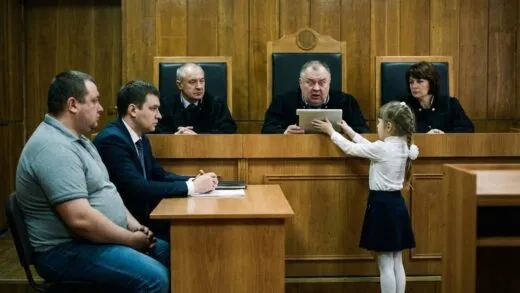
Her voice was quiet, cautious. This child had long ago learned not to take up too much emotional space, even when she was hurting, even when she had every right to scream. “Sit here for a minute,” Susan said, backing toward the door. She needed her daughter not to see her face when she learned the truth.
Lily’s silent suffering, her restraint, her readiness to blame herself even now—it was all slowly turning into fuel inside Susan, a heavy, maternal rage that was about to find its outlet. Susan found her family in the kitchen, where everything was disgustingly normal, nauseatingly familiar.
Her mother, Patricia, sat by the window with a mug and her phone, striking the pose of a woman holding the world together by a thread and utterly exhausted by it. Her father, Michael, was scrolling through something on his tablet, the picture of a man confident the universe would always provide him with a comfortable chair.
Karen was perched on a stool with a green smoothie, sipping it delicately. She didn’t even look up when Susan entered, her whole demeanor broadcasting that the conversation hadn’t even started and she was already bored. Kevin was nowhere to be seen—probably in the yard, overseeing the workers, playing the part of the man in charge, though he’d never earned a tenth of what was being poured into that hole in the ground.
“Where is Lily’s cello?” Susan asked, her voice flat, without any preamble or polite chatter. It sounded foreign to her own ears: too firm, too adult for this house. Patricia looked up from her phone, a flicker of annoyance in her eyes. Not guilt, not embarrassment, but pure annoyance, as if Susan had asked an inappropriate question at the wrong time. “Susan, what’s with the attitude? You just walked in. You didn’t even say hello.” “Where is the cello?”
Michael sighed heavily, a mannerism Susan knew well. It was the sigh one used when explaining the obvious to a child who still hadn’t grasped simple truths. He set down his tablet, pinched the bridge of his nose, and finally said, “We sold it.”
The two words landed in the quiet kitchen with a final, irreversible thud, like a judge’s gavel or a slamming door that will never reopen. “You sold it,” Susan repeated, the words catching in her throat. “Lily’s cello? The one Grandma Ellie gave her? It was a family heirloom.”
Patricia set her mug down a little too loudly, signaling her irritation. “It was just sitting there, collecting dust. Grandma wasn’t using it anyway. A collector from up north gave us a great price for it. A hundred thousand dollars, wired straight to our account. It was all above board, with a contract and everything.” “Above board…” Susan felt a slow, heavy boil start inside her, like a kettle forgotten on the stove. “You sold something that belonged to my daughter, and you’re calling it ‘above board’?”
Karen snorted without looking up from her smoothie. “She’s eleven, Sue. What does she care what she plays on? Kids pick up new hobbies every month. Today it’s the cello, tomorrow it’s ballet, then it’s painting. Just rent one from the music school. It’s not a tragedy.” “Lily will be fine,” her father added, a phrase meant to end all discussion. “They have student cellos at the school. Nothing terrible has happened. We’re doing something nice for the kids.”
Patricia nodded toward the window, where the construction site was visible. “Mason and Amelia need a pool. They need somewhere to swim in the summer instead of being cooped up in a stuffy house. They live here, you understand, full-time. Your Lily just visits once or twice a month.” Susan stood in the middle of the kitchen, feeling the floor tilt beneath her, though everything was still: the tile, the table with its breakfast crumbs, the faces of her relatives looking at her with varying degrees of irritation. “You’re always turning Lily into some kind of charity case,” Karen finally said, looking up, her eyes filled with nothing but boredom and a hint of contempt. “Always making a drama out of nothing. She’ll be fine. She has you, what more does she need?”
The word “you” landed like a verdict: what more could the child of a divorcée possibly need? Forget about priceless cellos, talent, or conservatories. Just be quiet and grateful you’re even allowed in a nice house, that you’re still invited for the holidays. “Susan,” her mother’s voice turned sharp, with a steely edge that tolerated no argument. “Don’t you dare tell your grandmother, do you hear me? She can’t handle the stress. She’s just getting settled at the facility. Don’t you go upsetting her with your complaints.” Susan understood with perfect clarity: they meant “don’t upset us,” because they had never cared about their grandmother’s stress.
She returned to the music room. Lily was sitting on the edge of the armchair, her hands folded in her lap. Small, quiet, ready to hear bad news without making a fuss, without crying or screaming or demanding justice. Susan sat beside her and took her hand. Lily’s fingers were cold, despite the warm May day. She said the only thing she could, though each word was a struggle: “Let’s go home, sweetie.” Lily nodded. She didn’t ask why, didn’t demand an explanation. She just stood up and walked to the door. “Susan!” her mother yelled after them as they were leaving, her voice echoing down the hall. “Not a word to your grandmother! Did you hear me?!”
Susan didn’t answer or turn around. She had heard, but it no longer mattered. In that moment, she had made a firm, final decision: her grandmother was going to find out everything. That evening, Lily practiced on a battered cello her teacher kept for emergencies. The instrument was old and worn, with scratches on its body and loose tuning pegs. The sound it produced was dull and muffled, like a cardboard box with strings stretched across it. Lily didn’t complain, didn’t grimace, didn’t put the bow down. She corrected her posture, focused, and tried again and again. Each time the sound came out thin and wrong, she would blink hard, holding something back.
“I’m still going to practice,” she finally said, lowering the bow and looking at her mother. “It’s just harder now. But I can do it.” Susan stood in the doorway of their small apartment, pretending to just be watching, pretending everything was fine, that her child hadn’t just been robbed by her own family to build a pool for other children. “Mom…” Lily looked up, and in her eyes there was no anger, no outrage, but something far more terrifying—self-doubt. “Maybe Grandma Ellie… maybe she didn’t really want it to be mine yet? Did I do something wrong? Did I upset her?”..