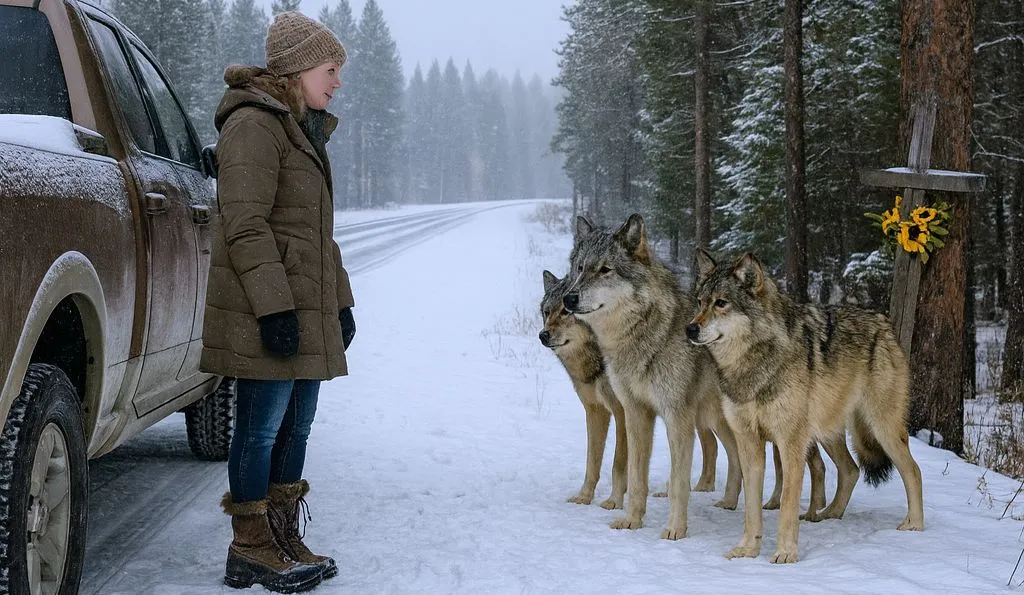
Sarah Mitchell’s knuckles were stark white against the dark leather of the steering wheel. The Montana blizzard reduced Highway 287 to a narrow, claustrophobic tunnel of swirling snow, blurring the line between earth and sky. It was February 5th, exactly three years to the day.
Her hands maintained a steady, white-knuckled grip as the headlights cut through the storm, illuminating the green reflector of Mile Marker 47. This was the curve where the landscape of her life had been irrevocably altered.
This was the precise geographic coordinate where her seven-year-old son, Ethan, had drawn his final breath. Unexpected black ice had sent their car spinning uncontrollably into a pine tree on the passenger side—his side, the side she had failed to shield despite her desperate instincts.
It was a solemn ritual, a quiet pilgrimage she undertook faithfully every single year without fail. She would drive two hours from Helena solely to secure fresh, bright sunflowers to the white cross she had nailed to that tree. She would stand there, enduring the biting wind for twenty minutes, and then return home.
She often left carrying a heavy burden of silence, heavier than when she arrived. But this year, the script would change. This year, at the exact spot where she lost her boy, Sarah would discover another mother fighting to stay amidst the snow.
Another family unit was being dismantled by that same merciless curve, and she would be compelled to make a defining choice. Sarah had walked away from the crash years ago with mere scratches, a physical survival that stood in stark contrast to her internal landscape.
Ethan had passed away three hours later in the hospital while she held his small hand. She had silently pleaded with the universe for a different outcome, for a reversal of time, for absolutely anything other than the reality settling in her chest.
There had been three years of therapy sessions where Dr. Helen asked gentle, probing questions about grief and recovery that Sarah struggled to articulate. Three years of her ex-husband insisting the accident wasn’t her fault, right up until the day the silence between them became too loud to ignore.
He eventually moved on because the shared grief had become a wall rather than a bridge. Three years of knowing, with absolute certainty, that she carried the weight of that day. She was the one who had been behind the wheel.
The ice had been invisible to her, but the result was not. The equation was simple and harsh: she felt deeply responsible for the absence of their son.
The snow was falling heavier now, thick wet flakes that plastered against the windshield as Sarah pulled onto the shoulder. It was 4:14 in the afternoon—the exact minute the timeline of her life had split into ‘before’ and ‘after’.
She reached over and grabbed the sunflowers from the passenger seat. They were the same variety Ethan had adored, the kind he used to harvest from their garden, roots and all. He would present them to her with a gap-toothed grin that lit up the entire room.
That memory used to fill her with a pure, unadulterated happiness that now felt like a distant echo. She stepped out of the truck, walking toward the white cross nailed to the pine tree. Her boots crunched loudly through the fresh powder, her breath pluming in clouds against the freezing air.
Then she noticed it. About twenty meters from the cross, on the very same shoulder where the emergency vehicles had once parked, a shape broke the uniformity of the drifts.
A wolf. It was a massive creature with a coat of silver and grey, lying on its side. Two tiny cubs pressed tight against its belly, trying to find warmth in the biting cold.
The mother wolf’s flanks rose and fell in shallow, labored breaths. The signs of critical exposure and injury were unmistakable. Sarah stood still, her mind suddenly cataloging details with the cold precision that often accompanies high-stress situations.
She observed large paw prints in the snow—deep, heavy tracks—leading from the forest to the highway before stopping abruptly at the asphalt. She noted the chaotic marks on the road surface.
She saw dark, contrasting shadows on the pristine white snow in scattered patches. There was a drag trail leading from the road back onto the shoulder, where smaller paw prints appeared uneven and struggling.
It appeared as if something incredibly heavy had been pulled with enormous effort. Sarah pieced together the narrative. The male wolf had likely been struck right there, in that blind curve.
He had been thrown a significant distance. The female had dragged his body off the road, her instinct refusing to let her abandon him on the highway. But he was gone, reclaimed by the elements.
And now she was here, at the exact location where Sarah had faced her own tragedy, trying to keep her cubs alive with a body that was failing. She was surrendering to the fatigue and the cold that would claim them all within hours.
One mother who lost everything at Mile Marker 47 was encountering another mother facing the same fate on the same date, February 5th. Sarah fell to her knees in the snow. The sunflowers slipped from her gloved fingers.
The cubs, twin males, perhaps eight weeks old, tried desperately to nurse, but their mother had no energy left to give. They were so weak their vocalizations were merely ghosts of sound beneath the howling wind.
The mother wolf lifted her head with immense effort. Her yellow eyes locked onto Sarah’s. There was no predation in those eyes, no aggression, no territorial warning.
There was something far more profound: resignation. A quiet acceptance. She was fading, and she seemed to understand the inevitable.
But the cubs needed help. Sarah’s mind raced through the logistical scenarios. She could get back in the truck and call Montana Fish, Wildlife and Parks.
They would arrive in two, maybe three hours given the severity of the blizzard. But with these ambient temperatures, the wolves would likely succumb long before professional help arrived.
She could drive away. She could leave this tragedy behind just like she tried to navigate her own grief, pretend she never saw them. It wasn’t her direct problem, nor her official responsibility.
Then Sarah noticed a detail that broke her resolve completely. The mother wolf hadn’t just been protecting the cubs from the wind. The paw prints in the snow told a story of deliberate action.
She had used her last remaining reserves of strength to drag them three meters closer to the road. Closer to the passing vehicles. Closer to humans. She was waiting for someone to stop.
Just like Sarah had waited for help in that ambulance years ago. Just like she had hoped for a miracle. Sarah realized that sometimes, the miracle is a stranger who decides not to look away.
Sarah acted without further deliberation. She sprinted to the pickup, fired the engine, and cranked the heater to maximum capacity. She grabbed the thermal emergency blankets from the cargo bed—supplies she had carried obsessively since the accident.
She was always prepared for a disaster, always seemingly too late. When she approached, the mother wolf did not growl. She didn’t move. She just watched with heavy eyelids.
When Sarah picked up the first cub, who was stiff with cold, the wolf closed her eyes as if granting permission. Sarah wrapped both cubs in blankets and placed them in the back seat, wedging them between portable heaters.
Then she returned for the mother. The wolf weighed approximately a hundred pounds. Sarah weighed 137. She tried to lift the animal and realized the difficulty.
The wolf let out a soft sound but offered no resistance. Sarah realized the heartbreaking truth. The wolf wanted to be moved. She was accepting help in the only way she could.
Sarah began to move her, inch by inch, using a tarp to slide her across the snow. The wolf tried to help, pushing weakly with her front paws. It took fifteen excruciating minutes of physical struggle.
Sarah cried the entire time, exertion causing sweat to pour down her back despite the freezing temperatures. She spoke words of encouragement to herself, to the wolf, and to the memory of Ethan.
When she finally managed to heave the wolf into the back seat beside the cubs, Sarah collapsed into the driver’s seat. Her hands shook so violently she could barely turn the ignition key. She glanced in the rearview mirror.
The wolf had managed to turn her head toward the cubs. Her tongue, weak and dry, licked them gently. Her eyes closed and opened slowly, fighting a losing battle to stay conscious.
Sarah hit the accelerator, not heading back toward Helena, but forward—toward Missoula. She drove toward the emergency veterinary clinic forty minutes away through a blinding whiteout.
Tears streamed down her face as she whispered into the empty cab. “Hold on, please hold on, do not leave them, stay with us.”
She didn’t know if she was talking to the wolf, or to the past, or to herself. The windshield wipers fought rhythmically against snow that fell as if the sky were trying to bury the entire highway.
Sarah’s truck fishtailed twice on the ice, but she corrected it and kept going. One hand gripped the wheel, eyes darting to the mirror every ten seconds to verify the wolf’s chest was still moving.
The cubs had stopped shivering, which could mean they were warming up, or it could mean their systems were failing. Sarah pressed harder on the gas. She thought about the fragility of life.
She remembered the helplessness she had felt years ago. The inability to change the outcome. But this time, the outcome was not yet written. This time, she was still driving.
She remembered how the medical staff had tried to comfort her, but words failed in the face of such loss. Sarah had spent three years believing she was defined by that loss.
She believed she did not deserve peace. But somewhere in the last hour, dragging an injured wolf through the snow at the site of her worst nightmare, something had shifted.
She didn’t fully understand it yet. She just knew that if these wolves survived, a part of her that was barely holding on might finally find a foothold. Dr. James Reardon was in the process of closing the Missoula Emergency Veterinary Clinic when he heard tires screeching.
It was 7:45 on a quiet Tuesday evening. He watched a woman jump from a pickup truck covered in snow, shouting for assistance. “I need help immediately!”
When he yanked open the back door of her vehicle, he paused, stunned. A wolf. Two cubs. All showing signs of severe hypothermia and shock.
“You realize I am legally required to report this to Fish and Wildlife?” he said, instinctively grabbing a gurney from inside.
“I know the protocols!” Sarah said, helping him lift the heavy animal. “But first we save them.”
For the next four hours, Dr. Reardon worked with surgical precision. The mother wolf had a dangerously low core body temperature. It was critical.
She was suffering from severe dehydration and acute malnutrition. She hadn’t eaten properly in days. Every bit of nutrition in her body had been biologically sacrificed to produce milk for the cubs.
He started intravenous fluids, applied heated blankets, and hooked up cardiac monitors. The cubs showed signs of hypoglycemia. The smaller one, grey and delicate, showed early respiratory distress indicative of pneumonia.
Sarah did not leave the room. She sat on the floor, her eyes glued to every movement on the monitors. When the wolf’s body trembled—a reaction to the warming process—Sarah flinched but stayed put.
“Is she hurting?” Sarah asked.
“She is stabilizing,” he said calmly. He was administering a dextrose injection and adjusting the warming protocols to prevent rewarming shock.