
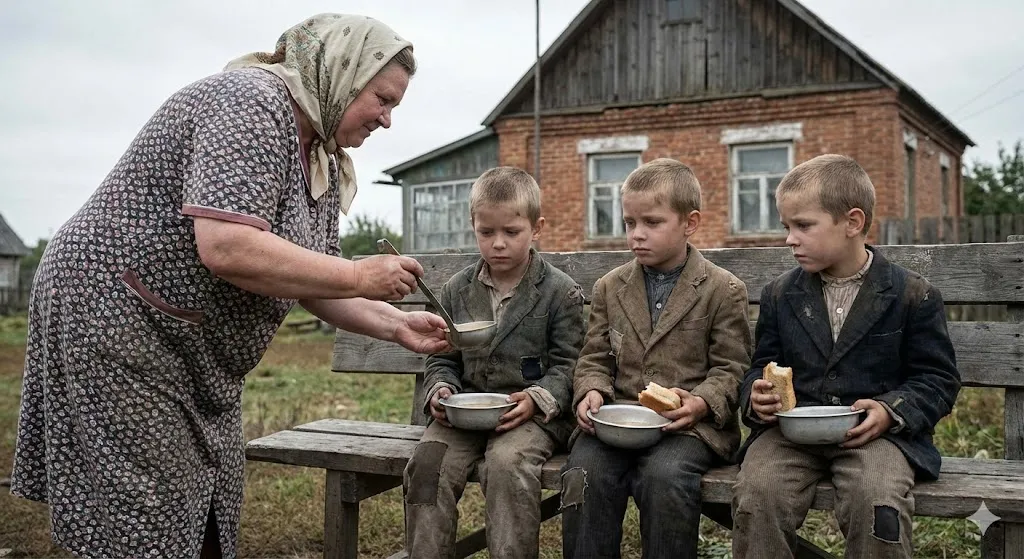
An elderly woman fed three homeless children, not suspecting that this decision would change her life years later. Steam rose slowly from the pot, mingling with the smell of broth and fresh pancakes. Zinaida Petrovna’s stall was modest but clean.
An old metal cart, a faded awning, a sizzling pan, and small jars of sauces lined up like soldiers. All around was the noise of the street: cars, hurried footsteps, a distant horn, and voices that crossed without looking at each other. Zinaida Petrovna had hardworking hands—hands with small burns and tired nails.
She adjusted her stained apron and handed a plate to a customer who had known her for many years.
— God bless you, Petrovna! — the man said, leaving a few coins.
She barely smiled. It wasn’t a wide smile, but one of those that don’t last long because life gives no respite.
— You’re welcome, son! — she replied.
When the customer left, Zinaida Petrovna looked at the small box of change. It wasn’t full; it never was. That day, it seemed even lighter than usual. There were fewer customers because of the construction on the corner, which diverted people, and because of a new competitor who had set up two streets away with a fancier stall.
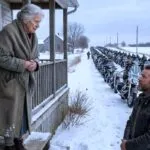
And yet, Zinaida Petrovna carried on. She always carried on. It was around six in the evening when the sun began to set, and the shadow from the awning grew longer. That’s when she saw them—three children. They weren’t running like the others, not talking loudly; they walked huddled together, as if the world was too big to walk through separately. All three had the same face: dark eyes, prominent cheekbones, and messy black hair. They looked like dusty mirrors. Their clothes were worn and too large, and their sneakers had lost their shape.
No backpacks, no adults—only hunger. Zinaida Petrovna looked at them calmly, without any show of horror. She didn’t clutch her heart or make a drama out of it; she just looked at them the way one looks at something that causes pain because it’s real.
The children stopped two meters from the stall, hesitant to come closer. One of them, the one in the middle, took a step forward and spoke softly:
— Ma’am, do you have anything you’re not going to sell?
Zinaida Petrovna froze with a spoon in mid-air. She had heard this phrase before, from other children, in other years. But there was something special about these three. They didn’t ask with cunning; they asked with shame.
— Do you have a mother? – she asked, not accusingly.
The three exchanged glances as if the question were a blow.
— No, – said the one in the middle, his voice barely trembling. — We don’t have anyone.
Zinaida Petrovna swallowed, looked at the pot. She looked at the ready plates, at the box of change, and then back at the three children. The one on the right looked down. The one on the left pressed his lips together as if trying not to cry. Zinaida Petrovna took a deep breath and made a decision that didn’t seem heroic to her. It seemed simple.
— Come here, – she said, waving her hand. — Come on, get closer, I won’t bite.
The three approached slowly, as if fearing it was a trap. Zinaida Petrovna gave them three small portions of what was left. They weren’t full plates like for an adult, but they were hot. And warmth, when you’re hungry, is a promise. The children sat on plastic stools, huddled together. At first, they ate quickly, greedily, then more slowly, as if their bodies finally understood that there would be something in their stomachs.
Zinaida Petrovna watched them eat and felt a lump in her chest, not understanding where it came from. Maybe from memories of her own son. Maybe from the fatigue of so many years. Maybe from the bitter thought that no one should have to see three children eat as if it were their last chance.
— What are your names? – she asked, trying to keep her voice from trembling.
The three exchanged glances again.
— I’m Matvey, – said the first one.
— I’m Gleb, – said the second, the one in the middle.
— And I’m Denis, – said the third.
Zinaida Petrovna nodded slowly, memorizing the names as one keeps something they don’t want to lose.
— And where do you sleep? – she asked.
The three looked down.
— Wherever we can… – whispered Gleb.
Zinaida Petrovna tightened her fingers around the ladle. She looked around. People passed by, bought things, didn’t look. A couple crossed the street, laughing, not noticing the children. A man in a nice shirt barely turned and grimaced, as if hunger were contagious. Zinaida Petrovna felt a pang of anger.
And then she heard a voice from behind, cold as a stone:
— Zinaida Petrovna, giving away food again?
She turned around. It was a man from the neighborhood, one of those who always speaks as if he owns the street. Rogov—the one who claimed to know the people who issued permits.
— Don’t complain later when you don’t have enough money, – he added, looking at the children as if they were trash.
The triplets froze. One gripped the edge of his plate, another hid his face. Zinaida Petrovna straightened up, though her back ached…