“I wanted to be an artist when I was young,” Susan confessed, studying every detail in the photos. “I even got into art school. But then I met your father and got married. Maria inherited your talent. She’s beautiful. And she has intelligent eyes, like her father.”
His mother memorized her daughter’s features.
“What’s her personality like?”
“Fiery. Brutally honest. She doesn’t forgive lies,” Alex put his phone away. “She’s afraid of disappointing you.”
“She could never disappoint me,” Susan said firmly. “No matter what she does, no matter who she becomes, she is my daughter. My love for her doesn’t depend on her actions.”
Alex knew that was exactly what Maria needed to hear.
On the way back to the car, Alex suggested:
“Write her a letter. Not to ask for a meeting. Just so she knows the truth. Your truth.”
Susan stopped, considering the idea.
“What if she doesn’t want to read it?” she asked, her voice pained.
“Then we’ll wait longer,” Alex shrugged. “Time heals. Sooner or later, she’ll get curious.”
“What should I write?”
“What you feel. No excuses, no asking for forgiveness. Just the truth about how much you love her.”
Susan nodded.
“Okay. I’ll give the letter to you,” she agreed. “I want her to know that I love her. I have always loved her. And I will wait as long as it takes.”
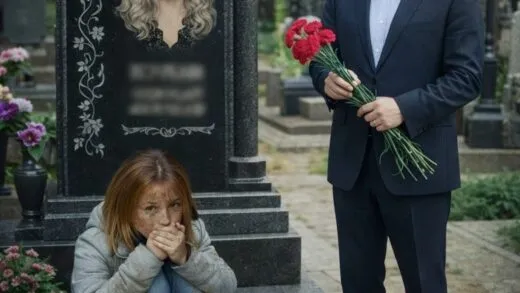
They walked back to the car along the autumn paths of the cemetery, and Alex felt that something important had happened that day. Not just meeting his father, but a final reconciliation with his mother. Next up was Maria. The most difficult part of reuniting their family. But now he knew: they would get through it.
The notepad rested on her knees, the pen trembling in her hand like an autumn leaf. Susan sat on the same tree stump where she had once collected pinecones with her children, trying to find the words for a letter to her daughter. The pines whispered around her, a calming sound; this was where they had once been happy.
“My Dearest Daughter…” she began, then crossed it out. “My Maria…” That wasn’t right either. She crumpled the page and tossed it to the ground. A second sheet. A third. The ground around her was littered with the white clumps of failed attempts. The quiet of the forest helped her think. There was no rush here, no prying eyes, no phone calls. Just her and the memories of a time when Maria slept in her stroller under these very pines.
“My sweet girl,” she finally wrote, and the words felt right. The letter flowed from her then: about a love that hadn’t died in twenty years, about the pain of separation, about how she had imagined her grown-up daughter. Among the familiar trees, the words came easier.
“Did Alex tell you how your father taught him to read animal tracks?” she wrote. “You were just a baby, but I believed that one day we would all come back here together.”
The wind rustled the pages, as if suggesting what to write next.
The envelope lay on Alex’s desk for three days before he dared to open it. Susan had given him the letter with the words, “Read it first. If you think it’s right, give it to her.”
He read it at home, in an armchair by the window, and tears streamed down his face. The letter was so full of pain and love that his heart ached with every word. Susan wrote about his father: how kind and patient he was, how full of dreams. She wrote about how she pictured her adult daughter: beautiful, talented, and happy.
“You’ve become exactly what I dreamed you would be,” Alex read through his tears. “I saw your work online. You’re as talented as I once hoped to be.”
The letter ended with simple words: “I’m not asking for forgiveness. I’m not asking for a meeting. Just know that you are loved. You have always been loved.”
Alex folded the letter and put it back in the envelope. He knew he had to give it to her. Maria had a right to know she was loved.
The ad agency was buzzing with creative energy: designers hunched over mockups, account managers on the phone, art directors debating concepts. Maria sat in her cubicle, working on a campaign for baby food.
“Alex?” She looked up and saw her brother. “Is something wrong with Mom?”
The word “Mom” sounded natural, unforced. Alex noted the change.
“Everything’s fine,” he reassured her, perching on the edge of her desk. “She wrote you a letter.”
Maria put down her pencil and looked intently at the envelope in her brother’s hand.
“What does it say?” she asked quietly.
“I don’t know. I didn’t read it,” Alex lied. “Just a warning: it might be heavy.”
Maria took the envelope, turned it over in her hands, and put it in her purse.
“I’ll read it at home,” she decided. “Alone. I need quiet for things like this.”
“She’s not asking for a reply,” Alex added. “She just wanted you to know.”
Maria nodded, already mentally preparing herself for what was inside.
That evening in her apartment, Maria held the envelope for a long time before opening it. Then she tore it open quickly, like ripping off a bandage—all at once, to get it over with. She read slowly, rereading each paragraph several times. She cried without noticing the tears. The letter was filled with such maternal tenderness that her heart broke with pain and longing.
“Did Alex tell you about our walks in the woods?” she read, and realized she didn’t remember. She had been too young. But strangely, she felt a pull toward that place, as if something deep inside knew the way home.
That night, without thinking, Maria got in her car and drove to the state park. She didn’t need the GPS; her hands seemed to know which way to turn the wheel. She walked the trails in the dark, searching for a feeling of home. She found the clearing, sat under a tall pine, and stayed there until dawn, listening to the sounds of the forest and her own heart. As the sun rose, she understood: her mother had suffered no less than they had. Maybe even more. And the forest had given her the peace to make a decision.
Dennis was making coffee in the kitchen when Maria told him about the letter. He listened silently, occasionally stirring the pot.
“And how do you feel?” he asked when she finished.
“Confused,” Maria admitted honestly. “Pity. Curiosity. Fear.”
“Fear of what?”