
 Let’s Keep It Real
“I confirm the colonel’s statement. The captain did violate regulations. He ordered water withheld and rations cut without cause.”
“What are you saying, you old fool?” Melnikov shouted. “I’m saying what happened, Captain. My conscience finally caught up with me. I’ve got a daughter about this woman’s age.”
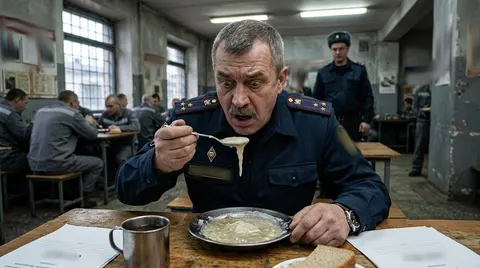
The officer from the capital turned to the major. “Place Captain Melnikov under arrest immediately pending investigation.” “But… this was mutiny. They threatened me,” Melnikov stammered. “They defended themselves. That’s different.”
Melnikov was seized by his own men. He shouted about betrayal and enemies of the state, but no one was listening anymore. And then came the moment that entered camp legend.
The two hundred men from car seven stepped forward and stood in silence around Anna. No theatrics. No spectacle. Just a quiet circle of witnesses. “You don’t owe me anything,” she said, shaken.
Crutch gave her a short nod. “We owe you plenty. And we know it.” Several men murmured their thanks. One by one, they offered what dignity allowed: a handshake, a steady look, a simple “Thank you, sister.”
She was crying now. For the first time in all thirty days, she let herself. And some of the hard men around her wiped their eyes too, pretending it was the wind.
The officer from the capital approached Anna. “Citizen Mikhailova, your case will be reviewed. Given the circumstances and the witness statements, there is a real chance your sentence will be reduced—possibly reassigned to settlement work instead of camp labor.” “And the others? The men who stood with me?” she asked.
“Their cases will be reviewed as well.” When the prisoners were separated and sent toward the transfer barracks, there was one final conversation. Crutch came over to Anna.
“You asked why I protected you. Here’s the truth. I had a daughter once. She was arrested young. I was already inside and couldn’t do a thing.”
“Later I heard she died in transit. In a car like this one. Maybe if someone like me had been there…” He stopped, then finished plainly. “You keep living. For yourself. And for her too.” He turned and walked away, limping harder than usual.
They never saw each other again. Decades passed, and those who survived tried to forget. Those who remembered usually kept quiet.
The story of the woman in the men’s car became a legend. One of those stories told quietly on camp bunks, half believed, half doubted, but never fully dismissed. Years later, in a retirement home near the capital, there lived an elderly woman.
She was quiet and unassuming. She spent most of her life working as a nurse in a local clinic and raised her children alone, since her husband never returned from the camps. Neighbors knew her as Anna Sergeyevna—a kind older woman who treated people with herbs and never turned anyone away.
She never talked about the past, her daughter later said. Only sometimes, when trains appeared on television, she would flinch and leave the room. And she could never sleep in a closed room. Even in winter, the window had to stay cracked open.
The older residents in that home whispered among themselves. Some recognized things. Some guessed. People who had survived the camps had a way of recognizing one another, even forty years later. One old man, a former underworld figure, once came up to her in the dining room and gave her a quiet nod.
She nodded back. They never spoke. But every morning he held the door for her, and she thanked him with the same small nod. When the time finally came and it was possible to speak, memories began to surface.
They were scattered, contradictory in places, but on one point everyone agreed. There had been such a story. There had been a woman, a railcar, and thirty days that changed everybody inside it. An old railroad worker from a distant station told his grandchildren how their station had once received a strange transport.

Share how the story made you feel
0Comments appear after a quick automatic check. Please no links, ads or personal data.
Next to your name we show your country, determined from your IP address; the address itself is never shown, and only a hashed fingerprint of it is kept to stop spam.