
 Let’s Keep It Real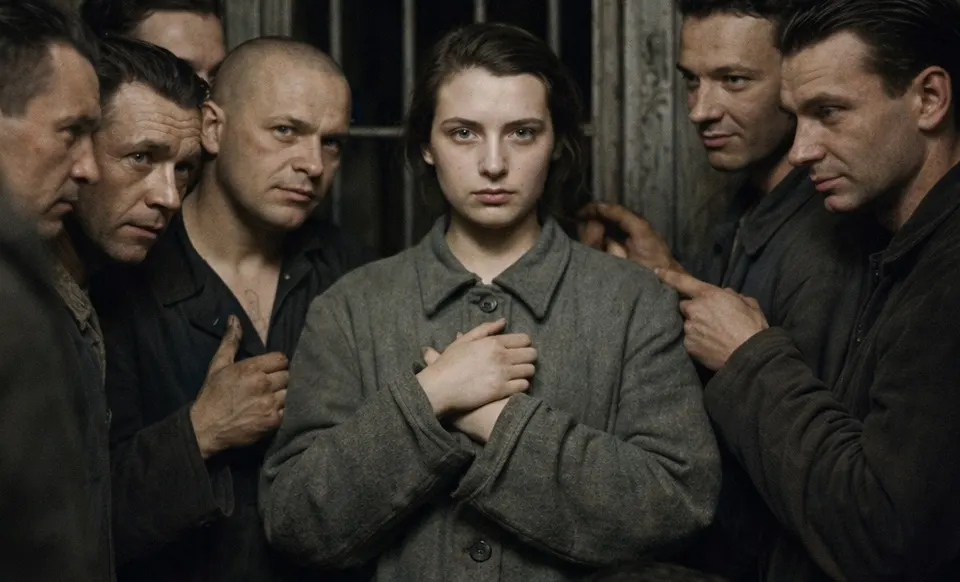
This was not supposed to happen. By every rule on the books, it should have been impossible. But in September of 1938, train number 512 was carrying a special load clear across the country.
And in one of those cars, among two hundred men, there was one woman. “Stop! Everybody stays where they are!” a guard shouted, his voice cutting through the night. People later said the convoy stopped right in the middle of the woods.
It was not a routine stop for water or inspection. They just stopped. The locomotive let off steam, and then came that kind of silence that seems to show up right before something terrible.
In car number seven, the noise started. First a low rumble of voices, then shouting, then metal pounding against the walls. “What’s going on? Hey, boss, what is this?” Voices from different cars blended into one rising roar.
The guards ran toward the seventh car, dogs barking. And then everybody heard it: a woman’s voice. One single woman’s cry among hundreds of men.
The kind that made even hardened people go cold. Her name was Anna Mikhailova. At least that is the name listed in the records that survived in the archives.
She was 32, a former bookkeeper at the large Dynamo factory in the capital. Convicted under Article 58 for anti-government agitation. The standard sentence in those years: 10 years in labor camps, no right to correspondence.
But what happened to her in September 1938 was anything but standard. “Listen carefully, Mikhailova. Did you really think you could humiliate a state security officer?”
“Did you think that would just blow over?” Those were the words Captain Melnikov said to Anna an hour before she was shoved into a men’s car. She had not been in the women’s car from the start of that transport.
Survivors later recalled seeing the convoy commander, Captain Melnikov, personally order her moved. Officially, it was for violating regulations. What violation, exactly, was never stated in the paperwork.
But among those who lived, another version circulated. Three months earlier, in the jail where she was being held, Anna had rejected his advances. Not just rejected them—she hit him in the face with a heavy inkwell when he tried to corner her in his office.
Ink splashed all over his new uniform jacket. Men outside the door heard him shouting in pain and humiliation. Car number seven was the worst one on the train.
That was where they put repeat offenders, killers, men who had long since stopped expecting mercy from life. Two hundred men in a space built for forty. Three-tier bunks, a waste bucket in the corner, one small barred window near the ceiling.
The smell was so bad newcomers sometimes blacked out in the first few minutes. “Well, boys, look what the bosses sent us,” came a raspy voice from deep in the car.
“No way. A woman? In here?” the prisoners said in disbelief. “I’m telling you, a real one. Alive,” others answered back.
Anna stood by the door with her back pressed to the iron and looked at two hundred pairs of eyes fixed on her. In that moment, time seemed to stop. Outside, the guard slid the bolt shut, and the train started moving again.
And then began what some would later call the most harrowing thirty days in the history of the camps. To understand the scale of what Anna Mikhailova walked into, you have to go back a few months. The capital, March 1938.
The Dynamo factory was buzzing like a kicked beehive. The chief engineer had just been arrested, and black prison vans were parked at the gate. Workers whispered in corners.
Anna worked in the main accounting office, tracking materials. An ordinary woman: husband was a skilled machinist, two children, one room in a barracks building on the edge of town. They did not have much, but they got by honestly.
On Sundays they went to the city park. In summer they rented a little cabin with friends for a week or two. It was a normal life for normal people. “Anna Sergeyevna, they need you in personnel,” the secretary said, and that was the beginning of the end.
In personnel, they were already waiting for her. Three security officers in uniform were flipping through her file. The senior one, a tired-looking major, did not even look up from the papers.
“Mikhailova, you handled the records for nonferrous metals?” he asked. “Yes,” Anna said. “There’s a shortage of three kilograms of copper. Explain it,” the major said.
“What shortage? My paperwork is in order. Every receipt, every form,” she answered, surprised. “Paperwork can be forged. Were you selling copper off the books?” the investigator pressed.
The questioning went on for a week: first at the factory, then at headquarters. Anna produced records, checked numbers, explained everything. But the investigators were not looking for proof. They were looking for enemies of the state.
No one had canceled the quotas for exposing them. On the eighth day, Captain Melnikov appeared. Tall, polished, with the manners of a man who thought highly of himself.
He walked into the interrogation room and dismissed the investigator with a flick of his hand. “Anna Sergeyevna, let’s be candid. You’re an intelligent woman. I’m a civilized man,” he began.
“Why play games? Sign a confession and you’ll get five years, maybe suspended. Don’t sign…” He spread his hands.
“I can’t sign something I didn’t do,” she said firmly. “That’s what they all say. Then they sign. The only question is how long it takes and what shape they’re in by then,” the officer replied.
He stood up, walked around the room, stopped behind her, and put his hands on her shoulders. Anna caught the smell of expensive cologne. “There’s another option. You’re an attractive woman. I’m unmarried. We could work something out like adults.”
Anna stood up so sharply the inkwell on the desk tipped. “Are you asking me to be your mistress?” she said. “Such harsh language. I’m offering you life instead of ruin,” the captain answered.
What happened next took three seconds. Anna grabbed the heavy glass inkwell and threw it straight at Melnikov’s face. It hit the bridge of his nose.
Blood and ink ran down his face and uniform. He shouted and grabbed his nose. Guards rushed into the room.
“Take her! Solitary! Ten days!” Melnikov yelled, pressing a hand to his broken nose.
In solitary, Anna understood she had signed her real sentence. Not the legal one—that came two weeks later—but the personal one. Melnikov had handed it down the second ink ruined his jacket and blood ran over his lips.
Men like that serve revenge cold, and they serve it carefully. The trial lasted 15 minutes. Article 58, anti-government agitation.
Witnesses—coworkers who had also been detained—testified that Mikhailova cursed the government, told subversive jokes, kept a banned political portrait at home. None of it was true, but that hardly mattered. Sentence: 10 years in a labor camp.
But the worst part came the night before transport. Her cellmate whispered that she had heard it from the guards: Melnikov would be taking her himself. He was now in charge of the convoy and had specifically asked for the assignment.
“Brace yourself, honey. Men like that don’t let things go.” And now, two weeks into the journey, the women’s car was behind her.
Ahead of her were days in the company of two hundred men who had lost everything. Anna understood exactly what kind of revenge Captain Melnikov had planned. He was not going to dirty his own hands.
He had thrown her to men who would do it for him. And he would come by every day to see whether she was still alive. But Melnikov had overlooked one thing.
The first seconds in the car stretched out forever. Two hundred pairs of eyes, two hundred dirty, exhausted faces staring at her. The air was so thick with the smell of unwashed bodies, urine, and rot that breathing through her mouth was the only option.
Even then, the taste of it settled on her tongue. “Boys, look at that—it’s a woman, a real woman,” a young voice cut through the silence.

Share how the story made you feel
0Comments appear after a quick automatic check. Please no links, ads or personal data.
Next to your name we show your country, determined from your IP address; the address itself is never shown, and only a hashed fingerprint of it is kept to stop spam.