
Bogorodsky had either lost his mind, was drowning in gambling debts, or was being blackmailed by some serious people. “Yegor Konstantinovich, are you sure?” the lawyer asked again as they sat over the documents in the meeting room. “This is daylight robbery.” “I’m sure.”
Yegor signed the last page, and his hand trembled—the disease had already reached his fine motor skills, but he attributed it to nerves. “I need cash. Now.” He transferred twelve million to his parents in Bila Tserkva—enough to last them the rest of their days, even if they lived another twenty years. The remaining tens of millions were deposited onto a premium-class bank card issued in the name of Angelina Mikhailovna Bogorodskaya.
Then, through a director he knew, he found a young actress, a fourth-year student at the Karpenko-Kary University, the type who wears vintage coats and drinks coffee with plant-based milk in trendy cafes on Reitarska Street. “Ten thousand hryvnias,” he told her when they met in a coffee shop on Khreshchatyk. “For one scene. The role of a rich man’s mistress: sit in a car with an indifferent expression, look at your phone.”
The girl had long hair, bright lips, and the condescending half-smile of someone confident in their own irresistibility. She shrugged her shoulders: “Half an hour’s work for that kind of money? I’m in.” “One condition: no questions.” “No problem.”
Yegor knew his wife with the precision of a watchmaker disassembling a mechanism he had built himself. Angelina was incredibly proud despite all her emotionality. If he simply left without an explanation, she would suffer, search for reasons, blame herself, and go mad from the uncertainty.
But if he appeared as a cruel traitor who had left his faithful wife for a young bohemian mistress, she would switch to hatred. And hatred works like an anesthetic, far better than grief. Hatred doesn’t let you drown in depression; it forces you to get up in the morning to prove to the world and to yourself that you are worth something. And a separate chess game involved the money.
If he told Angelina there were forty million on the card, she would throw it in his face. Her pride would physically prevent her from accepting such a sum from a traitor. So, he would say there were only fifty thousand hryvnias. An insultingly small amount, a paltry severance that would wound her pride but also make her keep the card as a trophy, a reminder of his villainy.
The end of November was damp and chilling. A sky the color of wet asphalt hung over the city, and a special kind of fine drizzle fell, the kind that seeps into your bones in minutes. Angelina walked out of the district courthouse, clutching a fresh divorce certificate in her hand. Yegor was standing by his black BMW, leaning against the hood.
His long cashmere coat—black, knee-length, unseasonably light—fit him well, hiding how much weight he had lost in recent weeks. A cigarette smoked in his hand, even though he had quit three years ago. He took a few steps towards her, pulled a bank card from his pocket, and threw it at Angelina’s feet, right into a puddle.
The card slapped into the dirty water, splashing the hem of her dress. “The PIN is my date of birth.” His voice was devoid of all emotion, and that was the hardest part for him—not to break, not to waver, not to give himself away. “There’s fifty thousand on it. Take it and disappear, don’t let me see you again. Consider it payment for the wasted years.”
In the car, in the front seat, sat a young woman—the very same theater student. A silk scarf was draped carelessly over her shoulders, her gaze fixed on her phone with an expression of boredom and superiority. Yegor turned, got into the car, and drove away without looking back. Angelina stood in the cold drizzle, tears mixing with the raindrops on her face.
Her first impulse was to pick up that damned card and throw it at his back. To scream that she didn’t need his handouts, that she would rather die under a bridge. But her legs wouldn’t obey, and her pride had already been trampled—not by him, but by life. A rented room in a communal apartment in Lukianivka, a low-paying job as a sales assistant in a fabric store, a mother in Boryspil who needed money for medicine.
She slowly bent down and picked up the card. Not out of greed—out of something else. This would be her trophy, proof of his cruelty. She would never spend this money. She would prove that she could make it on her own.
But in the car, which had just turned the corner onto Saksahanskoho Street, something entirely different was happening. Yegor pulled over to the curb, and his body was wracked by a hacking cough that tore at his lungs. He pressed a white handkerchief to his mouth, and it turned scarlet. “Hey, are you okay?” the actress reached for his shoulder.
“Get out!” he rasped. “I’ll transfer the money! Get lost!” The girl jumped out of the car, and Yegor was left alone. He rested his head on the steering wheel and dialed the number of Petro Kravchuk, whom he had let in on the truth. “She took the card,” he said in a strained voice.
“She bent down and took it. I thought I was going to die right there, Petro! I wanted to run out, hug her, fall to my knees and tell her everything. But if she had felt how thin I am, if she had smelled the medicine… She would have understood everything, and then it would all have been for nothing.” A week later, Yegor sold his car, his watches, his suits—everything that connected him to his former life.
Through a proxy, he rented a room in an old building in Lukianivka, in the same block where Angelina lived, literally across the street. It wasn’t an apartment, but a den: walls stained from old leaks, radiators that worked intermittently, the smell of other people’s food from neighboring apartments, a sagging sofa, a plastic table. On the windowsill, an army of orange pill bottles was lined up.
On the wall, an injection schedule was written with a marker directly on the wallpaper. And in the corner by the window, on a makeshift stand of wooden blocks, stood a pair of binoculars. Their lenses were aimed at Angelina’s windows across the street. Every morning, fighting the pain that split his spine, Yegor would crawl to a stool and press his eyes to the eyepieces.
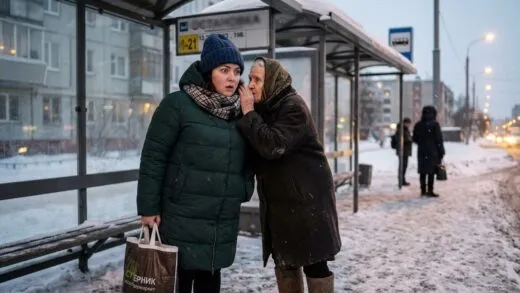
He saw her hanging laundry on a line in the kitchen, leaving for work, buttoning up an old beige trench coat, standing at the bus stop with her collar turned up against the cold. In his diary, he wrote: “Lina got a haircut today. The short hair makes her look like the student I fell in love with ten years ago. The same look. She’s been wearing that same coat for years. Why doesn’t she buy a new one? I gave her the money. God, how I love her!”
One day he saw a man in glasses approach her at the bus stop, helping her pick up a fallen bag. They exchanged a few words, and Angelina smiled—politely, distantly, but still, a smile. Yegor pulled away from the binoculars. His fingers wouldn’t obey—not from the disease, but from something else, something more ancient and irrational.
He slid to the floor, slammed his fist on the dirty linoleum, and sobbed like a child. “I have no right. I have no right to be jealous. I’m the one who left her.” Later, an entry appeared in his diary: “If he’s a good man, let him be with her. I’m going to die soon. She needs support. But why does it hurt so much? Why am I jealous of a stranger when I’m the one who gave her away? You deserve this pain, Yegor.”
One hundred and fifty meters across the street was the geographical distance between them. The emotional distance, however, was measured by an abyss of lies and misunderstanding that no bridge could cross. Angelina thought her ex-husband was somewhere in Europe with his young mistress, drinking wine on a terrace with a sea view and laughing at her poverty.
And he was fading away a three-minute walk from her, pressing his face to the binoculars every evening when the light came on in her window…