
“Do it. He’s your enemy. He wakes up, he turns you in.” The human part of her says something else. Don’t become him.
Katya slowly opens her fingers. The scalpel drops into the metal tray with a sharp ring. “Everything’s ready, Doctor. Here’s the clamp.”
She hands over the instrument cleanly and professionally. The operation begins. Ivashin closes his eyes and slips under anesthesia.
Katya stands beside the table, wiping blood, handing gauze. She helps save the life of the man who tried to destroy hers. Again.
The surgery lasts three hours. Broken ribs. Ruptured spleen. They patch him together piece by piece.
But he will live. When they wheel him to a private room, Katya steps outside onto the hospital porch. It’s night. Cold rain is falling.
She smokes a strong cigarette, and her hands shake so badly ash falls onto her white coat. She didn’t kill him. But she knows this isn’t over.
Ivashin will wake up. And then comes the next round. Two tense days pass. Ivashin lies in a private room.
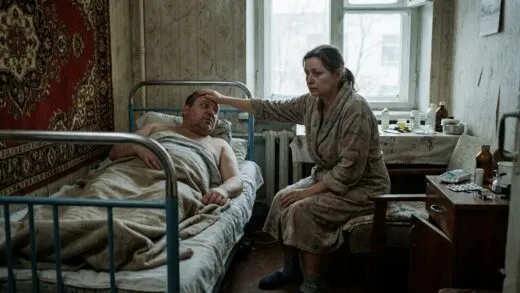
He is weak, but fully conscious. No guards yet. The police still think it was just a traffic accident. Night shift. The hospital is quiet.
The door opens without a sound. Katya walks in. In her hand is a syringe.
Ivashin is awake. He turns his head with effort. His face is gray and drawn. “So,” he rasps. “You came to finish it.”
Katya sets the syringe on the bedside table. “Pain medicine,” she says evenly. “On schedule.”
Ivashin looks at the syringe, then at her. “Why didn’t you cut my throat in the operating room?” “Because I’m not you.”
“I looked for you,” he says, staring at the ceiling. “A whole year. Searched reports, police bulletins. Thought you were hiding in some big city. And here you are… changing bedpans.”
“I’m living,” Katya says. “Like anybody else.” “You’re an escaped convict. A dangerous one. I can call my office right now. They’ll take you from this room. And any doctor who helped you.”
Katya pulls up a chair and sits beside the bed. She leans close enough for him to smell tobacco in her hair.
“Call,” she says quietly. “Phone’s in the hall. Who’s going to believe you?”
“You’re full of morphine. Concussed. Hearing things. Seeing old enemies. And I’m Vera Moroz, respected orderly, good worker. This whole town knows me.”
She picks up the syringe and flicks a tiny drop from the needle. “And this ampule could hold medicine. Or it could hold air. One good bubble in a vein and your heart stops. Air embolism. Happens after bad trauma. Any doctor will tell you that.”
Ivashin stares at the needle. For the first time, real fear shows in his eyes.
Not fear of a bullet. Fear of her calm certainty.
He understands she is not bluffing. She survived war, prison, and the woods. She beat him there. She can beat him here too.
“What do you want?” he asks. “Forget me.” “What?”
“You never saw me. I never saw you. We both died at that bridge. You file whatever report you need—say you were mistaken, say it was medication talking. And I leave. For good.”
“And if I find you again?” “You won’t. The country’s too big.”
Ivashin is quiet for a long time. He looks at the scar on his hand from the fireman’s shovel. Then at the woman who could have killed him twice and didn’t.
Something in him gives way. Maybe it’s exhaustion. Maybe it’s understanding. He will never win this war.
“Go,” he says at last, closing his eyes. “Just go.” “Right now?”
“Yes.” “And the report?” “I’ll say the night nurse was drunk and I had her removed.”
Katya stands. She doesn’t thank him. “Goodbye, Ivashin.”
“Melnik,” he says quietly as she reaches the door. She turns once.
“There is no Melnik anymore,” she says. “Melnik burned up in the war. Or froze in the woods. There’s only Vera.”
She walks out. An hour later she is standing on a station platform with one old suitcase. She boards the first train heading east.
Far east. To new towns under construction, where nobody asks too many questions and strong hands are always needed.
Time passes. It is now 1965. A small working town. Veterans’ Day parade on the square. Medals clink. Schoolchildren hand out flowers.
On a quiet bench in the park sits an older woman. Not yet fifty, but she looks older. Hair gone gray. Face lined deep.
She crumbles bread for the pigeons. A little girl with a ribbon in her hair runs up to her. “Grandma, were you in the war? Why don’t you have any medals?”
The woman smiles, warm and a little sad. “I was in a war, sweetheart. Most of my life, one way or another.”
“Where are your medals? Did you lose them?”
“No. I traded them.” “For what?”
The woman lifts her eyes to the clean blue sky. No bombers there. No smoke. No fire.
She takes a long breath.
“For peace and quiet,” she says softly. “Best trade I ever made.”