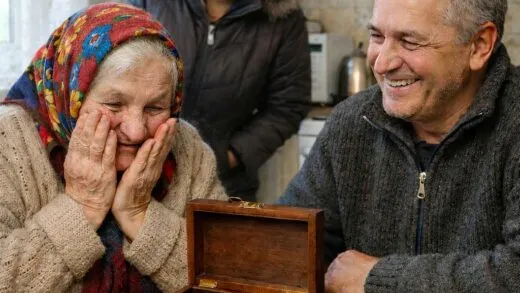
He tried to speak, but his voice failed him. “These are my sister’s earrings. Mary. She went missing in ’05.”
Father Mike turned even paler. “Dear God,” he whispered. “Are you sure?” “I bought them. I gave them to her. I know them.”
The priest stood up slowly. He looked at the scattered items: the purses, the phones, the jewelry. Fourteen IDs. Fourteen women over thirty years.
“The Sheriff is on his way,” he said. “Nobody touch anything else. This is a crime scene.” The police arrived twenty minutes later. Two cruisers and an unmarked silver SUV.
A man in his mid-forties stepped out of the SUV—tall, broad-shouldered, with a stern face and graying temples. It was the County Sheriff, Jim Garrett. Alex looked at him and felt a strange jolt. Garrett. He remembered that name.
The young deputy who had handled Mary’s case was also a Garrett. A coincidence? In small towns, names repeat. “What have we got, Mike?” Jim Garrett approached the priest, giving the workers a brief nod.
The priest silently pointed to the bags. Garrett knelt, looked inside. He was silent for a long time, then stood up slowly. His face was a mask. “Where did you find them?”
“In the attic,” Sam Miller answered. “Behind the chimney, in a hidden niche.” “Who opened them?” “We all did. We thought it was old church stuff.”
Garrett scanned the group. His eyes lingered on Alex for a second, and something flickered there. Recognition? Concern? Alex couldn’t tell.
“Alright,” the Sheriff said. “Tape this off. I’m going to need everyone to come down to the station to give a statement. It’s going to be a long night, so call your families.” He pulled out his phone and walked away.
Alex watched him pace back and forth, talking urgently. He caught fragments of the conversation: “State police… yeah, now… no, keep it quiet for a minute…” The next few hours were a blur. Questioning at the station. The same questions over and over: “How did you find them? Who saw them first? Did you move anything? Why did you open the bags?”
He told them about the earrings. The investigator—a woman from the State Police who arrived that evening—recorded everything with a neutral expression. She asked him to describe the jewelry. She explained they’d need a lab to confirm, but if they were his sister’s, it was a major lead. “Your sister was Mary Morris?” she asked.
“Yes.” She checked her notes. “Missing persons report filed September 2005. Case went cold in December. The lead officer was…” She frowned. “Deputy Jim Garrett.”
Alex felt a chill run down his spine. “Garrett? Jim Garrett?” “Yes. Why?”
“That’s the Sheriff. The man who was just at the church.” The investigator looked at him with renewed interest. “Yes. Sheriff Garrett. He’s been in charge here for a while.”
“He handled my sister’s case eighteen years ago. And he found nothing.” Silence hung in the room. The investigator scribbled something in her notebook.
“It could be a coincidence,” she said finally. “Or not. We’ll look into everything.” Alex wasn’t released until nearly midnight. He stepped out of the station onto the empty street and lit a cigarette.
His hands were shaking. Mary. For eighteen years, he didn’t know. For eighteen years, he’d hoped, against all logic, that she was alive—that she’d just started over somewhere and would call one day.
Now, that hope was dead. Her purse, her earrings, her things—all hidden in a church attic with the belongings of thirteen other women. It could only mean one thing. Mary was gone. And the person responsible lived in this town. Maybe he was still here.
Alex finished his cigarette and pulled out his phone. He searched: “Jim Garrett Oak Creek.” The first results were local news stories and press releases. Photos of the Sheriff giving out awards.
The Sheriff at a town hall meeting. The Sheriff with his father, George Garrett, a prominent local businessman. Alex clicked on the last link. The photo was taken two years ago at a community gala. Jim Garrett stood next to an older man, both smiling for the camera.