
Marina didn’t intend to snoop, but a few words on the top sheet caught her attention: “donor,” “compatibility,” “organ transportation.” She involuntarily moved closer and quickly scanned the text. It was some kind of list with names, dates of birth, blood types. Next to them were sums in dollars — very large sums. On another sheet was a correspondence, printed from an email, discussing delivery times for “material” and coordination with clinics in other cities. There were medical terms: kidneys, liver, heart valves.
Marina felt a chill in her chest. She wasn’t naive and understood she was seeing something she shouldn’t. But at that moment, she heard footsteps in the hallway. She quickly stepped away from the desk, grabbed the forms from the cabinet, and slipped out of the office, barely managing to close the door behind her.
For the rest of the day, Marina tried to push the anxious thoughts away. Maybe she had misunderstood something? Maybe they were just regular medical documents, with specific terminology? She wasn’t a top-tier medical professional; she didn’t understand all the intricacies of transplantology. And why should she get involved in things that weren’t her business? She had enough problems of her own. But the thoughts kept coming back. Donor organs, big money, secret patients on the third floor… What if something illegal was happening at the clinic?
Marina didn’t tell anyone. Firstly, she wasn’t sure of her suspicions. Secondly, she was afraid of losing her job. If she started asking questions or complained somewhere, she could be fired, and finding a new job with a similar salary and close to home would be difficult. No, it was better to keep quiet and not stick her neck out.
The days passed, and winter approached. Marina continued to work, care for her father, and help Vera Ivanovna. Sometimes in the evenings, when her father was already asleep, she would sit in the kitchen with a cup of tea and think about her life. 32 years old, no personal life, constant fatigue, a perpetual shortage of money. When would it end? Would things ever get better? But then she would remember her father’s smile when she came home. How happy he was when she read him the newspaper in the evening or turned on his favorite TV show. How gratefully Vera Ivanovna looked at her when she received money for medicine. And Marina understood that she couldn’t give up. She had to keep living, working, and hoping for the best.
One evening, in mid-November, Marina was finishing her shift. It was already dark outside, and a wet snow mixed with rain was falling. She was wearily gathering her things in the staff room, thinking about how she still had to cook dinner at home, feed her father, give him his medicine, and help him get to bed. Then she could lie down herself for at least a few hours. Leaving the staff room, Marina headed for the service exit on the first floor. The main entrance closed at seven in the evening, and after that, the staff used the back door on the side of the utility yard.
She was going down the stairs when she heard a quiet voice:
— Marinochka, wait.
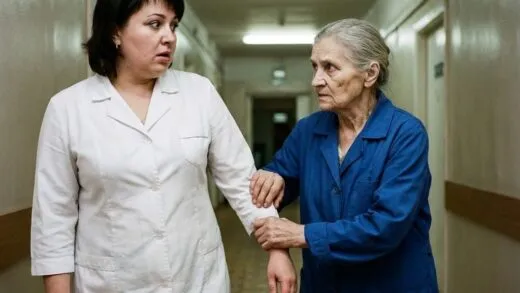
Turning around, Marina saw Vera Ivanovna. The old woman was standing in the dimly lit hallway with a bucket and mop, but her face was tense, almost frightened.
— Vera Ivanovna, are you still here? It’s late, you should go home.
— I’ll be done soon. I need to tell you something important.
Marina moved closer. The old woman looked around, as if afraid someone was listening, and with a trembling hand, she grabbed the sleeve of Marina’s coat.
— Listen to me carefully, dear. Tomorrow, when you go to work, don’t use the main entrance. Do you hear me? Under no circumstances should you use the main entrance.
Marina looked at her in surprise:
— Why? What happened?
— Use the service entrance, the back door. It’s very important. Please, believe me. I’ll explain everything the day after tomorrow, I promise. But tomorrow morning, you must come in from the back.
Vera Ivanovna’s eyes glittered in the dim light, and Marina saw genuine fear in them. The old woman was clearly not joking or making things up. Something had happened, something serious.
— Vera Ivanovna, you’re scaring me. Tell me something.
— I can’t right now. I can’t. Just do as I ask. You’ve done so much good for me, you saved me. Now it’s my turn. Promise me you’ll use the service entrance tomorrow.
Marina looked into the old woman’s pleading eyes and slowly nodded:
— Okay. I promise.
Vera Ivanovna let out a sigh of relief and released Marina’s sleeve.
— Thank you, dear. Go home, your father is waiting. And remember: only through the service entrance.
Marina left the clinic through the back door and walked towards the bus stop. Wet snow slapped her face, and puddles squelched under her feet. She pulled up the collar of her jacket and sank into thought. What could have frightened Vera Ivanovna so much? Why couldn’t she use the main entrance? The more she thought, the more her anxiety grew. Vera Ivanovna was not the type to panic over nothing. If the old woman was warning her with such fear in her voice, the danger must be real.
At home, Marina somehow managed her evening chores. Her father noticed she was distracted and asked if everything was alright. She smiled and said she was just tired. Late at night, already in bed, Marina couldn’t fall asleep for a long time. Vera Ivanovna’s frightened face was before her eyes, and her words echoed in her ears: “Don’t use the main entrance.”
The morning started as usual. Marina woke up at half past five, helped her father with his morning routine, and fed him breakfast. Pyotr Semyonovich was in a good mood, telling her about a pleasant dream he had about the sea, where they had vacationed as a family a long time ago, when her mother was still alive.
— Do you remember how you used to build sandcastles?