
She lay face down in the snow, a heavy tread on the back of her neck pressing her cheek into ice that had already scored a line across it. Cold found every gap in her jacket, but the kind of panic you’d expect from someone in her position didn’t come. Instead she was calm—efficient in a way that made no noise.
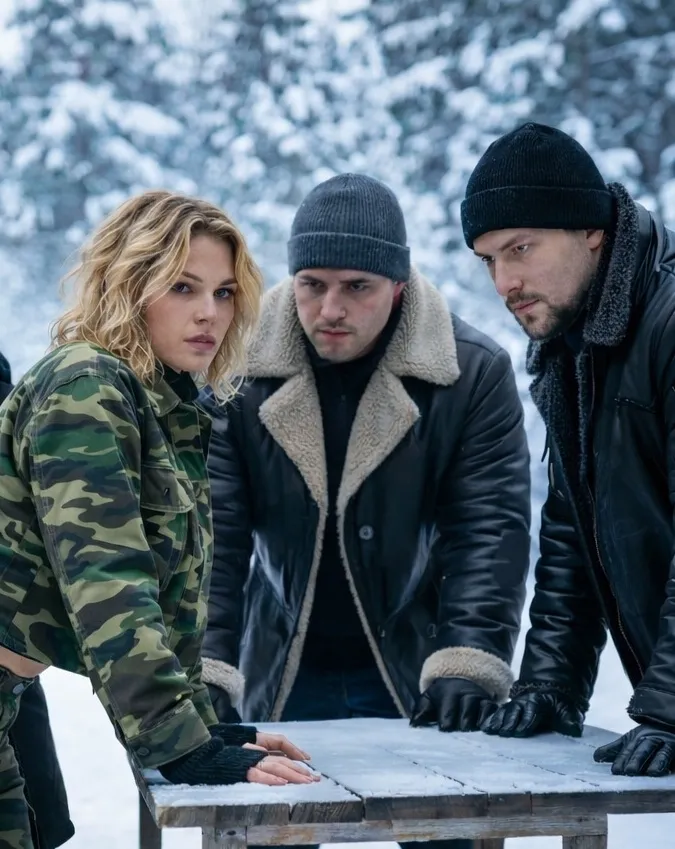
There were three men above her, laughing rough and smelling of cheap tobacco and engine grease. They thought their advantage was obvious: rifles, muscle and the kind of confidence that comes from having preyed on easier targets before.
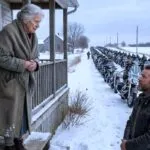
They called her “Park Ranger.” Eleanor had her old ranger badge in her jacket and a knife they’d already taken and were passing around like a joke. She knew the type—city toughs who treated the woods and the people in it as their playground. To them she was an opportunity, not a person.
“So, Ranger, gonna talk?” the man they called Vince said.
He sounded like the boss; the others quieted when he spoke. He lifted his boot off her neck only to yank her by the jacket and push her up to her knees.
Eleanor steadied herself and kept her movements slow. Her eyes, gray as a winter sky, met his for a second. He smirked and slapped her to humiliate her more than to hurt.
The blow stung, salt and blood in her mouth, but she didn’t struggle. She lowered her gaze and let them see the fear they wanted. It was a tactic: show weakness, don’t reveal steel.
“Look at her,” Kurt snickered. “All pride and no sense.”
The other, a hulking man in a scuffed down jacket, rooted through her gear. He pulled out a compass, a fire starter and a folded map as if they were trinkets. “You know where the old mill is?” he barked. “We’re stuck—sled went through the ice.”
They pointed at a half-sunken snowmobile in a ravine a couple hundred yards away. They needed a guide. They assumed she’d lead them straight to a mill and be gone.
Eleanor nodded. She knew the forest better than she knew the streets of town. Every ridge, every creek and blowdown was familiar. She also knew how to use that knowledge.
Vince snapped his fingers. “You lead us. No detours. Get us to that mill, and we’ll let you go. Try anything and we break your legs and leave you to the cold. Understood?”
“Understood,” she said quietly, making sure her voice trembled just enough.
She needed time—time to build a plan and to let the woods do what they do best. Her background helped: she’d been in Special Forces years back. Call sign “Shade.” Long days and frozen nights had taught her how to slow down a heart and how to move without being noticed.
She sized them up. Vince was the leader—ruthless and hungry for control. Kurt was brute strength, quick to anger and slow to think. Ray, the third, jittered on the edge of the group, a petty coward who’d come along for the money. Each one had a weakness she could use.
They made her take off her hat and give up her jacket. “You’ll be finer without it,” Vince said with a laugh, tossing her hat away. “Kurt’s colder than a rock.”
Her park jacket was high-performance gear; theirs were cheap winter coats. She took it off slowly and pulled Kurt’s heavier, damp coat over her shoulders. The swap was staged humiliation—but it was also a deliberate trade. The thin synthetic jacket would let heat go faster. The colder she looked, the more they’d underestimate her.
She stepped into deep snow. With every step her boots sank up to the knee. The men followed behind, confident—until the pace she set began to eat away at them. Her rhythm was a training trick: spurts of faster movement, then slow deliberate steps that forced them into a stop-start exhaustion.
The sky closed in. The wind picked up, throwing a stinging spray of ice that bit at the exposed skin. This was a February storm in the Appalachians, the kind that could be deadly in a night for an unprepared group.
“We need to keep moving,” Vince barked, jabbing a muzzle at her back. “How far to shelter?”
She told him what he wanted to hear: a small, believable lie. “A shelter in about three hours. We need to make it before dark.” The closest hunter’s cabin was in a different direction; she was leading them toward a barren, exposed ridge. It was where the wind became an executioner and where thin snow hid dangerous seams in the ground.
She remembered a drill from an old instructor: when the enemy is stronger, don’t outmuscle them—make them waste themselves. Let the cold and the terrain do the work of wearing them down.
They trudged on. The men’s boots were good-looking but not suited for a multi-day march in deep snow. Their packs were loaded heavy—too heavy. Eleanor watched their posture and the way sweat turned to ice on their collars. Greed makes people slow; it makes them overburdened.
“Move it, Sideshow,” Ray called, trying to sound like he was in charge. “We should be at a cabin by now.”
She kept her head down and kept going. She picked a steeper route, forcing them to labor. Their breathing grew ragged. Kurt cursed at a hidden root or rock, and Ray began to trail, every cough sappping more strength. Their confidence drained with the warmth from their clothes.
She stopped once and raised a hand. “Quiet,” she said, looking toward the tree line. “Wolves.”
It was a small lie—their tracks were old—but it changed the walk. Fear is a calorie burner. Ray’s shoulders tightened; Kurt’s jaw set. Anxiety makes people use up energy. That was the point.
They kept moving, tense and jumpy, and Eleanor let them. Somewhere on the line they started arguing about who had the heaviest pack. That’s when they handed a pack to her, the heavy one that had been on Ray’s shoulders.
She shouldered it. It was enormous and dense—about sixty liters and weighing close to 66 pounds. It rattled with the sound of hard metal. The picture clicked into place: they’d hit an armored transport at the highway and taken a haul—nearly $1.8 million worth of bullion, probably stashed as ingots. That explained the danger and the panic.
She set the pack, far heavier than anything a ranger would need for a day trip, and tightened the straps. It threw off her balance, made every step cost more. Good. She wore the weight like a promise: she would carry that burden to where the forest could finish the job.
Ray, suddenly lighter, moved perkier. Free of the load, he started to chat and take risks. He felt lighter—and colder. The pack had been his thermal mass as much as a cargo. Without it, his body surrendered heat faster.
They pushed on and finally dropped into a sheltered stand of trees where darkness fell fast. The men lay out the cold supper and tried to dry boots over a meager fire. They did everything wrong—green branches, smoky fire, drying wet boots too close and baking the leather. The smoke stung Eleanor’s eyes, but she sat back in the shadows and pretended to be out of it.
“Tell us a story, Ranger,” Ray slurred after a drink. “Something about bears or spirits.”
“Tell us where you’re taking us,” Vince cut in, voice flat now that the liquor had been poured. “You said there was a shortcut.”
“Just over the ridge,” she answered. “We’ll swing around Wolf Hollow. Safer than the main trail.”
Wolf Hollow was a real place—but not the kind of safe shelte they wanted. It’s an exposed chute between rock faces where wind funnels and cuts people down. She said it was safer to get them to move before the storm returned. They believed her because they needed to believe.
By midnight they’d wrapped her hands behind her with some nylon cord and shoved her onto some branches to lie on. She let them—she’d use the pain and numbness to fuel the act. When morning came, the cold had done its work. Ray’s cough was worse. Kurt’s swollen face showed the damage of night and cold. Vince moved stiffly, the boots he’d dried too close to the embers now tight and rigid.
“Up,” Vince growled. “We’re moving.”
When they forced the cord off, Eleanor acted weak and grateful, pressing her fingers until the circulation returned. She let them see tears that weren’t real. They were so used to being the tough guys that they overlooked one fact: the woods doesn’t care about anyone’s bravado.
Their breakfast was as bad as you’d expect—cold canned meat and hard bread. There was no hot tea because they’d burned through the dry stuff. Eleanor chewed slowly, saving calories. The plan was to get them up a ridge into the open where a mistake would have real consequences.
On the path uphill she moved deliberately slow, letting them prod and curse. They shoved her, pulled her up and pushed her in the snow. Pride deferred. She let them believe they’d won control. They started to leave their weapons slung rather than held, and they relaxed—just enough.
At the lip of a rock field she asked to step aside “for a minute.” Vince waved her off without looking. While she crouched, pretending to catch her breath, she staged a small slip and, in one practiced movement, nudged a glove Ray had tucked behind his belt. It fell into the snow and she buried it with a footstep so it wouldn’t be obvious.
Ray cursed when he noticed the missing glove and wanted to go back. Vince was furious at the idea of wasting time, but the panic that fluttered through Ray’s voice told Eleanor exactly what she needed: one man now distracted, worried about his hands. Another weak knot in the chain.
They pushed on into the worst of the field—an area of loose, frozen moraine where the snow bridged hidden voids. It was precisely the kind of terrain that breaks ankles, and it was where she wanted them to fail.
Ray slipped. His leg went down into a hole and he went headfirst, his pack tossing him forward. He screamed. Vince lunged, and with everyone grabbing at him there was a mess of limbs and panic. Eleanor did nothing. She watched and waited.
They hauled Ray up but his boot was full of icy water. He was hissing and shaking. When Vince ordered a fire, it became a frantic attempt to thaw a soaked foot that should not have been soaked: the kind of heat that ruins boots and finishes men off later with frostbite.
As they wrestled with a pitiful attempt to get a flame going in a wind tunnel, Ray’s condition worsened. He was weak, complaining that his hand had gone numb. That morning he could be coaxed along with a curse and a shove. By midday he was a liability.
It was at the narrowest stretch of a cliff-side trail—an animal track barely a foot wide—that the rope they used to stay together became the story’s hinge. Vince, for some reason, had tied them together like a team pulling a sled. Eleanor was first, Kurt next, Ray after him, and Vince at the rear to keep the line taut.
Ray lost his footing on the narrow ledge. The rope snapped tight. In a heartbeat he slid over the edge. The sudden pull dragged Kurt forward; he went over after him. Vince fought to brace himself, but the weight of two bodies pulling on a man at the back on an icy ledge is a physics problem with a sad answer.
“Cut it!” Vince screamed. “Cut the rope!”
Kurt yelled that he couldn’t reach a knife. They were all holding on; muscles burning, breath ragged. Ray’s voice from below begged for help.
Eleanor’s hand went to the jagged edge of the rucksack buckle at her hip. Aluminum had split there, leaving a rough, sharp rim. She had one chance to make a choice that would determine whether all of them lived—or if some payment would be exacted by the mountain.
She rubbed the rope against the buckle until the fibers began to wear. Vince slapped at the knot, his fingers useless with cold. Eleanor did not flinch. The cord finally gave with a sharp twang. The entire force changed instantly; Kurt and Ray slipped into the white. They were gone before the echo finished.
Vince collapsed throat-first on the ice, the rope still cutting into him as if reality had taken a bite. He lay there, shocked and bleeding rage. He looked up at Eleanor with a look beyond anger—pure, naked fear.
“Help!” he gasped once, voice broken. “Help me—please.”
She packed her shoulders, read his face, and walked away. “You tied yourself to them,” she said. “You chose.”
He had choices left—cut the rope himself earlier, lighten the packs, turn back—but he’d chosen to keep everything: the money, the men, the pride. The mountain and the storm made the accounting.
Eleanor did not wait to see what happened below. She had to move. With the heavy pack gone, she felt lighter than she had in days. She abandoned what they’d stolen in the snow—burying the rucksack under roots and covering it with drift so that the temptation might sit there and fester for someone else to find.
She left the pack because it was an anchor. She left it because greed had turned the three men into the kind of cargo the woods collects. Free of the weight, she pushed on toward a known shelter—a battered hunters’ dugout a couple of miles farther along. It wasn’t pretty, but it was dry and had a small woodstove that would do until the search came.
Vince survived the cut rope, but he didn’t survive intact. The choice to hold on to greed cost him the friends he’d dragged along and broke something in him that never came back. He found the rucksack again—he crawled to it—and hugged the metal like a child clinging to a blanket. He couldn’t stand to lift it. The cold had stolen his legs. A pack of wolves, drawn to the scent of blood and the warmth the bodies had left in the snow, finished what the mountain had started.
Eleanor reached the dugout by nightfall. It was a miserable shelter—an old pit dug into a bank, timbered over and stuffed with pine boughs. There was a tiny iron stove. She cleared a place inside, stuffed the stove with a few dry pieces of wood she found, and lit a fire. The warmth hit her like a hand and for the first time since the snowmobile went through the ice she let herself finally feel tired in a way that didn’t scream danger.
She lit her old flip phone to one bar and called the local ranger station. “This is Eleanor,” she told Ranger Tom. “I’m on Bald Ridge. I need extraction. Hypothermia risk.”
“Hold on,” Tom said, alert now. “We’ve got a helicopter on standby. Hang on to that phone. Keep a fire, keep talking.”
The battery died while she was mid-sentence. She had no power, no backup. She did the only sensible thing: she kept moving, kept warming, and kept talking out loud to herself to fight the heavy, sleepy pull of hypothermia.
The helicopter found her because she kept banging sticks and clearing a false signal—a trick she’d learned years before. The rescue crew lowered a line and took her off the ridge. The heat inside the chopper was overwhelming and it felt like mercy. She slipped into unconsciousness and woke up two days later in the county hospital with her hands bandaged and a very over-caffeinated Ranger Tom sitting beside the bed.
By the time she was coherent, the investigators had recovered what they could. Vince was found where he’d fallen, clutching the rucksack. Kurt and Ray had paid the price of their mistakes the mountain demanded. The stolen bullion had been reclaimed; at the current price it was worth nearly $1.8 million. The county returned it to the transport company.
“You did well,” Tom said, handing her the scuffed knit cap they’d found near the dugout. “You didn’t shoot anyone. You survived. That counts.”
She dismissed talk of medals. She’d not set out to be a hero—only to get through it and live. The men who took the money had made their choices; the woods had simply kept to its old rules.
A month later she was back at the ranger’s station. Her cabin showed the signs of chaos it had been through: a broken chair here, a torn curtain there. She cleaned, straightened, and went back on patrol. The winter had changed what she understood about fear and about what it takes to get by.
One morning she stood at the edge of Wolf Hollow, looking at the place where the rucksack had been found. The snow had smoothed everything over; the forest keeps no grudges, only records of what was done and what’s left. She adjusted the rifle on her shoulder, whistled, and her new rescue dog—a lanky mixed-breed she’d taken in—came skittering up.
“Take this as a lesson,” she said as she started a new track through the woods. “If you want something you can’t carry, you’ll end up carrying nothing at all.”
As for the money—let those who didn’t learn the lesson find it. In the woods, gold doesn’t warm you. The people who survive winter here know what really matters: a dry jacket, a warm stove, and the right people to call when the weather turns.