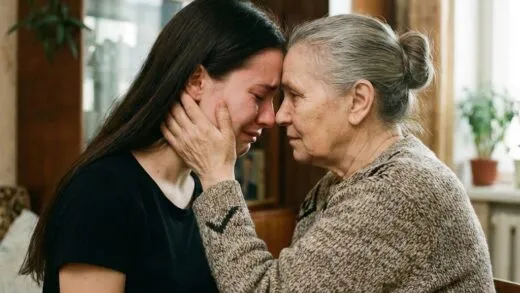

“Alex, what are you doing to yourself? You’re killing yourself.” I sat up and held my head in my hands.
“Mom, I can’t do this. I can’t live with it. Every night I see him.”
“He’s dead because of me.” “He’s dead because he chose the life he chose.”
“You just did what somebody should’ve done a long time ago.” “Why me? Why did I have to be the one?”
She crouched beside me and put her arms around me. “Because you love me. Because you’re strong.”
“Because you could do what others couldn’t.” I cried then, quiet and bitter.
“Mom, I don’t want to be strong. I want to be normal. I want to sleep through the night.”
“I want to close my eyes and not see blood.” She stroked my hair and whispered, “It’ll get easier.”
“With time, you’ll carry it better. You’re my son. You’ll get through it.”
But I wasn’t sure. The strength was gone. All that was left was exhaustion. A wish to disappear into sleep.
And not wake up. A week later I quit drinking. Just stopped.
I realized alcohol wasn’t helping. It only made things worse. I needed another way to live with what I’d done.
I started going fishing. Alone, early in the morning. Sat by the river.
Watched the water. Quiet, sunrise, birds in the trees. Nobody around.
Just me, a rod, and the river. Out there I could think. Sort through things. And I came to one conclusion.
Regret doesn’t change facts. Wade was dead. Luke and Steve were crippled.
That was done. I could destroy myself over it for the rest of my life, or I could accept it and keep moving. I chose the second.
Accept it. Yes, I killed a man. Yes, I crippled two more.
But I protected my mother. Saved her from more suffering. Freed the town from men who preyed on the weak.
That wasn’t an excuse. It was simply true. I wasn’t a hero, and I wasn’t a villain either. I was a man who made a terrible choice.
A hard choice. And now I lived with the consequences. Mom saw the change in me.
One day she said, “Alex, your eyes are different. Like your father’s were after the war.”
“He used to look at things that same way, like he’d seen something other people hadn’t.” I remembered my father. He died when I was fifteen.
A veteran. Fought overseas. Quiet man.
Drank sometimes by himself in the dark. Mom used to say the war changed him, made him into a different kind of man. Now I understood.
He’d killed too. In war, under orders, but still killed. And it stayed with him. He learned to live with it.
Worked, raised me, loved my mother. But there was always that weight inside him. Now that weight was in me.
I went to the cemetery to visit my father’s grave. Stood there for a while without saying anything. Then I said quietly:
“Dad, I’m sorry. I didn’t understand you until now. Didn’t understand what you carried or why you went quiet.”
“Thanks for teaching me how to be strong. Without that, I couldn’t have protected Mom.” The wind moved through the leaves.
Soft and steady. I stood there a little longer, then left. That evening Mom asked, “Where were you?”