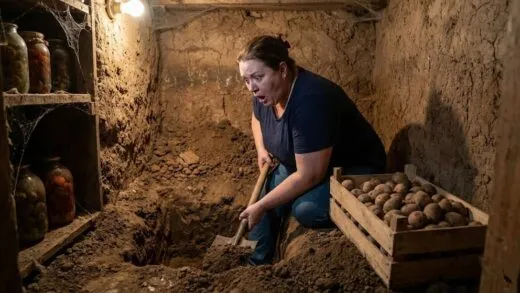

She shoved with her shoulder until it gappped a couple of inches. Behind it sat a narrow hidden compartment, sealed long ago. Eleanor slit the paper covering it with a kitchen knife. Inside, wrapped in old cloth, came the smell of oil and metal — a wartime rifle.
It was a WWII sniper rifle, scoped and carefully maintained. The wood was dark with age, the metal spotless. Her hands, which a moment ago had trembled holding a grocery bag, went steady as stone.
Her fingers found familiar places: the bolt slick as if it remembered the 1940s. Corporal Eleanor Walker had forty confirmed hits to her credit back then. The enemy had called her the Quiet White. Later, there’d been a factory job, the small-business paperwork, and retirement. She had thought that chapter was closed. She was wrong.
Eleanor cleaned the lenses with an old flannel rag. The woman in the mirror stopped being someone to pity. She was a person who knew how to make the world a little more just. The county had washed its hands; if the law wouldn’t act, she would.
She opened Katie’s notebook and wrote four names in a steady, careful hand: Bradley Stanton, Owen Briggs, Roman Cole, Vince Hernandez. Then she sat down at the kitchen table and methodically assembled the rifle. Her hands moved as if muscle memory ran deeper than arthritis.
For Eleanor, patience was as important as the rifle. The next three days she watched. To everyone else she remained a gray-haired neighbor running errands. But in her canvas bag now there was a field binocular wrapped in newspaper. She studied schedules, routines, and faces.
The Central Café glittered on Main Street that Friday night. Men in coats laughed over drinks. Eleanor stood across the street in the bus shelter’s shadow, chilled to the bone, but a controlled fire burned in her chest.
A black Cadillac with a government-style tag 0001 pulled up. Bradley Stanton stepped out first — tall, in an expensive coat, the sort of face money protects. Behind him came Owen with a flash of red hair and a crooked grin, then Roman, big and used to breaking things without consequence. Finally, the driver: Vince Hernandez. He polished the car fender while his bosses went in for dinner.
Eleanor watched through the bus shelter glass. They didn’t look like monsters, just boys with a lot of promise and a sense of impunity. But she remembered how they’d laughed when they left Katie in a field. That image stayed with her.
She picked a weak link: Vince. He hovered on the edge, running errands, opening doors, doing favors. When he took the car to a service station afterward, he parked at a row of garages on the edge of town. The place was perfect: rusty metal boxes, empty lots, and a half-completed windbreak. He lingered there more than he needed to.
Eleanor found a vantage point on an old catwalk over a disused boiler room. From that height she had a clean line to a third row of garages. The wind was right, and the lamp over the garage provided an easy aiming point. Distance: about 120 yards — close for a skilled shooter.
She came back late and packed her husband’s old clothes — padded pants, a heavy sweater — because comfort and silence mattered more than dignity. She wrapped the rifle in duck cloth and said good-bye to Katie’s photograph. “Rest easy,” she told the girl. “I’ll try to even the scales.”
That night she dreamed of the narrow focus of old war days — lying in a drift, the world reduced to a round of glass and numbers. She woke with the old calm. “Patience,” she told herself. It’s the weapon that never misfires.
Friday night, she climbed the catwalk and broke the cloth. She set up as if expecting a long wait. After half an hour of numb cold and clipped breath, the Cadillac rolled in. Vince stepped out alone, keys jangling, unaware he was standing in a perfect circle of light.
He was an easy target: standing tall under a single bulb. Eleanor’s breathing slowed. In the scope his face filled the lens: a small, smug expression that used to play on his lips. She had no mercy left. She squeezed the trigger between heartbeats.
The noise cleaved the industrial hush of the area. He jerked, staggered, and fell into the slushy snow by the garage door. Eleanor worked fast. She opened the bolt, swept the spent cartridge into her palm, and tucked it away. There would be no traces. The rifle was dismantled in under a minute and wrapped again.
Dogs barked; a sleepy garage hand muttered something about a loud bang. Life at the edge of a small town is used to odd sounds. Eleanor slipped away through a yard gap and walked home like the old woman she looked to be. At her kitchen table she crossed a single name off the list.
By nine the next morning the garage was ringed with sheriff’s cruisers and suits from the state. The sheriff’s face was ruddy and angry. “You tell me this is common violence?” he demanded. “That’s the personal driver for the commissioner’s son. This was surgical. Where’s the shell? Where are the leads?”
Detective Sam Reed, head of violent crimes and a man in his fifties with tired, honest eyes, squatted at the scene and let the wind carry his breath away. “Shot from above,” he said quietly. “About a hundred and twenty yards. Clean, fast. The shooter left nothing.”
In the Stanton house panic replaced the usual arrogance. Bradley sat on the sofa with a glass shaking in his hand while Owen fumed and Roman looked ready for violence. The commissioner’s call was tight and restrained. “Stay inside,” he ordered. “We’ll get security.” But for the first time these kids smelled fear.
Eleanor stood in line at the grocery when whispers swirled. People speculated: mob hit, a dispute gone bad, a message from out of town. Eleanor kept her hands on the milk pail and felt a quiet satisfaction. They assumed it was someone else. Let them.
Next on her list was Roman, the ex-athlete turned brute. He loved running in the park by the river, even in winter. Eleanor looked at the weather report, knew the park’s trails and trestles, and chose a place where the ground and gravity would do her work.
Sunday at dawn she sat on a worn bench by the riverside in thick clothes, sipping from a thermos. She’d poured warm water on a steep wooden turn on the jogging path the night before and loosened two bolts on the guardrail. At first light Roman came pounding down the trail in his headband and running shoes, breathing clouds of steam from the cold.
He didn’t notice the old woman on the bench or the hidden trick underfoot. In one slipping instant his shoe met ice; he grabbed the handrail that gave away and came down hard. There was a sickening thud five meters below. Eleanor waited, then stood and walked away as if nothing had happened.
Detective Reed was at the scene within the hour. The official line would be “a tragic accident.” Still, Sam ran his hand over the rail and frowned at how unnaturally smooth the ice looked. “Someone poured water,” he muttered. “This wasn’t an accident.”
Meanwhile, in the basement apartment where Owen paced, the talk was of running out of town, of hiring muscle. Bradley called a local fixer — Artur — to bring in paid protection. “A few thousand,” he said, as if cash solved everything. It did sometimes, but it couldn’t buy back what they’d taken.
Those talks put a target on Owen. He holed up at his father’s warehouse on the edge of town, a produce distribution center with high fences and hired guards. Eleanor did not need a long rifle this time. She used cover and a small-caliber pistol she found in the wardrobe. Up close worked, too.
She went to the clinic during the day with aches and a cough, then slipped out through a delivery door she’d noticed years before. At night she crawled through the perimeter shrubs, slipped across a yard, and found a window left unlocked. Inside, she moved like someone with nothing left to lose.
Owen surprised her in the corridor, belligerent and drunk. The old arthritis shook her hand and the pistol tipped once before she fired. The shot nicked a doorframe; Owen shouted. Footsteps came. Eleanor ran, and guards poured into the yard with lights and dogs.
She dove into a hollow between crates and held herself still as dogs sniffed and men cursed. She ripped open a bag of lime to make a bitter barrier; one curious dog backed off with a yelp. When a guard swept a flashlight over her hiding place, she fired through a crack and the light shattered. Chaos followed.
She stole into the night on the tail of a departing truck, hiding among crates until it slowed near the train tracks. The cold bit her, but she moved. Back in her apartment she sat, bloodless and tired, and heard Bradley on the phone: “We have her address. Knock on wood, we’ll be there tonight.” He sounded sure.
There is a moment when someone like Eleanor — with nothing left to lose — accepts the next turn. She went to the neighbor’s shed and found a can of fuel. If she could not outfight them at home, she would make leaving without her name easy and make their attempt to take her a disaster.
At three in the morning a dark sedan eased up to her building without headlights. Three men from Artur slipped into the stairwell. They knew how to break a door. Eleanor sat on a chair by the entry and waited. The hallway was coated with a shallow pool of fuel leading from the door to the stairwell. She struck a match and tossed it.
Flame roared along the floor. The attackers were cut off from the apartment and staggered back into the stairwell coughing and choking. Thick black smoke poured out into the hallway. Eleanor climbed out a neighbor’s balcony, alerting them to the fire and blending into the street among residents who fled into the cold night.
By the time the men escaped down the back alley, sirens were wailing. Eleanor watched from the fringe of the commotion. Detective Reed pushed through the crowd, furious and breathless. The attackers were gone, but the trail — as much as a small-town trail can be — led back to the Stanton circle. She left town as if she were a gardener getting a cup of coffee.
She had nowhere to go, but she had a set of keys to an old lake house out by the county line. The Stanton family owned the large lake house nearby at Cedar Point, an in-town exemplar of privilege. She took the neighbor’s keys and kept to the cold and the trees.
That night, at the Stanton lake house, the music was loud, the drinks were expensive, and the guards were thin on the ground. Eleanor dropped down from a pine, crossed the lawn, and slipped onto the back terrace as laughter floated out into the clear air.
Owen stepped out for air, and when he saw her he begged, stammering and offering money and promises. She reminded him of Katie in a voice that had lost nothing of the steel it had learned under a scope. The movement was quick and precise. He hit the snow and did not get up.
Inside, Bradley froze as smoke and the scent of burning filled the room. He fumbled for the gun on the wall. She fired a single time. The shot was a punctuation mark. He fell. She checked him to make sure. Quiet settled over the mansion.
One by one the houses of influence emptied as sirens converged. Special response teams arrived and more quiet men in plain coats. Detective Reed walked in, looked at the scene, and then looked at Eleanor. He could have read her arrest sheets like pages in a book; instead he wrapped his coat over her shoulders and led her out without cuffs.
At an emergency session upstairs officials decided an open trial would only make Eleanor a symbol, and that could be dangerous. They agreed on a tidy, closed version: this was the result of criminal rivalries. Publicly, the case was pinned on out-of-town hooligans. Privately, the county made sure the story ended quietly.
Eleanor was taken to a private medical facility under a gentle, protective cover. It was early 1990. Detective Reed visited her once and brought a photograph of Katie. “People still leave flowers,” he said softly. “They remember.”
She listened, and relief eased her. She died the same night, peacefully and without fanfare. In the spring neighbors who had once been quiet about her left small bunches of carnations at an anonymous grave. The files on the killings were consigned to a furnace, and the official record read like any other small-town tragedy.
But in Millfield the story did not evaporate. People told it quietly over kitchen tables and in the pews after church: about the old woman who had been a young soldier, who remembered what was owed and who was willing to settle the score when the justice system would not. Some called her vigilante, some called her a guardian. Most simply called what she did the end of a long, heavy chapter.