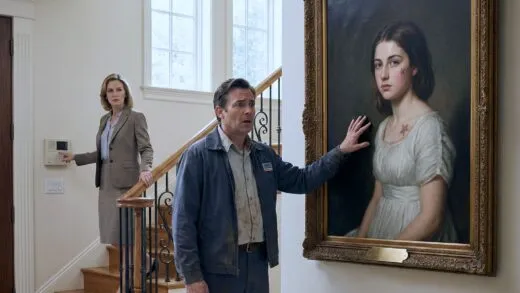
His voice jumped into a high, strained register. “Have you all lost your minds? Security, get that woman away from the patient!”
“Remove her immediately!” The guards stepped forward, reaching for Zemfira’s shoulders, but she didn’t move. She turned sharply, and her black eyes locked onto Dr. Edwards.
She raised one hand and pointed straight at his chest. “You’re the one killing her,” Zemfira said. Her voice wasn’t loud, but it filled the room.
“She’s not fading from the disease right now. You’re flooding her with heavy drugs so she’ll go quietly, so she won’t cry out, so she won’t spoil your neat numbers. Her immune system is asleep. Her blood’s standing still.”
“You’re not letting her fight.” “Shut her up, this is outrageous!” Dr. Edwards snapped, turning to Michael. “Mr. Warren, this fraud is taking away your granddaughter’s last chance!”
“The child cannot breathe on her own. She’s starving for oxygen. Tell your people not to interfere—we need to replace that catheter.” Michael stood against the wall.
His gaze—the hard, pressuring gaze of a man who had spent a lifetime reading people across boardroom tables—settled on the doctor’s face. He wasn’t looking at the man’s twitching throat. He was looking straight into his eyes. And in that moment, Warren saw something that changed everything.
There was no fear there for the child. No professional panic from a physician losing a patient. What flashed in Dr. Edwards’s eyes was sticky, cowardly fear—the fear of a man whose secret had just been dragged into the light. He wasn’t afraid Sophie would fail.
He was afraid Zemfira was right. And now that truth had been spoken in front of the girl’s all-powerful grandfather. Michael made his decision in a fraction of a second.
The rational world fell away, replaced by the oldest instinct there is: protect your family. Michael lifted one hand. Two of his personal security men, who had been standing silently in the hallway, stepped in at once.
These were not hospital guards. They were professionals, broad-shouldered men who moved with quiet precision. “Get them out into the hall,” Michael said evenly.
“All of them.” “Mr. Warren, you don’t understand what you’re doing!” Dr. Edwards tried to pull back, but one of the security men had already taken his forearm in a grip so firm the doctor gasped. The second man used one smooth movement to force the hospital guards toward the door.
No punches. No shouting. Just overwhelming physical control and absolute obedience to an order. Within seconds, the white coats were outside. “Lock the door from the inside. No one comes in, even if the police show up.”
“Hold the line,” Warren told his head of security. The door shut. The lock clicked.
Michael was alone with Zemfira and his granddaughter. There was no going back. If Sophie died now without the machines, it would be on him.
But there was no road behind him anymore. Zemfira paid no attention to the scene. As soon as the door closed, she knelt by her worn canvas bag on the floor.
The sharp smell of bleach, alcohol, and medicine began to give way. Zemfira took out several tightly tied cloth bundles. The moment she opened them, the room filled with a dense, living scent.
Bitter wormwood. Yarrow. Old oak bark warmed by summer sun. The smell of woods and open fields felt foreign in that room, but for the first time in months it brought with it the sense of life. Zemfira pulled out an old metal thermos.
She poured a dark, nearly black liquid into a plastic cup. A little steam rose from it. Then she went to the bed and bent over Sophie.
The girl’s lips were dry and cracked. Zemfira took an ordinary teaspoon, dipped it into the brew, and carefully touched it to Sophie’s mouth. She moistened the girl’s lips.
The sedatives that had smothered Sophie’s mind had stopped entering her bloodstream half an hour earlier. Freed from that chemical pressure, her body was slowly, painfully returning to itself. Sophie gave the faintest grimace.
The receptors on her tongue reacted to the sharp bitterness. She made a tiny swallowing motion. “That’s it, little sparrow, that’s it,” Zemfira said in a low, steady voice.
“Drink the bitter. Bitter drives sickness out. Sweet comfort has nearly put you under for good.”
After getting a few spoonfuls into the child, Zemfira set the cup aside. She pulled off her shawl, dropped it over the back of a chair, and rolled up the sleeves of her dark blouse. Her hands—lean, brown, with short nails—were ready for work.
She folded back the light hospital blanket. Sophie’s legs, thin under the pajama fabric, lay motionless. Months of immobility had left the muscles almost gone.
The skin was cold, marble-pale, with a fine web of capillaries showing through. Zemfira wrapped both hot palms around the girl’s right calf and began to rub. Not gently, not with the soft strokes of the expensive massage therapists Michael had hired before.
Zemfira’s movements were strong and forceful. She pressed her fingers deep into the chilled tissue, driving stagnant blood upward, from the feet toward the knees, forcing the vessels to open. The skin beneath her hands began to redden.
It was exhausting physical labor. Sweat gathered on Zemfira’s forehead. Her breathing grew deep and fast. She used her full weight to work the muscles stiffened by long stillness.
For Sophie, whose nerves had been dulled for so long by medication, the return of sensation was painful. The cold tissues burned from the friction. The girl jerked weakly.
Her brows drew together. A soft, pitiful moan escaped her dry throat. She tried to pull her leg away, but she had no strength.
Two large tears rolled slowly down her pale cheeks. Michael, standing by the window, felt every muscle in his own body tighten. He could not bear to watch the child suffer.
Every little sob hit him in the chest. Every instinct in him wanted to stop this, protect her, tuck her under a warm blanket. He took a step forward.
“Enough,” Warren said hoarsely. “You’re hurting her. Stop. She’s crying.” Zemfira didn’t turn around.
She shifted her grip to the girl’s thin thigh and kept going without slowing. “Step back, old man,” she said over her shoulder, breathing hard. “Remember the deal. I’m running this room.”
Then she bent closer to Sophie’s face. Her eyes met the girl’s half-open, tear-clouded ones. “Cry,” Zemfira said loudly, looking straight at her.
“Go ahead. Cry louder. It hurts? Good. That means you’re alive. It means your nerves haven’t gone to sleep.”
Sophie gave a weak sob and tried to turn away, but Zemfira gently, firmly held her chin. “Don’t you dare feel sorry for yourself,” she said. Her voice cracked like a whip, but there was no cruelty in it—only hard strength. “They’ve been pitying you in here while you slid toward the edge.”
“Enough of that. You lost your hair. You lost your looks. So what? You’re not porcelain anymore. You’re a fighter.”
“Trouble is standing right in front of you, and you’re giving up. Get mad, girl. Get mad at me for hurting you. Get mad at this sickness.”
“Anger is life. As long as you’re angry, you haven’t surrendered.” The words landed hard and solid. No one had spoken to Sophie like that.
For months she had heard only whispers, careful voices, the sighs of doctors and the desperate eyes of her grandfather. Everyone treated her like a fragile vase about to crack. But this stranger who smelled like smoke and herbs was demanding that she fight.
Somewhere deep inside Sophie, under the layers of apathy and chemicals, something stirred. At first it was just dull resentment at the pain. Then it began to turn into a small but hot spark of anger.
Sophie dragged air in through her dry mouth. Her breathing quickened. The thin hand resting on the sheet twitched.
Her transparent fingers slowly, with enormous effort, curled into the fabric and clenched into tiny fists. She couldn’t hit. She couldn’t shout. But that gesture was the first act of resistance in months.
Zemfira saw those clenched fists. A faint, satisfied smile crossed her tired, sweat-damp face. “That’s right, fighter,” she said softly. “Take the hit.” And she kept rubbing life back into the girl’s stiff joints.
At the same time, in another wing of the medical center, a very different scene was unfolding. Dr. Edwards’s office looked nothing like a hospital room. Dark wood paneling. Leather chairs. A thick rug that swallowed footsteps.
There wasn’t a single patient chart on the large black desk. Only an expensive laptop and a gold-trimmed pen stand. The door flew open without a knock.
Margaret stepped in. A thick cloud of expensive perfume followed her—amber, musk, and something cloyingly sweet. Margaret, the sister of Sophie’s late mother, looked flawless.
Her hair was perfectly styled, her cashmere coat immaculate, and on her arm hung a designer bag from the latest collection. But beneath the expensive makeup, her face was tight with panic, and her lips were trembling. She threw the bag onto the sofa and strode to the desk.
“What is going on, Arthur?” she snapped, her voice rising. She planted both hands on the polished surface. “Security at the front desk told me Warren barricaded himself in that room with some ragged old woman, and you were thrown out.”
“Are you in control of this or not?”