
Mike Sullivan noticed the wildlife avoiding one particular trail in the woods. When he decided to walk it himself, he turned pale. He woke at five out of habit — twenty years of living off the land will do that to you. It was still predawn outside his small wooden cabin, but he was already alert. Mike was forty-two, and he’d spent most of the last two decades in the Appalachian woods. He knew every deer path, every creek and ridge around his home near the little town of Briar Hollow.
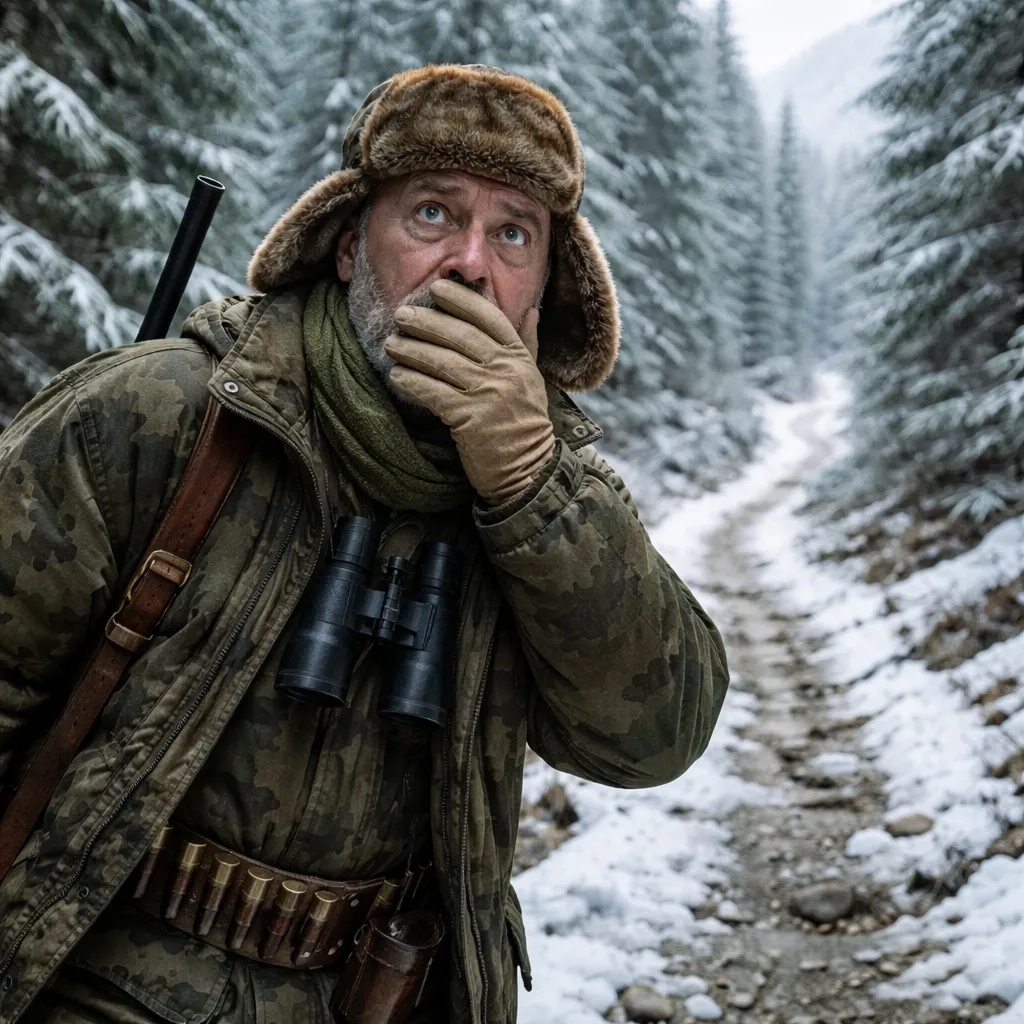
After the Army — he’d served in a reconnaissance unit — Mike returned to his hometown and tried regular life for a while. It didn’t suit him. His marriage ended when his wife couldn’t handle the isolation; she moved off to the city and they divorced. There were no children, so Mike kept doing the one thing he understood completely: hunting and guiding. It was late October now — prime hunting season.
He packed slowly and methodically: a daypack, extra shells, a fixed-blade knife, a thermos of coffee, crackers, matches and a compass. He carried an old double-barrel shotgun, checked the action, and stepped out into the sharp, cold air. The first snow would fall soon, and then tracking would be much easier.
Mike followed a familiar path to the stream where deer and wild hogs usually came to feed. The trail went through a thick stand of firs, climbed a small ridge, then dropped toward the creek. It was a ten-mile walk he’d made dozens of times. Usually by nine he’d be settled in his blind and ready to wait. But over the last couple of weeks something had changed.
The deer that always crossed that trail to the water stopped coming. He spent six-hour shifts in his stand without seeing a single animal. Meanwhile, the long logging road a mile over — a detour of five miles and a slog through marsh — had fresh tracks almost daily. Mike was puzzled. Animals don’t change routes without a reason. Was a bear using the trail? People? But he knew every neighbor within fifty miles, and no new folks had moved in. The day before, he’d walked three miles of the trail and found nothing unusual.
No bear signs, no footprints, no traps or snares. Just a regular forest path. Still, the animals were making a wide detour around a specific stretch starting about a mile beyond a large moss-covered boulder the locals called Old Man Rock. Today Mike decided to examine that stretch meter by meter.
He had a feeling something was off. When he reached Old Man Rock — a three-meter boulder crusted with moss — he stopped and scanned the area. The trail continued into dense firs like always. The ground showed ankle tracks, roots and fallen needles. He walked slowly, eyes down and hands ready.
Half a kilometer in, the ground beneath his boots began to feel odd — springy, too loose for a long-used path. He stomped the soil hard with his boot.
The earth gave under his weight. He crouched and pushed aside the surface litter. The soil looked fresher than the surrounding ground, like it had been disturbed recently. He dug out a little with his hands. When it looked like someone had turned the topsoil, he took out the compact folding entrenching shovel he always carried and began to scrape more deliberately.
The blade hit metal with an unmistakable ring. Mike froze. He cleared more earth to find an old, rusted circular metal cover — a hatch about eighty centimeters across, cast iron and heavy, with a lifting ring and a corroded padlock.
The lock was nearly eaten through by rust. Mike wiped his forehead despite the cold. A hatch like this under a forest trail raised real questions: who put it here and why? Then he remembered stories about forgotten government bunkers from the 1980s, sealed supply caches and emergency shelters. Maybe it was something like that. Still — why had fresh soil been piled on top? Why did the animals avoid the area?
He pulled a short pry bar from his pack — another thing he always carried — and undercut the padlock. It crumbled into flakes. With a grunt he wedged the bar under the rim of the hatch and put his weight into it. Metal screamed and the lid shifted. A damp, chemical tang hit him from below, not the smell of loam but something sharp and artificial.
He lowered a flashlight into the darkness. A metal ladder dropped down nearly three meters to a concrete floor. Beyond that a tunnel led into a larger underground room. Mike paused, weighing the risks, then slid his shotgun to the side (it wouldn’t fit down the ladder), tucked his knife at his belt, took the light and climbed down.
The steps were slick with rust. At the bottom a long corridor opened into a concrete vault reinforced with steel beams. Old cables still hung from the ceiling — someone had wired power here once. A diesel generator sat cold and dusty in a corner and rows of wooden shelving ran along the walls.
Mike walked the aisles and opened the nearest crate. Inside, wrapped in sealed plastic, were stacks of hundred-dollar bills — neat bundles of American currency. He pulled one bundle out. The bills were older design, from the 1990s, but in pristine condition. He counted: a hundred notes per bundle, ten bundles in the crate — one crate held $200,000. A shelf held ten such crates. One shelf alone was $2 million. There were five long shelving runs.
He stood in the dim light, holding a bundle, and realized the scale: hundreds of millions of dollars in cash packed into this bunker. He opened another crate. Inside were military-issue explosives and devices, wrapped in oilcloth. Further down were short-barrel pistols — dozens of them. A third crate contained sealed kilos of white powder, vacuum-packed. From his experience at crime scenes and reading years of local news, Mike didn’t need a lab test to suspect hard drugs.
Other crates held passports with different names, forged seals and driver’s licenses — professionally done fakes. The next shelf was stacked with euros. He did a quick mental estimate: roughly $300 million in dollars and the equivalent in euros and other assets — an enormous criminal stockpile. The air down there was cold, dry and edged with that same chemical tang he’d smelled at the top.
The bills were from the mid-1990s and early 2000s — this stash had been here for decades. Mike remembered the messy years after the Cold War and how small criminal groups had boomed back then. It made sense: someone with long memories and resources had quietly hidden huge assets in old military-style caches. Why hadn’t authorities found this before? The hatch was nearly invisible once covered with soil and moss. Even he, a veteran woodsman, had missed it until the animals started giving him a hint.
The wildlife had been avoiding this spot because something from the crates — fumes, the chemical smell — seeped out through an old ventilation pipe. He noticed a rusty vent sticking up from the ground about thirty meters away. Animals, with their keener noses, had steered clear. Mike took a few photos on his phone — no signal down there but the camera worked — then climbed up and closed the hatch, covering it with branches and needles to hide it again.
He left his shotgun at the hatch and sprinted to a cell tower on a ridge he knew, about fifteen miles away. The climb burned his lungs, but he got a weak signal and called 911. The dispatcher picked up and he told her, calmly but firmly, that he’d found a huge underground cache in the woods with stacks of U.S. currency, weapons and packages that looked like illicit drugs. He sent photos and coordinates through a messaging app.
At first the dispatcher hesitated — had it been a prank? But when she saw the photos she immediately alerted federal authorities. Mike was told to stay put and not to touch anything. Within an hour a helicopter lifted off from the regional FBI field office. It touched down windy and noisy in a clearing near the tower. Men in tactical gear piled out — federal agents along with an experienced field supervisor.
“Agent Jack Crawford,” the supervisor introduced himself, shaking Mike’s hand. “Show us the way.”
Mike led the team back through the woods. They were fast and professional. At the hatch Agent Crawford gave two operators a hand and a pair of them went down to check for booby traps. A minute later their handhelds chirped: clean. Agent Crawford descended with a group, and Mike followed. The agents methodically opened crates, catalogued serial numbers and took samples.
The supervisor’s face was stony, but he couldn’t entirely hide the tension in his eyes. After a quick sweep he contacted the base on his radio. “We’ve got a major stash—prelim count indicates roughly $300 million in U.S. cash, another large amount in euros and gold, multiple weapons caches and what appears to be hundreds of kilos of illicit substances. We need forensics, explosives experts, and armored transport.”
“Keep the perimeter tight,” came the reply. “Specialized evidence teams are en route.”
Agent Crawford turned to Mike. “You did the right thing calling us. If you had taken anything, you’d be in trouble. We’ll need a statement. And for your safety — don’t tell anyone about this.”
Mike bristled at the secrecy but understood the point. Crawford warned him more bluntly: these weren’t street-level dealers. Whoever owned this had been careful and dangerous. If the original owners — or their associates — found out the stash had been compromised, they might come for any witnesses. Mike felt a cold knot in his stomach. Federal agents worked fast. Over the next hours forensic teams, explosives techs, and evidence handlers arrived by helicopter and truck. They photographed every box, dusted currency for fingerprints, and catalogued weapons and documents.
By nightfall the crates were boxed, sealed in evidence containers and flown out under armed escort. An operations officer told Mike he should consider himself a witness in a major criminal investigation and that his help might earn him a government reward. For a moment Mike allowed his thoughts to stray — what would that mean for his small life? Then he shook himself. He did what he thought was right. That was that.
They flew him to the regional FBI office that evening for an official interview. He sat in a bright room, offered coffee and a sandwich, and told his story from the moment he noticed the animals avoiding that stretch of trail. The lead agent recorded it all, asking precise, practical questions — when did he first see it, did he tell anyone, what exactly smelled, what he handled. There were no theatrics, just careful fact-gathering.
He was asked if he’d told anyone before calling the FBI. “No,” he said. “I went straight to the tower and called.” That mattered. The federal team began running serial numbers and chemical analyses. Their working theory: a mid-1990s criminal organization had hidden multiple caches across the region. Most of the gang had been dismantled years ago, and one of its leaders — a former soldier-turned-criminal named Victor Lawson, known locally as “Elk” — had been reported dead after a 2005 raid, but the body identification had never been ironclad. Now, given the scale of the find, authorities entertained the possibility that Lawson was still at large.
The agents warned Mike plainly: if Lawson learned this stash had been found and seized, Lawson’s people could try to silence witnesses. The agent handed him a business card with an after-hours number and told him to call immediately if anything seemed off. For the next week they put him under discreet protection: an unmarked car patrolled near his cabin and a local deputy stayed in contact. For a man used to open sky and empty trails, the house felt like a cell.
Mike did what he was told. He stayed home. He was used to being on his feet early, moving through the woods, not sitting by a window watching the mailbox. After three days he asked the lead agent if he could take a short escorted walk in the nearby park — he needed to clear his head. The agents agreed, with strict rules: two plainclothes agents would accompany him, and they would stick strictly to planned routes.
They went to a small community park not far from downtown. The air was cold and sharp, and Mike stood for a minute on a bench just enjoying the wide blue sky. A sudden, sharp cracking sound cut the quiet. One of the agents pushed him hard to the ground and shouted “Sniper!” — a single bullet had punched through the bench Mike had been about to sit on. They dove for cover. The shot had come from a distant rooftop; by the time a rapid response team arrived, the shooter was gone but they recovered a single fired casing and signs of a sniper’s setup.
That night the lead agent called with a dire update: “This isn’t amateurs. Elk isn’t just a ghost story. He hired professionals. No more walks.”
Two nights later, while he was staying at a safehouse under constant guard, Mike awoke to a faint scraping at the door. He called his security detail; no answer. He called the regional line. A reassuring voice said help was coming. Then the door was slammed hard and a masked man in black came into the apartment, knife in hand. Mike grabbed the kitchen knife and yelled for help. The intruder hit him with the butt of the knife and he blacked out.
Gunshots rang out. Federal tactical teams threw themselves into the doorway and neutralized the attacker. Mike woke in a hospital with a splitting headache and his arm in a sling. A senior agent in uniform sat at his bedside and explained that the intruder was a contract killer — a professional — and that he’d been sent to finish the job. The attacker had been traced to contacts connected to Lawson. Mike’s head throbbed, but the news from the field took priority: in a parallel operation abroad, federal teams had raided a ranch they believed belonged to Lawson and had engaged in a firefight.
Except the man they killed at the ranch wasn’t Lawson. He was a handsome double — surgically altered and trained to imitate Lawson. Lawson had again managed to trick the authorities, using a decoy to draw fire. The real Lawson had slipped away. It was a bitter blow; he was still free.
Mike was released after a couple of days, moved to another safe apartment and placed under intensive protection. Back at FBI headquarters, the lead agent — Agent Crawford — was livid but pragmatic. New leads were developing: the contract killer they’d shot at Mike’s safehouse had regained consciousness and was now cooperating. Under questioning he named a middleman, a man known as “Gray” — Iggy Gray — who ran an auto repair shop in the county and had continued ties to Lawson’s old network.
The informant said Lawson was preparing to return home to settle unfinished business: retrieve one last hidden cache and take out witnesses. He said Lawson intended to come to the area within days. For Mike it was the worst possible news. Agent Crawford laid out a plan that sounded risky but necessary: use Mike as bait and set an invisible net. They would march him back to Briar Hollow, make it look like the witness protection was over, and wait for Lawson to show up.
It was dangerous, and Mike thought about refusing. For weeks he had been trapped in hotels and apartments, living like a man on a thread. But he also wanted this nightmare to end. He agreed, with one condition: he wanted a real, professional team on hand and a clear extraction plan if things went wrong. Crawford gave him a firm handshake and promised precision.
They drove him back in an unmarked SUV and left him at his front gate as if everything had returned to normal. He settled back into the rhythms of his small life: trips to the general store, short walks to the edge of the woods and, in full view of neighbors, the odd display of cleaning his shotgun on his porch. It was all theater, but it had to look natural. Undercover teams and snipers blended into the town — hunters, maintenance workers, even a few visiting anglers.
Days passed. Then, just before dawn on the appointed morning, Mike rose and packed a light kit. He took his old double-barrel and headed down the path as if for a routine woods check. He knew a team of ten operators trailed him at a discreet distance, masked as local hunters, with drones overhead. He moved slow, scanning the trees like he always had.
After about three kilometers he reached a small clearing and sat on a fallen log to drink coffee. A distant thump sounded to his left — a muffled explosion of metal and wood — then a shout in his earpiece: “Mine! Move back!” One of the forward teams had triggered a booby trap; a man was badly injured. Mike turned to run and suddenly a figure stepped out onto the trail: a tall man in high-end winter camo, black balaclava and a modern rifle. The voice that shouted his name was gravelly, commanding. It was Victor “Elk” Lawson.
Mike had no time for heroic sentiments. He dropped behind a tree and screamed the signal word over the hidden mic: “Birch!” The woods erupted. Automatic fire shredded the air. He could feel the fate of his next few seconds. Elk advanced, methodical and cold. Mike fired his shotgun once toward the attacker but it was a desperate, ineffective shot. He ran like he used to run from bears, darting through cover until a round clipped his shoulder. He dove behind a large rock, tasting metal in his mouth and feeling his legs burn.
Elk kept coming, but a high, sharp rifle crack split the air — the sniper covering Mike had a bead on Elk’s shoulder. The attacker staggered, then tried to reach for a sidearm. Another crack took his hand. Within moments, a dozen operators in armored gear swarmed in, cuffing the wounded man and laying him face-down in the snow. Mike slumped against his rock, shaking from the cold, the adrenalin and the relief. He was bruised, with a shallow shoulder wound, but alive.
Elk was taken to a hospital under heavy guard, operated on and later moved to a maximum-security federal detention facility. In interviews that followed he finally talked. He admitted to building a criminal enterprise in the 1990s and hiding assets across several caches scattered through remote areas. He confessed in stages, and though he refused to disclose the location of one remaining cache, the authorities managed to piece together much of his operation.
The subsequent federal trial was long and public. Mike testified several times — calmly and plainly — about how he found the hatch, what he saw in the bunker and the attempts on his life. The jury heard from victims, from undercover agents and from Elk’s former associates. In the end, the court convicted Victor Lawson on multiple counts, and he received consecutive life sentences without parole. The holdouts in his network were rounded up; the legal work to freeze and forfeit assets took months.
After the trial, the FBI recognized Mike’s role in helping bring down a dangerous criminal. The agency awarded him a civilian commendation and a financial reward for assisting the investigation. The check was substantial enough to change his life: he used part of it to buy a larger home in town, a reliable SUV for trips into the backcountry, and to upgrade his gear. He invested some money in a modest lodge and guiding business aimed at weekend hunters and city folks who wanted a couple of days in the woods. He put a safety fund aside and used the remainder for travel and to help the community.
He repaired the old town school roof, donated to the clinic, and hired a local couple to help run the lodge. Business picked up. Guests came from the city for clean air, decent cooking and stories around the fire. Mike never lost his taste for quiet days in the wild. He still went out alone sometimes, but now he had insurance, savings and a small, honest business providing a steady income.
A year later, while out checking trails, he noticed deer again avoiding a narrow stretch of an old logging road, just as they had the first time. He hesitated, then followed the instincts that had started everything. In under a kilometer he found another rusted hatch, hidden by moss and needle litter. Mike opened it and climbed down into a second bunker: more crates, more cash, pallets of foreign currency and a room piled with gold bars.
He called the FBI from the nearest ridge. “Agent Crawford, this is Mike. I think I’ve just found another one.”
Within hours a helicopter arrived. The second stash turned out to be enormous — hundreds of millions of dollars and significant quantities of gold. For his honesty and cooperation, Mike received another official reward. He used the proceeds to expand the lodge, add a few more cabins and buy a boat for summer fishing trips. He kept living simply but comfortably, and he invested back into Briar Hollow.
Over time, he sometimes wondered if more hidden caches existed. Given how Lawson operated, it was entirely possible. So Mike kept watching the woods like always — not out of greed, but because he respected the place that had been his life. Years later he found himself standing over yet another oddly avoided patch of trail, a small grin on his face. “Let’s have a look,” he said, shouldering his shovel.
That’s where this story leaves him: a man who paid attention to the land, who did the right thing and who lived to be rewarded not just with money but with a quieter kind of peace. The woods, it seems, still have secrets — some of them costly, some of them dangerous, and some, like this, that changed one man’s life for the better.
EpiloG. Mike Sullivan became local legend — not because he sought the spotlight, but because he helped bring down a dangerous criminal and later helped build the town back up. Reporters asked him if he’d ever regretted not taking the money for himself. He always gave the same answer: “No. Those were stolen goods. I sleep better at night knowing I did the right thing.”
He used his share to help the community, pay for a new school roof and medical supplies, and comfortable retirement funds. He still runs the lodge, still takes guests into the woods, and still keeps an eye out for places where animals suddenly avoid the trail. The forest holds secrets — maybe more than one — and if there’s another odd patch of ground, there’s a good chance someone who knows how to read the land will notice it.