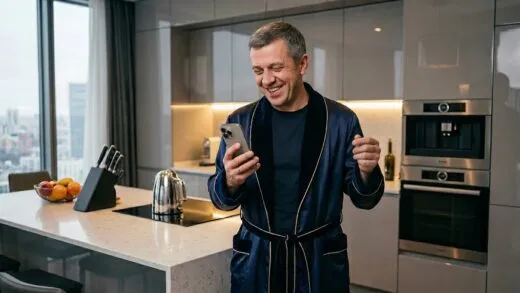
“Because I’m second in command,” Nikita said. “Know your place.”
Alena stepped back from the door, heart pounding. There was something off in Nikita’s voice. Not just anger. Fear.
And in that moment, she understood. The danger wasn’t only outside in the dark. It was inside this house. And she was the only person here who didn’t belong to this world.
Morning light poured into the guest room through the floor-to-ceiling windows. Alena woke with a start, her hand flying to the bandage on her cheek. The nightmare of the night before was real. She sat up, silk sheets twisted around her waist. The silence in the house felt heavier than city noise ever had.
She had to get out. She had to check on her mother. Her mother, Lyubov, lived in a private care facility called Quiet Harbor outside the city, suffering from early-onset dementia. If Alena missed a payment or failed to visit, her mother would panic. Worse, the facility might put her out.
Still wearing her stained waitress uniform, Alena got out of bed, found a thick robe in the closet, and wrapped it around herself like armor. She opened the door carefully. To her surprise, it wasn’t locked.
Then she saw why. At the end of the long hallway, standing like a statue, was Ilya. His tattooed arms were crossed over his chest.
“Breakfast is in the solarium,” he said, nodding left. “And don’t wander.”
“I need my phone,” Alena said. “I need to call my mother.”
“Boss has it. Talk to him.”
Knowing better than to argue, Alena tightened the robe and headed for the solarium.
The room was bright and glass-walled, overlooking a pine forest wrapped in morning fog. Danylo sat alone at a round glass table. He wore a black turtleneck and dark slacks and looked less like a mob boss than a tech billionaire—if not for the 9mm pistol lying next to his coffee cup.
He didn’t look up from his papers when she entered. “There are clean clothes in the guest closet,” he said. “You chose not to use them.”
“I want my life back,” Alena said, stopping at the table. “I want my phone, and I want to go home. I’m not one of your people.”
Only then did he raise his eyes to her. In the morning light, his face looked sharp, rested, and dangerous.
“Sit,” he said.
She hesitated, then pulled out a chair and sat.
“Eat,” he said, gesturing to the breakfast spread.
“I’m not hungry.”
“Adrenaline burns through calories. Eat before you pass out. I need you functioning.” He took a sip of coffee. “I had someone look into you, Alena Lynnyk. State orphanages. Foster homes until eighteen. Three low-paying jobs. A mother in Quiet Harbor. Debt.”
Alena felt a flush of anger. “You had no right to dig through my life.”
“I had every right to know who saved me,” he said evenly.
Then he slid a new black smartphone across the table. It wasn’t hers.
“Your old phone is being checked for trackers. Use this for now. I called the director at Quiet Harbor. Your mother’s care is paid in full for the next year. I told them you were sent away on a long work assignment.”
Alena stared at the phone, speechless. Her anger collapsed into relief and suspicion.
“Why would you do that for me?”