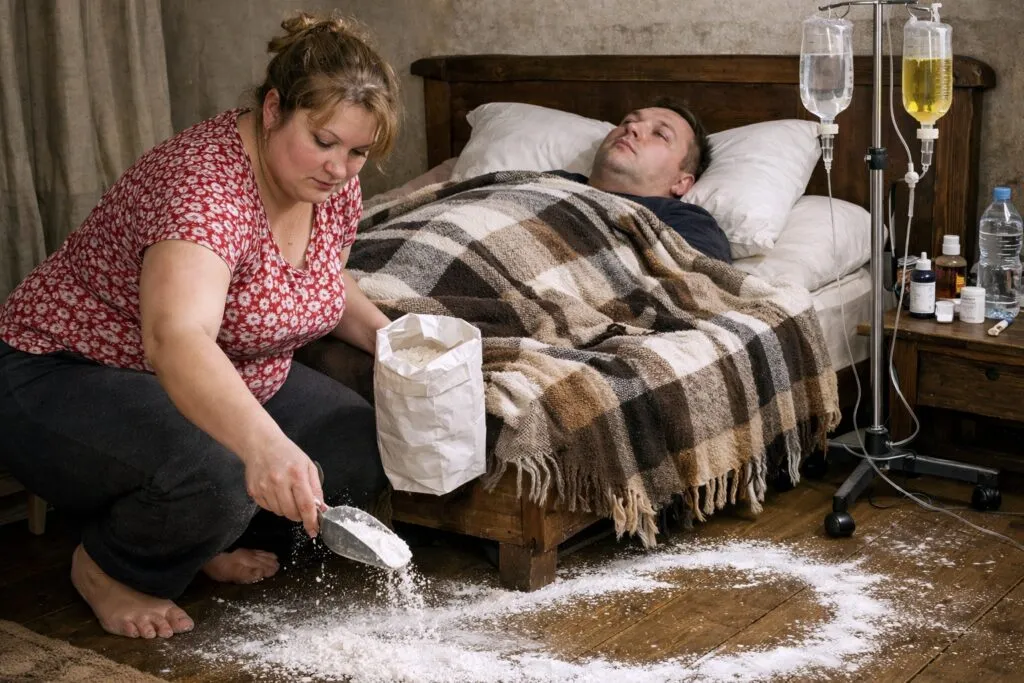
“Sprinkle some flour by his bed and leave for a day,” Tamara whispered after Eleanor once again broke down about her bedridden husband. She said it so quietly it was almost lost in the stairwell, and the look she gave Eleanor was so steady and serious that Eleanor took a step back. “Flour? Why on earth would I do that?” she asked, blinking in confusion.
They were standing on the landing between the second and third floors, and Tamara’s voice bounced softly off the concrete walls. She was a wiry woman in her late sixties, surprisingly brisk and sharp for her age, with keen brown eyes that missed very little. As she tilted her head, there was something in her expression—a mix of sympathy and resolve—that made Eleanor uneasy.
“Just do what I’m telling you, honey. Spread a thin layer of flour by the bed where it won’t be obvious, then go stay somewhere for a day—your mother’s, maybe. When you come back, look at the floor very carefully.”
“But why? I honestly don’t understand,” Eleanor said, her voice fraying. Tamara let out a long breath and rested a dry but steady hand on the younger woman’s shoulder. “You’ll understand when you see it. Or you won’t, if I’m wrong.”
“Then you sweep it up and forget we ever had this conversation.” She paused. “But if I’m right…” She didn’t finish. Eleanor stood there, torn. After the last eight months, she was so worn down that even one more odd thing felt like too much to carry.
Her common-law husband, Owen, had been lying at home ever since a serious workplace injury left him supposedly unable to walk. They’d never gotten around to getting married after six years together, but she had long since thought of him as family. “Severe compression fracture. Long recovery,” the doctors at a private clinic had told her after the ambulance took him away. They warned her he might never be back on his feet.
From that day on, Eleanor had become a shadow of herself. Her life was split between work as a medical assistant at a county clinic, with its endless stream of patients, and home, where helpless Owen waited to be fed, cleaned, and tended to. Their eight-year-old son, Mike, needed her too. And hanging over all of it was a huge loan she’d taken out in her own name to cover Owen’s treatment, since he had no steady job history on paper.
The insurance payments that landed in Owen’s account every month were substantial, but he spent the money on “his own arrangements,” claiming he was saving for a surgery that would finally get him better. Eleanor was running herself into the ground while he lay there issuing one demand after another. “Tamara, do you know something specific?” she asked in a shaky voice on the landing.
“Honey, I spent thirty years in law enforcement. I was a detective. You learn to notice what other people miss.” Tamara straightened. “That’s all I’m saying for now. Just do what I told you. Then we’ll talk.”
Without waiting for an answer, Tamara turned and made her way up to her apartment on the third floor, leaving Eleanor standing there in a fog. The rest of the evening, she couldn’t shake the strange advice. She moved through dinner on autopilot, fed Mike, checked his homework, and finally headed into the bedroom Owen had taken over.
He was lying in the room they’d refitted around his supposed condition. He held the TV remote in one hand and rested on a pricey adjustable medical bed they were still paying off. Bottles of medication lined the nightstand, all prescribed by the same doctor at the private clinic Owen insisted was his only hope.
“Ellie, where’s my dinner?” he snapped the moment she appeared in the doorway. He always called her Ellie, though she preferred her full name. “I’m bringing it now,” Eleanor said quietly.
She looked at him, and for the first time in a long while, something shifted in her chest. Owen did look pale and worn, the way a man might after months in bed. But there was something in his eyes—something evasive—that she suddenly realized she’d either missed or chosen not to see.
“Mike asked again today when you’re going to get better,” she said, setting the tray carefully on the overbed table. “What am I supposed to tell him? The doctors don’t know anything. Maybe I never will,” he replied in a dull voice. But Eleanor caught herself thinking there was none of the real despair you’d expect from a man truly trapped in bed for life.
“Owen, we need to talk about money. The insurance sent more this month than usual,” she began carefully. “Maybe we should use some of it for other expenses.”
“I’ll handle the money,” he cut in sharply. “It’s my insurance and my injury. You don’t need to worry about it.”
“But the loan for your treatment is in my name, and Mike needs new winter boots.”
“Ellie, I said I’ll handle it.” His voice rose, and a cold flash of anger crossed his face. “Not now. My head’s killing me.”
Eleanor sighed and let it go. Over the months, she’d learned not to push. It was easier than listening to his long, bitter speeches about how miserable he was and how she didn’t appreciate what he was going through. She stepped out into the hallway and leaned against the cool wall, feeling her heart beat too fast.
Why did everything suddenly feel off now, after Tamara’s strange warning? “Mom?” Eleanor jumped. Mike was standing beside her in pajamas covered with little cars, clutching a worn stuffed bear.
“What are you doing up, buddy?”