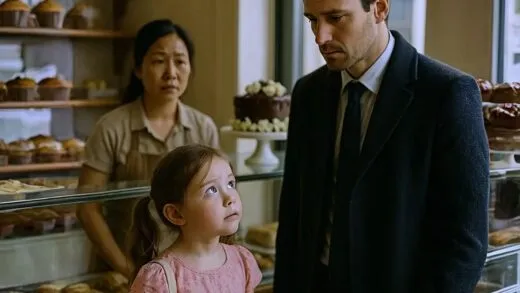

When we returned, I helped her take off her shoes in the hallway. She was already eager to go to her room to change when a motorcycle braked sharply at the gate. My name was called out loudly. I looked out and saw a courier in uniform with a large bag over his shoulder. He reconfirmed my last name, asked if I was Dmitry, and handed me a thick brown envelope with the logo of some law firm on it. No familiar advertising slogans, just a name and a small symbol. My heart sank unpleasantly. Sofya, who was standing behind me, asked who it was. Trying to keep my voice steady, I replied that it was probably some advertisement or junk mail, and asked her to go up to her room, change, and then we would have lunch together. She ran upstairs, and I remained in the hallway, staring at the envelope, which felt unexpectedly heavy.
I went into the living room, sat on the sofa, and placed the envelope on my lap. My fingers were trembling noticeably as I tore open the edge. Inside was a hefty stack of documents, neatly stapled together. I took the top sheet, glanced at the first line, and for a second, I stopped breathing. There, in black and white, it said that this was a petition for divorce. The world seemed to sway, and a ringing started in my ears. I read it again, as if hoping I had made a mistake, but no. In the “plaintiff” field was Marina, and in the “defendant” field was me. What followed was standard legal jargon about how the husband had allegedly completely failed in his marital duties.
A tight knot formed in my stomach. I had given so much of myself to this house, this family. At Marina’s request, I had left my job when her career took off. It was she who had insisted that one of us focus on the home and child. I took care of Sofya, helped with homework, extracurriculars, cleaning, meals—all the little things that create that very comfort she would later boast about to her colleagues. And now, reading each new paragraph of this petition felt like a physical blow. In the document, Marina wasn’t just asking for a divorce. She was demanding that our daughter be left solely with her and that I be stripped of any right to participate in her upbringing. She cited that I was supposedly emotionally unstable, prone to outbursts, and incapable of providing the child with a normal environment. Furthermore, she claimed that all the property, including the house, was bought with her money, that I had not contributed financially, and therefore everything should go to her alone. My legs gave way, and I sank to the cold floor. The papers scattered across the carpet. And only then did the full reality hit me: why she had been so cold in recent months. It wasn’t just an exhausted personality; it was a carefully calculated plan.
At that moment, the door slammed. Marina had returned earlier than usual. She stopped in the living room doorway, looked at me sitting on the floor amidst the scattered papers. Her face showed no surprise, no shame, only a calm, icy assessment of the situation. I managed to force out a question, what all this meant, what these papers were, why she was doing this. My voice trembled as if I had a cold. She took off her heels, placed them neatly aside, and slowly walked over, bending slightly to glance at the title page. She shrugged indifferently and said that it meant exactly what it said: she didn’t want to live with me anymore, that I had supposedly failed as both a husband and a father. I asked again, almost whispering, in disbelief, reminding her that for all these years I had carried the weight of the house and Sofya, given up my own job at her request, managed the entire household. She smirked and asked if I called spending her money “care.” She said that Sofya needed a different father, a normal, successful one, not a useless kitchen crybaby who only knows how to cook and get wet under the tap. I snapped, started shouting, repeating that the house, our things, our daughter were not her personal trophies. That she had no right to take them from me. My voice broke into hysterics. Marina crouched down slightly, so our eyes were on the same level. And for the first time, I saw in her gaze not just irritation, but genuine hatred. Quietly, almost in a whisper that sounded scarier than a scream, she said that she could, and that’s exactly what she was going to do. She added that her lawyer had already prepared all the necessary evidence and that I would get nothing. I would leave this house without a penny, like a stranger who had overstayed his welcome. She straightened up, adjusted her jacket, glanced quickly at the stairs to see if Sofya could hear us, and finally, coldly warned me to prepare for the fact that even our own daughter would testify in court about what a bad father I was, because, according to her lawyer, it was necessary for the case.
When she went to the bedroom, I felt as if I were nailed to the floor. I realized that Marina didn’t just want a divorce. She wanted to destroy me as a man and as a father, to erase me from our daughter’s life.
That night, I barely slept a wink. Marina locked herself in our shared room, and I went into the nursery and sat there until dawn on a chair by Sofya’s bed. I listened to her steady breathing, watched her messy bangs, the soft toys around her, while tears streamed down my face, which I didn’t even try to wipe away. The same thought kept circling in my head: how could Marina possibly dare to tell the court that Sofya would speak against me? What had they managed to put into her head? How could a child who had always been drawn to me be so easily torn away?
In the morning, Marina acted as if the previous evening had never happened. She woke Sofya, picked out her clothes, helped braid her hair, and drove her to the gymnasium herself. She didn’t exchange a single word with me the entire time. When our daughter asked why my eyes were so red, Marina calmly, almost affectionately, replied that Daddy just wasn’t feeling very well, that he was tired. As if she were talking about a slight cold, not the fact that she had just stabbed me in the back.
As soon as they left, I was filled not only with pain but with a panicked fear. I understood that if I did nothing, I would be erased from Sofya’s life by an official court decision. I opened my laptop and started searching the internet for family law attorneys. It quickly became clear that consultations cost a decent amount of money. Everywhere they asked for retainers, fees, payment for each meeting, and I had almost nothing. For years, Marina had given me a neat sum for groceries and child expenses. There was no way to save anything. The only real safety net we had was a joint account, a family reserve for a rainy day. I took out my phone, opened the banking app, entered the password. My heart was pounding in my chest as the page loaded, but instead of the expected amount, I saw a word that made my legs weak. It said zero. The account was empty. I refreshed the page several times, hoping for a glitch, but the zero didn’t disappear, like a black stain on a white sheet. That account was supposed to hold the savings from Marina’s many years of work; there should have been several million. I opened the transaction history and saw how, over the last few months, she had been regularly withdrawing large sums and transferring them to some other account I had never even heard of. The last transfer was made just a few days before the envelope with the lawsuit arrived. Marina wasn’t just leaving; she had left, having first deprived me of any chance to defend myself.
I sat in front of the screen, staring at that foreign, icy word about the empty account. And only after some time did it dawn on me that besides this, we had almost no cash in the house. I jumped up as if I’d been jolted. I went to the kitchen, opened the drawer under the countertop where we used to keep money for large purchases, for unexpected expenses. There was only a lone checkbook and a couple of old receipts. No folded bills, no neat stack that I had considered our family reserve for so many years. Almost without thinking, I went to the wardrobe in the bedroom, checked the box from under my winter boots where I kept a little cash I had saved from time-to-time by helping a neighbor with his small tire-fitting business. But that was empty too. The box was neatly folded and put away, as if it had been deliberately placed back after the most important thing was taken. I sat on the edge of the bed, my hands dropping between my knees, and for the first time in a long while, I felt not just hurt, but a raw, cold fear. Fear not of being left alone, but of truly being left without a penny and without a single legal tool to protect myself and my right to my child.
I dialed Marina’s number. My finger trembled on the screen. It rang for a long time, then the call dropped. I dialed again, and again. At some point, the phone gave a short, dry signal, and a message came through, short as a punch, in which she wrote that all questions were now to be handled through her lawyer, that personal calls would be considered pressure and an attempt to interfere. Below was the neatly listed number and email of a person named Chernov. Another name that would later be seared into my memory. I put the phone on the nightstand, walked into the living room, and just sat on the floor, leaning my back against the sofa like a child. And I sat in that position for some time, until the thoughts in my head, instead of chaotically racing as usual, suddenly began to order themselves. I understood a simple thing that I had refused to admit before: Marina had been preparing for this not for a day or a week. She had long been constructing a legal and financial picture to make me look like a helpless freeloader on paper, and her the sole breadwinner and reasonable party who had everything under control. I could sit and cry all I wanted, but that wouldn’t change anything. I got up, wiped my face with my sleeve, sat back down at the laptop, and started searching not just for articles about divorce, but specifically for family law attorneys in the city. I read one ad after another, where cheerful faces in expensive suits promised to win any case. But almost everywhere, the first line was about fees, retainers, hourly consultation rates. Sums that seemed insurmountable to me in my current situation. The same thought pounded in my head: without a lawyer, they would tear me apart; with a lawyer, I had no way to pay him.
I remembered Andrey, an old acquaintance from my previous job, the one I used to sit with at the same desk in the office until Marina convinced me it would be better for the family if I left and focused on the house and child. Andrey was always known for being able to connect with the right people, while still remaining a decent human being. I dialed his number, preparing to hear an irritated “I’m at work,” but he answered almost immediately. I tried to speak calmly, but my voice still trembled as I briefly described what was happening, said I urgently needed a good family lawyer, and had almost no money. There was a pause on the other end, and then Andrey said in his usual, slightly hoarse voice that he had a lawyer friend, not the most brilliant according to advertisements, but very stubborn and, most importantly now, honest. He warned me that he didn’t work for free, but sometimes made exceptions if he saw someone was being genuinely screwed over. He dictated the address of a small office not far from the center, the last name—Kharlamov—and added that if this man took on a case, he fought to the end, even when everyone else gave up. I thanked him, promised to explain the drama of my life in more detail sometime, and a minute later I was standing in the hallway with my jacket in my hands. Then I remembered I had to pick up Sofya soon, checked the time, figured I had enough time to at least go and meet him, and then I’d head to the gymnasium.
Kharlamov’s office was on the ground floor of an old, now-renovated brick building, but it still had those same creaky steps and a heavy door you had to push with your shoulder. Inside, it wasn’t like the glossy offices pictured on websites. Instead of glass partitions and expensive furniture, there were simple desks and a tall shelf with folders and books. A few modest diplomas hung on the wall in simple frames, and in the corner stood an old but well-dusted leather sofa, on which many people had clearly weathered difficult moments in their lives. A short man in his fifties with graying temples and attentive eyes sat at a desk by the window. He looked up when I entered and asked if I had an appointment. I honestly admitted that I hadn’t had time to call, that the situation was urgent. He glanced at the clock, sighed, and, to my surprise, offered me a seat, saying that his client was running late and he had a little time. I sat down opposite him, placed that same thick envelope with the copy of the lawsuit on the table, which still felt like it was burning my hands, and managed only to squeeze out that it seemed they were planning to take not only my home but also my daughter from me…