
The room fell silent. The other bikers watched, visibly surprised at her simple act of kindness. For a moment, the palpable tension in the room eased. Agnes didn’t smile, but her eyes softened. She had invited the storm inside her home, and strangely, it began to feel less threatening. It felt like maybe, just maybe, there was humanity hidden under all that leather and reputation.
Agnes moved carefully, her slippers sliding across the wooden floorboards as she poured hot water into the mismatched mugs. The kettle hissed, filling the room with steam. The bikers stood awkwardly, their massive frames shrinking within the coziness of her tiny farmhouse. One man ducked his head to avoid hitting a low ceiling beam; another rubbed his hands together vigorously, like a young boy just back from sledding.
Agnes caught herself staring. These men, painted by the world as monsters, suddenly looked oddly human—cold, tired, and almost lost.
Jack cleared his throat. “We’ll pay you, ma’am. Food, heat, whatever you’ve got. We’re not freeloaders.”
Agnes set the mugs down on the coffee table and shook her head firmly. “You don’t owe me a dime. Just don’t break anything.”
The men chuckled quietly, the tension lifting just another inch. When one of them sipped the tea and winced at its bitterness, Agnes allowed herself the smallest ghost of a smile. For the first time that night, she began to breathe easily.
The storm continued to howl outside, rattling the shutters against the siding. Agnes sat in her worn armchair, knitting needles in hand, though she barely touched the yarn. The bikers stretched out on the floor, boots unlaced, jackets hung to dry. Some closed their eyes, while others whispered stories only they could hear.
Jack sat near the fire, his gaze fixed on the dancing flames. After a long silence, he spoke.
“You remind me of my grandmother,” he said softly, surprising everyone in the room, perhaps even himself. “She used to scold me just like you did out there.”
Agnes tilted her head, her eyes narrowing with curiosity. “What happened to her?”
Jack’s jaw tightened. “Cancer. A long time ago.” His voice cracked slightly, but he hid it quickly, staring harder into the fire.
Agnes’s heart softened. She recognized grief; it was a companion that lived inside her, too. For a moment, the labels of “outlaw” and “old lady” vanished. It was just two souls, scarred by loss, sitting in the glow of a fire while snow buried the world outside.
Later that night, the farmhouse hummed with an unexpected rhythm. One biker carefully tuned a broken guitar he carried with him, strumming chords that filled the silence with melody. Another dozed, his head tilted back against the couch. Agnes brought out a pot of stew she had stretched from potatoes and beans.
“It’s not much,” she said, placing it on the table.
The men rose quickly, almost reverently, as if she had presented them with a royal feast. They filled their bowls, steam fogging the air, and muttered their sincere thanks. Agnes ate too, slowly, watching them with wary but observant eyes. She noticed something important: they laughed, not cruelly, but warmly. Their jokes carried no malice. When one man dropped his spoon, another clapped his shoulder and teased him like a brother.
Agnes thought of the townsfolk who whispered about these men, painting them as demons. But here they were, chewing potatoes, blowing on hot stew, and laughing like boys who had found shelter in the middle of nowhere.
As midnight approached, the storm only grew wilder. Snow pounded the roof, and the wind screamed against the walls. The lights flickered once, threatening to die, then held. Agnes prayed silently that they would last. She glanced at the men sprawled across her rugs, some already asleep, others whispering low.
One man, barely in his twenties, caught her eye. His name was Luke. He had tattoos up both arms, but his face was young, almost boyish.
“Thank you,” he said, his voice nearly lost under the noise of the storm. “Most people see this patch”—he touched the emblem on his jacket—”and slam doors in our face. You opened yours.”
Agnes’s throat tightened. She wanted to reply, but found only silence. Instead, she reached over and tucked an extra quilt around him. Luke’s eyes glistened, and he looked away quickly, embarrassed by the emotion. Agnes sat back, knitting needles in her lap, her mind turning over the events. Perhaps the world was too quick to fear what it didn’t understand. Perhaps she had been, too.
Sleep came slowly. Agnes lay in her bed, listening to the muffled snores and shifting boots downstairs. She thought of James again, of how proud he would be that she had chosen compassion over fear. Yet, doubt still pricked her. What if she had been wrong? What if morning brought regret? She drifted into restless dreams, only to wake at dawn to the sound of engines.
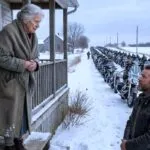
At first, her heart dropped. Had they betrayed her trust? She rushed to the window, pulling back the curtain. The snow had finally stopped, and the fifteen bikers were pushing their motorcycles down the drive, trying not to wake her as they prepared to leave.
Jack noticed her at the window. He raised a hand in silent thanks. No words, no promises, just gratitude etched across his weathered face. Agnes’s eyes filled with unexpected tears. She had let strangers into her home, and instead of chaos, they had left her with a gift she hadn’t felt in years—belonging.
The morning sun spilled across the white fields, glistening against the untouched snow. Agnes moved slowly down her steps, her boots crunching on the ice. The bikers were lined up, brushing snow off their machines, preparing for the long road ahead.
Jack walked toward her, helmet in hand. “We owe you,” he said firmly. “More than we can repay.”
Agnes waved her hand as if brushing away the thought. “You don’t owe me anything, Jack. Just stay warm, and try to remember someone’s grandmother once gave you stew.”
For the first time, Jack grinned. It wasn’t a cruel grin, but one of genuine warmth. “You’re tougher than you look, Agnes Porter,” he said.
With that, the men mounted their bikes. One by one, the engines roared to life, echoing across the valley. Agnes stood at her porch, small against the horizon, watching them disappear into the distance. She thought it was over, but what she didn’t know was that this night would travel far beyond her farmhouse.
Later that day, Agnes ventured into town for flour and kerosene. The storm had broken, but the roads were heavy with slush. As she entered Miller’s General Store, the familiar creak of the wooden door announced her arrival. Conversations stopped instantly. People stared. Whispers rippled through the aisles. Agnes felt the shift immediately. She kept her chin high, choosing her items with deliberate calm.
But the store owner, Mr. Miller, leaned across the counter, lowering his voice. “Agnes, word’s going around. Folks say the Night Nomads stayed at your place last night.” His tone carried accusation, not concern.
Agnes’s eyes narrowed. “Yes,” she said plainly. “They were caught in the storm. They needed shelter.”
A woman near the flower sacks gasped audibly. “You let them inside your home? Agnes, they’re criminals.”
Another man muttered, shaking his head. “Reckless, that’s what it is.”
Agnes’s cheeks flushed, but she didn’t flinch. “Reckless would have been leaving them to die,” she said firmly.
The room went silent. For the first time, Agnes realized her act of kindness had become a public scandal. The gossip spread faster than the snow melted. By evening, Agnes could hear whispers even at church, eyes glancing her way with quiet judgment. To some, she was foolish. To others, she was dangerous—an old woman who had invited wolves into her home.
That night, her neighbor, Ruth Coleman, stopped by, clutching her shawl tightly around herself. “Agnes,” she said, disapproval dripping from her voice. “I’ve always admired you, but this? Letting them sleep under your roof? What if they’d hurt you?”
Agnes poured her a cup of tea and sat opposite her. “They didn’t hurt me,” she said simply. “They were cold and they were men. Men with mothers once, men with children perhaps. I couldn’t turn them away.”
Ruth’s lips thinned. “People won’t see it that way.”
Agnes sighed. She looked out the window at the frozen fields, whispering mostly to herself. “Maybe people need to see differently.” Ruth shook her head, unconvinced, and left. Agnes knew a storm had only just begun, and this time, it wasn’t the weather.