
 Let’s Keep It Real

A young nurse was caring for a wealthy man in a coma, but when he suddenly woke up, something extraordinary happened. The fluorescent lights in a private clinic in suburban Chicago hummed softly as Anna walked down the spotless white hallways. She had worked there as a nurse for nearly two years, but today felt different. The moment she got an unexpected call to Dr. Harrison’s office, the head of neurology, a strange uneasiness settled in her chest. Had she done something wrong, or was she being transferred to another unit?
She took a deep breath before knocking on the polished oak door. When she heard him tell her to come in, she stepped across the threshold and saw Dr. Harrison standing by the window. His hands were clasped behind his back, and his usually sharp gaze was fixed on the skyline outside. The office smelled faintly of antiseptic and expensive leather, and the mood felt heavier than usual. At last, the doctor turned toward her and said her name.
His voice was steady and serious. He told her they had a patient who needed special care, but it was not an assignment for the faint of heart. Anna frowned at that. She carefully asked who the patient was and why the job would be so difficult. Dr. Harrison studied her for a moment, then pointed to the thick medical file on his desk.
He gave her the name — Grant Bennett. Anna caught her breath, because this was that Grant Bennett, the one everybody knew. Even if she had not recognized the name right away, the folder made it plain enough, with a black-and-white newspaper clipping about a serious car crash. A year earlier, one of the city’s youngest billionaires had been in a devastating accident. His sports car had gone off a bridge late at night, and he had been in a coma ever since.
His name had once been everywhere. Grant Bennett was the hard-driving, untouchable CEO of a major corporation. A man who had built an empire by age thirty-two was now trapped inside his own body. Dr. Harrison went on to explain that family members visited only rarely. Most of the staff handled his care out of duty, but Grant needed someone truly committed.
He needed someone who would genuinely care what happened to him. Anna bit her lip, catching the hesitation in the doctor’s voice. She asked why he thought she was the right person for that role. Dr. Harrison gave a small nod. Anna slowly exhaled, taking in the weight of what he was asking.
It was an intimidating assignment — caring for a man who might never wake up. A man whose money and influence had once shaped the lives of thousands of people. But deep down, she already knew her answer before she said it. She agreed to take on the responsibility. Dr. Harrison’s mouth tightened into a thin line, but there was approval in his eyes, and he told her her shift would begin that evening.
The private suite on the top floor of the hospital felt unnervingly quiet when Anna stepped inside. Unlike the cold sterility of the other rooms, this one had been furnished with understated luxury. The spacious layout, the soft chandelier light, the dark oak furniture — everything reflected the patient’s status. And at the center of it all lay Grant Bennett. Anna caught her breath as she looked at him closely.
Even with the tubes, the life-support equipment, and the stillness of his body, he was strikingly handsome. A strong jawline, dark lashes against pale skin, broad shoulders visible beneath the hospital gown. If not for the complete lack of movement, he could have passed for someone simply asleep. But this was no ordinary sleep. This man was suspended in a silence that seemed endless. Anna swallowed and stepped closer, adjusting his IV.
She picked up the warm washcloth prepared for him and hesitated for a second before gently touching his skin. The moment she did, a strange chill ran down her back, one she could not explain. It felt as though he sensed her presence, as if somewhere deep inside that unconscious state, he understood more than anyone knew. The quiet, steady rhythm of the heart monitor filled the room. Anna pushed the feeling aside and continued her work.
She carefully washed his arms and chest, making sure his body stayed clean and well cared for. Under her breath, she joked that he did not exactly get a vote in the matter. The only answer was silence, and she took that as consent. A faint smile touched her lips despite the seriousness of the situation. Little by little, the days settled into routine.
Every morning and every evening, Anna washed him, changed the bedding, and checked his vitals. But before long, it stopped feeling like routine nursing care. She caught herself talking to him, telling him stories about her day and about the world outside his window. She complained about the cafeteria food, joking that even a billionaire probably would not survive it. When no answer came, she wondered out loud why she kept talking to him at all.
Anna figured maybe she just liked the sound of her own voice, or maybe he really could hear her. The heart monitor kept up its steady rhythm, almost as if it were answering back. And maybe, in its own way, it was. She hummed softly as she dipped a clean cloth into warm water. After all these weeks, she had grown used to the sterile quiet of the elegant room.
The steady beep of the monitor and the faint hum of the IV pump had become familiar background noise. She leaned over the bed, gently wiping Grant’s face with careful, practiced motions. She had read that some coma patients could still hear what was being said around them. So she teased that he was the worst listener she had ever met. When he gave no reaction, she sighed and shook her head.
Anna told herself she was already used to talking to herself. She moved down to his jawline when suddenly she noticed the slightest movement and held her breath. She thought she must have imagined it, and she froze, staring at his hand. But nothing happened. His fingers lay still on the crisp white sheet. She gave a quiet laugh and told herself she was the one who needed a hospital bed if this kept up.
Still, the uneasy feeling stayed with her, and over the next few days it happened again. The second time, she was adjusting his pillow and not even looking at him when she felt it. A faint pressure against her wrist. Her head snapped down, and she saw that Grant’s hand had shifted. Just a fraction of an inch, but enough to turn her stomach over.
She whispered his name before she even realized she was doing it. The same steady monitor answered her. She placed her hand over his, feeling warmth, stillness, and the possibility of movement all at once. Nothing else happened, and again she wondered if she had imagined it. Unable to let it go, Anna reported everything to Dr. Harrison.
The doctor raised an eyebrow skeptically and asked her to describe the movement again. Anna admitted that at first she thought it was wishful thinking, but it kept happening. His fingers twitched, his hand shifted slightly — the movements were subtle, but they were there. Dr. Harrison leaned back in his chair, thinking it over. He promised to run tests, though he warned her not to get her hopes up too high.
He suggested it could be nothing more than reflexive muscle activity. Anna nodded, but deep down she did not believe that was all it was. She felt something important was happening. When the test results came back, she was not surprised. The doctor reported increased brain activity and stronger neurological responses. Anna’s heart lifted at the thought that he might be waking up.
Dr. Harrison was more cautious, saying it could mean a number of things, though it was certainly encouraging. It was not the answer she wanted, but it was enough. That night, sitting beside Grant’s bed, Anna talked to him more than usual. Quietly, she admitted that she felt he could hear her, even if she could not prove it. She looked at his still face, with its strong, steady features.
For the first time, she felt as though she was not alone in the room. So she kept talking — about her day, about the patients who frustrated her. She mentioned the rude doctor on the third floor who always walked off with her coffee. Anna told him about her childhood, about the small Midwestern town where she had grown up, and about her longtime dream of becoming a nurse. And while she spoke, she had no idea that somewhere inside the silence of his coma, Grant was listening to every word.
Morning sunlight streamed through the large windows of Grant Bennett’s room, casting a warm glow over his motionless figure. The beep of the heart monitor filled the silence, steady and unchanged, just as it had for the past year. Anna stood beside the bed, rolling up her sleeves before another routine procedure. It was one more day of care and conversation with a man who might never answer her. She dipped the warm cloth into the basin, wrung it out, and began gently washing his chest.
Her movements were careful and practiced. With a faint smile, she murmured that she was thinking about getting a dog, just so somebody would listen to her instead of lying there ignoring her all day. The room stayed quiet, and she sighed, deciding the joke had not exactly landed. She reached for his hand, running the damp cloth over his skin, and her fingers brushed his wrist. In that instant, his hand closed around her wrist, and Anna froze.
Her breath caught as she stared at his hand. The pressure was gentle, weak, uncertain — but unmistakably real. Her heart pounded so hard she could hear it in her ears. She wanted to believe this was not another reflex or random twitch. And it was not, because then Grant’s eyes opened.
For a moment, Anna could not move, breathe, or think. For months she had looked at those closed eyelids, waiting for the smallest sign of life. And now those deep blue eyes were looking straight at her. There was confusion in them, and vulnerability, but they were alive. Grant’s dry lips parted, and he let out a hoarse, barely audible whisper.
His voice was faint, but he asked who was there. Anna’s whole body tensed, her knees nearly giving way, her breathing caught somewhere between disbelief and pure alarm. He had spoken. He was awake. The impossible had happened. She barely noticed the basin slipping from her hands and water splashing across the spotless floor as she stepped back. Instinct took over. She turned and hit the emergency call button on the wall.
The alarm sounded down the hallway. Within seconds, the door flew open and a team of doctors and nurses rushed in, led by Dr. Harrison. He immediately demanded to know what had happened as he moved to the bedside to check the monitors. In a shaking voice, Anna said the patient had grabbed her hand and opened his eyes. She looked back at Grant, still hardly believing what she was seeing.
His chest rose unevenly as his eyes moved around the room, as if he were trying to understand where he was. He was not fully aware yet, but he was back. Dr. Harrison’s expression shifted from shock to focus, and he ordered the neurology team in right away. Nurses moved quickly, their voices overlapping in disbelief as they rushed through the necessary tests. The room turned into a blur of motion, but Anna could not take her eyes off Grant.
Then, as if he felt her looking at him, his eyes found hers again, and this time he did not look away. Everything was happening fast: doctors asked questions, shined lights in his pupils, checked motor function. But through all the commotion, Grant’s gaze kept returning to Anna. She hesitated, then stepped forward, swallowing hard. Quietly, she said his name and asked if he remembered anything.
He looked at her and blinked slowly, and a long silence settled between them. Then his fingers moved again, and before she could react, he reached for her hand. Weakly, slowly, but with purpose, his hand closed around hers. The grip was fragile but steady, as if some part of him had known her all along. Anna caught her breath, and Dr. Harrison looked up sharply.
The doctor asked Grant if he knew who she was. Grant did not answer right away. His brow furrowed, and his eyes stayed on Anna. In a voice made rough by months of silence, he said he did not know her, but he felt like he should. A chill ran down Anna’s back. Even if Grant Bennett did not remember her consciously, something deep inside him recognized her presence.
The days after Grant’s remarkable awakening were filled with tests, therapy, and endless questions. The doctors were stunned by how quickly he improved. Physically, he was weak, but his condition got better fast. Muscles that had stiffened during a year of immobility slowly regained strength through rehabilitation. But emotionally, things were more complicated, because Grant had no memory at all of the accident itself.
The more the doctors pressed him for details, the more frustrated he became. During one session, Dr. Harrison suggested he try to recall the last events before the crash. Grant rubbed his temples, his face tight with strain. He admitted he did not know where he had been or what he had been doing. He let out a sharp breath and said all he had were fragments and flashes.
The doctor asked him to describe those flashes, and after a long pause Grant closed his eyes and frowned. His voice was slow and uncertain as he described a feeling that something was wrong, that he was in danger. Anna, standing quietly off to the side, tensed. Grant went on, clenching his fingers as he remembered the road, headlights, and then complete darkness. Dr. Harrison sighed and explained that trauma victims often block painful memories.
He said the memory might return on its own, but for now Grant needed to focus on recovery. Grant nodded, but Anna noticed the frustration in his clenched jaw. Deep down, she could not shake the feeling that something about the whole story was off. That same night, unable to stop thinking about it, Anna went to the hospital records office. She had read Grant’s file before, but now she studied every detail with fresh eyes.
That was when she noticed what she had missed earlier. The accident reconstruction report stated that Grant’s brakes had failed. They had not simply worn out or broken down — they had been tampered with. A cold feeling ran through her as she realized this had not been a random crash. Someone had deliberately tried to cause that accident, and Grant did not even know it yet.
Taking a shaky breath, she closed the file. She had to tell him the truth. If someone had tried to hurt him once, that person might try again. Grant’s recovery moved ahead at a remarkable pace. In just a few weeks, he went from being bedridden to sitting up, feeding himself, and speaking in full sentences.
Now, with physical therapy, he was learning to walk again, and through it all Anna stayed by his side. Every step, every setback, every moment when he wanted to quit — she was there. Grant muttered that he could not do it, gripping the parallel bars as he tried to pull himself upright. Anna answered firmly from beside him that he had already come too far to stop now. He turned toward her, breathing hard, and saw real conviction in her eyes.
She was not just saying the right thing to keep him going. She truly believed in him, and that made him start believing in himself. With a determined breath, he took another step. Anna’s face lit up, and she praised him for it. For the first time since waking up, Grant smiled — not out of politeness or obligation, but because for the first time he felt alive again. And he knew exactly who he had to thank for that.
Anna was not like the other people in his world. She did not treat him like a charity case, and she did not see him as a billionaire stuck in a hospital bed. She saw him as Grant, a person. That was why he felt himself drawn to her in a way he could not ignore. When she was in the room, the world seemed a little brighter.
Her voice pulled him out of the darkness that still lingered in his mind. And every time she touched him — adjusting his pillow or steadying him as he walked — a warmth spread through him that he could not explain. One evening, after an especially long therapy session, Anna suggested they take a walk in the hospital garden. With a small smile, she said some fresh air might do him good, and Grant agreed. He had not expected how different everything would feel outside the hospital walls.
The cool evening air, the rustle of the trees, the moonlight laying a soft glow over everything. For the first time, he felt like an ordinary man again. Not a patient, not a mystery with missing memories, just himself. And beside him walked Anna, holding his hand to steady him. At first, Grant assumed it was simply part of her job, but then he began to notice the details.
He saw how her fingers lingered at his wrist, how she looked at him when she thought he was not paying attention. He heard the slight catch in her breathing when he stepped a little too close. And all at once, he realized she felt it too — that pull between them, that unspoken connection. They stopped near a small stone bench, where moonlight cast long shadows across the garden path. Grant turned toward her, and his heart began to beat faster for an entirely different reason.
Anna opened her mouth to say something, but before she could, Grant took her hand. Her lips parted in surprise, and her eyes searched his face. Lowering his voice, he told her that he did not remember anything about his life before the coma, but there was one thing he knew for sure. Anna swallowed and quietly asked what that was. He tightened his hold on her fingers and said he trusted her.
The words were simple, but to him they meant everything. And judging by the way Anna caught her breath, by the color rising in her cheeks in the moonlight, she understood exactly what he meant. She did not pull away. For now, that was more than enough. The night was restless. Grant shifted in his hospital bed. His body was still weak, but his thoughts raced until suddenly a memory broke through, like a dam giving way.
The road was dark, rain hammered the windshield, and the wipers could barely keep up. Grant gripped the steering wheel, his mind still clouded after the meeting he had just left. He had a strong sense that something was wrong, and then, out of nowhere, bright headlights appeared. A black SUV came straight into his lane at full speed. Grant jerked the wheel, the tires skidding on the wet pavement, and the brakes did nothing at all.
His heart pounded as he fought desperately to regain control of the car. A second before impact, he glanced toward the shoulder and saw the dark outline of a man simply standing there, watching. Then everything went black. Grant’s eyes flew open, his breathing coming in short, uneven bursts. His pulse raced, and cold sweat covered his skin as the memory hit with brutal clarity.
Now he knew the truth — this had not been an accident. Someone had arranged it. Anna knew something was wrong the moment she walked into his room the next morning. He had changed. His usual half-smile was gone, his body was tense, and his hands were clenched into fists. She carefully asked Grant what had happened. His sharp blue eyes met hers with a new and unsettling intensity.
He told her he remembered the crash, and Anna’s heart dropped. He gave a hard nod and said someone had deliberately sabotaged his brakes. Grant added that a man had stood on the side of the road and watched his car go down. A chill went through Anna. Everything she had suspected had just been confirmed. But the biggest questions were still unanswered: who had done it, and why?
Over the next several days, Anna and Grant started digging for information. They went through his records, company financial reports, and anything else that might point to someone who wanted him harmed. Eventually, they found a lead — a large wire transfer made just days before the crash. The money had gone to a man known for arranging criminal setups. And the sender was Michael Bennett, Grant’s half brother.
The realization hit them hard. Grant said under his breath, gripping the edge of the desk, that his own brother had done it. Michael had always resented him, always felt overshadowed by the brother who inherited their father’s business empire. And now he had decided to remove Grant from the picture for good. Anna’s heart tightened as she said aloud that Michael had wanted him gone. Jaw set, Grant said he would make sure his brother answered for it.
That same evening, Grant and Anna arranged to confront Michael face to face. In the dimly lit study of the Bennett family estate, Michael lounged in a leather chair, slowly turning a glass of whiskey in his hand. When they walked in, he smirked and greeted his brother with a cutting remark about his return. Grant’s eyes were hard with anger as he asked Michael directly why he had done it. Michael took a slow sip and said Grant already knew the answer.
Anna stepped forward and told him he had gone after his own brother for money and control. Michael’s smirk disappeared, and he said coldly that he had done it for what should have been his in the first place. He let years of resentment spill out, calling Grant the golden child, the heir who had everything handed to him. Michael admitted he was tired of waiting his turn. Grant’s hands tightened into fists as he asked about the sabotage of the car.
Michael gave a short, humorless laugh and admitted he had not expected his brother to survive, but figured miracles happened. Anger rose in Anna, but before she could speak, the door opened. Two uniformed police officers stepped into the room, and Michael’s face went pale at once. One officer announced that Michael Bennett was under arrest on charges related to a planned criminal act resulting in severe bodily harm. Michael turned toward Grant in panic, accusing him of setting him up.
Grant tilted his head slightly and answered in an even voice that Michael had set himself up. Michael was led away in handcuffs, shouting empty threats as he went. When the door shut behind him, a heavy silence settled over the room. Grant finally let out a breath, and for the first time since waking up, his shoulders relaxed. Justice had been done, and he was finally free.
The Bennett estate had always felt grand, imposing, and cold — a fortress of wealth built over generations of power. But that evening, when Anna walked into the softly lit dining room, everything felt different: warmer, more welcoming. Candlelight flickered across the elegantly set table by the tall windows overlooking the evening lights of the city. The air carried the scent of fresh roses, and a bottle of wine chilled beside two perfectly arranged place settings. Anna caught her breath and asked Grant what all this was for.
Grant stood behind her with his hands in his pockets, his blue eyes soft but steady. He simply said it was dinner for the two of them. Anna’s heart tightened with emotion. The past few weeks had been a whirlwind: his recovery, the truth about his brother, everything that followed. But now that the storm had finally passed, there was only this quiet moment.
And somehow that made it feel even more overwhelming. When they sat down, Anna could not help noticing the way Grant looked at her. It was as if he were memorizing every detail of her face, as though she were something fragile and deeply precious. With a faint teasing smile, she pointed out that he was being unusually quiet. Grant exhaled and turned his wineglass in his hand, admitting he had been thinking.
She joked that this was probably dangerous, but he did not laugh. Instead, he leaned forward, and his gaze held hers. He asked Anna if she knew how many people had turned away from him while he was in the coma. Her smile faded, because she had seen it herself — relatives who treated him like a burden, so-called friends who had simply moved on. The only reason he had made it through that darkness was because one person stayed.
And that person was her. Grant said quietly that Anna had been there day after day, caring for him when he could not even open his eyes. To everyone else, he had been a hopeless case, but she had refused to give up on him. Anna felt a lump rise in her throat, because she had never thought of it that way. She had only done what she believed was right. But to Grant, it had meant everything.
He leaned a little closer, his fingers brushing her hand on the table. Gently but firmly, he told her he had everything — money, influence, power — but none of it meant much without her. Anna caught her breath again as Grant asked her to let him finish. His hand closed around hers, and his thumb moved slowly, tenderly across her skin.
He admitted he did not know exactly how or when it had started, but he was sure of one thing. Every moment he had been trapped in that coma, she had been the one keeping him tethered to life, the light in the dark. Tears filled Anna’s eyes as he told her he loved her. The words hit her hard, stealing her breath, because hearing them from him meant more than she could put into words. A man who had once lived by cold calculations and business deals was now speaking to her with complete honesty.
For the first time in her life, Anna felt truly, deeply loved and valued. Tears slipped down her cheeks, but through them came a happy smile. In a whisper, she told him he had no idea how much that meant to her. Grant gently brushed a tear from her face and promised he would spend his life showing her. When he leaned in and rested his forehead against hers, Anna understood this was only the beginning of their life together.
Months passed after the night Grant confessed his feelings to Anna. In that time, everything changed. Grant recovered fully, regaining his strength through hard work and rehabilitation. His body was no longer limited by the weakness left behind by the crash. Now he was once again Grant Bennett, standing at the head of his corporation. He returned to the boardroom with the confidence of a man who had been through hell and made it back.
But there was one important difference between the man he had been and the man he was now. This time, he was not alone. Anna was beside him. And very soon, if she said yes, she would be beside him for good. The rooftop terrace of the Bennett estate glowed in the soft light of sunset, the skyline washed in warm gold. Anna stood at the edge, taking in the view, with no idea what was about to happen.
She said quietly that it was beautiful up there as the breeze played with her hair. Standing behind her, Grant smiled and said the view had competition. She turned to him and rolled her eyes with a playful look, lightly grading the compliment. But her smile faded when she saw his expression. There was something deep, steady, and certain in his eyes.
Before she could ask what was going on, he took a deep breath and reached into his jacket pocket. Anna’s breath caught, and she covered her mouth in surprise. Grant opened a small velvet box, revealing a stunning engagement ring — an elegant diamond set in a slim platinum band. But it was not the ring that left her speechless. It was the man standing in front of her. His voice shook slightly as he told her she had not just saved his life — she had become his life.
Her heart pounded as she listened to him speak with complete sincerity. He said that before meeting her, he had everything except the one thing that mattered most — her. Tears rose in her eyes as he told her she was the reason he had fought to live and found himself again. Now he wanted to spend the rest of his days proving how much she meant to him. Without looking away, he held out the ring and asked Anna Taylor if she would marry him.
The world seemed to go still, and Anna could hardly speak or breathe through the rush of emotion. All she could do at first was nod through tears and laughter at the same time. Finally, in a trembling voice, she said yes — more than once. Grant let out a long breath of relief, slid the ring onto her finger, and pulled her into his arms, into his world, for good. They kissed in the fading light of sunset, and Anna knew without question that this was where she belonged.
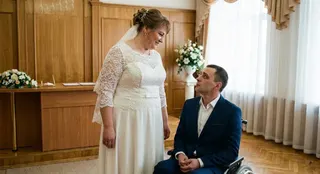
The Bennett estate had never looked more beautiful than it did on their wedding day. The grounds had been transformed into something out of a storybook: white roses lined the walkways, and twinkling lights glowed in the old oak trees. Soft music played in the background as guests gathered in quiet admiration. Anna stood at the entrance in an elegant white gown, her heart fluttering with happiness. Her bridesmaid Lisa leaned in and quietly asked if she was ready.
Anna took a deep breath, tightened her grip on the bouquet, then looked up and saw him. Grant stood at the altar in a classic black tuxedo, looking at her as if she were the only person in the world. Every trace of nerves disappeared, and she stepped forward with confidence. Each step brought her closer to forever with the man she loved. When she finally reached him, Grant took her hands, his eyes shining with open, genuine love.
They spoke their vows, sealing promises built not just on words, but on a bond forged through everything they had endured together. The officiant pronounced them husband and wife to the joyful cheers of their guests. Grant gently cupped her face in his hands and kissed her with a sincerity that said more than words ever could. And while the whole world seemed to celebrate around them, Anna realized this was not the end of their story. It was only the beginning.
As the sun began to set, Grant and Anna slipped away from the guests for a few quiet minutes. They walked hand in hand through the garden, taking in the reality of their new life together. There were no more hospitals, no more loneliness, no more pain — just the two of them, together for good. Grant gave her hand a gentle squeeze and said that before meeting her, he had thought he already had everything. Anna smiled, resting her head against his shoulder, and asked him what he thought now.
He looked at her with a soft, devoted, deeply loving expression. Grant said that now he knew the truth: none of what he had before really mattered, because she was the best thing that had ever happened to him. Anna blinked back tears, deeply moved by his words. As they walked forward in the golden light of sunset, she understood that they had made it through storms, darkness, and hardship, and in the end, love had won. And with Grant beside her, Anna had finally found home.






Share how the story made you feel
0Comments appear after a quick automatic check. Please no links, ads or personal data.
Next to your name we show your country, determined from your IP address; the address itself is never shown, and only a hashed fingerprint of it is kept to stop spam.