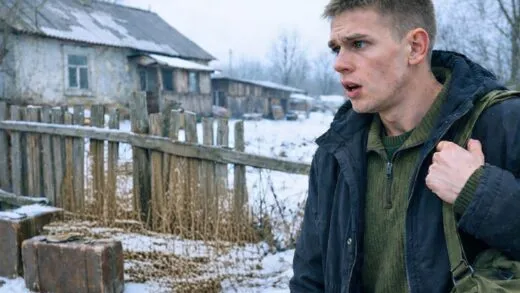
“Alright,” Sam said out loud into the cold night. “You want this finished, Paul? Fine. We’ll finish it.” Atlas barked once, a brisk, affirmative sound. The next morning the air felt different: still, sharp, like the pause before the beginning of something. Sam stood looking at the fresh mound beneath the cedar, thinking about the phrase he’d found scrawled in the pit: “Bury what’s left of me.”
There had been another note in Paul’s tin, Sam discovered later — a reference to a spot “where springwater comes right from the rock.” It sounded like a landmark. Atlas went to the door and gave a short bark in the direction of the treeline. “Lead on, then,” Sam said. The dog moved through the woods with quiet purpose, following a scent only he could track.
After a long trek, they came to a narrow gorge where two rock faces nearly met. A thin steam of water hissed out between them, barely a trickle, but the air was wetter here, and the moss was green in a way it wasn’t elsewhere. Atlas pawed at a patch of moss. Beneath the compacted leaves and old needles was a stone hatch, expertly hidden.
Together they levered the hatch open. A cool, dry smell came up — like a cellar or an old archive. Stone steps led down to a small, stone-lined room. On a crude workbench were hand tools, woodworking plans, and a stack of rough drawings. This had been Paul Morris’s hidden workshop: the place he’d gone to when he needed a task to keep from sliding.
Pinned to the wall were pencil sketches of his dog, a list of materials he’d meant to gather, and pages torn from his journal. “When the night gets too heavy, I come here,” one entry read. “Working keeps me here.” On the bench sat a small sealed jar with several large, dark seeds and a simple note: “Plant these.”
“Let the ground remember something new,” Sam read aloud. It wasn’t poetry — it was a practical instruction, and that made it hit harder. Paul had been trying to put life back into this place bit by bit. Sam took the jar and the note and climbed back into daylight.
They found a soft spot by the stream and planted a few of the seeds by hand, tamping the earth with their palms and topping the spot with a thin blanket of snow. On the walk back the world felt a little brighter. The little patch of ground where Sam had planted the seeds seemed to have a faint, bluish sheen — he told himself it was the light, though he liked to think Paul’s intention had something to do with it.
That afternoon Sam got to work in earnest. He patched the roof, pulled out rotten boards, replaced them with planks he’d scavenged from the shed, and banged nails until his hands were sore. Atlas trotted around and sometimes carried a stick in his mouth as if helping. By evening the cabin looked straighter, more solid — a place someone could sleep without worrying the ceiling would cave in.
On his way to fetch wood, a woman appeared on the lane. She was older, maybe in her seventies, short and wiry, wrapped in a heavy scarf. She introduced herself as Agnes Cole from a hollow a few miles over. She carried a loaf of bread and a small sack of salt. “For the house,” she said, setting them on the table. “Paul did a lot of good around here.”
That surprised Sam. “You knew him?”
“Knew of him,” Agnes said with a little smile. “He helped anyone who knocked. Veterans, kids without much, anyone who needed a hand.” She patted Atlas. “Good dog. Reminds me of his Bo.”
Sam felt something like a thaw. The next morning a pickup rolled up with help — two broad-shouldered men and a young woman named Lydia from the nearest town. They’d heard about the cabin from Agnes and had brought stacked lumber, bricks, and a can of blue paint. “Figured it could use a good door,” Lydia said, cheeks windburned but smiling.
It took the three of them a day to make the place respectable. Eli and Ethan — the two men — repaired the roof and set new windows. Lydia painted the door a calm sky blue. The color changed everything; when the paint dried, Sam found himself touching the door like a man accepting a hand offered to him.
That evening the neighborhood kids came by to see Atlas. He tolerated the attention with a patient dog’s pride. Sam stood by the stove and, for the first time in a long while, found himself telling stories that weren’t all that far from the truth — about dogs that found people in the dark and about stubborn survival. It felt good to have an audience.
Sam pinned Paul’s letters up on the wall near the table. “People ought to see this,” he told Lydia. “He worked at keeping the place together for a reason.” Pages fluttered in the stove’s draft. The cabin no longer looked like a place where things were forgotten; it looked like a place someone had been trying to save.