After losing his last steady job, a veteran drove into the foothills of the Appalachians and spent the last fifty dollars he had on a ramshackle cabin. He wasn’t expecting much. When he and his husky, Atlas, stepped across the threshold, the dog froze, ears up, and started growling at the floor. Sam Walker didn’t know then that under a rotten board lay a secret that had been quiet for decades. Snow fell thick and soft, covering tracks and making the woods feel farther away.
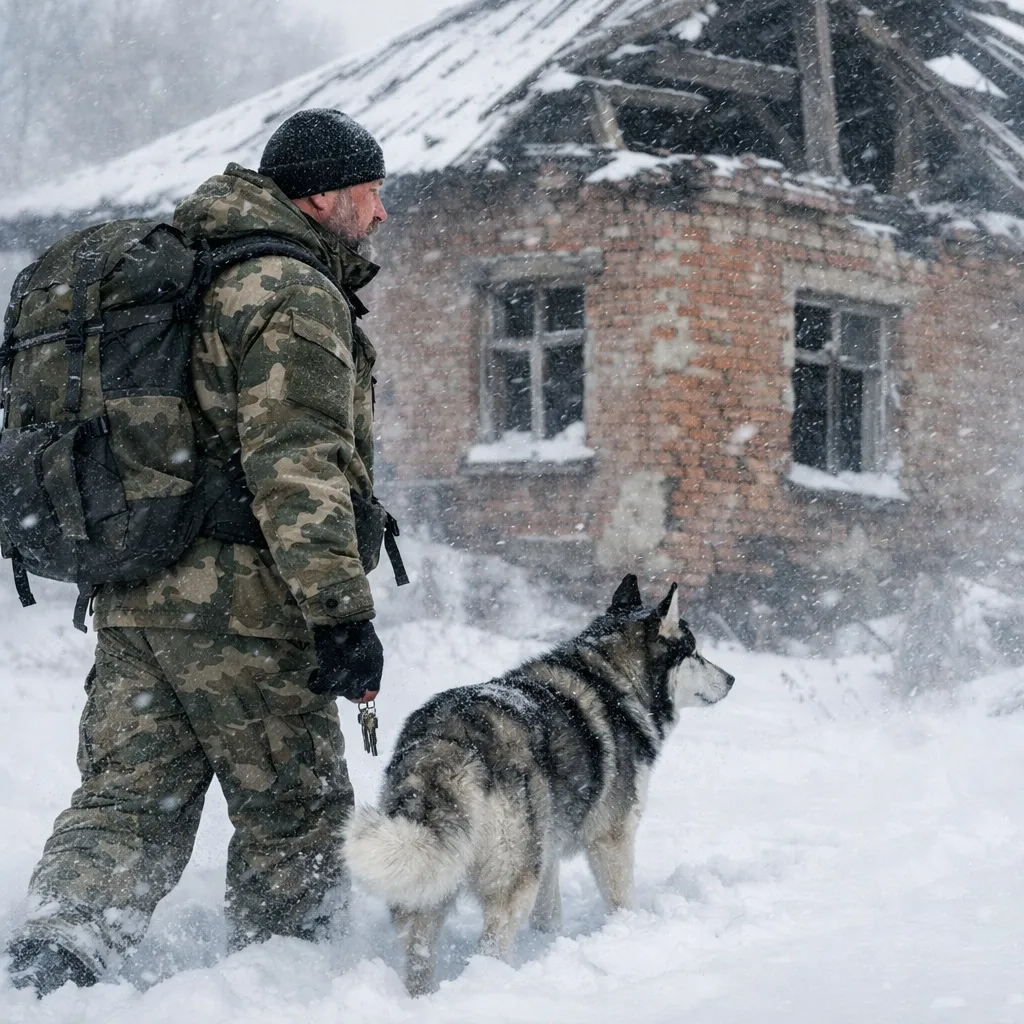
The old Ford pickup juddered over another pothole on the mountain road. Behind the wheel sat Sam Walker, a man in his early forties, solid-shouldered and weathered around the edges. A few scars and a tired set to his eyebrows gave him the look of someone who’s been carrying heavy things for a long time. Tours in Afghanistan had left more than physical marks — they had left a restlessness he hadn’t managed to shrug off.
On the passenger seat, Atlas — a gray-and-white husky with clear blue eyes — lay alert. Atlas was middle-aged, strong and steady. He was the one living thing Sam trusted without question. The dog seemed to understand Sam in a way other people didn’t.
Sam glanced at the fuel gauge; the needle was near empty. “Well, buddy,” he muttered, “looks like this is the end of the road.” In his jacket pocket were his last few bills — fifty dollars in total. After an episode of PTSD at a construction site months earlier had cost him his last job, Sam’s life had compressed down to a few worn possessions and a truck that could still roll.
The road bent left as a crooked, rusted sign creaked in the wind. Someone had scrawled, in a half-peeled sticker, that the cabin was for sale “as is” for fifty dollars. Sam blinked, half expecting the flakes to hide a trick. Atlas rose, fixed his gaze on the sign and gave a low warning growl. “You serious?” Sam said with a short laugh. “A cabin for fifty bucks? Even the truck’s worth more than that.”
The road led them into the trees. A few minutes later the trees opened on a low, leaning cabin. Moss had claimed its siding. The roof sagged. A window was rimed with old ice.
Wind rasped across the walls. Atlas went ahead, pads soft on the snow, then stopped at the door, hair raised. He barked quickly — not out of fear but as a signal. Sam stood on the porch and asked, more of himself than the dog, “What’s up?” The door hung on one rusted hinge; someone had broken the lock years ago. Sam pushed it open.
Air full of damp and old smoke hit them. The floorboards bowed under weight. Inside: a tipped-over table, a broken stool, a soot-streaked stove. Dust lay thick on everything, and the place felt, oddly, like it had been waiting.
Atlas nosed along the floor, smelling between the cracks. Sam’s voice shook before he meant it. “Take it easy, boy.” The dog’s growl shifted, fixed now on a board along the far wall. Sam knelt. Dust had settled like snow, but something underneath caught the light. He brushed away grime and found a metal dog tag. The name scratched into the dull metal read: “Paul Morris.” Sam felt a small, familiar hollow open in his chest at the sight of the old tag.