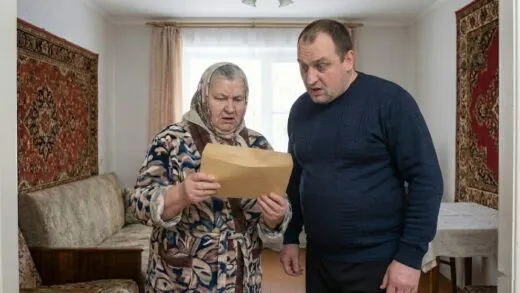
— “Absolutely.”
The next day, an application to initiate a criminal case for fraud was filed with the police. The wheels of justice were set in motion. I knew there was no going back. I was on the threshold of the most terrible battle of my life. And I was ready for it. My quiet family life was over. A war had begun, and I had to win it. For my father. For my son. And for myself.
The week before my father’s departure to Kyiv turned into a marathon. I had to gather all the documents, arrange for transportation, and find a rental apartment near the clinic. I was torn between phone calls, trips around the city, and caring for Mishenka, who, fortunately, didn’t understand the gravity of the situation and was happy about my constant presence.
Igor and his mother, apparently having learned about the filed application, went quiet for a while. No calls, no messages. This silence was deceptive and ominous, like the calm before a storm. I knew they were plotting something, preparing their line of defense, and I had no doubt it would be dirty.
My mother was holding on by a thread, but I could see how much weight she had lost and how she had aged in these weeks. Every new difficulty related to organizing the trip threw her off balance.
— “Marinochka, what if we don’t have enough money?” — she would whisper on the phone in the evenings. — “A loan… that’s such a responsibility. What if something goes wrong?”
— “Mom, everything will be fine,” — I would reply confidently, although my own heart was heavy. — “The main thing is for Dad to be healthy. We’ll handle everything.”
My confidence was contagious, and she would calm down a little. But I knew what that confidence cost me. I barely slept at night, replaying the worst-case scenarios in my head: what if the surgery is unsuccessful? What if Igor really tries to sue me for custody of our son? These thoughts gripped my heart with a sticky fear.
Finally, the day of departure arrived. I saw my parents off at the train station, settled them in their compartment. My father looked very weak, but in his eyes, I saw a determination to fight.
— “Don’t worry about us, daughter,” — he said, squeezing my hand. — “We’ll manage. You better take care of yourself and Misha.”
— “I love you,” — I whispered, hugging them goodbye.
The train started moving, carrying my closest people towards the unknown. I stood on the platform until the red light of the last car disappeared from view, and I felt terribly lonely.
Returning home, I found an envelope under the door with no return address. Inside was a single sheet of paper. It was a copy of Igor’s application to the guardianship authorities. He accused me of “leaving a minor child without proper care” due to an “immoral lifestyle” and “not being involved in my son’s upbringing.” Every word was so saturated with blatant lies that it took my breath away for a moment. He really did it. He decided to hit me where it hurt the most—my motherhood.
I realized I could no longer stay in our shared apartment. Too many things here reminded me of the betrayal. Every corner, every object held memories of our past, seemingly happy life. I called my old friend Lena, with whom I had been friends since university.
— “Lena, hi. I have some… problems. Can Misha and I stay with you for a couple of weeks?”
I briefly told her what had happened.
— “Oh my God, what a nightmare,” — Lena gasped. — “Of course, come over. Don’t even think about it. My apartment is your apartment.”
That same evening, I packed our things—only the essentials—and moved in with Lena. It was a small but cozy one-room apartment, and for the first time in a long time, I felt safe.
And the next day, the investigator called me.
— “Marina Viktorovna, hello. Senior Lieutenant Petrov. Regarding your application. We need to meet. We have summoned your husband and his mother for questioning.”
Questioning. The word sounded like a gunshot. Everything was becoming real. This was no longer just a family quarrel. This was a criminal case.
— “Yes, of course, I’ll be there,” — I replied.
The meeting was scheduled for the next day. I didn’t know what to expect. I knew I would see them—Igor and Lyudmila Anatolyevna—for the first time since that day at the bank. What would I feel? Hatred? Pain? Contempt?
I arrived at the police station early. The investigator, a young man of about thirty with a serious face, led me to his office.
— “They are already here,” — he said. — “Waiting in the corridor. We will question them separately. First the mother, then the son. You can wait here for now.”
Through the slightly open door, I saw Lyudmila Anatolyevna. She was sitting on a chair, clutching her handbag. She didn’t look as confident as usual: confused, frightened. Igor stood next to her, gloomy and tense.
First, she was called into the office. The interrogation lasted over an hour. I sat in the investigator’s office and heard snippets of her voice through the door. She spoke loudly, sometimes breaking into tears: “I’m not guilty!”, “I didn’t know!”, “It was all her!”, “She herself!”.
When she came out, her face was blotchy red. She gave me a look full of hatred and walked past without a word.
Then Igor was called. He entered the office without looking at me. His interrogation was shorter—about forty minutes. He spoke quietly, uncertainly. Finally, the investigator called me.
— “Well,” — he said when I sat down opposite him. — “The picture is becoming clearer. They, of course, deny everything. The mother claims that you offered her the money as a loan, and then suddenly demanded it back. And the power of attorney, according to her, you signed voluntarily so she could ‘help’ you with financial matters.”
— “That’s a lie,” — I said…