
Zinaida Petrovna nodded. And that night, while the city continued not to notice, a deal was made in the modest room, without paper, but with something stronger—with loyalty. Only outside, on some corner, Rogov also made his deal, but with greed. And Zinaida Petrovna felt it in her chest.
The next day, the stall smelled the same as always: broth, pancakes, fresh dill. But there was one difference that wouldn’t leave Zinaida Petrovna alone. The feeling that they were being watched. Matvey, Gleb, and Denis arrived early, before the sun had warmed the sidewalk. Their hair was still damp, as if they had washed up with the seriousness of wanting to look presentable. Without saying much, they began to help. One set up the stools, another wiped the pan, the third carried a bucket of water that was a bit too big for him.
Zinaida Petrovna watched in silence, with a strange mix of pride and fear.
— Easy with that, son, — she told Denis when he strained his back. — I don’t want you to hurt yourself.
Denis nodded stubbornly, as if he didn’t know how to accept care.
Throughout the morning, people looked at them differently. Some with awkwardness, some with pity. There were those who bought something just to stare, as if the stall had become a show. And in the midst of this hustle, Rogov appeared on the other side of the street. He didn’t approach. He just leaned against a wall, watching, smiling with his lips but not his eyes. Zinaida Petrovna felt her heart clench.
— Don’t look at him, — she whispered to the children. — Just do your work.
Gleb, however, glanced at him and clutched the three-star pendant under his shirt, as if his skin warned him before his mind did.
The day went on. By noon, Zinaida Petrovna had almost relaxed. Almost. And then, during a short break, Matvey approached her with a quiet voice.
— Ma’am, I had a dream last night, — he said.
Zinaida Petrovna looked at him.
— What did you dream, son?
Matvey swallowed.
— I dreamed that we were called by a different name, — he whispered. — As if we had beautiful last names.
Zinaida Petrovna felt a jolt.
— Do you remember the name?
Matvey shook his head with frustration.
— I can’t remember, but I heard a song and smelled expensive soap, like Gleb said.
Zinaida Petrovna was silent for a second. Then she awkwardly stroked his hair, like someone not used to showing affection.
— Little by little, — she said. — The important thing is that you’re here, with me.
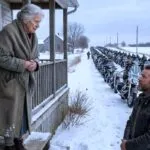
Matvey looked down and nodded. But the phrase didn’t have time to linger, because at 2:30 PM, when the sun was blazing and the street seemed sleepy, a white van screeched to a halt half a block away. Then another one. Then a police car. Slowly, without a siren, as if they wanted it to look normal. Zinaida Petrovna felt her heart jump into her throat.
— Don’t move, — she said quickly to the children. — Stay close.
The three immediately moved closer, as if they already knew this kind of danger.
Two men in vests with folders got out of the vans. A woman with a tablet. A patrol car parked behind them. A police officer watched without rushing. And as if the world wanted to confirm her worst fears, Zinaida Petrovna saw Rogov walking behind them with an expression that said, “I brought them.”
The woman in the vest spoke first.
— Good afternoon. We are here regarding a report of minors without a fixed residence, a potential sanitary risk, and possible exploitation.
Zinaida Petrovna felt her face burn.
— Exploitation? — she repeated. — I fed them.
The man in the vest held up a folder.
— We’re not accusing you, — he said in a mechanical voice. — We’re just checking. Do these children live with you?
Zinaida Petrovna clutched her apron.
— They spent the night at my place, — she admitted, — because they were on the street.
The woman looked at the three children, and her voice softened slightly.
— Kids, what are your names?
Matvey opened his mouth, but Denis answered first with distrust:
— Matvey, Gleb, and Denis.
The woman nodded, writing it down.
— Do you have relatives? Is anyone looking for you?
Zinaida Petrovna felt the world spin. If she said “yes,” they might take them away. If she said “no,” they would take them away anyway.
— I don’t know, — she said honestly. — I only know that someone recognized the symbol they wear.
The man in the vest frowned.
— What symbol?
Gleb instinctively covered his chest with his hand. The woman gently leaned toward him.
— Don’t be afraid, — she said, — we won’t hurt you, we just want to help.
Zinaida Petrovna heard the phrase, but her fear didn’t subside. Not because she believed they would hurt them, but because she knew what they had already told her: they would be separated.
— Don’t take them separately! — Zinaida Petrovna blurted out, almost without thinking. — I’m begging you, if you separate them, they’ll be lost.
The woman in the vest looked at her with a mix of exhaustion and sympathy.
— I don’t decide that, — she said. — There are protocols.
Denis clenched his fists.
— No, — he said, his voice breaking. — Don’t separate us.
Matvey clung to Gleb. Gleb stood frozen, staring at the patrol car. Zinaida Petrovna felt her heart breaking.
— Look at the stall, — she said, gesturing desperately. — It’s clean. They help. I’m not using them. I just couldn’t abandon them.
The bored police officer threw out:
— Ma’am, don’t make things complicated.
And that indifference was a blow. Then the man in the vest opened his folder and showed something. A printed sheet with a logo in the corner. Zinaida Petrovna froze. Three stars. The same symbol.
The woman in the vest looked at Zinaida Petrovna with new seriousness.
— These children may have been listed as missing for many years, — she said. She paused. — We must take them into protective custody to establish their identity.
Zinaida Petrovna felt her legs give way.
— Missing… — she whispered.
Rogov smiled from behind, as if he had just won the lottery.
— You see, Petrovna…
Zinaida Petrovna looked at him with silent fury.
— It was you, — she whispered. — You called them.
Rogov shrugged.
— I just reported it, — he said. — For the good of the children.
A lie wrapped in benevolence. The people in vests approached the triplets calmly, without aggression, but firmly. The children took a step back, pressing against Zinaida Petrovna.
— Ma’am, — said Matvey in a trembling voice. — Are you going to abandon us?
Zinaida Petrovna felt something inside her break.
— No, — she said, swallowing. — I won’t abandon you.
The woman in the vest looked at her.
— You can come with us to the station if you want, — she said. — But you can’t prevent their removal.
Zinaida Petrovna nodded quickly.
— I’m coming, — she said. — I’m coming with them.
At that moment, Denis turned to look at the stall, as if to memorize it. Gleb clutched his pendant. Matvey looked at Zinaida Petrovna as if she were the only thing he had. They were put into the van. Together, for now. Zinaida Petrovna also got in, trembling, still in her stained apron. The door closed, and as the vehicle started moving, Zinaida Petrovna saw Rogov through the window, standing on the corner and watching them go with satisfaction. Zinaida Petrovna pressed her lips together because she understood: this wasn’t help. It was a move. Someone had set something big in motion, and now the children were no longer under her care…