
The sky opened up with a cold downpour the exact moment the mahogany casket touched the bottom of the grave. It felt as if nature itself was mourning Eleanor Miller—the woman Andrew had spent twenty-eight years with. Or perhaps he just wanted to believe it was love. Andrew stood at the edge of the plot, barely feeling the icy water on his face, mixing with what might have been tears.
Around him stood a crowd: business partners, casual acquaintances, and distant relatives he hadn’t spoken to in decades. They had come to pay their respects to the wife of a successful CEO, but Andrew knew the real reason. Most were just curious to see how the most powerful man in the county would handle the loss.
— Mr. Miller, — his driver, Jim, whispered, gently touching his elbow. — The car is ready. It’s time to go.
Andrew gave a short nod, but his feet felt like lead. His gaze was fixed on the fresh mound of earth covered in the white lilies Eleanor had loved. He was desperately trying to hold onto her image in his mind.
Strangely, the memory was slipping, blurring like a reflection in a disturbed pond. Over the last five years of her long illness, he had grown used to seeing her frail and exhausted. He had almost forgotten the woman she used to be: vibrant, with a laugh that filled the room and dimples in her cheeks.
The crowd began to thin. People approached one by one, shaking his hand and offering standard condolences. Andrew nodded on autopilot, the words barely registering. A single, haunting thought echoed in his mind: he was now completely alone.
They never had children. The doctors had delivered that verdict early in their marriage: Eleanor was unable to conceive. They had tried everything—specialists in New York, clinics in Europe, even experimental treatments. Eleanor had once even dragged him to a holistic retreat in the mountains. Andrew didn’t believe in miracles, but he couldn’t deny her hope.
Nothing worked, and eventually, he accepted their fate. But Eleanor never quite forgave herself. Perhaps that lingering sadness, that sense of a missing piece, had been what triggered her decline.
— It’s time, sir, — Jim reminded him softly.
This time, Andrew complied. Moving with the heavy gait of a much older man, he headed toward the cemetery gates. His expensive shoes sank into the mud, and his wool coat was soaked through, but the physical discomfort didn’t matter. Nothing did.
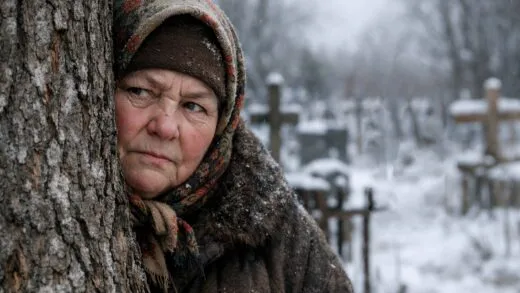
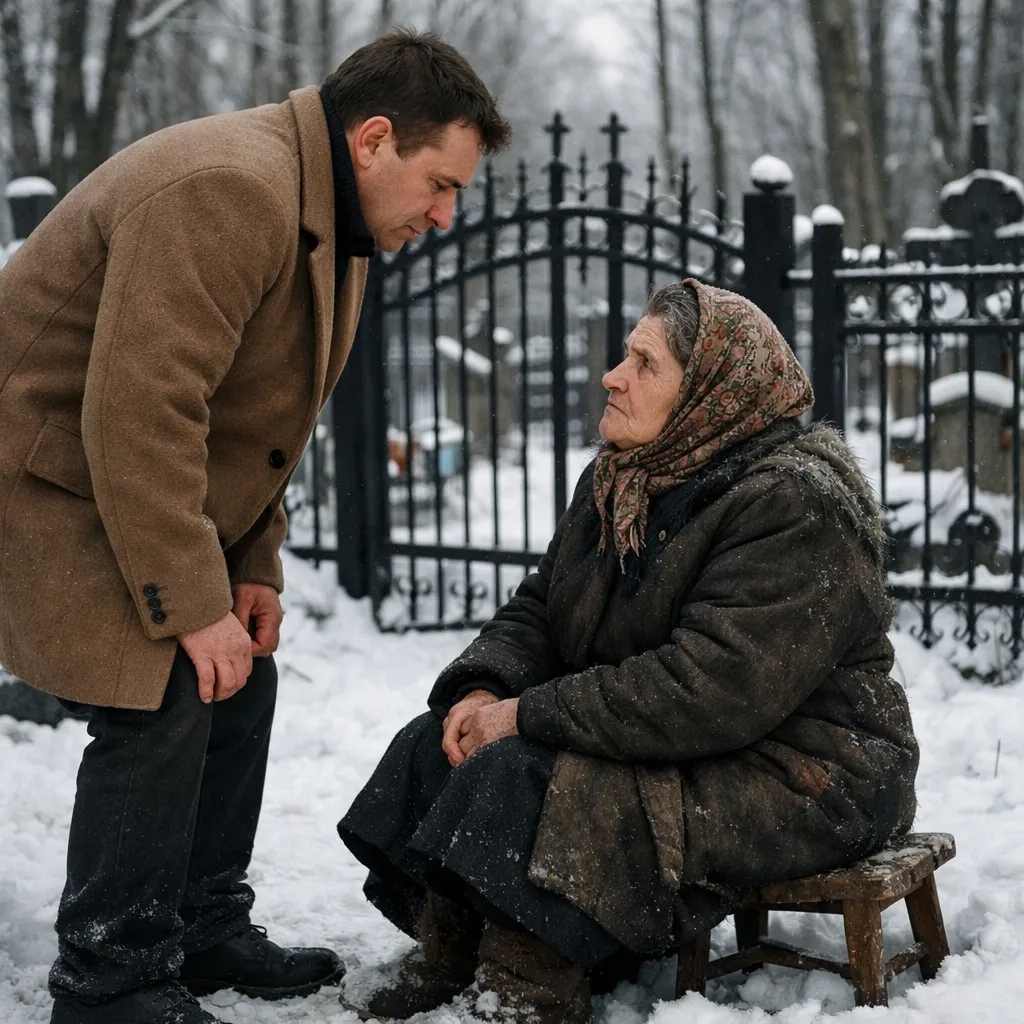
Near the wrought-iron gates, seeking shelter under the eaves of a small stone chapel, sat an elderly woman. Andrew had noticed her from a distance: a slumped figure in a dark coat, her weathered hands resting calmly on her knees. She looked like one of those local fixtures who spent their days near the church or the graveyard, knowing that grief often makes people generous.
Andrew slowed down and stopped in front of her. He reached into his inner pocket and pulled out his wallet. Without looking, he took out a hundred-dollar bill and handed it to her.
— For my wife, Eleanor, — he said hoarsely.
The woman slowly raised her head. Her eyes were striking: pale, almost translucent, the eyes of someone who had seen a lifetime of hardship. She took the bill without looking at it, tucked it away, and looked at Andrew as if she were reading his life story.
— And what will you tell your daughter? — she asked, her voice quiet but clear.
Andrew froze as if he’d been hit by a live wire. His heart, which had been beating with a dull rhythm, suddenly skipped.
— Excuse me? — he asked, thinking the rain had muffled her words.
— Your daughter, — the woman repeated. There was no mockery in her voice, only a deep, almost maternal sadness. — What are you going to say to her now?
— I don’t have a daughter, — Andrew said slowly. — I never did.
The old woman slowly shook her head. Her thin lips curled into a knowing, bitter smile.
— You do, Andrew. She’s nearly thirty now.
Jim had already opened the car door, waiting for his boss. The rain intensified into a sheet of water. But Andrew couldn’t move. He stared at the woman, feeling the world he had built for decades begin to crack.
— You’re mistaken, — he said, though his voice wavered. — You have me confused with someone else.
— Andrew P. Miller, — she said firmly. — CEO of Miller Logistics. Widower of Eleanor Miller, formerly Eleanor Bond. No children on the tax returns. That’s what the paperwork says. But life keeps its own records.
Andrew felt the ground shift beneath him. How did this stranger know his full name and his company? How did she know Eleanor’s maiden name? This wasn’t a coincidence. This wasn’t the rambling of a crazy person.
— Who are you? — He stepped closer, looming over her. — What do you want? Money? How much?
The woman raised a hand, a gesture so commanding that Andrew instinctively stepped back.
— I have no use for your money. I’ve taken what I need for the soul. But I’ll tell you this: look for her. If your heart hasn’t turned entirely to stone—look. Start at the Pines Assisted Living on the edge of town. Ask for Hope Gable. She remembers. She remembers everything.
— Who is Hope? What are you talking about?
But the woman was already standing up, pulling her coat tighter. Her movements were surprisingly quick for her age.
— Look for her, Andrew. Before it’s too late. Thirty years is a long time. Но blood—blood knows its own. You can’t lie to blood.
She walked away, disappearing into the gray curtain of rain. Andrew started to follow, but Jim was there, firmly but respectfully catching his arm.
— Mr. Miller, you’re soaked through. Let’s get you home. The doctor said you need to watch your blood pressure.
Andrew allowed himself to be guided into the car. He stared out the window, trying to spot the woman, but she was gone as if she had dissolved into the mist. It felt like a fever dream. But the words remained, ringing in his head: “What will you tell your daughter?”
He didn’t say a word on the drive back to the estate. Jim, used to his boss’s moods, didn’t ask questions. The black SUV glided through the wet streets, past suburban developments and shopping centers, past a world that was moving on without Eleanor.
The house was deafeningly quiet. The sprawling mansion he and Eleanor had built fifteen years ago now felt like a mausoleum. The high ceilings, the marble floors, the custom furniture—it had all been for her. She wanted a legacy, and he had built her a palace. And now…
Andrew went to his study and poured a glass of scotch. His hands were shaking; the glass clinked against the decanter.
A daughter. Could it be possible?
It seemed impossible. He had never cheated on Eleanor. Not once in twenty-eight years. Even on long business trips, even when younger associates made their interest clear. He had been faithful. He had truly loved his wife.
But his memory began to unearth things he had buried deep. The summer of 1996. He was twenty-three, a young MBA grad working his first real job. Eleanor had gone to stay with her parents for the summer—her mother was recovering from heart surgery. He had stayed behind in their small rental apartment.
And there was a girl. A neighbor in the complex. Quiet, blonde, with sad gray eyes. What was her name? Sarah. He remembered the name now, even though he had tried to forget everything else. One night. Just one night that he had sworn to forget forever. And he had. He had buried that memory so deep it almost ceased to exist.
But what if? Andrew downed the scotch. He poured another. The shaking wouldn’t stop. “Nearly thirty,” the woman had said. The summer of ’96. Thirty years ago. If that girl had a child… if she had gotten pregnant after that one night… the child would be twenty-nine now. Almost thirty.
The math worked. It was terrifying, but it worked perfectly.
— No. This is crazy, — he whispered to the empty room. — How could a stranger at a cemetery know about something that happened thirty years ago?
It had to be a scam. A cruel joke. Or a blackmail attempt. He expected a phone call tomorrow demanding money for silence. But deep down, Andrew knew. Those eyes—those pale, translucent eyes—hadn’t been lying. She knew something vital. Something that would change everything.
— The Pines Assisted Living, — he muttered. — Hope Gable.
He opened his laptop. His fingers flew across the keys. There were a few facilities with that name in the tri-state area, but only one on the western edge of the city. Tomorrow. Tomorrow he would find out.
For now, he would sit in his empty house and try to remember the face of a girl from a distant summer. A girl who might have carried his child.
Outside, a thunderstorm rolled in. Lightning lit up the study, and thunder shook the walls. Andrew Miller, a man who seemingly had everything, sat in the dark feeling completely lost.
The next morning was gray and damp. Andrew hadn’t slept, tossing and turning through fragments of nightmares. He dreamed of Eleanor—young, beautiful, her hair down. She was standing on a shoreline, looking at him with a strange expression. “You knew,” she seemed to say without speaking. “You always knew.”
By 8:00 AM, he was in the car. Jim raised an eyebrow; usually, after a loss like this, the boss took a few days off. But he didn’t ask, just waited for the destination.
— The Pines, — Andrew said. — Out on the West Side. You know it?
— I’ll find it, sir.
The drive took nearly an hour. The city was waking up, traffic was building, and people were rushing to their lives. Andrew looked out the tinted window, thinking about the irony of it all. Yesterday he buried his wife, and today he was looking for a daughter he never knew existed. Or did he know? Somewhere in the dark corners of his mind where we hide the things we’re afraid to face.
The Pines was a two-story brick building from the seventies, surrounded by overgrown trees. Peeling paint, a sagging porch, a rusted fence—it screamed of a tight budget. Andrew winced. He donated large sums to charity every year, but he never really looked at where it went. Maybe he should have.
The lobby smelled of floor wax and industrial cooking. An older woman in a nurse’s station was flipping through a magazine. She looked up as he entered, her eyes widening slightly; men in custom-tailored suits weren’t common visitors here.
— Can I help you? — she asked cautiously.
— I’m looking for Hope Gable, — Andrew said firmly. — I was told she lives here.
The nurse frowned and set down her magazine.
— Are you family?
— An old friend. A family friend. — It was a lie, but he said it with such authority that she nodded.
— Room 12, second floor. But… — she hesitated. — She hasn’t been doing well lately. The doctor says she doesn’t have much time. So, please… be gentle with her.
Andrew walked up the creaking stairs. The second-floor hallway was dim, lined with identical doors. It smelled of medicine and age. From behind some doors came the sound of televisions; from others, a silence that felt heavy.
Room 12. Andrew stopped at the door, taking a breath. What was he going to say? What did he hope to find? Maybe this was all just the delusion of an old woman at the cemetery.
He gave a short knock.
— Come in, — a frail, raspy voice called out.
The room was small but tidy. A narrow bed by the window, a nightstand cluttered with pill bottles, a couple of chairs, and an old TV. On the wall were several framed photos, faded by the sun.
On the bed, propped up by pillows, sat an elderly woman. She looked ancient—at least eighty-five. Her white hair was pulled into a thin bun, her face a map of wrinkles. But her eyes… her eyes were sharp, alert, and unsettlingly focused.
— Hello, — Andrew said, closing the door behind him. — Are you Hope Gable?