The July sun was blinding when Greg first saw them through the window. Three of them, standing by the gate. A beat-up black sedan with out-of-state plates sat idling on the shoulder, the engine ticking in the heat. They looked to be in their late twenties—athletic builds, gym shorts, tank tops, and heavy ink on their arms. One of them, a broad-shouldered man with a fleshy face, was the first to step toward the porch.
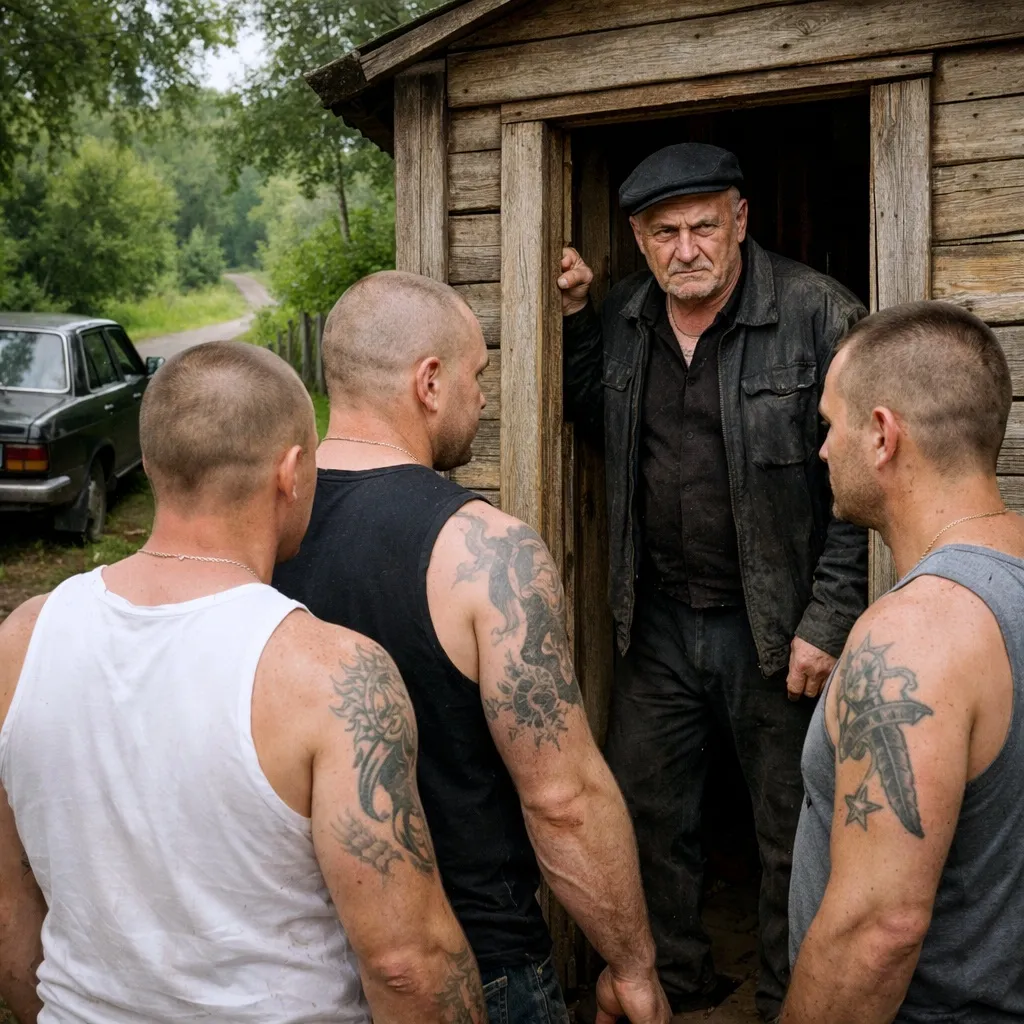
The other two shared a look and followed. Greg didn’t recognize their faces, but he knew their type—prison-bred. It was in the way they carried their shoulders, that arrogant swagger of men who believed that out here, in the civilian world, they could take whatever they wanted. The broad-shouldered one knocked on the door—two short, sharp raps. Greg didn’t rush.
He wiped his hands on his work pants, walked through the small hallway, and stopped at the threshold. He opened the door. The leader sized him up from head to toe: an old tracksuit, worn-out sneakers, thinning gray hair. Just a grandpa. A typical old man living out his days in the hills.
“Hey, Pops!” the leader’s voice was smug and loud. “There’s a new management in this county. You want to pay the fee, or do we have to have a talk?” Greg remained silent, observing. Not just the leader, whom he dubbed ‘Vinnie,’ but the two behind him. A short, twitchy one—’Zip,’ most likely.
The second was lanky with a prominent Adam’s apple—’Slim.’ Both were nervous, shifting their weight. Vinnie, however, stood firm, hands in his pockets, a smirk plastered on his face.
“You deaf?” Vinnie stepped closer. “Two thousand dollars per house, by the end of the week. Or things start breaking.” Greg paused, then gave a slow nod.
“Come on in. I’ll put some coffee on.” Vinnie chuckled, glancing back at his crew.
“After you, Pops.”
But to understand how Greg Miller ended up in this quiet Appalachian town, and how three arrogant punks could make the mistake of crossing his threshold, you have to go back to the beginning. Greg was born in 1959 in a tough industrial town outside of Pittsburgh. His father was never in the picture.
His mother, Vera, worked double shifts at the textile mill, coming home with a gray face and hands that smelled of machine oil. Greg was raised by the streets. Back alleys, basements, construction sites. By age seven, he knew which scrap yards paid cash for copper.
By eight, he knew where the older boys hid when the cruisers rolled through the neighborhood. At thirteen, he was a lookout. A neighbor’s older brother, ‘Lefty,’ was boosting a liquor store. Greg stood on the corner, supposed to whistle if he saw a patrol car. He missed the car, and Lefty got busted.
Greg was let go because of his age. His mother cried for three days; he stayed silent. He learned one thing then: if you’re going to do something, do it yourself. Don’t rely on anyone. At fourteen, he got a job at the docks. He hauled crates, unloaded freighters, and saved every cent.
But more importantly, that’s where he met ‘Monty.’ Monty wasn’t a street punk; he was the real deal. He’d done five years for armed robbery and came out running several rackets at the port. Greg gravitated toward him, listened, and learned. Monty told him about the ‘Old Guard’—the high-ranking syndicate members who lived by a strict code.
Greg soaked up every word. At seventeen, he had his first ‘stretch.’ Greg and two friends hit an apartment in the city. They took jewelry, cash, and electronics. They split it. A week later, one of the friends folded during a traffic stop and gave them up.
They were all picked up. Greg got two years in juvenile detention. His mother stopped visiting after the first year. It was a tough facility in the mid-seventies. Greg found the guys who lived by the code. He didn’t push, didn’t show off; he worked, but not for the guards—for his own people. He shared what he had. Respect didn’t come fast, but it came. At eighteen, he was moved to a state penitentiary.
It was simpler there. Greg studied. Not books, but the science that mattered: how to keep your word, how not to bend under pressure, how to be responsible for your actions. He was released in 1978. Twenty years old. His mother had passed while he was inside. He wasn’t allowed out for the funeral.
He returned to the city. He worked construction, hauling bricks and mixing concrete, spending his nights drinking with old associates, reminiscing about the inside. Freedom felt hollow, chaotic. Behind bars, things were clear: who was a friend, who was an enemy, who was right, and who was wrong. Out here, it was all gray.
In 1985, he was taken down again. Armed robbery. Greg and two others hit a high-end jewelry store downtown. They made off with a fortune. They split it. But a month later, one of the accomplices got caught on an unrelated charge and started singing to the feds.
Greg was arrested in December. He was sentenced to 20 years in a maximum-security facility. This time, he wasn’t upset. Freedom didn’t call to him anymore. Stateville Correctional Center. Max security. Greg arrived in January 1986.
The cold was so sharp it took his breath away. The guards unloaded a group of ten. Greg was last in line. He looked around. Towers. Razor wire. Long, gray cell blocks. A familiar sight. The first month was spent in intake.
They vetted everyone. Where are you from? What’s your beef? Who do you know? Greg kept a low profile. He answered briefly, never volunteered information. He watched and listened. The prison had an order. It was ‘Old School.’ The heavy hitters ran the blocks, and the guards stayed out of internal business.
It was a disciplined environment. After a month, Greg was assigned to C-Block. A cell for two. His cellmate was Mike from Philly. Doing his second stretch for robbery. A solid guy. Didn’t talk much, but didn’t hide anything either.
Greg bonded with him quickly. Mike showed him the ropes. Who was the boss, who handled what, where the lines were drawn. The man in charge of the block was ‘Big Sal.’ He’d been in for ten years, an undisputed authority. He managed the ‘kitty,’ settled disputes, and ensured the code was followed.
Greg met Sal three months in. Sal called him over, asked about his history. Greg told him the truth. Two stretches, sold out by a partner, but never snitched. Sal nodded and gave him the green light.
Greg refused to work for the administration. That was the golden rule. The warden tried to squeeze him. They called him into the office, threatened him with the SHU (Solitary). Greg held firm. He did four stints in solitary that first year—five days each. Cold, hungry, concrete floor.
But he didn’t break. After the fourth time, they gave up. They realized this one wouldn’t fold. Greg earned his keep another way. He fixed watches and electronics. Back at the docks, Monty had taught him the trade. Greg could take apart any mechanism, fix it, and put it back together.
In prison, that was a valuable skill. Inmates brought him watches, radios, lighters. He fixed them. He took payment in commissary—coffee, cigarettes, snacks. He shared with his crew. He lived by his conscience. He was never greedy. He’d give away his last cup of coffee if someone needed it more.
1989. The world was changing, and the news reached the prison. Talk of reforms and early releases. It didn’t affect Greg. His sentence was long. But the power structure inside was shifting. Big Sal was paroled in the fall of ’89. The top spot was open.
A power struggle began. There were two contenders: ‘Vinnie the Butcher’ and ‘Red.’ Both were heavy hitters with long sentences. Greg stayed out of it. But one day, Vinnie came to him. Asked whose side he was on.
Greg was honest. Neither. Not until he saw who was right. Vinnie grunted and left. A week later, Red asked the same thing. Greg gave the same answer. The conflict ended violently.
Red tried to cut a deal with the guards to have Vinnie transferred. That was a violation of the code. Vinnie found out and called a ‘sit-down.’ Red was judged by the elders. Found guilty of being a rat, he lost his status. Vinnie took over.
Greg realized then: authority isn’t based on muscle. It’s based on integrity. On the fact that your word is your bond. He continued to live by his code. He kept his word, stayed out of other people’s business, but never abandoned his own. His reputation grew. 1991. The country was in flux, but inside, it felt distant.
Greg was 32. No longer a ‘young buck,’ but not yet an old-timer. In the joint, he was known and respected. Vinnie kept him close, consulted him. Greg helped settle disputes and kept order in the block. He didn’t seek power, but he didn’t hide from it either.
In the winter of ’92, a delegation arrived. Three high-ranking ‘Made Men’ from the city. They came to settle matters of leadership. Vinnie put Greg forward. Said this man had earned his stripes. Greg didn’t expect it, but you don’t say no to that kind of honor.
The ceremony was held in March. A large cell, about 30 people, the block’s heavy hitters, and the visitors from the city. Greg was placed in the center. They asked about his life, his deeds, his principles. He answered calmly, without fluff. He told them how he lived, why he was there, and how he never broke the code.
The elders looked at each other. The senior man, ‘Old Joe,’ nodded. Greg was ‘crowned’—recognized as a Chairman of the Circle. They gave him the name ‘The Ghost.’ Because he was quiet, unbreakable, and always there when it mattered. From then on, life changed.
Greg became responsible for the ‘Common Fund.’ He made sure resources were distributed fairly—for legal fees, for commissary for the indigent, for helping those in need. He mediated disputes. He never worked an official prison job and never took a favor from the guards.
He lived strictly by the rules of the Circle. Respect for him was absolute. The 90s were hard years in prison. The outside world was getting more violent, and that bled into the system. Greg kept the peace.
He didn’t allow senseless violence, and he didn’t let the administration interfere in their internal affairs. The block lived by the code. In 1993, protests broke out. In February, the warden tried to move the facility to a ‘Level 4’ lockdown. Extra searches, restricted mail.
The inmates weren’t going to take it…