— “Maybe. I think I might have a lead on one of the victims.”
A pause.
— “Come over to the command post. I’ll be waiting.”
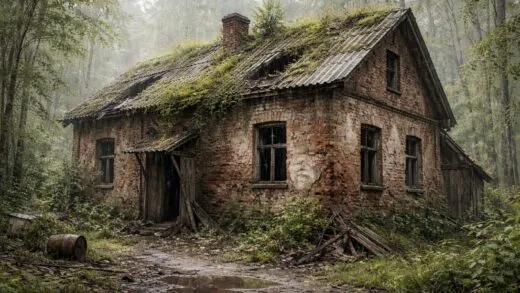
Henderson was in the mobile unit—a trailer parked near Mike’s house. He was surrounded by files, maps, and a laptop. He looked beat, but his eyes were sharp.
— “Sit down. Tell me what’s on your mind.”
Mike sat across from him, trying to steady his voice.
— “My mother had a brother, James ‘Jim’ Larson. He went missing in 1978.”
Henderson froze. He put down his pen.
— “Go on.”
— “Uncle Jim was a contractor. He built barns, houses, commercial sheds. He traveled all over the state. Sometimes further.”
— “Where was he working in ’78?”
— “Outside of Philly. He’d been on a big project for three months. He was driving home.”
— “To where?”
— “Home to Scranton. That’s about a two-hour drive from here.”
Henderson pulled out a map and traced a line with his finger.
— “Oak Creek is right on the back highway between Philly and Scranton.”
— “Yeah,” Mike nodded. “I realized it last night. He would have taken this road.”
— “And he never made it?”
— “Never. My mom expected him for Thanksgiving. He’d promised. He was bringing his paycheck and gifts for the kids. He never showed.”
— “Did they look for him?”
— “They did. My mom filed reports. The police told her he probably just took off. Maybe started a new life. They didn’t take it seriously.”
— “But she didn’t believe that?”
— “Never. Jim wasn’t that guy. He gave his word. She believed until the day she died that something bad happened.”
Henderson was typing fast now.
— “When did your mother pass?”
— “2015. Nine years ago.”
— “So she never knew.”
— “She never knew.”
The detective turned his laptop screen around.
— “James Stephen Larson. Born 1946. Missing persons report filed November 1978. I found it in the cold case database.” He pointed to a grainy black-and-white photo. “Is this him?”
Mike stared at the photo. It was Uncle Jim. Young, grinning, wearing a flannel shirt. It was the same photo his mother kept on the mantel for decades.
— “That’s him.”
— “You’re sure?”
— “Positive. I grew up looking at that picture.”
Henderson nodded and closed the laptop.
— “We need to verify. DNA testing.”
— “How?”
— “We’ll take a swab from you and compare it to the remains. Since you’re his nephew, we can establish a familial match.”
— “How long will it take?”
— “A week or two. We’ll rush it through the state lab.”
Mike sat there, stunned. Uncle Jim. Forty-six years in a well. Fifty yards from where Mike was now living. Was it a fluke, or was it fate?
That evening, Mrs. Gable told him more. They sat in her kitchen, the smell of coffee filling the air. She spoke softly. Miller had arrived in ’52, fresh out of the service. He was appointed Sheriff after the old one passed away. Nobody really knew where he was from—somewhere out west, maybe. He was strict but seemed fair at first. He cleaned up the town, dealt with the drunks and the troublemakers. But then… she paused, looking into her cup.
Then he changed. Not all at once, but slowly. He became a recluse. No friends, no social life. She thought it started in the early sixties, after a certain incident.
— “What incident?”
— “A young man was passing through. His truck broke down near the edge of town. Miller offered to let him stay the night at his place while they waited for a part.”
— “And?”
— “Miller said the man left the next morning. But a month later, I saw that same truck in Miller’s shed. Stripped down to the frame.”
— “Did you tell anyone?”
— “Who was I going to tell? Miller *was* the police. I was a young woman, and he was a war veteran, a respected official. Who would believe me? I was scared.”
Mike understood. A small, isolated town in the mid-century. The Sheriff was king. Your word against his meant nothing.
— “You think that driver was the first?”
— “I think so,” she whispered. “And then there were others. I’d see a strange car at his place, and the next day Miller would say they’d moved on. But I’d see the parts later. In his shed.”
After talking to her, Mike went back to Henderson. The detective was still at it, despite the late hour.
— “I have a witness,” Mike said. “Mrs. Gable.”
— “What does she know?”
Mike relayed the story—the truck, the parts, the fear. Henderson listened intently.
— “I need to get a formal statement from her. She’s 87. We need to move fast.”
The next day, they recorded her statement. She told them everything. About the driver, the cars, the cold way Miller would look at her when he thought she wasn’t watching.
— “Did he ever threaten you?” Henderson asked.
— “No. He didn’t have to. I just knew. If I spoke up… I wouldn’t be here today.”
— “Did you know about the well?”
— “No. The well was behind a high fence. I never looked.”
— “But you suspected?”
She was silent for a long time.
— “I suspected for forty years. And I’ve been afraid for forty years. Even now that he’s dead.”
The DNA results came back ten days later. Henderson called Mike early in the morning.
— “We have a match.”
— “Uncle Jim?”
— “Yes. James Larson. He’s one of the seven.”
Mike sat in silence, the phone heavy in his hand. He’d found him. After forty-six years.
— “What happens now?”
— “Come down to the morgue. We need a formal identification of the personal effects.”
The morgue was cold and sterile. The coroner, a professional woman in a white coat, led him to a table. There were no bodies, just remains and evidence bags.
— “We found these with him,” she said, pointing to a plastic bag. “Take a look.”
A Timex watch. Cracked crystal, hands frozen in time. A pocketknife with a wooden handle. And a ring—a gold wedding band with an engraving. Mike picked up the bag and read the inscription: *J.S.L. & T.V.L. 1970.*
James Stephen Larson and Theresa Valerie Larson. Their wedding date. Aunt Theresa had died in ’93, still wondering where her husband was.
— “It’s him,” Mike said. “That’s my uncle.”
Afterward, Mike sat in his car for a long time. He couldn’t drive. His hands were shaking too hard. Uncle Jim. He’d been thirty-two when he was killed. A wife, a son, a whole life ahead of him. And he’d been dumped in a well like trash. For forty-six years.
Mike slammed his fist against the steering wheel.
— “You bastard,” he yelled into the empty car. “You absolute monster!”
Miller was dead, buried with honors. Beyond the reach of the law. But not beyond the truth. Not anymore.
That evening, Henderson sat with Mike on some crates outside the command tent. They drank coffee from a thermos.
— “We identified two more,” the detective said. “From the missing persons files.”
— “Who?”
— “Victor Evans, born 1951. Disappeared in ’75. He was a long-haul trucker. And Andrew Reed, born 1944. Disappeared in ’82. He was a traveling salesman.”
— “All travelers?”
— “Yeah. All passing through Oak Creek.”
Mike looked at his house. His dark, quiet house.
— “Why?” he asked. “Why did he do it?”
— “Robbery, mostly,” Henderson said. “The trucker was carrying a cash payroll for his company. The salesman had his commissions. Your uncle had his three-month paycheck.”
— “So it was just for the money?”
— “Money and parts. We checked. Miller used to sell high-end car parts to a shop three counties over. Rare stuff, hard to find back then. It was a lucrative side business.”
— “And the people were just in the way?”
— “Witnesses. Dead men don’t talk.”
The pattern was chilling. Miller would stop them at the edge of town. A routine check. He’d find out who they were, where they were going. If they were alone and carrying cash, he’d invite them to stay the night. A friendly Sheriff offering a warm meal and a bed because the roads were bad or the sun was going down.
People trusted the badge. They’d have dinner, maybe a drink. And then, in the middle of the night, Miller would strike. One heavy blow to the head. Then the well. Then the shed to strip the car. The next morning, he was back on patrol, the perfect Sheriff.
— “How did he never get caught?” Mike asked.
— “How could he?” Henderson shrugged. “The victims were from all over. They disappeared at different times. There was no connection.”
— “But there were reports.”
— “Sure. Eleven in this county alone. But who investigated them? Miller did. The reports would come to his desk, and he’d write back that he’d interviewed locals and found nothing. He was covering his own tracks for forty years.”
That night, Mike stood by the well. The police were gone, the tape was down. Just a black hole in the ground. A grave for seven men.
He tried to imagine it. Uncle Jim, tired from a long job, just wanting to get home to his wife and kids. He stops in a quiet town. A polite Sheriff offers him a place to stay. A warm meal. A few laughs. And then… darkness. Forty-six years of silence.
— “I’m sorry, Uncle Jim,” Mike whispered. “I’m sorry it took so long.”
The wind stirred the grass. The stars were cold and distant.
— “I’m going to find them all. Everyone he took. And I’m going to give them a real burial.”
It was a promise. Miller was gone, but Mike could still bring them home. It wasn’t revenge; it was justice. The only kind left.
The next morning, Mike called his cousin, Jim’s son. Steve. He was sixty now, living in Scranton. They hadn’t spoken in twenty years.
— “Steve. It’s Mike Larson.”
— “Mike?” Steve sounded surprised. “Long time. How are you?”
— “I’m okay. But I’m calling about something serious.”
— “What is it?”
Mike took a breath. How do you say this?
— “Steve. I found your father.”
Silence. Long and heavy.
— “What?”
— “I found him. After forty-six years. I found Uncle Jim.”
— “Where?”
— “In Oak Creek. On the property I just bought.”
— “Is he…?”
— “No, Steve,” Mike said softly. “He’s gone. He was murdered in ’78. On his way home.”
He heard a choked sob on the other end of the line.
— “How?”
— “Come down here. I’ll tell you everything. We need to bring him home. For real this time.”
Steve arrived two days later. He looked like a man who hadn’t slept in a week. They hugged, a long, tight embrace.
— “Where is he?” Steve asked.
— “At the county morgue.”
— “Take me there.”
— “First, you need to know the whole story.”
They sat on the porch, and Mike told him everything. The well, Miller, the other victims. Steve listened, his jaw tight.
— “Forty-six years,” Steve said. “He was in a hole while we thought… I thought he’d just walked out on us.”
— “Your mom never thought that.”
— “I know. But I was fourteen. I was angry. I thought he’d found another family and left us behind.”
— “You were a kid, Steve.”
— “I hated him for it. My whole life, I hated him for leaving.” He rubbed his face with his hands. “My mom died waiting for him. Every day she’d look out the window. She knew. She knew he wouldn’t just leave.”
At the morgue, Steve stared at the remains. He looked at the ring, the watch he’d given his dad for his birthday.
— “It’s him,” he whispered. “Can we take him home now?”
— “Once the paperwork is done. Another week.”
Steve nodded, his hand resting on the evidence bag.
— “I’m sorry, Dad. I’m sorry I didn’t believe in you.”
Meanwhile, Henderson was still digging. He was obsessed now. By the end of the second week, they’d identified the remaining victims.
The fifth was Michael Jordon, disappeared in ’71. A farmer who’d just sold his livestock. The sixth was Bill Vance, disappeared in ’80. A mechanic coming home from a training course. The seventh was Peter Lucas, disappeared in ’85. A courier carrying sensitive documents.
Seven men. Seven lives cut short. All for a few bucks and some car parts.
— “Why did you keep going?” Mike asked Henderson one night.
— “Because they deserve names,” the detective said. “They weren’t just ‘remains.’ They were people.”
The families started arriving. One by one. Children who were now seniors. Widows who had never remarried. They gathered at Mike’s house, sitting around a long table in the yard. They shared stories, photos, and tears.
Michael Jordon’s daughter, now 75, cried as she remembered her dad bringing her candy after a trip to the market. Bill Vance’s son spoke about how his dad wanted him to be an engineer. Peter Lucas’s widow, now 82, spoke about the bond they had—how she felt it break the night he died.
Mike listened to every story. He realized he wasn’t just a homeowner anymore. He was the caretaker of a tragedy. And he was okay with that.
— “Why me?” Mike asked Henderson later.
— “What do you mean?”
— “Why did I buy this house? Out of a thousand listings, I picked this one. My own uncle was in that well. Is it just a fluke?”
— “I don’t know,” Henderson said, looking at the stars. “Maybe he called you. Maybe they all did.”
Mike didn’t argue. It felt right.
The funerals were held in September. A beautiful, crisp day. They buried them in a row at the old cemetery on the hill. Seven graves, seven headstones. Mike stood with Steve at Uncle Jim’s grave.
— “Goodbye, Dad,” Steve said. “Rest easy.”
Mike put a hand on his cousin’s shoulder. There were no more secrets. No more lies.
The town eventually decided what to do about Miller. They couldn’t put a dead man on trial, but they could strip him of his honors. They removed his name from the local records. They took down his portrait in the courthouse. They moved his grave to an unmarked plot on the edge of the cemetery. He was no longer a hero. He was a murderer.
Mike stayed in the house. He renovated it, but he kept the well. He filled it in and placed a granite memorial over it. A plaque with seven names. *To those who were lost, and finally found.*
Every year, the families come back. They have a barbecue in the yard. They talk, they laugh, and they remember. Mike is always there, the host of a family he never expected to have.
He’s not a lonely retiree anymore. He’s the man who brought seven souls home. And in Oak Creek, that’s a legacy worth having.
One evening, Mike sat on his porch, looking at the memorial. The sun was setting, casting long shadows over the grass.
— “We did it, Uncle Jim,” he whispered.
The wind rustled the leaves, a soft, peaceful sound. For the first time in forty years, the house felt light. The shadow was gone. The truth had set them all free.